Brian Kogelmann

35 posts

Brian Kogelmann banner
Brian Kogelmann

Brian Kogelmann

@bkogel89

Associate Professor of Phil and Poli Sci. Interested in PPE. Views my own.

West Lafayette, Indiana Katılım Ağustos 2023
567 Takip Edilen302 Takipçiler
Brian Kogelmann
Brian Kogelmann@bkogel89·
@erniebornheimer @landemore I think that's the beauty of electoral representative democracy, when it functions well. All get an equal say through equal votes, but we can elect individuals with special competencies to govern.
English
1
0
2
30
Ernie Bornheimer
Ernie Bornheimer@erniebornheimer·
@bkogel89 @landemore Re: "an uncomfortable question: are ordinary citizens competent enough to rule?" A fair question, and we should look at the facts dispassionately But I'm concerned about legitimacy. There are both moral and practical reasons for popular rule. How to balance these values?
English
1
0
2
42
Brian Kogelmann
Brian Kogelmann@bkogel89·
@Ansel @landemore Great question that I don't know the answer to! It is an empirical one, and I am unfamiliar with the evidence.
English
1
0
1
82
Ansel Herz
Ansel Herz@Ansel·
@bkogel89 @landemore Interesting stuff, Brian. Do you believe American juries in the legal system suffer from the same supposed elite biases as mini-publics?
English
1
0
2
132
Philip Bunn
Philip Bunn@PhilipDBunn·
I genuinely do not believe that AI can make me a better writer. Not in the drafting, not in the editing, not in the conceiving or brainstorming, none of it. I crave human reviewers and editors. I embrace the virtue of doing things "inefficiently."
English
88
189
1.4K
36K
Brian Kogelmann
Brian Kogelmann@bkogel89·
@PhilipDBunn AI has made my writing so much faster and better that I now spend so much more time reading. It's great!
English
0
1
6
155
Philip Bunn
Philip Bunn@PhilipDBunn·
If AI is actually making your research and writing more efficient and productive, I would expect you to be reading more source material, not less. If AI is helping you read less, you are becoming dumber.
English
39
58
494
11.8K
Brian Kogelmann
Brian Kogelmann@bkogel89·
@BrandonWarmke I don't think the argument works, and will hopefully have a paper soon explaining why :)
English
1
0
7
730
Brandon Warmke
Brandon Warmke@BrandonWarmke·
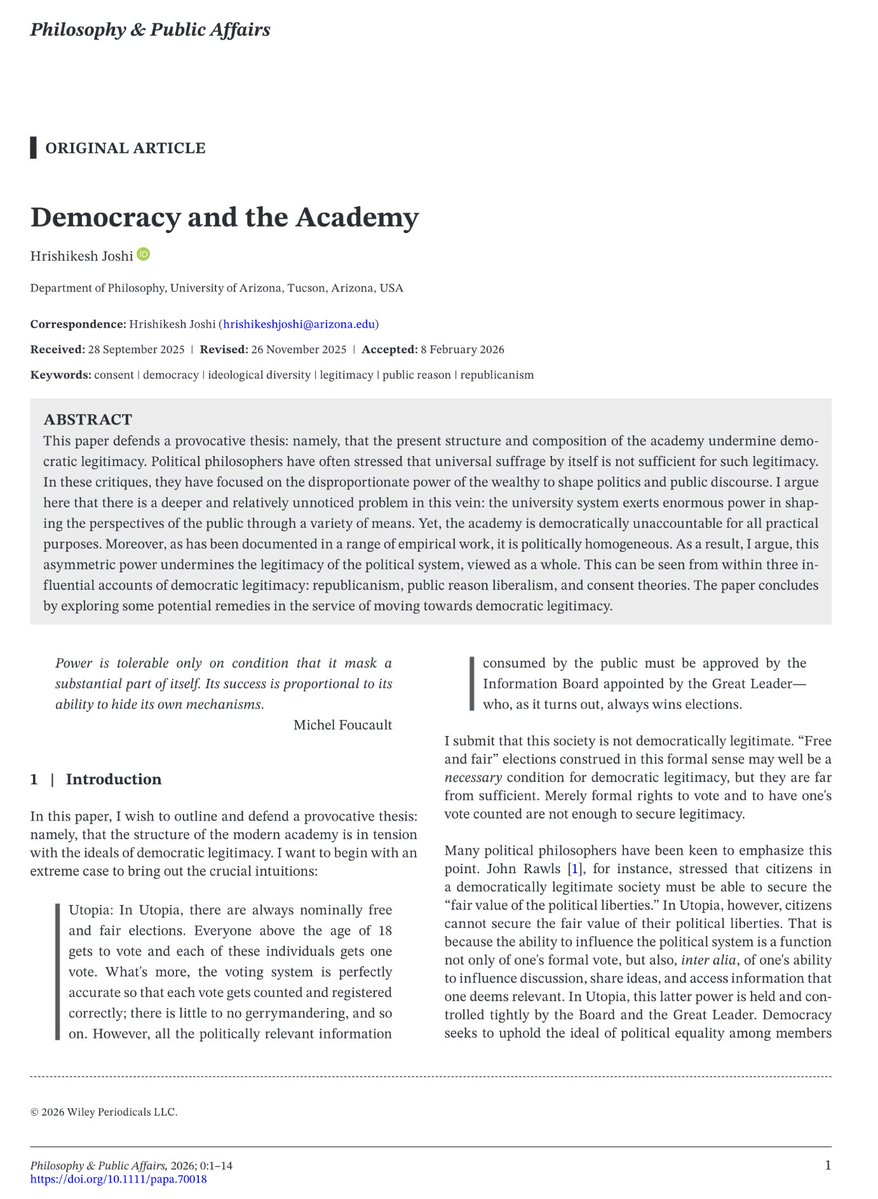
Joshi argues for a striking thesis: If you care about democratic legitimacy, you must be committed to ensuring adequate ideological diversity within the academy. And if universities are unable or unwilling to do this themselves, outside forces may legitimately intervene.
Brandon Warmke tweet media
Reihan Salam@reihan

Political philosopher Hrishikesh Joshi is known for his work on contentious issues like immigration control. He’s helped clarify my thinking on a number of different issues. His latest paper in Philosophy & Public Affairs argues that the academy’s extreme political homogeneity is a threat to democratic legitimacy. Though I don't expect you to agree with every aspect of his argument, I hope it gives you a sense of why I find his work stimulating and worthwhile. We often worry about the ultra-wealthy "buying" influence through campaign contributions or media ownership. But Joshi argues the university system exerts a "deeper and relatively unnoticed" power. By shaping the worldviews of every future CEO, journalist, and politician, the academy effectively sets the "Overton Window" for what the public is allowed to view as important. Why is this more dangerous than "Big Money" in politics? No "Exit Option": In a market, you can switch from the Wall Street Journal to the NYT if you dislike the bias. But because a degree is a de facto requirement for the elite, and because the product is identical whether you go to Yale or the University of Michigan, there is no genuine ideological "exit". Epistemic Domination: Political power is zero-sum. If the academy has the non-mutual capacity to control the evidence available to the public, the political power of the non-college-educated public becomes less valuable. The Zero-Oversight Shield: Unlike other public spending, the academy is uniquely insulated from democratic accountability by tenure and academic freedom. There are many reasons to want more viewpoint diversity (e.g., reducing "groupthink" and "confirmation bias"), but Joshi's point is more fundamental: consent isn't genuine if the "epistemic diet" of the voters is controlled by an unaccountable monopoly. Ironically, Joshi suggests that economic inequality might be the only partial check remaining. Wealthy patrons are often the only ones capable of funding the alternative ideas the academic "monoculture" excludes. I suspect this will be the part of the argument Joshi’s critics will find most objectionable, but of course I think there’s a lot to it. onlinelibrary.wiley.com/doi/10.1111/pa…

English
37
40
250
70.5K
Brian Kogelmann
Brian Kogelmann@bkogel89·
@alexolegimas I think a big part of basic research is reading without yet knowing what it is you are looking for, and I think it is hard to prompt AI for that.
English
1
1
17
810
Alex Imas
Alex Imas@alexolegimas·
This is a skills issue. Part of using AI effectively is knowing what you want to just look up (eg you need an answer to a query) vs what you want to *learn*. Learning is not just a function of seeing the information, it’s a function of spending time with it. Getting stuck, failing, looking back to something you missed is how information turns into skill. This isn’t new. Remember spark notes? You weren’t supposed to use them as substitute for reading the original text. After you read it closely, sparknotes were great to look up random details. AI summaries are similar. But that’s not to say AI can’t be used for learning effectively. I have now seen several scaffolds that prompt user to stop and think, to read original text before asking questions, etc. Claude teaching mode is one example. There’s a lot of promise in using AI to improve learning, but just getting summaries instead of reading text ain’t it.
David Perell Clips@PerellClips

Ezra Klein: "Having AI summarize a book or paper for me is a disaster. It has no idea what I really wanted to know and wouldn't have made the connections I would've made. I'm interested in the thing I will see that other people wouldn't have seen, and I think AI typically sees what everybody else would see. I'm not saying that AI can't be useful, but I'm pretty against shortcuts. And obviously, you have to limit the amount of work you're doing. You can't read literally everything. But in some ways, I think it's more dangerous to think you've read something that you haven't than to not read it at all. I think the time you spend with things is pretty important." @ezraklein

English
10
6
142
20.8K
Ben Golub
Ben Golub@ben_golub·
one of the smartest people i've ever talked to: "philosophy as a field is like if astrology and physics were one department"
English
78
59
965
106.1K
Victor Kuhlman
Victor Kuhlman@victorckumar·
Excited to mog our colloquium speaker
English
1
0
7
587
Kevin Vallier
Kevin Vallier@kvallier·
@victorckumar What is it about AI that blinds incredibly smart people so dramatically? With many issues, the truth is hard to see. With this issue, you just need to give OpenAI $200.
English
7
0
22
2.7K
Victor Kuhlman
Victor Kuhlman@victorckumar·
Yesterday, I listened to a respected philosopher of AI argue that LLMs can’t make predictions, that the future is utterly closed to them, because their training data is limited to the past. Unlike humans.
English
80
10
260
32.4K
Brian Kogelmann retweetledi
Nathan P. Goodman
Nathan P. Goodman@NathanPGoodman·
If your friends aren't talking about: -institutions -self-governance -political economy -knowledge problems -the art of association -the impartial spectator Time to find new friends. Apply to @mercatus fellowships to meet them & discuss ideas: mercatus.org/students/fello…
Suhail Kakar@SuhailKakar

if your friends aren’t talking about: - claude code - creatine - openclaw - looksmaxxing - ai agents - taste - prediction markets - mac mini time to find new friends

English
5
19
179
9.3K
Brian Kogelmann
Brian Kogelmann@bkogel89·
@enzoreds RE not inconsistent w/ intuition pumps, but requires them. RE just means you don't privilege a proper subset of intuitions.
English
1
0
0
118
Enzo Rossi
Enzo Rossi@enzoreds·
Does anyone actually use the method of reflective equilibrium? Or do people just do intuition pumps? I mean, if a considered judgment is strong enough the theory will have to yield even in RE. So what’s the difference with straight Cohen/Partit-style intuitionism, really?
English
7
0
15
2.5K
Ben Golub
Ben Golub@ben_golub·
In this post, Bryan concludes by praising Chris Rufo and encouraging him to use his patented culture-war tactics to dramatically reduce funding for higher education in the US. A scholar who does that doesn't deserve much respect, whatever his views otherwise.
Bryan Caplan@bryan_caplan

Tenure is great for me and other academic dissidents. But dissidents are vanishingly rare, so it's silly to prioritize us. It's far more important to stop wasting taxpayer money funding dream jobs for life for low-quality faculty. P.S. Most non-STEM faculty are low quality.


English
21
14
250
32K
Brian Kogelmann retweetledi
Ryan Muldoon
Ryan Muldoon@RyanPMuldoon·
UB's PPE program secures $4 million federal grant to facilitate and study civil discourse, led by PI Justin Bruner buffalo.edu/news/releases/…
English
0
4
10
703
Itai Sher
Itai Sher@itaisher·
I think I am a pretty tolerant person politically but I don’t have tolerance for people advocating authoritarianism in the United States.
English
43
54
606
11.2K
Brian Kogelmann
Brian Kogelmann@bkogel89·
Anyone interested in doing a panel on populism at the Philosophy, Politics, and Economics annual meeting in London this summer?
English
0
0
2
155
Brian Kogelmann
Brian Kogelmann@bkogel89·
Should we scrap elections and pick legislators at random? Some philosophers say yes. In my latest paper, I argue there are strong reasons to doubt that ordinary citizens are smart enough for the job. journals.sagepub.com/doi/10.1177/14…
English
5
7
25
9.9K
Brian Kogelmann
Brian Kogelmann@bkogel89·
@FriedrichHayek Poor character is probably true, but the best empirical evidence we have suggests that they are far smarter than the average citizen.
English
2
0
0
89
TakingHayekSeriously
TakingHayekSeriously@FriedrichHayek·
@bkogel89 we have endless receipts, showing us that elected officials are incredibly ignorant, have poor character, and are as dumb as bricks
English
1
0
0
114