
bl888m

15K posts

bl888m banner
bl888m

bl888m

@bl888m_eth

all in on claude // prediction markets

Serbia Katılım Temmuz 2024
1.6K Takip Edilen10K Takipçiler
Sabitlenmiş Tweet
bl888m
bl888m@bl888m_eth·
every endowment with real diversification has one unwritten rule: never let two positions fail for the same reason not because more holdings means less risk because most diversification is just one bet wearing different tickers in 1952 a 25-year-old named harry markowitz wrote a phd thesis at the university of chicago it argued that what matters isn't how many assets you hold it's how they move relative to each other milton friedman sat on his defense committee he argued the whole thesis wasn't even economics markowitz passed anyway the math said combining low-correlation assets cuts risk without cutting expected return for years almost nobody outside academia used it in 1985 a 31-year-old economist named david swensen took over yale's endowment it was worth about $1 billion at the time he'd studied under james tobin, one of the few people building on markowitz's math swensen moved the fund out of the standard stock-and-bond mix into private equity, venture capital, timber, real assets things that don't fail for the same reason stocks do harvard, princeton, stanford copied the approach within a decade it got a name: the yale model by 2021 the fund had gone from $1 billion to over $30 billion averaging close to 13% a year for two decades straight this is what nobody explains when they sell you diversification: owning more tickers isn't diversification if they all break for the same reason ten stocks in ten sectors can still be one trade if they're all leveraged to the same rate, the same consumer, the same cycle real diversification is measured in correlation, not in the number of names on the statement retail diversification usually means more stocks institutional diversification means fewer shared failure points the portfolios that survive a real crash weren't the ones holding the most positions they were the ones holding positions that had no reason to move together in the first place bookmark this diversification was never about how many things you own it's about how many ways you can be wrong at once
bl888m@bl888m_eth

x.com/i/article/2066…

English
1
1
23
890
bl888m retweetledi
bl888m
bl888m@bl888m_eth·
every endowment with real diversification has one unwritten rule: never let two positions fail for the same reason not because more holdings means less risk because most diversification is just one bet wearing different tickers in 1952 a 25-year-old named harry markowitz wrote a phd thesis at the university of chicago it argued that what matters isn't how many assets you hold it's how they move relative to each other milton friedman sat on his defense committee he argued the whole thesis wasn't even economics markowitz passed anyway the math said combining low-correlation assets cuts risk without cutting expected return for years almost nobody outside academia used it in 1985 a 31-year-old economist named david swensen took over yale's endowment it was worth about $1 billion at the time he'd studied under james tobin, one of the few people building on markowitz's math swensen moved the fund out of the standard stock-and-bond mix into private equity, venture capital, timber, real assets things that don't fail for the same reason stocks do harvard, princeton, stanford copied the approach within a decade it got a name: the yale model by 2021 the fund had gone from $1 billion to over $30 billion averaging close to 13% a year for two decades straight this is what nobody explains when they sell you diversification: owning more tickers isn't diversification if they all break for the same reason ten stocks in ten sectors can still be one trade if they're all leveraged to the same rate, the same consumer, the same cycle real diversification is measured in correlation, not in the number of names on the statement retail diversification usually means more stocks institutional diversification means fewer shared failure points the portfolios that survive a real crash weren't the ones holding the most positions they were the ones holding positions that had no reason to move together in the first place bookmark this diversification was never about how many things you own it's about how many ways you can be wrong at once
bl888m@bl888m_eth

x.com/i/article/2066…

English
1
1
23
890
bl888m
bl888m@bl888m_eth·
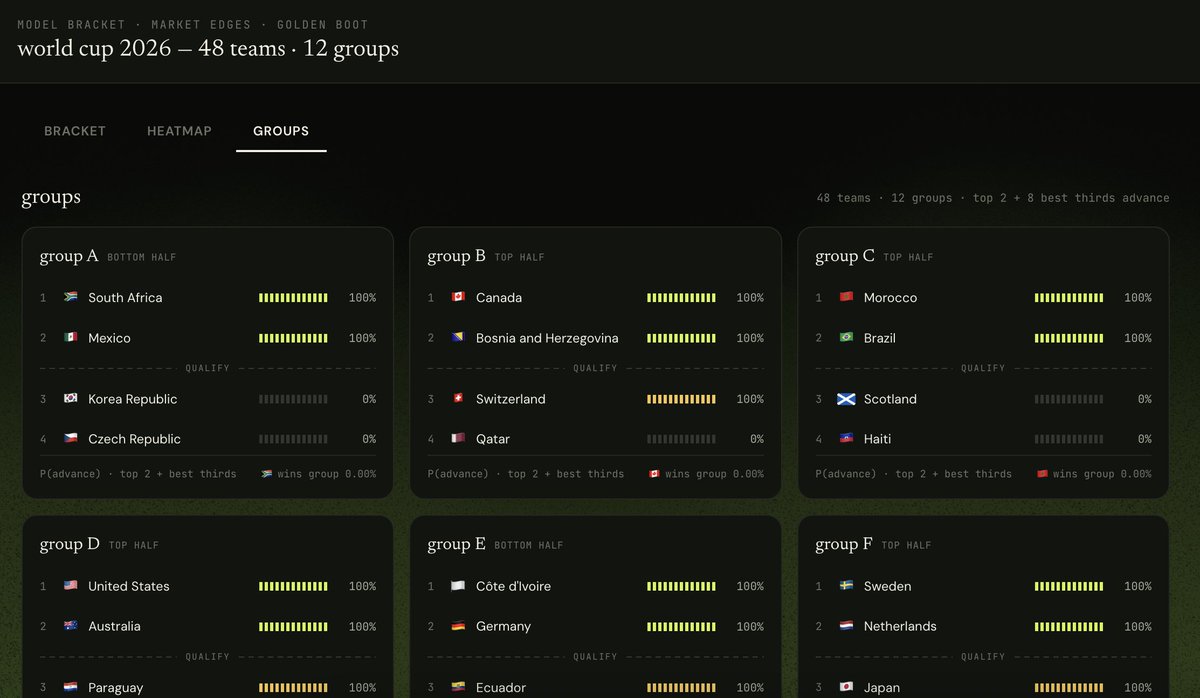
The Sozu finals trading competition is coming! Sign up using my referral link to claim a $5 bonus - available to the first 100 new users only grab a spot (FCFS) - fifa.getsozu.xyz/?ref=wc-cbra7y…
bl888m tweet media
English
0
0
0
111
bl888m
bl888m@bl888m_eth·
noticed @sozuposting's signal spiked to 2.98x right before Spain scored in the knockout stage checked a few more goals - same pattern > 2.92x before England's extra-time winner > 2.95x before Argentina's 120' goal signal crossed 1.5x before 12 of 15 tracked goals - 80% hit rate first 100 signups get $5, link's in the comments
Sozu@Sozuposting

Sozu called it. Again. That's 5 in a row. +9.1¢ edge on Spain model at 38.1% vs market at 29%. Every pre-match risk flag hit: ✅ Saliba missed training → subbed off early ✅ Yamal vs the fullbacks was THE matchup → wins the opening penalty ✅ France's midfield flagged vulnerable → Spain controlled it from kickoff Final: Spain 2-0 🇪🇸 Next up: Argentina vs England. Keep the eyes

English
5
0
31
2K
Codez
Codez@0xCodez·
@bl888m_eth One day I’ll run Monte Carlo simulations for every event in my life - for now, only trading. Thanks for the share, mate.
English
1
0
0
100
bl888m
bl888m@bl888m_eth·
every quant desk with a real backtest has one unwritten rule: never trust the one curve you got not because the curve is fake. because it's one draw out of thousands that could have happened in 1946 a mathematician named stanislaw ulam was recovering from an illness at los alamos he was playing solitaire, trying to work out the odds of winning by counting every possible hand then he realized it was faster to just lay the cards out a hundred times and count the wins he brought the same idea to a problem nobody could solve with an equation: neutron chains inside a bomb too many particles, too many interactions, no closed-form solution existed so he and john von neumann ran the physics randomly, thousands of times, on one of the first computers nicholas metropolis named it after ulam's uncle, who used to borrow money to gamble at the monte carlo casino a single simulated run told them almost nothing on its own the answer only showed up in the shape of the distribution after thousands of runs this is what nobody explains when they sell you a backtest: one equity curve is one draw from history. it's not the drawdown, it's a drawdown the drawdown you're staring at could be the best 5% path, or the worst the single curve can't tell you which one you got quant desks resample the trade sequence thousands of times and read the range, not the one line citadel, jump trading, renaissance - none of them size a strategy off a single historical path retail runs one backtest, gets one number, and treats it as the truth about live deployment the funds that survive the bad years aren't the ones with the prettiest curve they're the ones who already knew what the ugly 1% of curves looked like, before they went live bookmark this the backtest curve was never the truth - it was one roll of the dice you happened to watch a single simulated run told them almost nothing on its own nicholas metropolis named it after ulam's uncle, who used to borrow money to gamble at the monte carlo casi nicholas metropolis named it after ulam's uncle, who used to borrow money to gamble at the monte carlo casino a single simulated run told them almost nothing on its own the answer only showed up in the shape of the distribution after thousands of runs this is what nobody explains when they sell you a backtest: one equity curve is one draw from histor
bl888m@bl888m_eth

x.com/i/article/2066…

English
5
0
57
3K
Kreo
Kreo@kreoapp·
Get 25% of your FEES back! ❤️‍🔥 Kreo is the ONLY place, where you can get fees back & daily rewards. Profit more with us. 💸
Kreo tweet media
English
190
100
216
7.5K
bl888m
bl888m@bl888m_eth·
every real risk model has one unwritten rule: never trust the bell curve past 3 standard deviations not because the math is wrong. because the market doesn't move the way the math assumes in 1963 a mathematician named benoit mandelbrot pulled a century of cotton price data he wasn't looking for tail risk. he was just checking if the price changes followed a normal distribution they didn't. big moves happened far more often than a bell curve allows and they clustered together instead of spreading out evenly most economists heard him out, then kept building on the normal distribution anyway the whole field of modern portfolio theory needed that assumption to work 34 years later, two of the men who built option pricing on it won the nobel prize the next year their own fund, ltcm, blew up on a move their models called almost impossible russia defaulted on its debt in august 1998 every position ltcm held was supposed to be uncorrelated. within days, all of them moved together the fed convened 14 banks just to unwind the fund without taking the market down with it goldman sachs, jp morgan, merrill lynch were all in the room the bell curve wasn't wrong about most days. it just described almost none of the days that mattered this is what nobody explains when they sell you a risk model: returns aren't normally distributed. the rare moves happen far more often than a bell curve says because a bell curve assumes moves are independent, and in a crisis, every position starts moving together most retail risk tools still run on the same assumption ltcm did a clean percentage on a dashboard doesn't mean the tail got smaller it means someone chose not to model it the funds that survive the rare days aren't running better forecasts they're just the ones who priced the fat tail in before it showed up bookmark this the bell curve was never wrong about tuesday. it was wrong about the one day that mattered
bl888m@bl888m_eth

x.com/i/article/2066…

English
5
2
46
3.5K
bl888m
bl888m@bl888m_eth·
@im_harish_hari that's why risk management matters more than forecasting
English
0
0
0
96
Harish
Harish@im_harish_hari·
@bl888m_eth fat tails don't care about your model
English
1
0
0
52
bl888m
bl888m@bl888m_eth·
you can't create a prediction market until someone else shows up to take the opposite side that's the entire flaw baked into every prediction market that exists @prophetmarketai fixed it - the AI is your counterparty, no waiting on liquidity, no waiting on another trader to disagree with you > create a market on literally anything you follow > plain language - will this happen or not > your market goes live the second you post it first thing I made: Will a pitch invader interrupt play during the FIFA World Cup 2026 Final on July 19? follow @prophetmarketai and create your own on app.prophetmarket.ai use my code - HCIhrPZ20YI not available to users in the United States
Prophet@prophetmarketai

x.com/i/article/2075…

English
5
1
35
3.4K
MadFan
MadFan@vslyhcrypto·
@bl888m_eth In fact, this is a very important observation for traders
English
1
0
0
37
bl888m
bl888m@bl888m_eth·
every exchange with a real edge has one unwritten rule: never let the free feed catch up not because the free feed is fake. because it only stays valuable if the free one lags a trader at RBC named brad katsuyama noticed something odd in his own order flow every time his desk sent a buy order, the price moved before it finished filling he pulled the logs, tested it by hand the gap was consistent - milliseconds, every time, on every exchange someone was seeing his order before it finished executing then buying ahead of him on other exchanges, in the same trade he went public with it in 2014 virtu, citadel securities, and a dozen prop shops were already paying for that exact feed it wasn't rare. it was standard the sip - the feed your broker still shows you - never got faster it's built to arrive after the direct feed, on purpose reg nms only requires it to exist, not to be fast this is what nobody explains when they sell you a "real-time" chart: real-time was never one number arriving at one moment it's a queue, and some accounts get computed to the front of it for a fee retail sees a candle built from a price that already moved somewhere else that's not an accident - that's what reg nms actually guarantees the market makers who print money off this aren't running a smarter model they're reading the same tape, just a few milliseconds before you get to bookmark this the "real-time" on your chart was real, for someone else, a few milliseconds ago
bl888m@bl888m_eth

x.com/i/article/2066…

English
6
5
202
6.8K
bl888m
bl888m@bl888m_eth·
a motel night auditor in tucson figured out why banking and trading aren't the same job at all not the hours, not the suits - the actual thing each job gets paid to do he runs the night desk at a roadside motel, 11pm to 7am. reconciles the day's folios, one lamp, one laptop question that started it: why do bankers and traders describe the same day so differently he'd always assumed wall street was one big job with different desks found a free yale lecture on it, watched it twice, took notes on a motel receipt pad here's what he found investment banking gets paid a fee for arranging a deal - merger, ipo, bond sale, doesn't matter which that fee gets paid whether the deal is good for the client five years later or not trading gets paid by the position itself - marked against the market, no fee for trying the number either went up or it didn't a banker's report card is deals closed. a trader's report card updates every day, in public one business monetizes access and relationships. the other monetizes being right, priced in real time the lecture's from yale's open course on financial markets, taught by robert shiller - free, no login required he checked it against what he'd already seen two years of both types walking through his motel on business trips the banking guys showed up in groups, expensed everything, talked about the deal like it already happened the trading guys showed up alone, checked the market before they checked in, ate at the desk same industry. completely different relationship with being wrong he started calling it "who owns the loss" on a bad deal, the bank eats it - the banker already has the fee on a bad trade, the trader eats it, immediately, with nowhere to hide it that's the whole difference in one sentence everyone graduating college sees "wall street" as one door it's actually two different bets on how you want to get paid he started sorting his own decisions the same way - paid up front, or lived with later stopped taking the "sure thing" shifts, started taking the ones he'd actually be judged on later he's still behind the motel desk every night. the receipt pad's still in the drawer never applied to either kind of job, just wanted to know which game people were actually playing i asked why it mattered to him. he said "i wanted to know if i was getting paid for being right or just for showing up" most freshman year finance kids never get taught this distinction at all they assume the suit is the job they're right about almost everyone who wears one. they weren't right about the guy checking people into motel rooms at 2am the lecture's been free and online for years bookmark this and go watch the one lecture your career fair never plays banking pays you for the deal. trading pays you for being right - pick the one you can actually live with
bl888m@bl888m_eth

x.com/i/article/2066…

English
6
6
58
4.8K
bl888m
bl888m@bl888m_eth·
@rimtoln that's why 99% of traders lose money
English
0
0
0
16
cryptopsihoz
cryptopsihoz@rimtoln·
@bl888m_eth graveyard shift guy wrote the three signals down, most traders still cosplay gut like it's magic
English
1
0
0
25
bl888m
bl888m@bl888m_eth·
a storage facility guard in reno figured out how to turn his trading gut feeling into code not a signal, not a strategy - just a pattern his eyes caught before his brain could explain it he works the graveyard shift, 10pm to 6am. one camera wall, one desk, charts open the entire shift question that started it: why did he always exit right before the reversal he'd never once written the rule down - it just felt right in the moment, every time spent a week logging every trade where the feeling hit, timestamps in a notebook by his desk here's what he found every trade he flagged shared the same three things happening at once a volume spike, a failed breakout, and price back inside yesterday's range - never just one alone his gut wasn't magic. it was pattern-matching three signals faster than he could consciously list them that's the actual trick to coding intuition find what your gut is reacting to, then write it down as a rule the trap is doing it backwards - fitting rules to trades you already know worked he needed two things his notebook couldn't give him real historical data, years of it, not the six months his broker's chart went back and a way to test the rule without secretly already knowing the answer he found quantpad it's the only coding agent wired to institutional-grade historical market data from the start he wrote the three-signal rule in plain english, right inside it quantcopilot - the platform's built-in validation suite - ran it deterministic: same rule, same data, same result, every time no lucky random seed, no quietly cherry-picked date range he ran the rule across 12 years of data before it ever touched a real trade trading on feeling alone, he'd been right about 55% of the time coded and tested the same way, the three-signal setup held at 61% across all 12 years same instinct. now it had a number attached to it he went live with a fraction of his usual size, just to watch it hold six months later, the win rate held at 59% - close enough to the backtest to trust it he's still on the camera wall every night. the notebook's still on the desk never touched a feeling-trade again without checking the rule first i asked if it felt different, trading the coded version he said "it feels like i finally get to know if i was right for the right reason" most discretionary traders never write the rule down at all they assume intuition means it can't be tested - so they never test it they're right about almost everyone. they weren't right about the guy checking cameras all night the data to prove or disprove your own gut has existed the whole time bookmark this and go write down what your gut is actually reacting to intuition isn't the opposite of a rule - it's a rule you just haven't written down yet
bl888m@bl888m_eth

x.com/i/article/2066…

English
6
1
29
2.5K