Sabitlenmiş Tweet
Blind Spot Movie
71 posts

Blind Spot Movie
@blindspotdoc
Blind Spot is a 2024 American documentary film about campus antisemitism in the United States, prior to and after the October 7th attacks.
Katılım Ekim 2025
16 Takip Edilen31 Takipçiler

Brandy describes her alarm as a doctoral student in a school of education regarding the one-sided far-left ideology, rhetoric, and resources which were infused into the training of education students in how to teach core subjects in grades K–12.
She explains that this activist, foundational ideology includes a running theme that the United States is a settler-colonialist state which deserves to be dismantled, and that this narrative includes a running antisemitic theme referred to as “from Turtle Island to Palestine.”
She notes that K-12 students whose teachers are trained this way then go on to hear more of the same ideology from their university professors, and she worries that we haven't yet seen the full force or end result of this problem in K–12 classrooms.
English

In a pre-10/7 interview, Fordham's President, Tania Tetlow, reminds viewers that Fordham has always welcomed Jewish students for the same reason that it was founded to welcome Catholic students, i.e. because both groups were not welcome at elite institutions.
She views contemporary antisemitism in America with great alarm, and blames social media for not only fueling much of antisemitism but also for chipping away at democracy itself.
She takes pride in Fordham's harder and slower but more effective approach to combating antisemitism, which involves offering (and having hundreds of students per year enrolling in) courses in Judaism as a religion; antisemitism; and Jewish life, culture, art, and history - courses which ask students to put themselves in the shoes of the Jewish people, to tell the story not just of the violence, oppression, and horror, but of the lives led by Jewish communities throughout history.
She asks where is the line between the profound need in higher ed for the ability to disagree and have ideological debate, and that which is hurtful, harmful, and makes people feel threatened?
She believes that most students on both sides feel most nervous and silenced by other students rather than by the school, so it is the school's job to create the spaces where students can speak and represent their identities to be their full selves.
She says that part of the job of universities is not just to play defense and tell people what they can and cannot think but to engage in the complexity and insist that people examine their preconceived notions and go to the facts, details, and history. She notes the challenges of overcoming the tendency of the phenomenon of "the simple tends to win" when the reality is complicated, and that part of the enemy is entitlement, self-righteousness, and selfishness which leads to students throwing out deeply threatening and hateful language because they are trying to provoke and revel in self-righteousness.
English

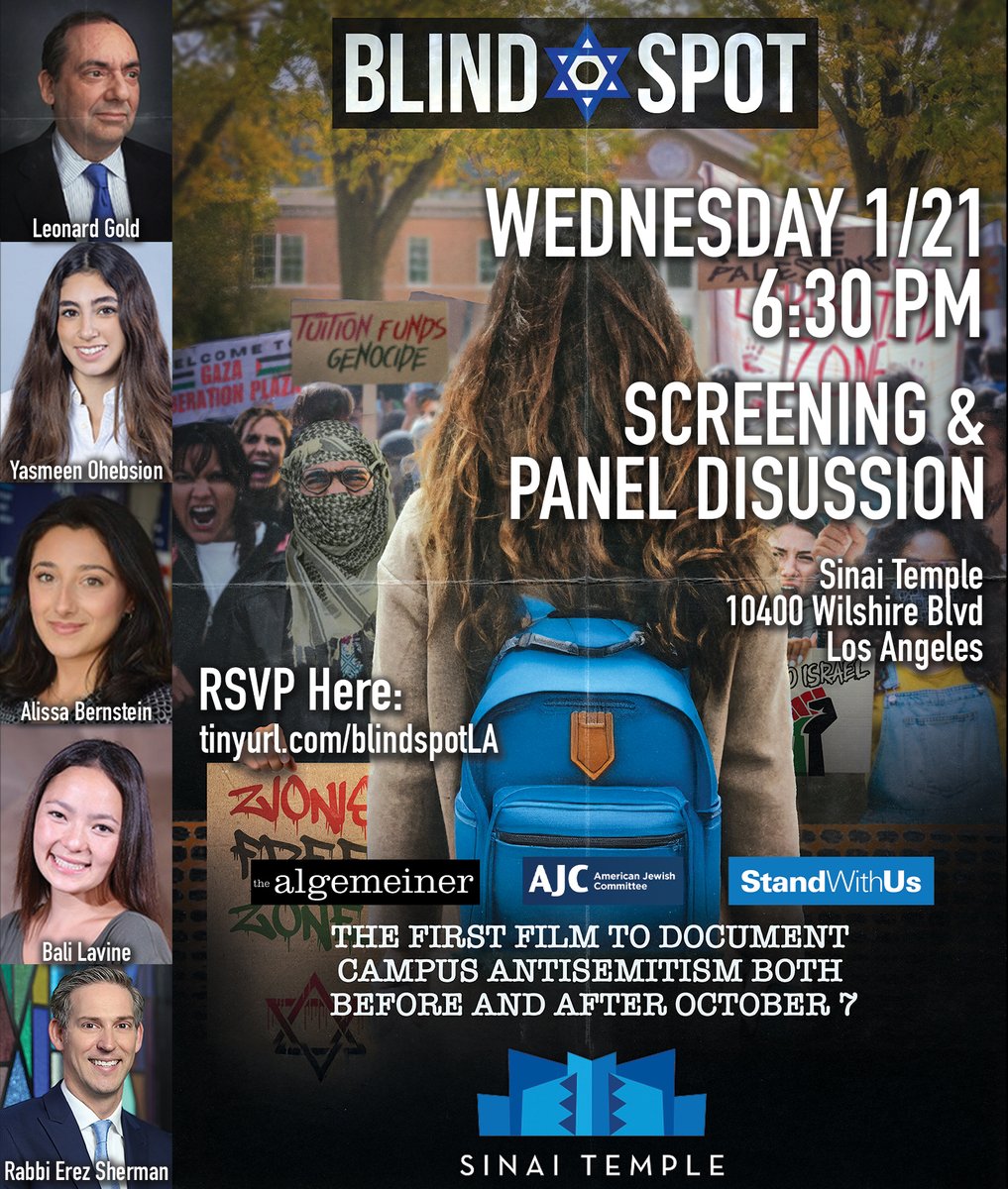
At a Q&A panel following a Blind Spot screening hosted by Sinai Temple in Los Angeles on 1/21/26, an audience member asks how to support Jewish students in 2026, noting that many organizations have been “preaching the same old things to the same old people” since October 7, 2023.
Recent Tulane graduate Bali Lavine explains the challenge of sustaining the pro-Israel movement on campus. She emphasizes the importance of reaching into the broader community to find student leaders, both on college campuses and in K–12 spaces, and supporting them.
Lenny Gold, Blind Spot’s Executive Producer, shares a story from two Penn students who note that while students feel safer wearing their Magen Davids openly on campus, antisemitic professors are still teaching there. This forces Jewish students to choose between avoiding those classes entirely or hiding their identities, reminding the audience that vigilance remains essential - and that the failure to remain vigilant is how we got here in the first place.
English

Brandy considers it an insult and an example of cultural appropriation to compare Palestinians with Black Americans. She explains that it is inaccurate to equate a population descended from enslaved people, brought to a foreign land against their will, with a population descended from people who came from the Arabian Peninsula, colonized the land, and have lived there for roughly the same amount of time that white Europeans and their descendants have lived in the United States (which, in neither case, makes such people indigenous).
She further says that there is no comparison between current conversations about reparations for Black descendants of slaves and aid money to Palestinians, which she claims has been used to harm not only Jews and Israelis but also fellow Palestinians and other Arab civilians.
She laments the failure to teach Black history, which has led to a false sense of solidarity.
English

According to the Campus Antisemitism Report Card published by the ADL, the percentage of colleges receiving either an A or B grade jumped from 23.5% in 2024 to 58% in 2026.
But are campus climates really improving for Jewish students, or is this a misleading case of grade inflation?
Citing the University of Pennsylvania as an example, Lenny Gold, executive producer of Blind Spot, joins JBS’ Teisha Bader to discuss the disconnect between the ADL's grades and the reality of antisemitism which students still face in their classrooms - and to respectfully suggest that no school’s grade should improve until Jewish students no longer have to choose between avoiding classes taught by antisemitic professors or hiding their Jewish identities in those classes, because antisemitism in the classroom only puts us back to the status quo on October 6: a tinderbox of hatred waiting to explode.
Special thanks to @AlizaLicht for her assistance spreading the message of Blind Spot.
English

Grateful to John Reid for hosting Blind Spot Executive Producer Lenny Gold on The Reid Revolution for an honest conversation on the rise of campus antisemitism, the line between civil discourse and civil rights violations, the blind spot towards Jews when those violations are committed against them, and a comparison between anti-gay sentiment and antisemitism.
English

Jewish activist and mother Lizzy Savetsky spoke at a protest organized by EndJewHatred on September 12, 2023 - less than four weeks before October 7.
Standing outside the City University of New York (CUNY) office of Chancellor Felix Matos Rodriguez, she called out what she described as a pattern of inaction in the face of antisemitism on CUNY campuses. Pointing to the CUNY Law commencement speaker, Fatima Mousa Mohammed, Savetsky highlighted past social media posts in which Mohammed wrote, “May all Zionists burn in the hottest pit of hell” - comments made prior to being selected to speak.
Savetsky questioned how university leadership could move forward with the invitation despite those statements, and criticized what she described as a broader environment where rhetoric like this is tolerated and even applauded, and a climate of open hostility is fostered, by the leadership of a taxpayer-funded public university.
English

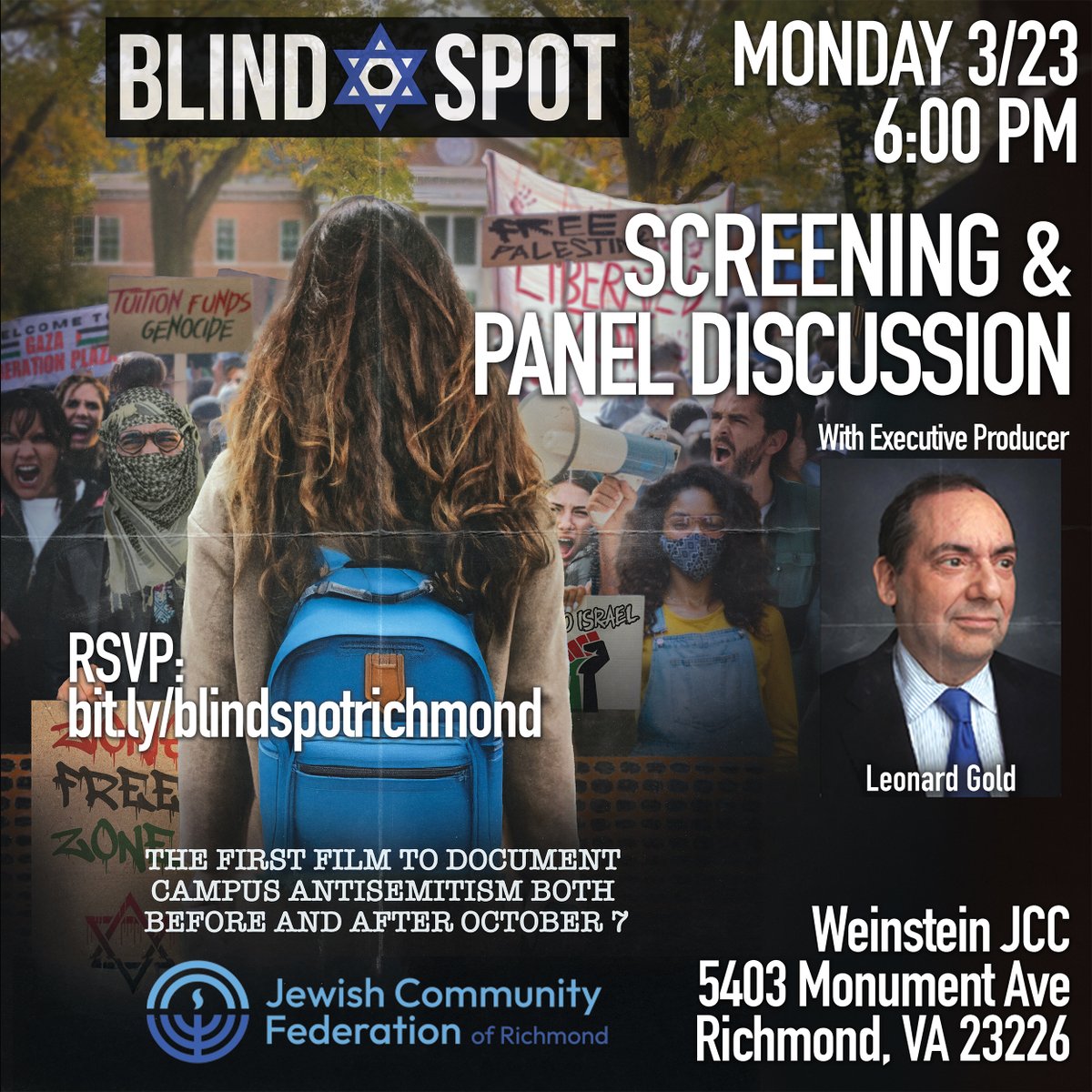
We're excited to announce that Dion Pierre, the Campus Correspondent for The Algemeiner will be joining our panel alongside Blind Spot's Executive Producer Leonard Gold at the upcoming screening of Blind Spot in Richmond, VA!
Join us on Monday, March 23rd at 6:00 PM at the Weinstein JCC in Richmond for a special screening of Blind Spot, the only current film exclusively devoted to campus antisemitism, showing the problem both before and after 10/7 – and what can be done about it.
Independently produced and beholden to nothing but the truth and nobody but the students, Blind Spot takes a raw look at campus antisemitism through the eyes of more than two dozen 20-year-olds directly impacted by it, showing the toll it took on them, some of those responsible for it, and many who helped and supported them.
Blind Spot's stars are undergraduates who refused to hide their identities in the face of unchecked antisemitism and the evil of indifference that fostered it, and who instead spoke out against it, at great risk to themselves.
Nearly 30 schools across America are represented in Blind Spot, including 13 where filming occurred or whose students were interviewed, and 16 additional schools which are shown or mentioned.
And, long before the release of the new Henry Louis Gates film, Blind Spot examined the shared history of discrimination suffered by blacks and Jews, and shared efforts to fight it.
Following the screening, there will be a Q&A with the film’s Executive Producer, Leonard Gold and Dion Pierre, the Campus Correspondent for The Algemeiner.
This is a one-time, free community screening — we hope you’ll join us.

English

In 2022, at the University of Vermont, pervasive antisemitism harmed Jewish students through incidents ranging from faculty docking grades to vandalism of the campus Hillel to exclusion of Jewish students from a sexual assault victims support group.
The Louis D. Brandeis Center for Human Rights Under Law, working with Jewish on Campus, filed a Title VI civil rights complaint with the U.S. Department of Education’s Office for Civil Rights, which opened an investigation that, for the first time, applied the IHRA definition of antisemitism by signalling that shunning, harassment, or exclusion of Jewish students under the guise of anti-Zionism will be treated as a serious civil rights issue.
Ken Marcus of the Brandeis Center called this a "big victory."
As Dion Pierre, campus correspondent for The Algemeiner, reported: "There's a real vitriol involved here that just goes beyond the boundaries of free speech."
English

Join us on Monday, March 23rd at 6:00 PM at the Weinstein JCC in Richmond for a special screening of Blind Spot, the only current film exclusively devoted to campus antisemitism, showing the problem both before and after 10/7 – and what can be done about it.
Independently produced and beholden to nothing but the truth and nobody but the students, Blind Spot takes a raw look at campus antisemitism through the eyes of more than two dozen 20-year-olds directly impacted by it, showing the toll it took on them, some of those responsible for it, and many who helped and supported them.
Blind Spot's stars are undergraduates who refused to hide their identities in the face of unchecked antisemitism and the evil of indifference that fostered it, and who instead spoke out against it, at great risk to themselves.
Nearly 30 schools across America are represented in Blind Spot, including 13 where filming occurred or whose students were interviewed, and 16 additional schools which are shown or mentioned.
And, long before the release of the new Henry Louis Gates film, Blind Spot examined the shared history of discrimination suffered by blacks and Jews, and shared efforts to fight it.
Following the screening, the re will be a Q&A with the film’s Executive Producer, Leonard Gold. This is a one-time, free community screening — we hope you’ll join us.
English

Sports entrepreneur and Jewish activist Ari Ackerman speaks at a protest organized by EndJewHatred outside the City University of New York (CUNY), condemning a pervasive climate of antisemitism on campus, fostered by administrators and faculty. Jewish students should never have to hide their identity to feel safe at school. Enough is enough.
English

Join us on Monday, March 23rd at 6:00 PM at the Weinstein JCC in Richmond for a special screening of Blind Spot, the only current film exclusively devoted to campus antisemitism, showing the problem both before and after 10/7 – and what can be done about it.
Independently produced and beholden to nothing but the truth and nobody but the students, Blind Spot takes a raw look at campus antisemitism through the eyes of more than two dozen 20-year-olds directly impacted by it, showing the toll it took on them, some of those responsible for it, and many who helped and supported them.
Blind Spot's stars are undergraduates who refused to hide their identities in the face of unchecked antisemitism and the evil of indifference that fostered it, and who instead spoke out against it, at great risk to themselves.
Nearly 30 schools across America are represented in Blind Spot, including 13 where filming occurred or whose students were interviewed, and 16 additional schools which are shown or mentioned.
And, long before the release of the new Henry Louis Gates film, Blind Spot examined the shared history of discrimination suffered by blacks and Jews, and shared efforts to fight it.
Following the screening, there will be a Q&A with the film’s Executive Producer, Leonard Gold.
This is a one-time, free community screening — we hope you’ll join us.

English

We were proud to feature Sabrina Soffer’s fight for accountability at George Washington University in Blind Spot, and to see her and Carly Gammill testify in Washington, DC before the United States Commission on Civil Rights on February 19 and 20, 2026.
Their courage and determination embody the film’s mission to give voice to the violation of Jewish students' civil rights and vigorously advocate for those students' protection and the enforcement of their rights.
English

Grateful for a powerful evening at @SinaiTemple for the screening of Blind Spot on January 21, 2026.
Thank you to Rabbi Erez Sherman, Alissa Bernstein, and Bali Lavine for your meaningful insights and leadership during the Q&A, and to everyone who came out to engage in this important conversation.
We are gratified by the opportunity to enable audiences to learn, be inspired to become leaders, and support Jewish students.
English

This testimony on the violation of the civil rights of Jewish students on college campuses was delivered before the U.S. Commission on Civil Rights on February 19 and 20, 2026.
These speakers - all of whom were involved in the production of Blind Spot - describe what unfolded on American campuses in the aftermath of October 7th, including demonstrations that rationalized and glorified violence; harassment and exclusion of Jewish students; and indifference towards and denial of the civil rights of Jewish students by schools and courts.
The testimony describes the invocation of academic freedom to justify discrimination against Jews, the failure to recognize academic responsibility, and the blind spot towards the obligation to protect Jews from attack based on their inextricable connection to their ancient homeland.
Blind Spot continues to document the conversation about antisemitism on campus and the efforts to fight it.
English

When we set out to document campus antisemitism before and after October 7, we wanted to center the lived experiences of Jewish students — their courage, their dignity, and their refusal to stay silent in the face of discrimination, harassment, and hate - at great risk to themselves.
What moved us deeply in this piece is the reminder that our story is not only about fighting back — it’s about who we are and want to be, not just what we are forced to be; an aspiration to thrive and contribute rather than to have to defend ourselves. And the moment in the film about Louis Armstrong and the Karnofsky family is there to remind us that, even in times of rising Jew-hatred, there is also Jew-love. There is generosity. And there is a shared American story.
Jewish students shouldn’t have to become activists just to feel safe on campus. They want to build, create, lead, and contribute — just like generations before them. All they want is the unfettered opportunity to do so, as promised by American laws and values, on an equal footing with all others.


English

Blind Spot’s executive producer, Leonard Gold, delivered a statement at the US Commission on Civil Rights’ 2/20/26 Public Comment Session on Antisemitism on America's College and University Campuses. He noted that, despite the elimination of encampments, the underlying hatred which gave rise to them is alive and well, and could explode again at any time. He also pointed out that, while schools often invoke academic freedom to justify their indifference to antisemitism, they fail to recognize freedom’s inseparable partner, responsibility, and he offered examples of what academic responsibility should look like. He closed by informing the Commission of Blind Spot’s reminder that Jews have overcome many greater challenges than this, and of the film’s imploration for us to have the strength and courage to overcome this too.
English

Blake Ziegler talks about being part of a tiny Jewish student community at Notre Dame, where he didn't encounter much of the animosity towards Israel which is common at so many other schools, but did encounter classic antisemitic tropes, e.g. beliefs that the Jews killed Jesus, and was able to engage in civil conversation about it by explaining why ideas like that are antisemitic and have led to prejudice and physical violence against Jews for centuries.
He explains that this is what they were trying to have at Notre Dame, i.e. educational moments where people are taught that certain ideas are antisemitic and offered examples of how such beliefs have led to actual harm against the Jewish people.
English

Tulane student leader Ben Bernstein meets with Arnie Fielkow to discuss Ben's movement to include antisemitism education and awareness as part of the university's campus-wide DEI initiatives.
Ben explains how the effort brought together a broad coalition, with endorsements from 20+ student groups, including the Black Student Union, Gender and Sexuality Advisory Council, and nearly every Greek organization on campus.
Arnie Fielkow, CEO and President of the Jewish Federation of Greater New Orleans, underscores the importance of not only educating people about this problem but also of Jewish students partnering with other groups, particularly African American and other minority groups that also face hatred and discrimination, noting that American history has taught us that we are much stronger (and can accomplish much more) together.
English