Seb
1.3K posts


Supernova is the sonic boom of blockchain interaction. But in what way, precisely? Well, a sonic boom happens when an object outruns its own sound. There's no warning or no build-up. The thing just arrives before the sound it makes can catch up. With Supernova, the transaction lands before the user even registers they're waiting. The experience outruns the expectation. And creates a perception boom. Every architectural bet we made over the past five years points here. Right at this moment. The phase of instantaneous interaction has arrived.


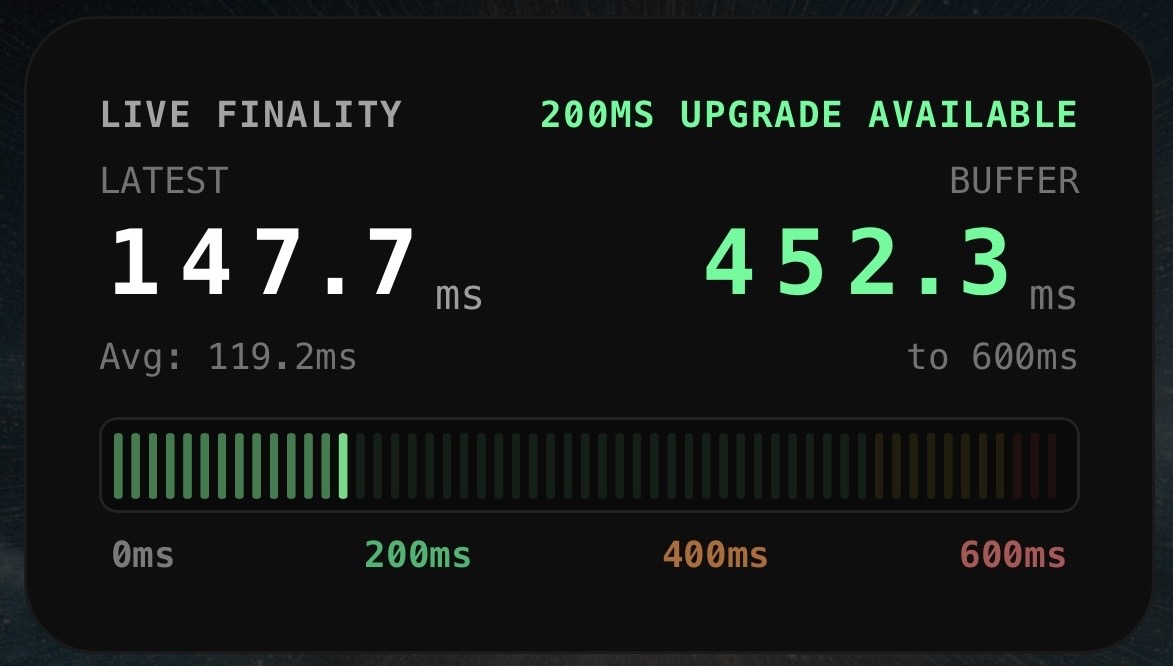
Supernova is live on Battle Net. Here's what changed under the hood and why it matters. The paradigm shift nobody's talking about: Every blockchain in the industry is measured on two metrics: block time and throughput. Faster blocks = better chain. More TPS = better chain. ---------- Supernova breaks this framing entirely. For the first time in the blockchain industry, block finality is faster than block slot allocation. Let me explain what that means. How every other blockchain works: Traditional blockchains follow Execute → Propose → Vote. Validators must execute every transaction before proposing a block. The block slot is the clock. Finality can never be faster than the slot, because execution is in the critical path. Ethereum: 12.8s slot, ~12.8 minutes finality. Solana: 400-600ms slot, 13 seconds finality. Sui: variable, ~500 to 1000 ms for complex transactions. In every case: finality ≥ block slot. This is treated as a law of physics. It's not. ---------- How Supernova works: We flipped the model to Propose/Vote → then Execute. Consensus proceeds independently of execution. Validators agree on transaction ordering first. Execution results are notarized in subsequent block headers via inclusion proofs. The inclusion proof is the key innovation: it allows a block to be finalized with cryptographic proof that its transactions will execute correctly, before the execution itself completes. The virtual state tracker in the transaction pool maintains a deterministic view of account states (nonces, balances, pending transactions) so consensus can validate without waiting for full execution. Result: the block is finalized faster than the block round itself. 88ms finality measured in testing. Sub-200ms under real-world conditions. On 600ms block slots. Finality < block slot. First time in the industry. ---------- The throughput story: With the same hardware specification as pre-Supernova mainnet, the network now achieves ~120,000 transactions per second in burst mode. Same nodes. Same machines. 10x the block production cadence. This is the same validator infrastructure running fundamentally better software. The backpressure system (Execution-Result Inclusion Estimator) ensures this scales safely - dynamically adjusting per-block gas limits if execution lags behind proposals, so minimum-spec nodes never get overwhelmed. What this means in context: - Block time: 6s → 600ms (10x) - Finality: ~88ms measured (first blockchain where finality < slot time) - Throughput: ~120,000 TPS burst mode (same hardware) - Architecture: consensus fully decoupled from execution - Sharding: 3 execution shards + metachain, fully preserved - Validators: 3,200+ nodes, no hardware upgrade required ---------- Battle of Nodes is stress-testing all of this right now. $150K in prizes to find what breaks. Validators, security researchers, builders, and guilds pushing the limits. If Supernova survives this, it ships to mainnet. 150,000 lines of new protocol code. 20 months of engineering. The most significant upgrade since genesis.


Challenge #6 has wrapped. The network remained healthy throughout the stress test. In total, the network processed 7,221,856 transactions throughout the challenge window, including intra-shard, cross-shard, and relayed transactions, as well as simple and relayed SC calls.


Weekly Development Report as of March 22, 2026 #multiversxtech 👇🛠️


Insights from the Supernova Engine Room 10 days of Battle of Nodes. Real load, real participants, real findings. A recap 🧵 from today's space 👇


Supernova.


Today, the Algorand Foundation made the difficult decision to reduce our workforce by 25%. This decision was not taken lightly and is in response to the uncertain global macro environment as well as the broader downturn in crypto markets. These employees have been best-in-class contributors to this ecosystem and to the Foundation, and this was an incredibly tough decision. We are sincerely grateful to them, and we are, of course, committed to supporting them through this transition. We believe that we now have a more sustainable alignment of Algorand Foundation resources with the protocol’s long-term business, technology, and ecosystem priorities. We remain fully focused on our mission of financial empowerment and the continued development and growth of the Algorand protocol, network, and ecosystem.


I'm going to make some obvious points. (1) Blowing up all the oil infrastructure in the Middle East is an insane idea, and may well result in a global economic crash and humanitarian crisis unrivaled in the lives of those now living. We're talking about the price of everything everywhere rising, from food to gas, at a moment when inflation was already high. All of that will be laid at the feet of the authors of this war. (2) The antebellum status quo of Feb 27, 2026 was just not that bad, but we're unlikely to return to it. Expect indefinite, long-term, ongoing disruptions to everything out of the Middle East. (3) Also assume tech financing crashes for the indefinite future. The genius plan to get the Gulf states caught in the crossfire has incinerated much of the funding for LPs, for datacenters, and for IPOs. Anyone in tech who supported this war may soon learn the meaning of "force majeure" as funding gets yanked. (4) Many capital allocators will instead be allocating much further down Maslow's hierarchy of needs, towards useful basic things like food and energy. (5) It's fortunate that all those progressives yelled about the "climate crisis." Yes, their reasoning about timelines was wrong, and much of the money was wasted in graft, but the result was right: we all need energy independence from the Middle East, pronto. It's also fortunate that Elon and China autistically took climate seriously. Now they're going to need to ship a billion solar panels, electric vehicles, batteries, nuclear power plants, and the like to get everyone off oil, immediately. (6) It's not just an oil and gas problem, of course. It's also a fertilizer problem, and a chemical precursor problem. Maybe some new sources will come online at the new prices, but it takes time to dial stuff up, particularly at this scale, so shortages are almost a certainty. That said, China has actually scaled up coal-to-chemicals[a,c] (C2C), and there's also something more sci-fi called Power-to-X[b] which turns arbitrary power + water + air into hydrocarbons. But all of that will need to get accelerated. I have a background in chemical engineering so may start funding things in this area. (7) Ultimately, this war is going to result in tremendous blame for anyone associated with it. It's a no-win scenario to blow up this much infrastructure for so many people. Simply not worth it for whatever objective they thought they were going to attain. But unless you're actually in a position to stop the madness, the pragmatic thing to do is: scramble to mitigate the fallout to yourself, your business, and your people. [a]: reuters.com/business/energ… [b]: alfalaval.com/industries/ene… [c]: reuters.com/sustainability…