
Bryan Nearnberg

40.4K posts

Bryan Nearnberg banner
Bryan Nearnberg

Bryan Nearnberg

@bnearnb1

The Intersection Of The Economy, Markets, AI, Crypto And Exponential Technology

New York, USA Katılım Ağustos 2010
5.3K Takip Edilen1.4K Takipçiler
Sabitlenmiş Tweet
Bryan Nearnberg
Bryan Nearnberg@bnearnb1·
Why the AI Doom Narrative Is History Repeating (Wrongly) If you’ve been panicking about the “2028 Intelligence Crisis” report — the one claiming AI will crush white-collar jobs, implode demand, and send the market into a tailspin — take a breath. I’ve just published a new piece, “We’ve Seen This Movie Before: The Forgotten Fight of Early Factory Workers and AI Today,” where history speaks louder than any spreadsheet. Through the eyes of Thomas Hargreaves, a fictional weaver in 1812 Nottinghamshire, you’ll see what real disruption looks like: fear, hunger, rage — and ultimately, adaptation and expansion. His grandson, Elias, shows how the same forces that once seemed apocalyptic built a world of new opportunities. The takeaway? AI isn’t fundamentally different — the first phase may feel catastrophic, but history suggests this is the beginning of something new, not the end of work. It’s not blind optimism — it’s pattern recognition from the last time we thought machines would end work forever. If you’re tired of doom-laden headlines and want a perspective that combines: • Human stories (real empathy, not just data) • Historical patterns that predict long-term outcomes • Macro insight on institutions, adoption, and opportunity …then this essay is for you. Read the full story here and see why the fear is familiar — and why it’s also misplaced: open.substack.com/pub/bryantalks…
Bryan Nearnberg tweet media
English
1
3
42
23.6K
Bryan Nearnberg
Bryan Nearnberg@bnearnb1·
NVIDIA reports tonight. $355 billion in market cap on the line. Everyone's asking if AI is a bubble. Wrong question. Josh Brown nailed it this week — AI isn't a bubble. It's a wave. And that's a critical distinction. Real bubbles pop and never come back. SPACs popped — gone. Meme stocks popped — gone. The EV speculative names popped — most never recovered. Those weren't waves. Those were bubbles. AI is different. Inside the AI wave, you get mini-bubbles that pop and get replaced. Quantum's wobbling. Oracle just became the poster child for AI bubble fears with CDS spreads at 2009 levels. Some names get crushed. The wave keeps rolling. Gavin Baker — one of the sharpest tech investors alive — says trust the process. The biggest AI spenders are public companies. Audited. And their return on capital is higher now than before they started spending. That's not what a bubble looks like. That's what a wave looks like. Tonight tells us which sector rips next. Full breakdown 👇
English
0
0
0
57
Bryan Nearnberg
Bryan Nearnberg@bnearnb1·
Inflation screamed late-cycle. Bonds agreed. The Nasdaq ignored both. Then Larry Fink stood on stage at Milken and said the world doesn't have too much AI investment — it has too little. Three pictures that aren't supposed to coexist. One framework that makes them click. This week: why this inflation is rented (not owned), why Cisco 1999 ≠ Nvidia 2026, and why BlackRock is literally inventing a new asset class to keep up. Read ↓ open.substack.com/pub/bryantalks…
Bryan Nearnberg tweet media
English
0
0
1
14
Bryan Nearnberg
Bryan Nearnberg@bnearnb1·
Nasdaq +650%. NVDA at 47x. Fink says “no bubble.” Here’s the math. The Nasdaq just beat the Roaring 20s. Inflation hit a 3-year high. Yields punched through 4.5%. And Larry Fink looked at it all last week and said: “There is not an AI bubble. There is the opposite.” Something doesn’t add up — until you look closer. In this week’s 3 minute video, I break down why this inflation is rented, not owned, why Cisco 1999 ≠ Nvidia 2026, and why BlackRock is literally trying to invent a new asset class to keep up. Watch the breakdown ↓
English
0
0
0
25
Bryan Nearnberg
Bryan Nearnberg@bnearnb1·
Kevin Warsh is officially Fed Chair. 54-45. Most divisive Fed chair vote in history. I wrote about him back in January — when he was just the nominee — and laid out exactly why this mattered. The thesis hasn't changed. It's just gotten more relevant. The old rule: strong growth causes inflation. The Fed must cool it. Warsh's rule: growth doesn't cause inflation. Bad policy does. Supply-driven growth — AI, reshoring, energy expansion — adds output. Prices stay flat. Or fall. Demand-driven growth — cheap money chasing limited supply — bids prices up. The distinction matters. It's the difference between treating productivity as a threat and treating it as the solution. For 50 years, the Fed has played growth cop. Warsh wants to retire the badge. He's also said the FOMC should speak less. Pull back forward guidance. Stop telegraphing every move. Shrink the balance sheet. Cut rates when data justifies it — but don't flood the system. This is regime change. Not vibes. Not theater. Short term: speculative plays get pressured. Long term: the barbell wins. AI productivity on one side. Real assets — energy, infrastructure, crypto as a debasement hedge — on the other. Warsh once called Bitcoin a 'policeman for policy.' Said if you're under 40, it's your new gold. That's your new Fed Chair. Full breakdown from January — including why I was nervous about his 2008 record, and why his hawkish history might be exactly the credibility this moment needs — in the piece below. Imagine when the setup actually turns bullish. 👇 bryantalksfinance.substack.com/p/kevin-warsh-…
Bryan Nearnberg@bnearnb1

Trump nominates Kevin Warsh for Fed Chair. His view: growth doesn’t always cause inflation—supply-side gains (AI, reshoring, energy) can deliver strong GDP + jobs without price spikes. Surprised by the pick given Warsh’s hawkish history (incl. 2008 caution that slowed recovery), but his discipline could enable thoughtful cuts. Full breakdown + crypto/AI implications: open.substack.com/pub/bryantalks… What’s your read—regime change or more restraint? #Fed #Economy #Crypto #AI

English
0
0
1
26
Bryan Nearnberg
Bryan Nearnberg@bnearnb1·
Paul Tudor Jones says the AI bull market has another year or two to run. I’m more optimistic than that — and this week told you exactly why. AMD’s data center business is now the whole engine. Micron’s CEO is openly admitting hyperscalers can’t get half the memory they need. Corning, a 175-year-old glass company, is suddenly an AI infrastructure play. And the hyperscalers are spending $700 billion on AI this year, on track for a trillion next year. Then today’s jobs report came in at nearly double expectations. Unemployment held steady. Cooling, not collapsing. This isn’t a cycle topping. This is a cycle accelerating. PTJ says one to two years. I say longer. Barbell stays on. 🎥 Full breakdown in the video.
English
1
0
2
39
Bryan Nearnberg
Bryan Nearnberg@bnearnb1·
🚨 The capex line isn't the loudest signal anymore. "When the constraint stops being capital and starts being matter, you're in a real cycle." The bottleneck on hyperscaler buildout right now isn't budget approval. It's electrical substations. Transformer lead times. Power generation that physically has to be poured. That's how you tell a real industrial cycle from a hype cycle. The piece walks through three more signals just like this one — all running at the same time. Read it — bryantalksfinance.substack.com/p/ai-is-the-ne…
Bryan Nearnberg@bnearnb1

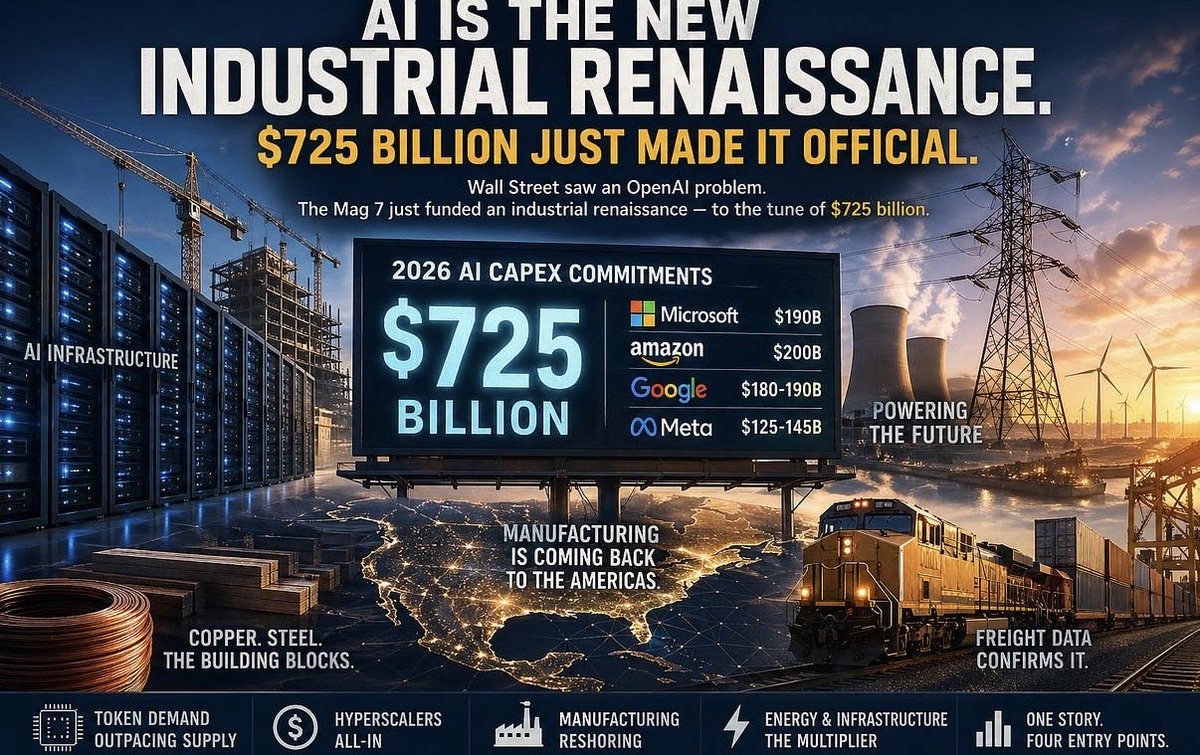
🚨 AI isn't a software cycle with hardware attached. It's an infrastructure cycle with software riding on top. Tuesday's OpenAI panic was the market briefly forgetting that. By Wednesday, the Mag 7 had committed an extra $55 billion of capex, bringing 2026 AI infrastructure spend to $725 billion — the largest annual capex step-up in tech history. BlackRock and Jensen Huang both peg the 15-year cumulative buildout at $85 trillion. Underneath: a manufacturing renaissance Wall Street still isn't pricing, and a four-signal framework in the piece for spotting this kind of cycle anywhere. open.substack.com/pub/bryantalks…

English
0
0
0
14
Bryan Nearnberg
Bryan Nearnberg@bnearnb1·
🚨 AI isn't a software cycle with hardware attached. It's an infrastructure cycle with software riding on top. Tuesday's OpenAI panic was the market briefly forgetting that. By Wednesday, the Mag 7 had committed an extra $55 billion of capex, bringing 2026 AI infrastructure spend to $725 billion — the largest annual capex step-up in tech history. BlackRock and Jensen Huang both peg the 15-year cumulative buildout at $85 trillion. Underneath: a manufacturing renaissance Wall Street still isn't pricing, and a four-signal framework in the piece for spotting this kind of cycle anywhere. open.substack.com/pub/bryantalks…
Bryan Nearnberg tweet media
English
0
0
0
86
Bryan Nearnberg
Bryan Nearnberg@bnearnb1·
Yesterday I told you the OpenAI selloff was an OpenAI problem — not an AI problem. The Mag 7 just settled it. Going into last night: $670B of combined AI capex guidance. Coming out: $725B. That’s a $55B upward revision in 48 hours. Meta raised. Microsoft running $150B annualized. Amazon holding at $200B. The largest annual capex step-up in tech history — and it just got bigger, not smaller. The bears had 48 hours. They got steamrolled. The Fourth Industrial Revolution isn’t a thesis anymore. It’s a line item. 🎥 New video up
English
0
0
0
15
Bryan Nearnberg
Bryan Nearnberg@bnearnb1·
Yesterday the market panicked over a leaked OpenAI report. SoftBank dropped 10. The chip names got hammered. The narrative wrote itself: “AI bubble cracking.” It’s wrong. An OpenAI problem is not an AI problem. In my new video, I break down why yesterday’s selloff misread the signal — and why tonight’s Mag 7 reports, with roughly $600B of 2026 capex hitting the table, are the actual story. Plus what Dylan Patel’s token economy data and Craig Fuller’s manufacturing renaissance are telling us about the bigger setup. One supercycle. Two engines. Watch below.
English
0
0
0
75
Bryan Nearnberg
Bryan Nearnberg@bnearnb1·
🧵 Tom Lee sat down on CNBC this week and used the phrase "in our lifetimes." Yes, he leans bullish. He's also a technician who's been right more often than wrong — and he just called the next 18–24 months "one of the best periods we've ever seen in our lifetimes" for US equities. "In our lifetimes" isn't his usual framing. Big call. Look at the tape: 🟢 S&P just printed fresh all-time highs Friday while UMich consumer sentiment finalized at 49.8 — a record low. Those two almost never coexist. 🟢 Iran is structurally weakening across multiple axes — even when Monday's headlines stall and oil rips. The directional story is bigger than the day-to-day tape. 🟢 The AI-jobs bear case is unraveling. Pomp publicly reversed his thesis this week. I made a similar call in January. 🟢 Nvidia retook $5T. AMD up 347% YoY. Hedge funds adding risk, retail still in cash. Honest steelman: Goldman shows AI erased 192K US jobs in the same window. Both true. Creation winning 3-to-1. Kill condition named in the article. Price already moved. Belief is the lagging indicator. Imagine when the setup actually turns bullish. Full piece → open.substack.com/pub/bryantalks…
Bryan Nearnberg tweet media
English
0
0
1
44
Bryan Nearnberg
Bryan Nearnberg@bnearnb1·
Three months ago I wrote that Warsh’s nomination signaled a potential regime change in U.S. monetary policy. Today in his confirmation hearing, Warsh used the exact phrase: “I think that means a regime change in the conduct of policy. I think that means a different, new inflation framework.” The thesis holds: growth doesn’t automatically cause inflation. Supply-driven growth — AI, reshoring, energy — can lift GDP without price spikes. The Fed stops being the growth cop. Full breakdown from January 👇 open.substack.com/pub/bryantalks…
Bryan Nearnberg@bnearnb1

Trump nominates Kevin Warsh for Fed Chair. His view: growth doesn’t always cause inflation—supply-side gains (AI, reshoring, energy) can deliver strong GDP + jobs without price spikes. Surprised by the pick given Warsh’s hawkish history (incl. 2008 caution that slowed recovery), but his discipline could enable thoughtful cuts. Full breakdown + crypto/AI implications: open.substack.com/pub/bryantalks… What’s your read—regime change or more restraint? #Fed #Economy #Crypto #AI

English
0
0
0
37
Bryan Nearnberg
Bryan Nearnberg@bnearnb1·
Iran Opens Hormuz → Oil Down ~10% Since Yesterday: Latest Video + Article on Why Markets Just Want Direction The situation is moving fast. Since yesterday’s article, Iran has declared the Strait of Hormuz completely open to commercial traffic during the Israel-Lebanon ceasefire. Oil prices have plunged nearly 10% — Brent below $90, WTI sharply lower — while stocks have surged on the sudden directional shift. We all want peace. But markets just want direction. In yesterday’s piece, “We All Want Peace — The Market Just Wants Direction,” I broke down the psychology of rate of change: how traders don’t need perfect or permanent solutions — they aggressively reward any clear momentum flip from uncertainty to hope. My latest video (just posted) walks through today’s Hormuz announcement in detail — including why even a temporary, coordinated opening is enough to trigger such violent price action while the U.S. blockade on Iranian ports remains active. 👉 Watch the latest video here + Read yesterday’s full article (now playing out live): bryantalksfinance.substack.com/p/we-all-want-… Is this the directional clarity markets were desperate for, or will the fragile nature cause a quick reversal? Drop your thoughts in the comments. If you want timely updates + deeper psychological takes on how geopolitics moves markets, subscribe and turn on notifications. — Bryan
Bryan Nearnberg tweet media
Bryan Nearnberg@bnearnb1

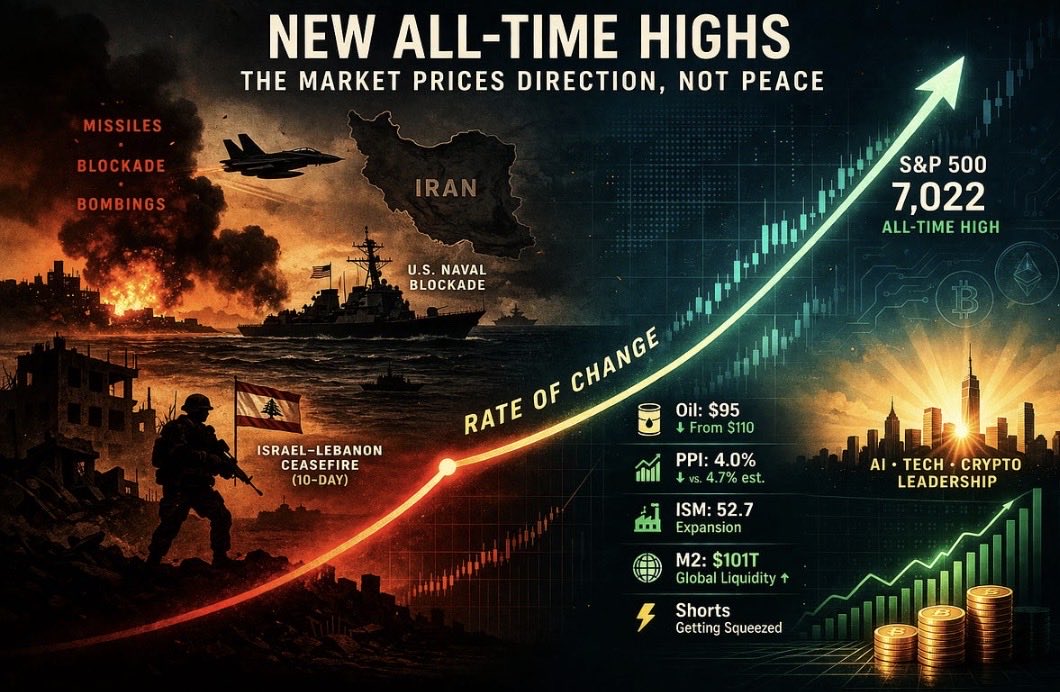
The S&P 500 just hit 7,022 — new all-time high — while a naval blockade sits off Iran's coast and a ceasefire in Lebanon just kicked in tonight. Markets don't price peace. They price rate of change. Iran nuclear talks shifted from "if" to "how long." PPI came in at 4.0% vs 4.7% expected. ISM hit 52.7 — fastest expansion since 2022. Bitcoin broke $75K. Tom Lee called the bottom on April 8 when AAII bearish sentiment was above 52%. The people who bought the fear are sitting on 15% gains in two weeks. I predicted this spring pullback in January. The correction played out. Now the barbell trade is back at full strength — SMH at records, oil still elevated, and crypto shorts getting destroyed. Full breakdown 👇 open.substack.com/pub/bryantalks…

English
0
0
0
62
Bryan Nearnberg
Bryan Nearnberg@bnearnb1·
The S&P 500 just hit 7,022 — new all-time high — while a naval blockade sits off Iran's coast and a ceasefire in Lebanon just kicked in tonight. Markets don't price peace. They price rate of change. Iran nuclear talks shifted from "if" to "how long." PPI came in at 4.0% vs 4.7% expected. ISM hit 52.7 — fastest expansion since 2022. Bitcoin broke $75K. Tom Lee called the bottom on April 8 when AAII bearish sentiment was above 52%. The people who bought the fear are sitting on 15% gains in two weeks. I predicted this spring pullback in January. The correction played out. Now the barbell trade is back at full strength — SMH at records, oil still elevated, and crypto shorts getting destroyed. Full breakdown 👇 open.substack.com/pub/bryantalks…
Bryan Nearnberg tweet media
English
0
1
1
92
Bryan Nearnberg
Bryan Nearnberg@bnearnb1·
Why is the hiring rate at a four-year low when the economy supposedly just added 178,000 jobs? Because companies spent the last two years learning they can do more with fewer people. Wage growth slowed to 3.5% year-over-year — the lowest since May 2021. We added more jobs AND wages cooled. That only makes sense if the new hires aren’t the high-value ones. The gains are concentrated in healthcare, construction, and warehousing. Physical work. Not knowledge work. That’s not a recession. It’s a restructuring. And the jobs report doesn’t know the difference. But here’s why I’m still optimistic: 5.6 million new business applications in 2025. Fourth record year in a row. The same AI trimming corporate headcount is giving entrepreneurs superpowers. The transition is rough — could last another year. But the barbell still works: own the physical economy while it’s messy, own the AI buildout for when the dust settles. bryantalksfinance.substack.com/p/the-march-jo…
Bryan Nearnberg@bnearnb1

The March jobs report just dropped — 178,000 new jobs, nearly triple what Wall Street expected. Sounds like the labor market is healing. But 396,000 people left the labor force entirely — participation fell to its lowest since Nov 2021. The unemployment rate went down partly because people stopped looking, not because they got hired. And every time BLS goes back with better data, the revisions go one direction: down. 2025's benchmark revision wiped 911,000 jobs off the books. Meanwhile, the hiring rate just sank to 3.1% — the lowest since April 2020. Twenty percent of 2026 tech layoffs are explicitly tied to AI. Salesforce cut 4,000 roles after AI started handling half their customer interactions. The low-hire, no-fire pattern isn't just caution anymore. It's a restructuring. But I'm still optimistic long-term. 5.6 million new business applications in 2025 — record levels for the fourth straight year. AI is giving solo founders leverage that used to require a team of ten. The old economy is shedding what it doesn't need — the new one is building underneath. The transition is ugly. It might last another year. But history says what comes after restructuring goes parabolic open.substack.com/pub/bryantalks…

English
0
0
0
41
Bryan Nearnberg
Bryan Nearnberg@bnearnb1·
The March jobs report just dropped — 178,000 new jobs, nearly triple what Wall Street expected. Sounds like the labor market is healing. But 396,000 people left the labor force entirely — participation fell to its lowest since Nov 2021. The unemployment rate went down partly because people stopped looking, not because they got hired. And every time BLS goes back with better data, the revisions go one direction: down. 2025's benchmark revision wiped 911,000 jobs off the books. Meanwhile, the hiring rate just sank to 3.1% — the lowest since April 2020. Twenty percent of 2026 tech layoffs are explicitly tied to AI. Salesforce cut 4,000 roles after AI started handling half their customer interactions. The low-hire, no-fire pattern isn't just caution anymore. It's a restructuring. But I'm still optimistic long-term. 5.6 million new business applications in 2025 — record levels for the fourth straight year. AI is giving solo founders leverage that used to require a team of ten. The old economy is shedding what it doesn't need — the new one is building underneath. The transition is ugly. It might last another year. But history says what comes after restructuring goes parabolic open.substack.com/pub/bryantalks…
Bryan Nearnberg tweet media
English
0
0
0
65
Bryan Nearnberg
Bryan Nearnberg@bnearnb1·
Of all the jobs AI could’ve disrupted first — doctors, lawyers, truck drivers — it went after the programmers. The people who built it. Jensen Huang says the new programming language is human. Anthropic’s engineers don’t write code anymore. They just edit what AI writes. If the coders aren’t coding, coding isn’t the barrier. Which means if you understand an industry and can spot a problem — you can now build the fix yourself. No technical background. No funding round. No dev team. That’s why 5.62 million people filed business applications last year and the number is still climbing. The software selloff on Wall Street? Some of it is the market waking up to exactly this. New video breaks down the 1st through 4th order thinking most people are missing — and why you don’t have to quit your job to take advantage of it. bryantalksfinance.substack.com/p/ai-wont-wide…
Bryan Nearnberg@bnearnb1

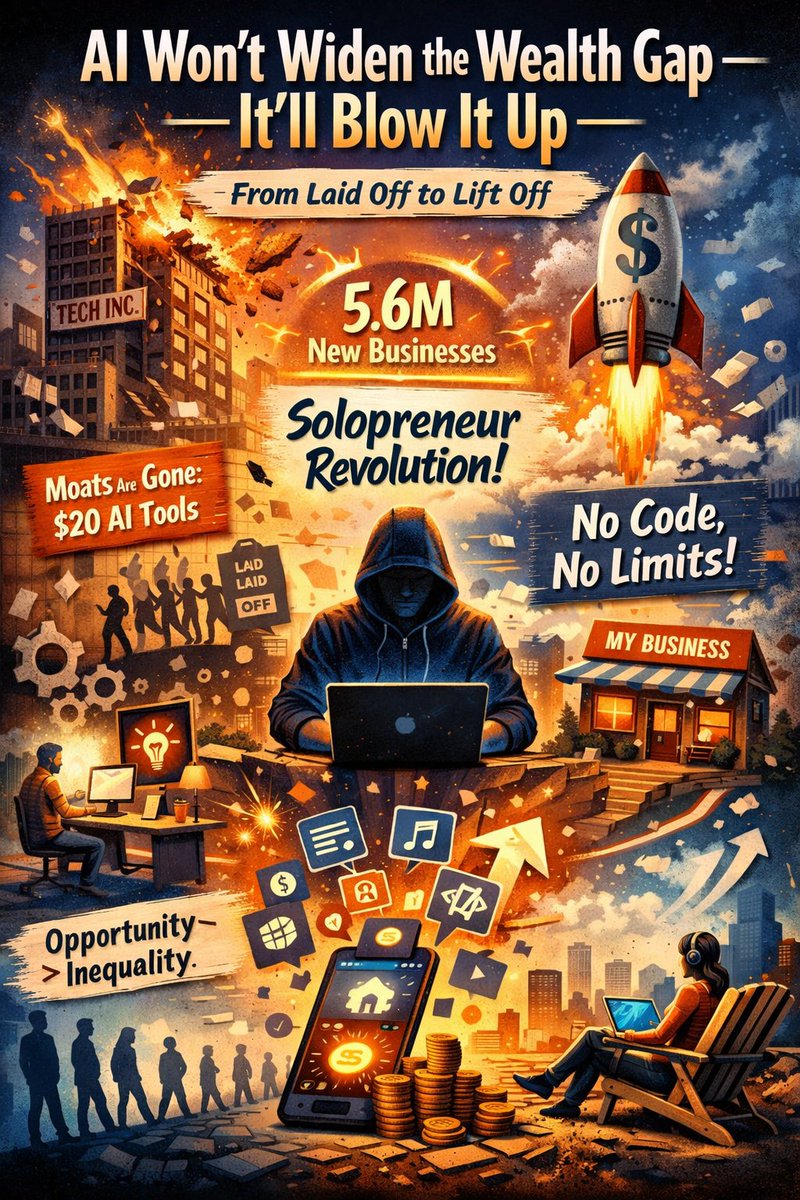
AI Won't Widen the Wealth Gap — It'll Blow It Up, by @bnearnb1 Every expert panel says AI will make income inequality worse. The IMF, Brookings, the White House — same story. They're all looking at who builds AI. They should be looking at who uses it. 5.62 million new business applications in 2025. Up 25% in early 2026. Tech companies are cutting 700 workers a day while posting record revenue — and those workers are filing business applications instead of resumes. Meanwhile the software selloff on Wall Street? Some of it's warranted. When a person with industry knowledge and a $20 AI subscription can build software that used to require a funded startup, the moats of big software companies start looking a lot thinner. You don't have to quit your job and go all in. Even a side gig — something you build on nights and weekends with knowledge you already have — gives you a hedge your employer can't take away. The ceiling used to be your boss's budget. AI removed it. The people who see that first are the ones who close the gap — from the bottom up, not the top down. Full breakdown in the new piece. @bryantalksfinance/note/p-192969681?utm_source=notes-share-action&r=jukso" target="_blank" rel="nofollow noopener">substack.com/@bryantalksfin

English
0
0
0
65
Bryan Nearnberg
Bryan Nearnberg@bnearnb1·
AI Won't Widen the Wealth Gap — It'll Blow It Up, by @bnearnb1 Every expert panel says AI will make income inequality worse. The IMF, Brookings, the White House — same story. They're all looking at who builds AI. They should be looking at who uses it. 5.62 million new business applications in 2025. Up 25% in early 2026. Tech companies are cutting 700 workers a day while posting record revenue — and those workers are filing business applications instead of resumes. Meanwhile the software selloff on Wall Street? Some of it's warranted. When a person with industry knowledge and a $20 AI subscription can build software that used to require a funded startup, the moats of big software companies start looking a lot thinner. You don't have to quit your job and go all in. Even a side gig — something you build on nights and weekends with knowledge you already have — gives you a hedge your employer can't take away. The ceiling used to be your boss's budget. AI removed it. The people who see that first are the ones who close the gap — from the bottom up, not the top down. Full breakdown in the new piece. @bryantalksfinance/note/p-192969681?utm_source=notes-share-action&r=jukso" target="_blank" rel="nofollow noopener">substack.com/@bryantalksfin
Bryan Nearnberg tweet media
English
0
0
0
101
Bryan Nearnberg
Bryan Nearnberg@bnearnb1·
🚨 Iran's "No" Is Actually the Market Signal Iran just publicly denied talks with the U.S. — but then countered with five conditions. You don't counter a proposal you're ignoring. This is the exact same pattern we saw during the China tariff wars. Deny publicly. Negotiate privately. Save face in front of your audience while your intermediaries draft the deal in the next room. Iran's denial IS the negotiation. Brent is sitting at $108 — priced for a "middle" outcome that Larry Fink says doesn't exist. He says it's $40 oil or $150 oil. Two COSCO mega-ships just got turned around in the Strait of Hormuz this morning. Even China can't get through. Until ships move freely, the market is trading headlines, not resolution. Watch the strait. Ignore the press conferences. That's where the truth is. 📌 Full breakdown: open.substack.com/pub/bryantalks…
Bryan Nearnberg@bnearnb1

Iran’s Denial IS the Negotiation. Trump gave Iran 48 hours to reopen Hormuz. The deadline passed. He didn’t strike. He walked it back and admitted back-channel talks are happening. Iran’s response? “We’re not negotiating.” Sound familiar? China said the exact same thing during the tariff talks last year. Denied everything. Then sat down two weeks later. Here’s what most people are missing: Iran isn’t refusing to talk. They’re choosing WHO they talk to. They demanded Vance. Rejected Kushner and Witkoff — the guys in the room right before the February 28 strikes. That’s not defiance. That’s leverage. Meanwhile: Gas at $4. Polls at 59% opposition. A Florida district just flipped. Trump needs a deal as badly as Iran does. And Iran knows it. Larry Fink said it best — this ends at $40 oil or $150 oil. No middle. But here’s my line: we are not in the clear until the Strait reopens. Not Trump’s posts. Not Iran’s denials. Ships moving through Hormuz freely. That’s the only signal. New video breaks the whole thing down — the pattern, the psychology, the trade.

English
0
0
0
43