

Vipul Agarwal
3.8K posts
Vipul Agarwal
@bonzerkaizen
Mission VIKSIT BHARAT. Let’s make India(भारत) a DEVELOPED Nation.
INDIA Katılım Eylül 2009
20 Takip Edilen69 Takipçiler
@sciencegirl sleep-reading books- yoga- systemic& tactical rest.
English


@prakdadlani skin in the game- passion - some patience -skills- developing team/s..
English
India & China both have the same problem.
The 2nd generation factory owners are often not as passionate.
The first generation built with struggle.
They took risks, worked long hours, and fought to survive.
The second generation inherits comfort.
The factory is already running.
Money is already there.
The market is already built.
So, the hunger drops.
A lot of them:
- don’t want to run operations
- were pushed into the family business
- like ownership more than responsibility
And slowly, strong factories are becoming average factories.
Meanwhile, new founders enter the same industry with more energy, speed, and ambition.
That is why many old businesses decline while newcomers rise.
A business cannot survive on family name alone.
Every generation must earn it again.
What needs to change to solve this?
English
@stockifiabhijit appreciate it-travel by metro 2*a week for better focus and sustainability..what a time to Live in INDIA:)
English

Calling a car a "depreciating asset" is just BS accounting talk.
Here's what actually depreciates:
Your time. Stuck waiting for a bus that never comes on time.
Your dignity. Unwanted touch in packed commutes is real.
Your energy. Heat. Rain. Smells. Every single day.
No "appreciating asset" gives you this:
✓ AC on a hot afternoon drive
✓ Personal space for your family
✓ Predictable travel when weather turns bad
Money can grow back.
Lost time can't.
Lost comfort can't.
Lost control can't."
English
@sigmoid300 @shambhav15 Point but nope- we are developin with much better roads and infra - but how do we bring about accountability -from t babus,from the cosmos of BHARAT..?- see what parineeti's hubby[AAP fame] tried to do and he was made to keep mum!
English

@shambhav15 Can you go to any city or town and say this is on par with any town in a developing or developed country? We literally have the same issues that we had 20 years ago, poor public infra, garbage, filth, open sewage, bad roads, poor air and water quality. We are still third world.
English
This statement is the easiest way to find a r*tard online
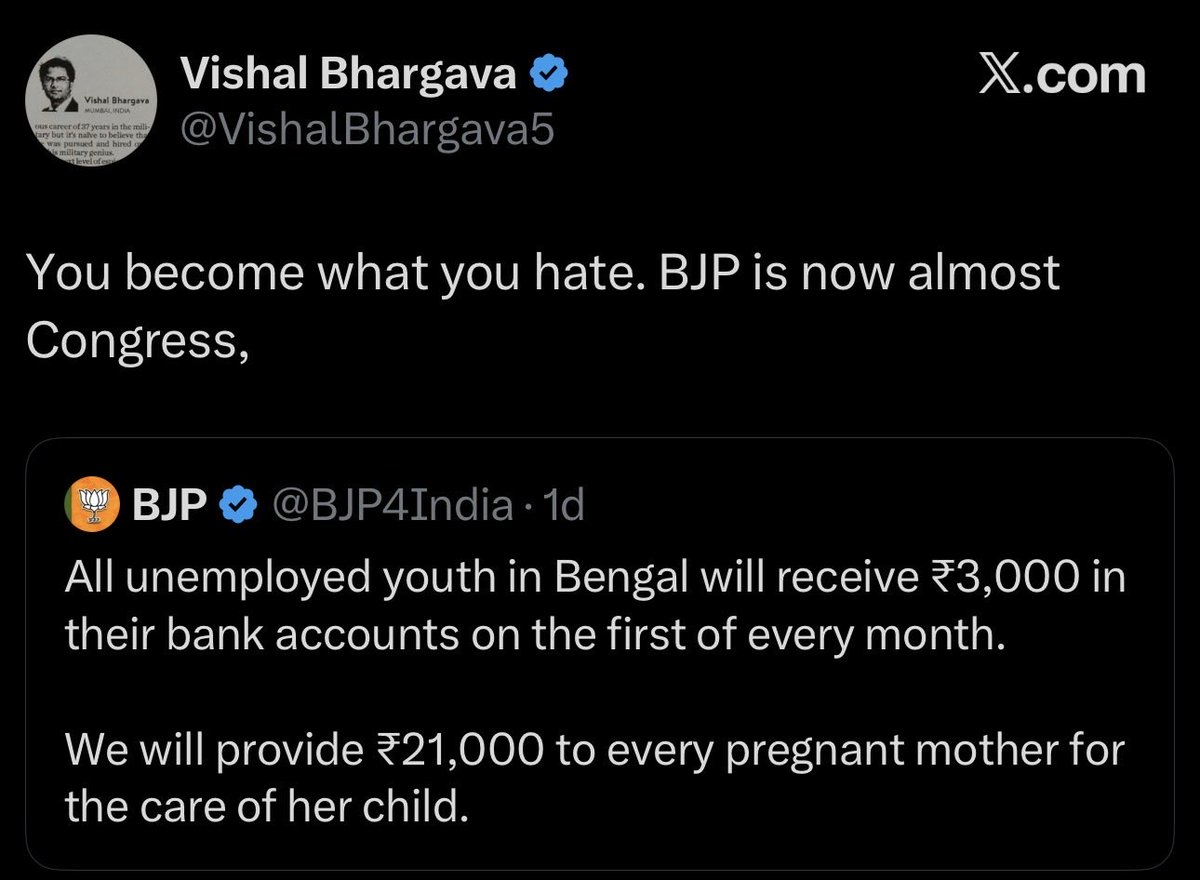
In 2024 voters told BJP exactly what they want. BJP’s existence, like any party depends on winning elections. They will do what they can to win. Freebies are unfortunate but they WIN election in the 2020s
BUT along with that BJP has legitimately invested in infrastructure, lifted 300 million people out of poverty, ENDED street shitting, ENDED Naxalism, made Pakistan AFRAID, and built the Ram Temple.
Meanwhile Congress was pocketing billions of taxpayer money, telling Hindus that they are responsible for terrorism, giving Pakistan a Thai Massage and having 40% of the population shitting on the streets
There are many mistakes, yes, which people have highlighted (urban infra & pollution, UGC F*ck up, etc)
But 'BJP is same as Congress' is a statement made by either r*tards or closet Congressis who are too chickenshit to admit they are Congressis
English
why do these foreign funds give so much gyaan on how we should orient ourselves &upgrade/downgrade INDIA as per their whims. bro, get your house in order. We are a great nation and its just coz a good part of the population is casual, we dont grow as much but we will.
English
@VijayKedia1 absolutely- we still havent scaled solar as much as we can although private cos have given a push - hoping more of plantation , algae , bamboo ,other sustainable elements are adopted to curb pollution coz thats also gonna be a key factor in shaping up true growth!
English
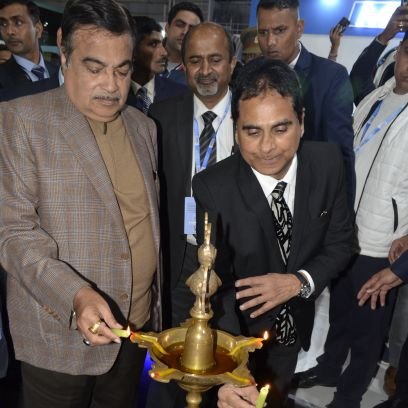
"Nuclear : Energy of the Future "
China is rapidly expanding its nuclear power capacity and is currently the fastest builder of nuclear energy in the world.
It has approx 55 - 60 GW installed and is adding another 25 -30 GW through 25-30 reactors.
(A reactor is a single power generating unit, while a plant can have multiple reactors . Which is why saying “30 plants” can be misleading.)
China is approving 8 to 10 new reactors every year, far ahead of any other country. At this pace, its total nuclear capacity could reach around 100- 120 GW by 2030.
Nuclear power is capital intensive, costing around $5- 7 billion (Rs 45,000 to 65,000 crore) per GW - significantly higher than thermal and hydro.
This implies a total investment of $125–200 billion ( Rs 10–16 lakh crore) by 2030.
However nuclear also offers continuous (baseload) power unlike solar and wind, requires far less land, produces near-zero emissions unlike thermal, and is more scalable than hydro.
Despite the high cost, nuclear provides stable, clean electricity for 60+ years and helps reduce coal dependence, strengthen energy security, power EVs and industry.
English
Vipul Agarwal retweetledi

Same street. Two realities.
🌆 Without trees: 40–46°C
🌳 With trees: 32–34°C
Trees aren’t decoration. They’re survival. 🌍
We keep cutting trees and then complain about heat.
Nature already gave us the solution 🌳

English
since ive got so much love and good information on "x" i'd love to share my toolkit- its a bag with different coloured pencils, a pen, book/s , a neat diary , a bottle of water and a plant in it. the rest are mere accessories..lol.happy weekend ,cya next week.
English
Just an observation
That when I was a kid (30 years ago), I distinctly remember there were no stray dogs
We’d go to other localities to play and all, no stray dogs anywhere
But now, wherever we go, there’s almost an army of stray dogs waiting
What changed ???

English
@aakancvedi That really brings me to a feedback by an American that INDIA has all going for it - we need to get to high value paying stuff that the world needs then we can scale further,not necessarily manufacturing low end but thats open to conjecture!
English

India is called the Pharmacy of the world, yet the whole pharma sector in India combined makes less money than global giants like Pfizer or Merck
India’s entire pharma market was about $55 billion in 2025
Compare this to Merck that did $65 billion and Pfizer that did $62.6 billion in sales
So then why even is India called the Pharmacy of the World?
Thing is, the global pharma players make money by investing in R&D, developing new drugs which they can patent, and selling them at really high margins as long as the patent doesn’t go expire, that’s the way to make money in pharma
But then Indian companies do the opposite, once the patents expire on the drugs developed by the big pharma companies, they start manufacturing them at scale, these are called generics, and then they export these generics across the world (hence called Pharmacy of the World)
Read about this in Daily Brief by Zerodha, it really blew my mind
English
@Nithya_Shrii pt..also depends what ure eating and who'se cooking ..
English

Anyone else notice how food is getting more and more expensive, but also it just doesn’t taste as good anymore?
English
Thank u moneycontrol, team lnt sufin and groww for paving the way for some entrepreneurs and adding value.
English
Vipul Agarwal retweetledi

Vipul Agarwal retweetledi

An alternative perspective on low salaries of workers in NCR:
When consumers walks into the market, price is often the only deciding factor. Many are willing to accept a “kaccha bill” if it saves money. They don’t mind buying from unethical companies. They don't care if the product is imported products from China, Taiwan, or Bangladesh if it’s cheaper.
This mindset flows through the entire value chain. When distributors approach shopkeepers, the response is similar. Quality, intellectual property, and ethics take a back seat. Cost and service are what matter most.
In such an ecosystem, ethical companies that pay taxes, invest in R&D, build IP, and focus on engineering struggle to compete. They are up against players who bypass regulations, cut corners, influence decisions through informal means, and rely heavily on low-cost imports. On top of that, large OEMs often push these companies to operate on extremely thin margins.
The challenge doesn’t end there. Productivity is further impacted by absenteeism and lack of professionalism in the blue-collar workforce. During elections, harvest seasons, festivals, and family functions, workforce availability can drop to nearly 50%, leaving companies with little control and mounting losses.
The reality is far more complex than the narrative often portrayed in films featuring icons like Amitabh Bachchan or Dilip Kumar, where business owners are depicted as exploitative Seths and workers as helpless victims.
In truth, many companies are simply trying to survive in a system where low-ethics, low-IP, trading-driven businesses have a structural advantage. In such conditions, limiting salaries is often not a choice, but a compulsion.
English
Vipul Agarwal retweetledi

Some CEOs of major global companies:
🇮🇳 Sundar Pichai — Alphabet / Google
🇮🇳 Satya Nadella — Microsoft
🇮🇳 Neal Mohan — YouTube
🇮🇳 Shantanu Narayen — Adobe
🇮🇳 Ajay Banga — World Bank Group
🇮🇳 Arvind Krishna — IBM
🇮🇳 Salil Parekh — Infosys
🇮🇳 George Kurian — NetApp
🇮🇳 Nikesh Arora — Palo Alto Networks
🇮🇳 Jayshree Ullal — Arista Networks
🇮🇳 Vas Narasimhan — Novartis
🇮🇳 Sanjay Mehrotra — Micron Technology
🇮🇳 Vimal Kapur — Honeywell
🇮🇳 Revathi Advaithi — Flex
🇮🇳 Niraj Shah — Wayfair
🇮🇳 Leena Nair — Chanel
🇮🇳 Ravi Kumar S — Cognizant
🇮🇳 Reshma Kewalramani — Vertex Pharmaceuticals
🇮🇳 Shailesh Jejurikar — Procter & Gamble
🇮🇳 Srini Gopalan — T-Mobile
🇮🇳 Gavin Hattersley — Molson Coors
🇮🇳 Raj Subramaniam — FedEx
🇮🇳 Jay Chaudhry — Zscaler
🇮🇳 Phil Spencer — Microsoft Gaming

English
reading/media
learning / chatting on food in parties
xtra social/quiet work
packaged /healthy food
silent yoga & exercise / excess flaunts thro posts
bharati products/ firang made stuff
travel in india/travel abroad
Plz take a good rational call- no 2 brains are alike!
English
@Iamsamirarora i would have thought that cash flow- income from operations,finance and investing are what we were taught in school!of course would vary depending on ones orientation but in a nutshell..!
English
Why these random thoughts that people on X have-
" hey anyone can set up new age businesses by losing money and there is no other moat" are so wrong.
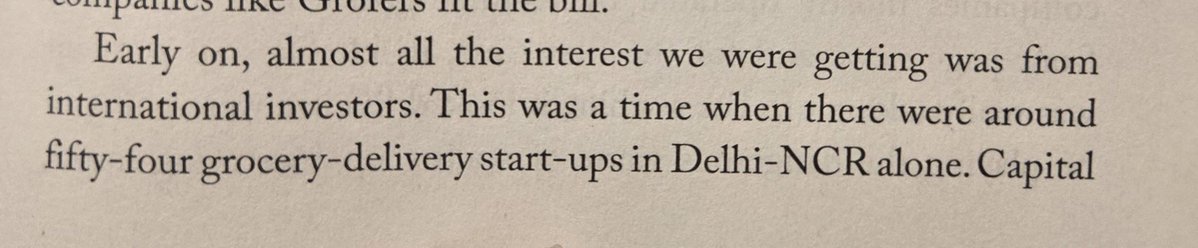
There were 54 grocery delivery start ups in Delhi NCR alone.
English
@connectgurmeet lol..before we get to supercapacity in artificial intelligence,etc etc we need to sort out human values and human intelligence, i d like to think
English

Taiwan market cap now is $4.2 trillion.
Taiwan GDP is $900 Bn .. market cap to GDP is 450%.. one stock alone TSMC is 40% of market cap..
But Taiwan is AI play and attractive.
And as per experts India at 18-19 times is expensive.. because there is no AI play.
Sahi hai !!
English
ye naya hindustan[BHARAT-INDIA] hai
VIKSIT HOGA BHI , AUR SAHI RAH DIKHAYEGA BHI.
हिन्दी