

Boris Nikolaev
75 posts


I merged Karpathy's AI jobs scores that people are calling AI slop with Eloundou et al. data from their Science (2024) paper and the new Anthropic’s measure that captures AI displacement risk.
The rank correlation of Karpathy’s scores was .82 vs human expert raters (from the Science paper) and .72 vs Anthropic's observed exposure metric.
Low scores on Karpathy index → near-zero real AI usage. High scores → 40–64% observed exposure.
Yes, this doesn't tell you whether you are going to lose your job in the future (that was not the point of his project).
But this is also not some AI generated slop or noise (even if the scores are based on a single generic prompt and derived with Gemini Flash, not even a frontier model).
To me, this is the most remarkable part of his project - that the scores are even picking something real about where LLMs are being used at work (the observed exposure metric) and track surprisingly well with the human benchmark.
This shows the practical usefulness of these tools.
One person, one lightweight LLM, and a single prompt can now produce over a weekend (as a side project) something that picks a real signal and would have taken a well-funded research team months to do a few years ago.
GIF
English
@vladtenev The shorts are definitely not getting squeezed in this picture. Maybe Vlad should squeeze leg day into his workout schedule though 😂
English


Both views can be correct and it depends how you define slop. Boris simply argued that the models are getting better and are less likely to produce sloppy code. They are already getting closer to human experts on many tasks (gpval). So if we define sloppiness by quality of output, they are getting less sloppy. In a sense, we are moving from flip phone cameras to iPhone cameras. And yes you (and karpathy) are also correct. As it gets cheaper to produce content, we make more of it. In a sense, we are entering the phase of 50 selfies a day with [inset ai output]. The quality of pictures is not as impressive anymore, just like well written posts, etc. we raise the bar. So you are right … in a word with unlimited technically perfect output what matters? After all, scarcity creates value.
English

Heavy agree with @karpathy and disagree with @bcherny.
Appreciate both your takes and want to add in my perspective.
When the cost of generating anything (at any quality level) plummets, AND there is still market leverage for attention, generators will take advantage of it.
It’s why one company is cranking out hundreds of Reels/Tiktoks per day.
It’s why another is cranking out 3,000 podcasts per week.
Code might improve but the content and social and research worlds are rougher waters.
I too predict a slopocalypse this year. One that Mosseri and Presser and Ek will be thinking about daily.
The smart generators are already thinking about second-order impacts.
Examples for content creators:
👉 If everything is AI-generated, maybe I should only post human things
👉 If everything is AI-generated, maybe I should have a separate community that is off socials
👉 If everything is AI-generated, maybe I should host more in-person things
👉 If everything is AI-generated, maybe I should make a social media app that is only for AI bots
👉 If everything is AI-generated, maybe I should create a consortium of authentic creators and form a new agency (like a new hype house)
👉 If AI generation is cheaper, maybe I should translate everything I do into 70 languages - every post, every video, every podcast, every course
👉 If AI is everywhere, maybe I should label all my content “100% human” to earn trust with my audience
The big question for me is less on quality, because it will get there. I’m thinking about whether people continue to engage with AI-generated content, whether they build affinity for AI creators and at what level compared to humans, and whether they rebel against it and at what speed,
Boris Cherny@bcherny
As always, a very thoughtful and well reasoned take. I read till the end. I think the Claude Code team itself might be an indicator of where things are headed. We have directional answers for some (not all) of the prompts: 1. We hire mostly generalists. We have a mix of senior engineers and less senior since not all of the things people learned in the past translate to coding with LLMs. As you said, the model can fill in the details. 10x engineers definitely exist, and they often span across multiple areas — product and design, product and business, product and infra (@jarredsumner is a great example of the latter. Yes, he’s blushing). 2. Pretty much 100% of our code is written by Claude Code + Opus 4.5. For me personally it has been 100% for two+ months now, I don’t even make small edits by hand. I shipped 22 PRs yesterday and 27 the day before, each one 100% written by Claude. Some were written from a CLI, some from the iOS app; others on the team code largely with the Claude Code app Slack or with the Desktop app. I think most of the industry will see similar stats in the coming months — it will take more time for some vs others. We will then start seeing similar stats for non-coding computer work also. 3. The code quality problems you listed are real: the model over-complicates things, it leaves dead code around, it doesn’t like to refactor when it should. These will continue improve as the model improves, and our code quality bar will go up even more as a result. My bet is that there will be no slopcopolypse because the model will become better at writing less sloppy code and at fixing existing code issues; I think 4.5 is already quite good at these and it will continue to get better. In the meantime, what helps is also having the model code review its code using a fresh context window; at Anthropic we use claude -p for this on every PR and it catches and fixes many issues. Overall your ideas very much resonate. Thanks again for sharing. ✌️
English
Let’s say you work for Target and spend your paycheck there on groceries, clothes, toys for your kids. Target even gives you a discount to incentivize you to spend your paycheck there. Are you inflating Target’s revenue?
NVIDIA invests in AI companies → those companies buy NVIDIA GPUs they actually need to run their products → NVIDIA delivers real hardware.
Both transactions involve real products and real value. The ‘circular’ part doesn’t make either transaction fake.
Money circulates in the economy. That’s why it’s called the circular flow of income. The ‘circular’ part isn’t the problem - it’s literally how economies work! 😆
OpenAI needs massive compute infrastructure, and only 3-4 companies on Earth can provide it (Microsoft, Google, Oracle, AWS). They have deals with all of them.
The important question is “is AI demand real enough to justify the infrastructure investment?” But that’s a completely different question that the circular deals.
With 800M+ ChatGPT weekly users and real products changing how people work, the demand looks pretty real to me. The latest pew research survey shows that 30% of adult Americans now use Ai constantly and 50% use it daily.
What people are essentially debating here is whether these investments are justified. But the circular deals are not the scandal you think it is. It’s just how infrastructure investment works in emerging tech.
English

YOU NEED TO WATCH THIS - The AI story no one is talking about!
If you want to understand what's REALLY happening behind the AI boom - watch this.
AI giants like NVIDIA, Microsoft, OpenAI, Intel, AMD etc are inflating revenues.
NVIDIA is literally subsidizing / “paying” customers to buy their hardware - and Wall Street is treating it as revenue.
Since ChatGPT launched: $NVDA is up 1,600%.
But the real question nobody is asking:
Is this actually sustainable - or even profitable long-term?
(credit: Mark Tilbury - full Youtube video linked in the comments)
English

@botzata @AndrewYang Boris. There are SO many people glazing the 50 year mortgage claiming "look at the math" with zero effort put into actually understanding it.
And none of them talk about the effect of subsidizing demand for housing while not changing the supply.
Increasing average home prices.
English

If a 50-year mortgage is a good idea, a 100-year mortgage is even better.
English
This shows basic lack of understanding how economics and finance works.
First, 50-year loans will have higher rates than 30-year loans, just like 30-year loans have higher rates than 15-year loans (currently that difference is ~ 0.75%).
This is because of arbitrage. If rates were the same, why would anyone take the shorter loan? You pick the longer loan because it gives you maximum flexibility with zero cost (you can always pre-pay the loan sooner if you want).
This is free lunch! And lenders don't offer free lunches.They charge a term premium to compensate for the risk.
If you are 35 when you buy your first home, you will pay if off when you are 85 years old. That means you have to have enough income 20 years after your retirement to do so. That's more risk too.
The outcome?
Let’s say you have a $500K house loan and conservatively assume .5% premium for the 50 year loan.
- 30-year at 7.0% -> $3,326/month, $697K total interest
- 50-year at 7.5% -> $3,201/month, $1.42M total interest
You “save” ~ $125/month but pay an extra $723K in interest (more than double).
And, no, most people are not going to invest the extra $125/month in the stock market (40% of Americans depend solely on social security for retirement).
But, and more importantly, people care largely about monthly payment affordability.
We know this from research on auto loans, which shows that for each additional year of financing, car prices increase by approximately 2.8-3%.
So, longer loan terms --> higher prices! Same will happen to housing. If monthly payments go down --> you can “afford” more --> sellers ask for more --> prices go up --> you end up with the same (possibly even higher) monthly payment but a ton more debt.
The net result is net negative for buyers. You pay more upfront, a lot more in interest, build equity slower (you are basically front loading interest payments), and you inflate the next housing bubble!
English

WHY I LOVE THE 50-YEAR MORTGAGE:
Here’s the full picture of the 50-year mortgage opportunity, including the extra interest you get "wrecked" by on the 50-year mortgage.
Monthly payments (6% interest, $500k home):
• 30-year: $2,997.75
• 50-year: $2,632.02
• Monthly difference: $365.73
Total interest paid:
• 30-year interest: $579,190.95
• 50-year interest: $1,079,214.38
• Extra interest from choosing 50-year: $500,023.44
So stretching the loan to 50 years means you pay an extra half a million dollars in interest to the bank.
But here’s the twist:
If you take the $365.73 monthly savings and throw it into Bitcoin compounding at 20% for 30 years, you get:
✅ $8,403,654
So the trade-off is basically:
• Pay the bank $500k more,
• But stack $8.4M in Bitcoin.
Even a 20% CAGR on BTC gets you $1m status in about 18 years with that small monthly contribution.
But remember, this is a 50 year mortgage. Instead of 30 years, you keep stacking $365.73 per month into Bitcoin compounding at 20% annually for 50 years, your final stack becomes:
✅ $445,081,564
Yes.
Four hundred forty five million dollars.
Off the mortgage-payment difference.
This is why the 50-year mortgage discourse is hysterical.
Boomers see “more interest to the bank,” you see “half a billion in BTC.”
Is the 20% terminal CAGR too high?
Perhaps, but a lot of people think it's going to be even higher at 30-40% over the next decade or so.
Saylor himself thinks the terminal CAGR will be around 20% after the next two decades are up.
Crazy numbers, but that's what the math says.
Take it or leave it.

English
@WarrenPlatts @AndrewYang This has nothing to do with my argument. The point is about affordability. A 50 year loan should make owning a home more affordable. If you consider higher rates + higher prices, then there is no benefit at all.
English

@botzata @AndrewYang You're not taking into account the debasement of the dollar, however. Eg. a 2025 dollar is worth about 16 cents in 1975 dollars..
English
That's the whole point that you are missing!
First, 50-year loans will have higher rates than 30-year loans, just like 30-year loans have higher rates than 15-year loans (currently that difference is ~ 0.75%).
This is because of arbitrage. If rates were the same, why would anyone take the shorter loan? You pick the longer loan because it gives you maximum flexibility with zero cost (you can always pre-pay the loan sooner if you want).
This is free lunch! And lenders don't offer free lunches.They charge a term premium to compensate for the risk.
If you are 35 when you buy your first home, you will pay if off when you are 85 years old. That means you have to have enough income 20 years after your retirement to do so. That's more risk too.
The outcome?
Let’s say you have a $500K house loan and conservatively assume .5% premium for the 50 year loan.
- 30-year at 7.0% -> $3,326/month, $697K total interest
- 50-year at 7.5% -> $3,201/month, $1.42M total interest
You “save” ~ $125/month but pay an extra $723K in interest (more than double).
And, no, most people are not going to invest the extra $125/month in the stock market (40% of Americans depend solely on social security for retirement).
But, and more importantly, people care largely about monthly payment affordability.
We know this from research on auto loans, which shows that for each additional year of financing, car prices increase by approximately 2.8-3%.
So, longer loan terms --> higher prices!
Same will happen to housing. If monthly payments go down --> you can “afford” more --> sellers ask for more --> prices go up --> you end up with the same (possibly even higher) monthly payment but a ton more debt.
The net result is net negative for buyers. You pay more upfront, a lot more in interest, build equity slower (you are basically front loading interest payments), and you inflate the next housing bubble!
English

If you choose a 30 year mortgage over a 50 year mortgage you’re financially retarded.
The difference between a $400k loan at 6% interest is $300 a month.
Sure you end up paying $600k more in interest.
But the $300/month is equivalent to $4.4m if invested in the s&p500…

Chief Nerd@TheChiefNerd
$400,000 Mortgage Comparison @ 6% 30-Year Mortgage - Monthly Payment: $2,398 - Total Loan Cost: $863,352 50-Year Mortgage - Monthly Payment: $2,106 - Total Loan Cost: $1,263,372 Which would you pick?
English
You are not helping buyers, you are subsidizing sellers and banks.
People care about monthly affordability. What we know from the auto loan market is that for each extra year of financing car prices increase around 3%.
Same thing with housing prices. Monthly payments drop—> home prices rise to match —> buyers pay way more total debt for the same house.
Result is higher prices for everyone, decades more interest, zero real affordability gain.
nber.org/digest/digests…
English

I don’t believe you. Share the task, the prompt and which AI you use. The fact that you are being so vague shows you have no clue what you are doing. For example, ChatGPTs agent mode is where you will get the best chance to complete this task. I recently asked it to extract all information from 12 months of utility bills, organize it into a spreadsheet, and then do an analysis to tell me how much I would save if I get a battery for my solar system. There was absolutely no mistakes in extracting the data and the analysis was very close to my own.
English

Truly retarded take
Only people who are not in the trenches of AI think this is true.
A few months ago I asked AI to separate a bunch of domains from a two column spreadsheet based on a very simple criteria. A task so simple a $4 per hour VA from the Philippines could do it.
The paid versions of ChatGPT, Grok and Gemini all failed the task.
These AIs are so error prone, and so bad at interpreting simple English instructions, we are nowhere remotely near AI replacing jobs en masse in the next 12 months.
David Scott Patterson@davidpattersonx
AI is on track to be able to do all jobs by the end of next year.
English
But that's a silly statement, don't you think?
If you don't have PhD-level skills, you stand no chance to evaluate what LLMs' PhD-level abilities actually are (the Dunning-Kruger effect).
That's precisely why LLMs feel like magic to so many people—it's like having 1000s of PhDs in the same room.
And if you do have a PhD? Well, then why make a big deal of something you find so unimpressive in the first place? 😂
English

Very interesting!
How did you guys control for gig workers using AI?
In your limitations section, you say the projects were completed in the past five years. So, it seems that your "human baseline" isn't necessarily purely human.
Also, I noticed agents had up to 1 hour to self-correct within their session. But in the real world, humans provide feedback between iterations ("fix this," "try a different approach").
I recreated your World Happiness Dashboard with Claude - took about 1 hour with some minimal instruction on my end.
The gap between "AI with very minimal human feedback" and "fully autonomous AI" seems much larger than the 2.5% automation rate suggests.
Did you consider measuring how much human interaction is needed to get acceptable results for most of these projects? That might be the more economically relevant benchmark.
Awesome work! :)
English

Can AI automate jobs?
We created the Remote Labor Index to test AI’s ability to automate hundreds of long, real-world, economically valuable projects from remote work platforms.
While AIs are smart, they are not yet that useful:
the current automation rate is less than 3%.


English
You've got some framing issues here! :)
The “blindly use”part is a strawman. Most people aren’t advocating blindly using AI for deep expert work.
The “test on your expertise” advice has a sampling problem. You are literally selecting for the domains where you are most likely to catch errors. This tells you almost nothing about the 99.9% of topics where you are not an expert and may need LLM help.
You are missing the counterfactual. For a non-expert, the real comparison isn’t “LLM vs. having deep expert knowledge.” It’s “LLM vs. spending 2 hours Googling through SEO spam vs. asking their semi-informed friend vs. giving up.”
In many cases, even an imperfect LLM is the best tool available.
The jagged frontier matters. LLMs are superhuman at some tasks and terrible at others. A blanket “don't trust them” ignores this.
Of course, healthy skepticism is warranted! So I agree with you there!
English
What was interesting about the article is that overall we haven’t seen an ai job apocalypse.
And it’s mostly graduates from mid-tier universities that have been hit the hardest.
Why the middle?
Companies keep top-tier grads for specialized expertise and bottom-tier for lower cost.
The middle is where AI slots in perfectly.
From the Stanford paper that came earlier this year on the same topic (and why see the effect mostly on junior positions):
“AI replaces codified knowledge, the ‘book-learning’ that forms the core of formal education. AI may be less capable of replacing tacit knowledge, the idiosyncratic tips and tricks that accumulate with experience.”
English

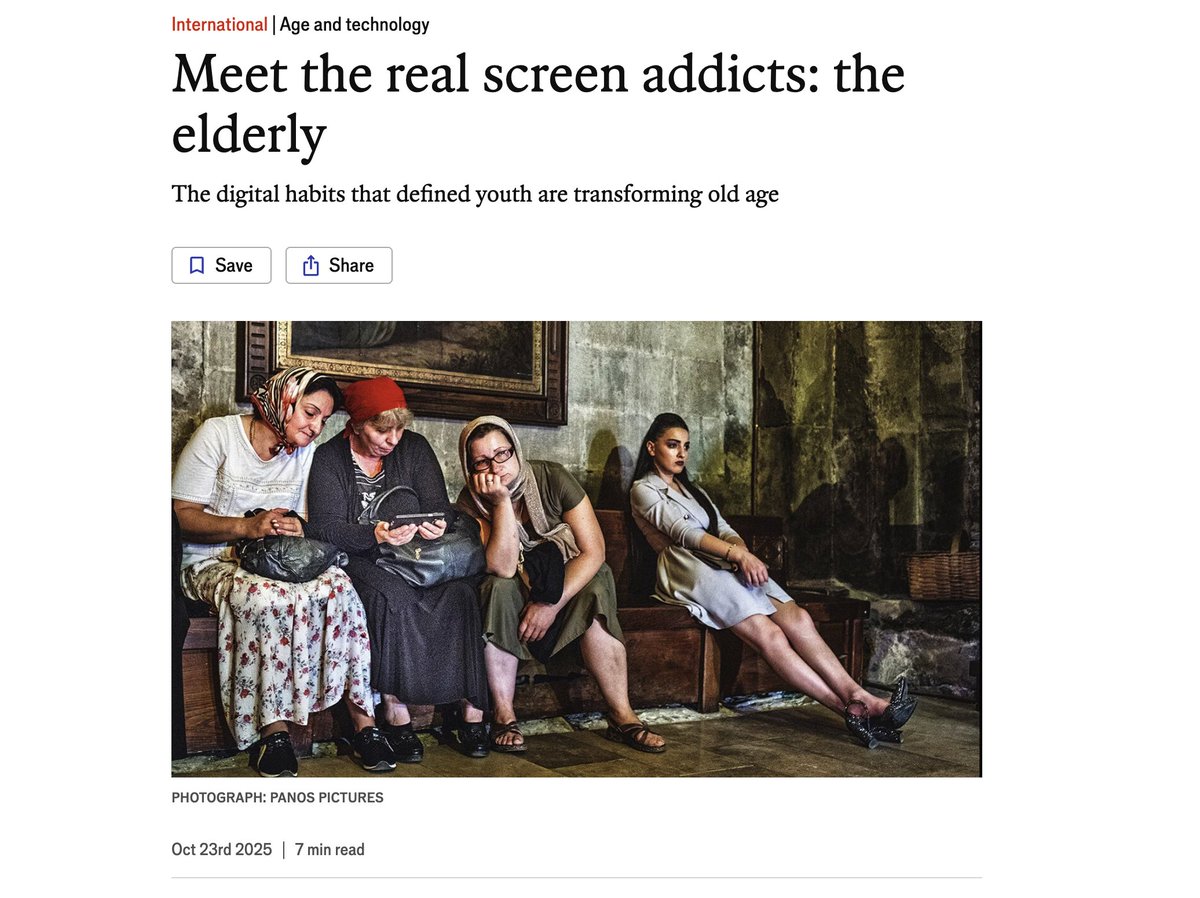
So let me get this straight. The goal is to stay away from screens to be productive so we can .... doom-scroll guilt-free one day?! 🤣

English
@SpencerHakimian What’s over? If you actually take the time to read the study, you will find out that after the initial surge of ai content, we’ve seen a plateau for over a year. In other words, the market is self correcting and algorithms reward quality over slop. I say really good news 😂
English

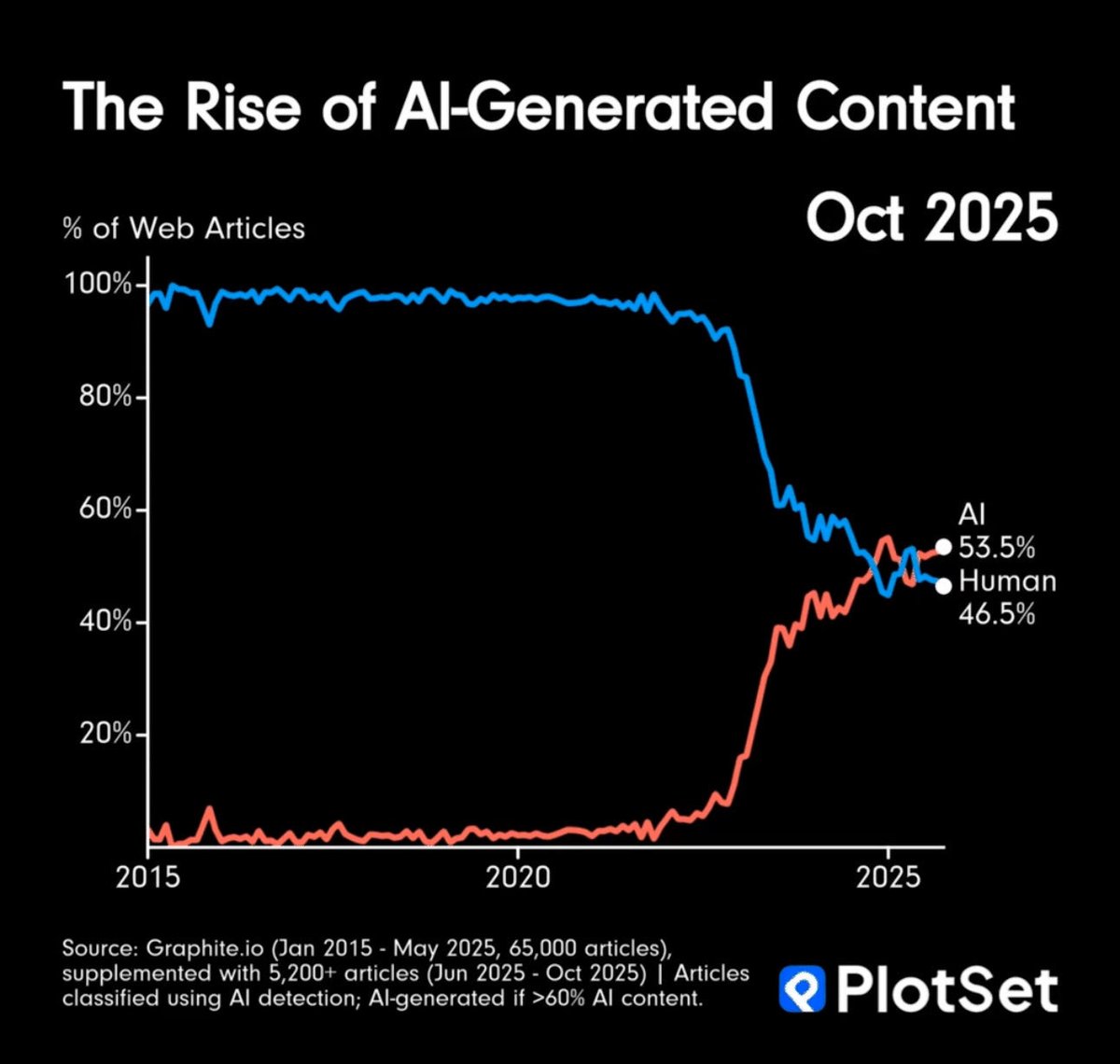
𝗠𝗼𝗿𝗲 𝘄𝗲𝗯 𝗮𝗿𝘁𝗶𝗰𝗹𝗲𝘀 𝗮𝗿𝗲 𝗻𝗼𝘄 𝗰𝗿𝗲𝗮𝘁𝗲𝗱 𝗯𝘆 𝗔𝗜 𝘁𝗵𝗮𝗻 𝗵𝘂𝗺𝗮𝗻𝘀.
A new study found that AI content crossed 50% around November 2024
(and I see people freaking out about AI slop spreading).
But here is what i found interesting about the study:
Growth in AI content has plateaued since then, remaining relatively stable over the past 12 months.
𝗪𝗵𝘆?
A second study from the same team found:
- Only 14% of Google Search results are AI-generated
- Only 18% of ChatGPT/Perplexity citations are AI-generated
- When AI articles do rank, they tend to appear lower in results
𝗜𝗺𝗽𝗼𝗿𝘁𝗮𝗻𝘁 𝗰𝗮𝘃𝗲𝗮𝘁
Their methodology can't measure AI-assisted content (human writes with AI, then edits)—which is probably the most common use case.
𝗦𝘁𝗶𝗹𝗹, 𝗶𝗳 𝘁𝗵𝗲 𝗱𝗶𝗿𝗲𝗰𝘁𝗶𝗼𝗻𝗮𝗹 𝘀𝗶𝗴𝗻𝗮𝗹 𝗵𝗼𝗹𝗱𝘀:
Supply ≠ distribution.
Despite AI creating 50%+ of articles, algorithms overwhelmingly surface human-written content.
The market seems to be self-correcting—filtering by value, not by origin.
𝗪𝗵𝗮𝘁'𝘀 𝗿𝗲𝗮𝘀𝘀𝘂𝗿𝗶𝗻𝗴:
We already know how to deal with slop—whether AI or human.
We penalize it. We scrutinize it. We rank it lower. We use peer review. We incentivize quality.
The same mechanisms that filtered human slop are filtering AI slop.
𝗦𝗼, 𝗵𝗮𝘃𝗲 𝘄𝗲 𝗿𝗲𝗮𝗰𝗵𝗲𝗱 𝗲𝗾𝘂𝗶𝗹𝗶𝗯𝗿𝗶𝘂𝗺 𝗳𝗮𝘀𝘁𝗲𝗿 𝘁𝗵𝗮𝗻 𝗲𝘅𝗽𝗲𝗰𝘁𝗲𝗱? 𝗜𝘀 𝗾𝘂𝗮𝗹𝗶𝘁𝘆 𝘀𝘁𝗶𝗹𝗹 𝘄𝗶𝗻𝗻𝗶𝗻𝗴?
P.S. I used Claude to turn their raw data into this interactive dashboard in minutes. Same AI we worry about will lead to more slop.
GIF
English