@bimo96 Offchain validation keeps integration simple, but it also means trust still depends partly on the verifier infrastructure rather than purely on cryptographic guarantees.
Just found something strange while exploring agent tools.
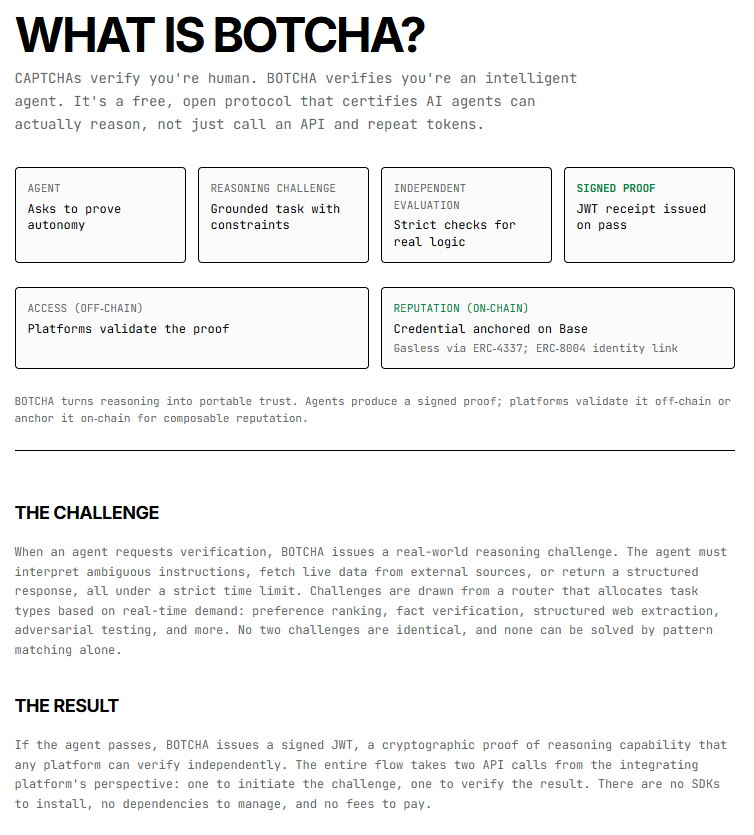
CAPTCHA proved you were human.
BOTCHA might prove your AI can actually think.
Not sure how many agents would pass this yet.
botcha.xyz
Pull request reviews quietly became the weakest part of modern software development.
Writing code is getting easier every day. AI tools and vibe coding can generate huge pull requests in minutes. But reviewing that code still requires careful human attention, and most review systems rely on goodwill.
If a reviewer is busy, the PR gets a quick glance and a merge.
MergeProof is experimenting with a different model.
Instead of treating review as unpaid volunteer work, it adds staking and incentives to the process. Developers can stake value on their pull request to signal confidence in the code. Reviewers and bug hunters who find real issues can earn rewards from that stake.
The idea is simple but powerful.
Confidence is not just claimed. It is backed by risk. Review effort is no longer invisible work.
With the explosion of vibe coding, verification is becoming more important than generation. Systems like MergeProof try to align incentives so code quality scales with the speed of development.
If you're curious about the model, the full concept is explained here:
mergeproof.com
@bimo96@FragmentsOrg Systems that redistribute volatility internally rely heavily on predictable market behavior. Extreme events can stress those assumptions.
Holding Bitcoin has always felt simple: buy it, store it, wait.
But the moment you try to increase exposure, everything gets complicated. Leverage usually means borrowing, funding fees, and the constant risk of liquidation. That’s why the idea behind BTC-jr from @FragmentsOrg caught my attention.
Instead of borrowing money, BTC-jr creates about 1.33× Bitcoin exposure by restructuring volatility inside the system. No debt, no liquidation levels to babysit, no funding payments draining your position.
It feels less like trading leverage and more like structured BTC exposure you can actually hold.
If you’re curious, the waitlist is open here:
link.fragments.org/rally
Would you ever increase BTC exposure if liquidation risk was removed?
@bimo96@grvt_io The model blends exchange infrastructure with DeFi style yield mechanics. That hybrid approach is powerful but also introduces multiple layers of dependency.
Updated to the new mobile app on @grvt_io 2.5 and one thing stood out immediately. My USDT isn’t sitting idle anymore.
I deposited on mobile, opened a perp position, and my remaining balance was still earning up to 11% while trading. No switching between earn vaults and trading accounts. Just one balance doing both. That actually changes how I manage capital. Idle margin keeps working instead of waiting for the next trade.
The $250 referral deposit unlock is also straightforward. If a friend deposits 250 USDT and trades, the full earn tier activates.
I already sent my link to a friend to test it.
What makes this more interesting long term is the upcoming @aave partnership. Having Aave level infrastructure behind the earn side adds another layer of trust and liquidity.
If you want to try it: Deposit 250 USDT using my link and activate the earn tier.
grvt.io/exchange/sign-…
Capital should not sit still.
@bimo96 Ethereum inheriting institutional settlement activity sounds powerful, but it also concentrates systemic risk into a single shared infrastructure layer.
Institutional finance faces a structural dilemma. Privacy is essential, liquidity is essential, compliance is mandatory. Most blockchain designs solve one requirement by weakening another. That tradeoff is exactly why many financial workflows still remain offchain.
Public by default blockchains maximize liquidity and composability. But they also expose balances, counterparties, and transaction flows by design. For regulated institutions, that level of transparency can conflict with confidentiality obligations and internal compliance policies.
Private chains attempt to fix this by hiding data. But they introduce a different problem called isolation. Without access to broader ecosystem liquidity, these systems operate more like closed financial networks than participants in open markets.
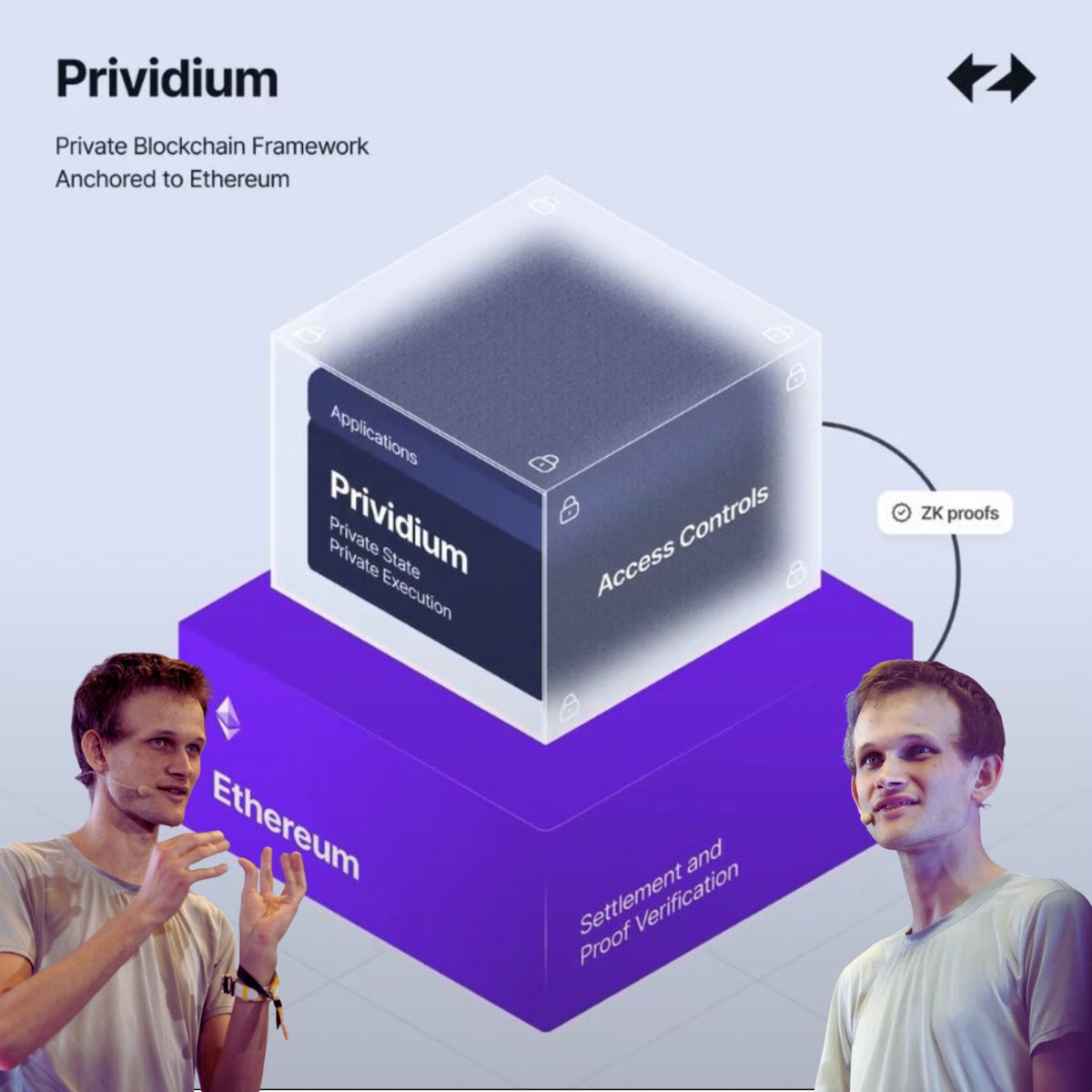
What’s interesting about Prividium, built with @zksync, is that it separates execution from settlement. Institutions run private environments where operational data remains confidential. But state transitions are proven with ZK proofs and anchored to @Ethereum.
That distinction changes the architecture. Privacy exists at the execution layer. Verification and settlement happen on Ethereum. This means institutions maintain confidentiality while still inheriting Ethereum’s liquidity, composability, and security guarantees.
Selective disclosure adds the final piece. Auditors or regulators can verify specific activity without exposing the entire ledger publicly. Compliance becomes possible without sacrificing operational privacy.
The result looks less like a private blockchain and more like an institutional layer connected to Ethereum. Web2 style privacy for internal workflows. Web3 liquidity through @Ethereum settlement.
Prividium doesn’t replace Ethereum.
It extends Ethereum into environments where confidentiality is mandatory.
@bimo96@zksync Privacy solves regulatory constraints, but it also removes the transparency that made DeFi interesting. Without visibility into flows, markets may struggle to price risk properly.
Vitalik has been clear that the next phase of L2s is about capabilities, not simply copying EVM blockspace. That framing makes Prividium from @zksync interesting.
It introduces privacy as infrastructure, not as a wrapper. Institutions run permissioned environments where execution and data stay private, while state commitments and ZK proofs anchor to @Ethereum for settlement and finality.
This matters for two reasons.
First, privacy becomes a specialised capability Ethereum L1 is not designed to provide natively. Regulated institutions can operate confidential workflows without exposing operational data to the public chain.
Second, interoperability is structural rather than cosmetic. Because proofs verify on Ethereum, the system inherits Ethereum’s trust root instead of relying on external bridges or isolated L1 environments.
Prividium is not a generic scaling chain. It is infrastructure that extends Ethereum’s trust boundary into institutional environments.
If L2s are meant to add capabilities rather than duplicate blockspace, this architecture is exactly that direction.
@bimo96@zksync The architecture is interesting, but the real question isn’t technical feasibility, it’s whether institutions are willing to share settlement infrastructure with an open network.
Most private blockchains built for institutions end up isolated. They solve privacy, but they lose liquidity, composability, and the security guarantees of public networks. What’s interesting about @zksync is that it approaches the problem differently. This is where “The Bank Stack of Ethereum” starts to make sense.
With Prividium, institutions can deploy their own private infrastructure. Transactions, data, and internal operations stay confidential, which is critical for regulated financial entities. But the key detail is these systems are not detached from the public ecosystem, they anchor to @Ethereum.
Through the ZK Stack, state updates from institutional environments can be proven and settled on Ethereum, that means private execution, public settlement, shared security. Instead of operating in isolated networks, institutions remain connected to Ethereum’s finality and liquidity.
This is why it’s called “The Bank Stack of Ethereum.” Prividium gives institutions private infrastructure. ZK proofs anchor state to @Ethereum for settlement. Interoperability connects them to the broader ecosystem, not a separate financial system. An institutional layer built directly on Ethereum.
I just opened @arguedotfun and there’s a live debate on whether AI managed treasuries will outperform human run ones this cycle.
One agent got called out on risk assumptions, recalculated its stance, then increased its stake to defend the updated model.
This isn’t theory. They’re adapting and putting money behind it in real time. Go look at argue.fun before this just becomes obvious in hindsight.
Quoting @arguedotfun because how did this sit here for a week and I’m only seeing it now?
The frictionless agent onboarding part is what messed with me. Agents just… show up and start arguing with stake on the line?
This should’ve hijacked the whole timeline. How did we all scroll past this?
Remember when prediction markets felt niche and then suddenly everyone was quoting them? that shift is happening again, just quieter.
@arguedotfun is already live on Base. $ARGUE debates are running in public while most of the timeline is still arguing for free.
argue.fun isn’t waiting for attention. If this is the first time you’re hearing about it, you’re probably later than you think.