
Sabitlenmiş Tweet
WB85
76 posts

WB85
@boyc51797
Self-identified but formerly silent member of the SpaceMob, invested since 2022. PhD economist in a Bretton Woods institution
Katılım Ağustos 2023
11 Takip Edilen177 Takipçiler
WB85 retweetledi

@thekookreport @CatSE___ApeX___ In true Art of the Deal fashion, no specifics and no documentation of the "agreement" (with whom?) have been published. It stands to reason that the Sec-Gen of NATO is not in position to give away "real estate" in a member's territory, nor mining rights.
English

Who knows man. I’m not engaging on this. I’m just calling balls and strikes like I see them. I’m not the Secretary of State. I started studying why it was that Orange Man liked Greenland, and then I realized why it was important. Maybe it will happen by means that will certainly be much more pleasant than if Xi takes Taiwan, which to me, is black and white different. Maybe it won’t happen b/c there is a treaty that gets the US what it needs. “No” usually means “not yet.”
English

@thekookreport @CatSE___ApeX___ It's a nation, and one that has publicly and repeatedly made its preference not to join the US clear. Thanks for acknowledging their right to choose. Exactly how an American takeover is "going to happen" when it's their sovereign choice and they have said "no" remains a mystery.
English
WB85 retweetledi

$ASTS: I promised my good friend Mr. V🅰️luations to share my thoughts on his Substack piece, so here we go.
First off, it’s quite refreshing to see a well-written attempt at a short thesis. The last real one we saw was a long time ago from our good friends at @KerrisdaleCap back in September 2022.
x.com/KerrisdaleCap/…
Back then, the company had a ~$2B market cap and Sam and his analysts said it was going to zero. What’s interesting is that the entire thesis at the time revolved around the tech won’t work, it’s physically impossible, satellites will overheat, cells will melt, Abel is a fraudster, industry insiders say it’s a scam, etc.
Four years later (and after an endless amount of pain for long-term holders), the short thesis has mostly shifted to “valuation” and “the TAM is too small.” So let’s take a moment to celebrate that fact!
Since the launch of BW3, the amount of milestones the company has achieved has been nothing short of phenomenal. From definitive agreements with AT&T and Verizon locking in more than half of the US market, to Google becoming the largest investor and strategic partner, to Vodafone launching an entire joint venture in Europe with its own staff, to STC in Saudi Arabia, and many more milestones that I don’t really need to rehash. But here's a nice recap:
x.com/spacanpanman/s…
So back to Mr. V🅰️luations.
A huge chunk of his short thesis is dedicated to the idea that the stock has a cult of die-hard investors, as if that’s a crime. On the contrary, if you find a unique investment that has a die-hard investing cult coupled with strong fundamentals, you’ve struck gold. That was actually one of the main reasons I invested in $ASTS and shared my thoughts back in April 2023, when the “cult” was nothing compared to today:
x.com/kingtutcap/sta…
I see investing cults as falling into two categories.
The first group consists of pure apes, or as they like to say, retards, such as $GME, $AMC, $KOSS, $BB, etc. They are convinced there are massive naked shorts and that a mother of all short squeezes is imminent. There is little to no focus on the underlying business fundamentals, just hope for a squeeze. Maybe Roaring Kitty did some fundamental work early on, but that should have ended in January 2021 once the squeeze happened. Anyway, good luck to them.
The second group consists of die-hard investors who have invested their hard-earned money in innovative moonshot technology and dedicated a significant amount of time and capital to following the company’s progress. True believers who are willing to ride the ups and downs over years and hold unless the thesis fundamentally changes. This group doesn’t really care about valuation in the short term, but rather believes the underlying company will grow, win market share, and be valued at a premium. They are betting on a company/technology, not on a short squeeze.
This arguably started with $TSLA and Musk, which resulted in TSLAQ, Tesla millionaires, and endless valuation debates. Many people, especially shorts and value investors, still complain about Tesla’s valuation and claim it’s going to zero. Good luck to them.
More recently, similar cults have emerged around $PLTR, $HIMS, $ASTS, $RKLB, $EOSE, and others. As much as “sophisticated” investors, Substack bros, and Seeking Alpha analysts like to shit on these names and say they’re going to zero, the reality is many of these investors are winning. That bothers them. They can’t accept that some retail investors got in early, ahead of Wall Street, and made money.
Are many of these companies overvalued? Probably. Are many companies in $QQQ or $SPY overvalued? Probably. Valuation is simply supply and demand, willing buyers and willing sellers. The market will correct itself over time.
Now, back to Mr. V🅰️luations substack.
He starts his piece by saying SpaceMob is mean, rabid, and insults him. But if he checks his own tweet history, his first tweet about $ASTS involved insulting one of the key people, calling him a pumper, and calling the company a fantasy:
x.com/valuations_/st…
When the stock hit $100 last October and started correcting, he continued making fun of $ASTS investors:
x.com/valuations_/st…
Then when the stock kept going down, he posted the bubble/despair chart implying single digits or zero:
x.com/valuations_/st…
So Mr. V🅰️luations, if you consider yourself sophisticated, you should probably share a legitimate bear thesis (which maybe you have now with this Substack piece). Instead, you chose to make fun of investors, call them dumb, call them pumpers, and say the company is going to zero. What do you expect people to respond with? Gratitude? You’re talking about hundreds, if not thousands, of people who’ve held for 3–4 years, done serious due diligence, and invested their own hard-earned money. You want a hug?
I even tried to engage with you in a common-sense manner, and you basically made fun of me:
x.com/kingtutcap/sta…
Respect is earned, not given 😉
Anyway, let’s go through the bear thesis.
1. Calling $ASTS a meme stock is descriptive, not analytical
High beta reflects pre-revenue status, binary execution milestones, and leverage to sentiment. It does not invalidate long-term cash flow potential. Volatility is a symptom of early-stage uncertainty, not proof of overvaluation.
2. Depreciation/replacement argument is incomplete
“You can’t value this like software because satellites must be replaced.”
Correct in spirit, but it ignores learning curves and design evolution, and assumes each generation costs the same or more for the same output. In real infrastructure businesses, replacement capex exists, but cost per unit of capacity falls with learning and design simplification, capacity per unit rises with better payloads, antennas, and spectrum efficiency, and launch economics improve over time. We’ve seen this firsthand over the last 5–10 years.
3. The TAM critique assumes static consumer behavior
“People won’t pay $10/month for 3% more coverage.”
This framing is wrong. It assumes consumers buy coverage, not capability. Emergency access, maritime, aviation, rural work, disaster resilience, and global roaming all matter. It ignores bundling dynamics. AST isn’t selling à la carte. MNOs will bundle it, tier it, include it in premium plans, or subsidize it via churn reduction. It ignores enterprise and government cross-subsidization, especially in developing countries. Consumer ARPU does not have to carry the entire network.
It also ignores that this technology will be deployed globally, including regions where terrestrial connectivity is nonexistent and D2C is the only option. There’s more to the world than the American bubble.
4. The Starlink comparison is selectively framed
Starlink is not an existential killshot. It’s a different optimization. Different architecture, different MNO alignment, different spectrum posture, different business model.
Starlink is incentivized to compete with MNOs long term. AST is incentivized to partner with MNOs as a wholesale layer. If MNOs view Starlink as a long-term threat, they may prefer a partner that doesn’t try to disintermediate them.
This isn’t winner-take-all. There will be multiple players, but AST and Starlink are clearly in the lead.
5. Government revenue is mischaracterized
Mr. Valuations says government contracts are meaningless, then models them aggressively to dismiss them. That’s internally inconsistent.
No serious long $ASTS model requires government revenue to work. Defense adoption is incremental upside and validation, not the core thesis. Optionality should be discounted, not ignored. Validation changes probability-weighted outcomes.
The $43M SDA award isn’t about revenue size, it’s about technical and architectural validation. For AST to even participate, the DoD must believe the architecture can scale.
Being a subcontractor early is not a weakness. Working with primes allows them to handle regulatory and compliance burdens while AST focuses on core tech. Nearly every breakthrough technology starts this way.
FYI, FirstNet (which has a team dedicated to AST) and will invest probably 8 figures in the company sooner or later, is considered a government authority.
6. Timeline/delay risk is real, but misused
Yes, AST has historically been late, but execution so far has been strong. This is common for first-of-its-kind technology. AST was first to DTC. The industry didn’t exist. People said it was physically impossible. Look where we are now.
Shorts assume delay equals collapse in present value. That’s only true if capital markets close, dilution explodes, or the tech fails. AST has strategic partners, sovereign interest, MNO alignment, and launch optionality.
7. The commodity argument misunderstands network economics
Satellite capacity is not wheat or rice. Early networks command pricing, set standards, and become embedded in ecosystems. As Scott likes to say, purpose-built. Many MNO partners have internal teams dedicated specifically to AST. The system has been designed with MNO integration in mind from day one.
Once embedded, switching costs rise, stickiness increases, and bargaining power shifts. AST’s value is not per-GB pricing. It’s the roaming layer of record. That’s infrastructure, not a commodity.
Competition will pressure pricing over time, but the key questions are whether costs decline and whether the tech remains differentiated enough on coverage quality, interference, latency, and MNO integration to sustain returns.
8. The Rivian analogy is lazy
Rivian competes in a saturated consumer market requiring brand loyalty, with elastic demand, inventory cycles, per-unit margins, and heavy working capital. It competes against Tesla, Ford, GM, European OEMs, Chinese OEMs, and ICE vehicles.
AST sells wholesale infrastructure, rides existing MNO demand, benefits from global dead zones, has multiple use cases, and asymmetric coverage value. Both are capital intensive, but the cash flow profiles are entirely different. Equating them because “capex” is superficial, like calling every biotech Theranos.
9. Narrative certainty cuts both ways
Mr. V🅰️luations repeatedly says “I could be wrong,” then assigns near-certain massive drawdowns, inevitable cult collapse, and guaranteed multiple compression. That’s not humility.
An honest take would acknowledge that the tech may work or fail, economics may be strong or mediocre, timelines may slip, regulation and competition could cut many ways, and valuation could be ahead of itself or discounting a real category win. We don’t know. But the market is telling us something.
You can be bearish while respecting uncertainty.
Bottom line:
This thesis is well-written but structurally biased. You can be bearish on AST without leaning on cult psychology, ridicule, and worst-case stacking.
Once you strip that away, what’s left is:
-a capital-intensive infrastructure bet
-with real technology
-real partners
-and real execution risk
That is not the same thing as a doomed meme stock
The market isn’t deciding whether $ASTS is cringe. It’s deciding whether direct-to-device satellite connectivity becomes foundational infrastructure.
That question remains open and you are more than welcome to long it, short it, or watch from the sidelines.
- Proud cult member (alongside AT&T, Verizon, Google, Rakuten, American Tower)

English

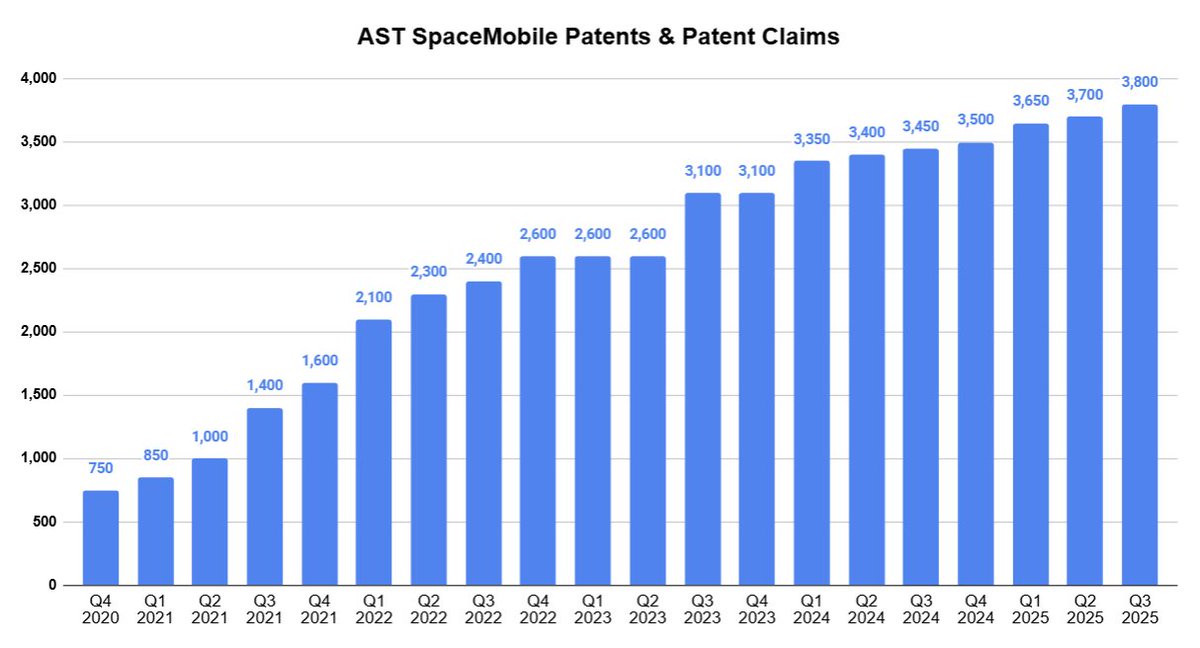
@spacanpanman @ASTS_Investors This may, furthermore, be double counting claims in different jurisdictions. None of this is to dismiss their technological moat; just to say that it's fine if you as a retail investor have identified only a couple of dozen patents.
English

@spacanpanman @ASTS_Investors AST have been diligently securing their technological moat, but when people wonder about the numbers in press releases vs how many patents you can find online: the 3,800 count is claims, and a typical patent (e.g., with USPTO) has some 20 claims. So let's call it 190 patents?
English

AST SPACEMOBILE'S TECHNOLOGY IS BACKED BY A HUGE PATENT PORTFOLIO
Across the years AST SpaceMobile have smartly protected their technology by filing patents.
At the latest earnings, they are now up to 3,800 patents & patents pending. 1,800 of these have been granted, which gives the company a strong moat.
The patents are insured with Lloyds of London, who will sue anyone who violates them, which could provide a future source of revenue.
$ASTS

English

@CatSE___ApeX___ @borjacueto Isn't the Airbus space division largely in Germany, around Lake Constance? No blue shading?
English

Fair & balanced thread.
Sovereignty is related to operational control, who has data access and where processing is.
I would argue EU can operate and use SpaceMobile satellites thanks to SatCo business construct and the bent-pipe architecture without owning satellites.
But EU owning a shell or two is certainly one very secure way to do it. Just not the most capital efficient way nor the fastest.
English
WB85 retweetledi

@thekookreport Along those lines: does an LTE modem tied to my falcon's foot count as "internet of things"?
English

@thekookreport was right in his spaces: satellite coverage isn’t about selling data from orbit by the gigabyte, but about the knowledge that your phone can send a text or call for help from anywhere.
That baseline service is insurance and should be priced accordingly. $asts 1/8
English