Sabitlenmiş Tweet
Brad Thomas
20.6K posts

Brad Thomas
@bradthomas
Wall Street Writer: Wide Moat Research and Seeking Alpha https://t.co/bZFNEw0bjp

United States Katılım Mayıs 2009
5K Takip Edilen21.6K Takipçiler

Beautifully said. Memorial Day is a powerful reminder that freedom is never free. We owe an immeasurable debt to the brave men and women who gave everything so future generations could live with liberty and opportunity. Their sacrifice should inspire gratitude, humility, and perspective in all of us. 🇺🇸
English

On this Memorial Day, I am reminded how eternally grateful I am to those who sacrificed their lives to preserve our independence and our democracy. The ultimate sacrifice to people they will never know.
We are incredibly fortunate to live in this amazing country at this remarkable time in history. We are the luckiest people of the last many thousands of years. Let’s keep our difficulties in perspective and profoundly thank and remember those that made now possible.
English

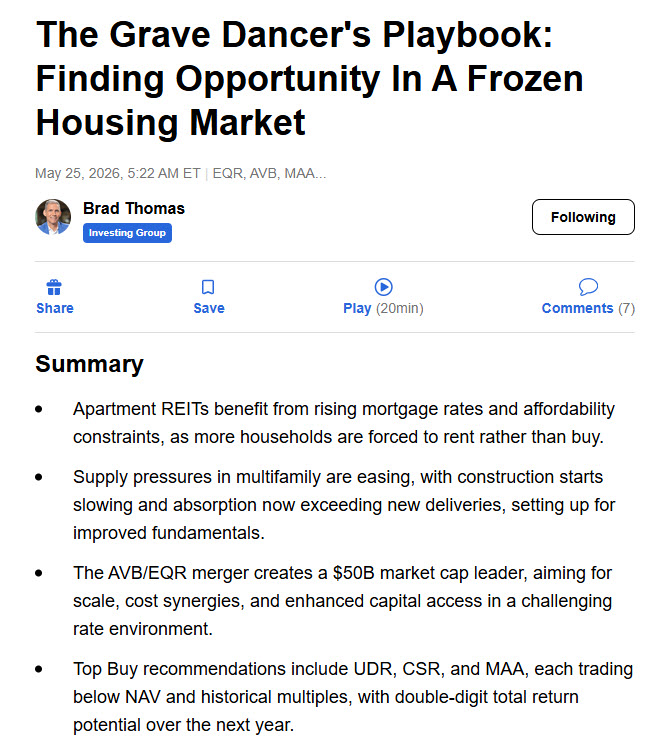
In my latest Seeking Alpha article, I explain:
• Why the “American Dream” is being delayed
• How apartment demand remains resilient
• Why slowing new supply matters
• The significance of the massive $AVB / $EQR merger
• And 3 Apartment REITs currently on my Buy List
As Sam Zell famously understood: discomfort creates opportunity.
Happy SWAN Investing.

English

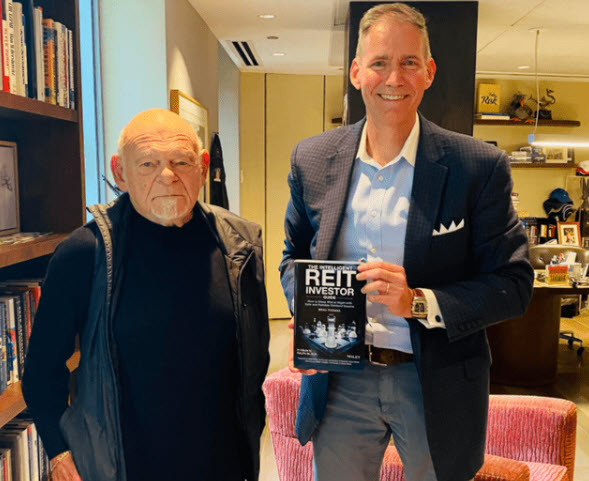
@Economyster Zell wrote a testimonial for The Intelligent REIT Investor, and when he passed away, I dedicated my book, REITs for Dummies, to him.

English

@marcuslemonis Wishing you and your family a meaningful Memorial Day as we remember and honor those who made the ultimate sacrifice for our freedoms.
English

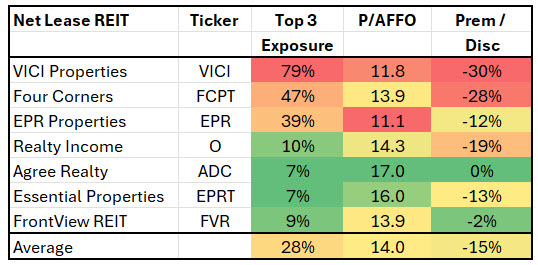
One of the most overlooked advantages in REIT investing is diversification.
The market is clearly rewarding diversified net lease REITs with stronger valuations while penalizing concentrated portfolios tied to a handful of tenants or industries.
Why?
Because diversification can reduce earnings volatility, strengthen balance sheets, lower cost of capital, and fuel more accretive long-term growth.
In my latest Wide Moat Research article, I explore $O's unmatched diversification and why $VICI, $FCPT, and $EPR trade at larger discounts.
Tenant concentration impacts valuation, and why diversification itself may be a competitive moat. Over the long run, diversification is not just defensive…it can become a powerful value-creation flywheel.
If you’re interested in learning more, sign up for the Wide Moat Daily...links in my bio.

English

Size can absolutely create bureaucracy, slower execution, and even pressure to pursue growth for growth’s sake. History is full of examples where large platforms destroyed shareholder value through poor capital allocation. General Growth + WeWork come to mind...
Some of the best long-term returns have indeed come from smaller, disciplined operators with local market expertise and the flexibility to move quickly when opportunities emerge.
That said, in capital-intensive sectors like REITs, scale can become a very powerful advantage when paired with disciplined management and a low cost of capital.
In my view, the key is not simply being bigger...it’s whether management allocates capital rationally while preserving balance sheet strength and operational efficiency. All the best
English

@bradthomas Scale absolutely matters, but size can also create bureaucracy, slower decision making, and pressure to deploy capital even when pricing doesn’t make sense. Some of the best returns in real estate have come from smaller, more nimble operators
English

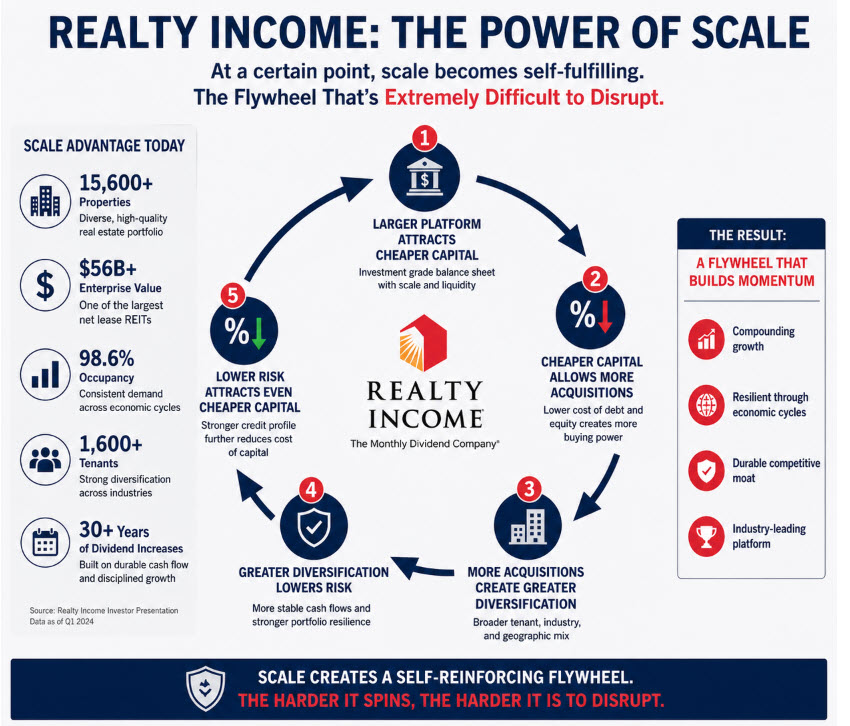
Many investors underestimate the power of scale in REIT investing. At a certain point, scale becomes self-reinforcing:
• Larger platforms attract cheaper capital
• Lower capital costs fuel more acquisitions
• More assets create greater diversification
• Greater diversification lowers risk
• Lower risk attracts even cheaper capital
That’s the flywheel and it’s one reason why companies like $O continue building durable competitive advantages over time.
I decided to write about that topic today because scale is often misunderstood, yet it may be one of the most important long-term moats in real estate investing.
If you’re interested in learning more, sign up for the Wide Moat Daily...links in my bio.

English

Many investors spend enormous energy searching for the next big winner while overlooking the behavioral side of investing.
Overtrading, emotional decision-making, and impatience often do far more damage than simply owning the “wrong” stock.
In many cases, the biggest edge is just having the discipline to let compounding work over long periods of time.
English

@bradthomas Seriously the best thing I've read in a while. Most returns are lost to overtrading, not bad picks.
English

The case for "Buy and Hold" Investing...
Behavioral finance researchers Brad Barber and Terrance Odean studied over 66,000 brokerage accounts and found that the investors who traded the most earned the worst returns.
• Market return: ~17.9% annually
• Most active traders: ~11.4% annually
That gap may not sound huge, but over decades, compounding turns it into a massive wealth difference.
The lesson: Successful investing is often less about finding the next hot stock and more about avoiding costly mistakes.
Patience. Discipline. Long-term ownership.
That’s how real wealth is built.
If you’re interested in learning more, sign up for the Wide Moat Daily...links in my bio.

English

@thetraderspro So true...many investors spend years searching for the next big winner while underestimating the power of simply owning quality businesses and letting time do the heavy lifting. In many cases, the real edge is behavioral discipline.
English

@bradthomas Turns out the hardest investing skill isn’t finding the next Nvidia. It’s sitting still long enough for compounding to actually work.
English

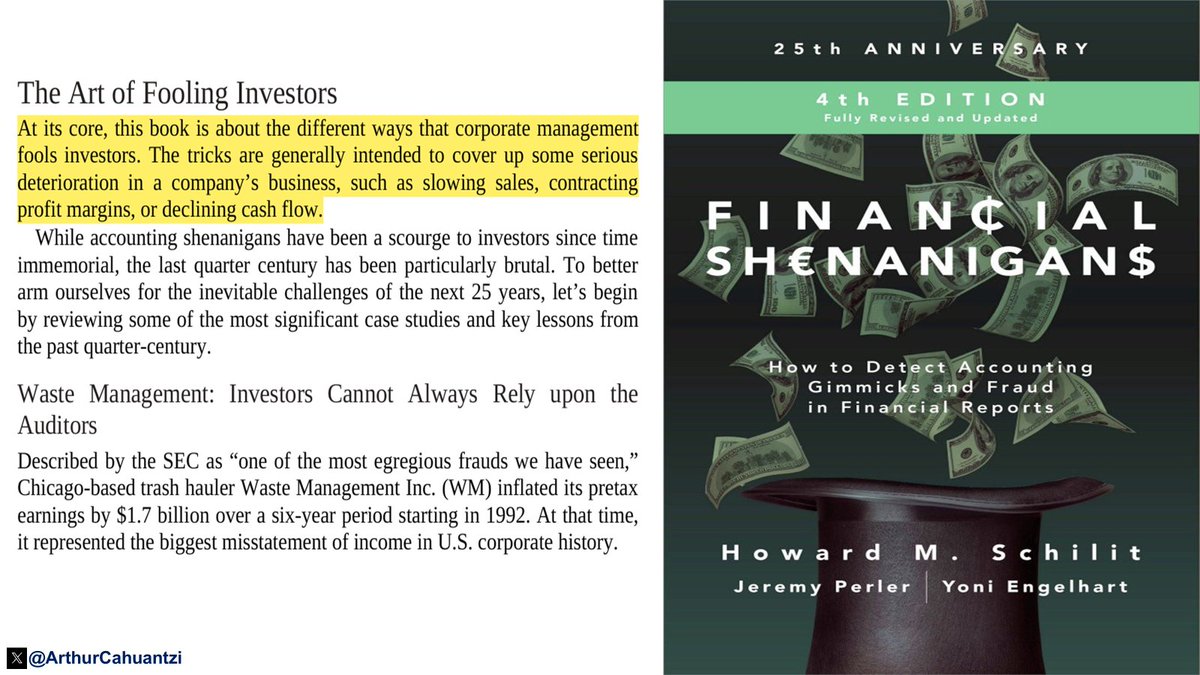
"At its core, this book is about the different ways that corporate management fools investors. The tricks are generally intended to cover up some serious deterioration in a company’s business, such as slowing sales, contracting profit margins, or declining cash flow." ↓:

Brad Thomas@bradthomas
One of the core lessons in this book (Quality of Earnings) is that earnings are an opinion, and cash is a fact. If profits are rising but cash isn’t following, something’s off. The best opportunities often come from seeing through the illusion first.
English

What would the "Grave Dancer" think of the $AVB + $EQR merger?
As I ponder the merger, I wonder how $EQR’s founder would view the transaction; after all, he was one of the architects of the modern REIT industry itself.
As I explained in my REITs for Dummies book, he helped popularize the REIT structure during the 1990s and transformed apartment ownership into an institutional, publicly traded asset class accessible to ordinary investors.
Known as “The Grave Dancer” for his willingness to buy distressed assets during periods of chaos and dislocation, he built $EQR into one of the most dominant apartment platforms in the country through disciplined capital allocation, opportunistic acquisitions, and relentless attention to balance sheet strength.
At its core, Zell’s investment philosophy revolved around scale, liquidity, and cost of capital advantages, precisely the same themes management is emphasizing in the $AVB / $EQR merger.
In many ways, this transaction feels very “Sam Zell-like.” He long believed that real estate ownership would increasingly consolidate into the hands of a few elite institutional operators with the lowest cost of capital and the strongest operating platforms.
He often argued that liquidity itself creates value, particularly during uncertain economic periods, and the proposed combination reflects that exact philosophy: bigger scale, broader diversification, stronger margins, and lower financing costs.
The multifamily business he helped institutionalize decades ago continues evolving toward larger, more sophisticated, and more capital-efficient platforms. If approved, the combined company would be a modern reflection of the consolidation trend that Zell helped pioneer throughout his extraordinary career.
(I'm finishing a deep dive Multifamily REIT article today for Seeking Alpha)

English

@MikeFritzell Absolutely. It sharpens your skepticism in the best way...turns earnings season from headline reading into investigative research.
English

It's a great book. Required reading for anyone trying to form a view on earnings results.
Brad Thomas@bradthomas
One of the core lessons in this book (Quality of Earnings) is that earnings are an opinion, and cash is a fact. If profits are rising but cash isn’t following, something’s off. The best opportunities often come from seeing through the illusion first.
English

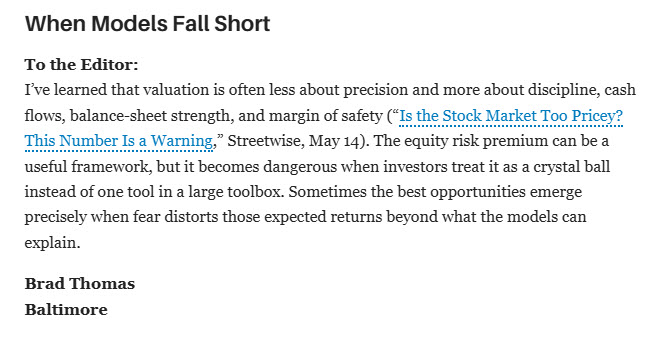
My Letter to the Editor at Barron's...
Working on an article this weekend related to "quality earnings" and a book I recently finished reading (Quality of Earnings) that showed that the biggest risks live in accounting choices: revenue timing, reserves, and one-time “adjustments.” Great investors don’t just read earnings...they interrogate them.

English