Rob Brooks

14.2K posts

Rob Brooks banner
Rob Brooks

Rob Brooks

@Brooks_Rob

Evolutionary biologist & author. What happens to #sex when evolved minds, old-fashioned #culture and new #tech collide? Read "Artificial Intimacy" out now.

robbrooks.net Katılım Ağustos 2009
2.8K Takip Edilen3.7K Takipçiler
Sabitlenmiş Tweet
Rob Brooks
Rob Brooks@Brooks_Rob·
Artificial Intimacy - a book trailer for people who remember dial-up modems.
English
4
6
32
0
Rob Brooks retweetledi
Daniel Sznycer
Daniel Sznycer@dsznycer·
Is shame maladaptive? A culturally constructed emotion? An adaptation that is part of human nature? And how would one know? 🔴 Cross-cultural evidence that shame is a defense against reputational damage pnas.org/doi/10.1073/pn…
Daniel Sznycer tweet media
English
2
9
23
5.1K
Rob Brooks retweetledi
Macken
Macken@MackenMurphy·
There's widespread concern that gender equality will leave successful women struggling to find partners. It makes sense: Women mostly want to "mate up" financially, and as women get richer, there are fewer men who are "up." But our experiment suggests we may not need to worry.
English
45
27
356
31.1K
Rob Brooks retweetledi
Steve Stewart-Williams
Steve Stewart-Williams@SteveStuWill·
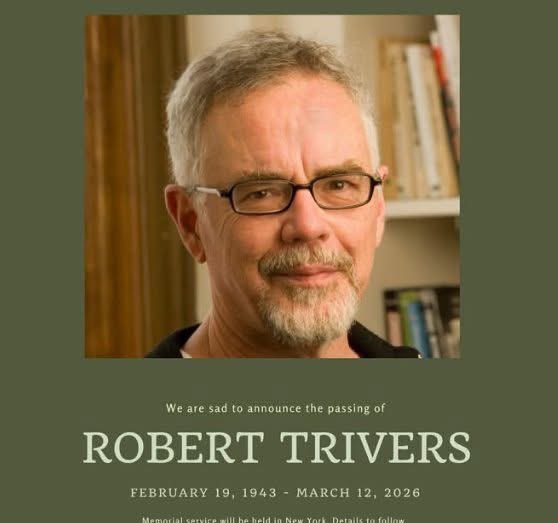
RIP Robert Trivers - the Einstein of evolutionary biology and one the greatest thinkers of our age. Among other things, Trivers came up with parental investment theory, reciprocal altruism theory, and parent-offspring conflict theory.
Steve Stewart-Williams tweet media
English
41
269
1.2K
201.2K
Rob Brooks
Rob Brooks@Brooks_Rob·
Great thread from @MackenMurphy on his/our experiment in @PNASNews manipulating gender inequality and testing changes in partnering preferences. Hope this advances an ancient scrap, bringing sense and nuance to an unnecessarily polarised issue.
Macken@MackenMurphy

Partner preferences for resources adapt to income and gender economic inequality. When women make more money than men, the sexes are equally inclined towards hypergamy. New from the Evolution Lab. (1/15)

English
0
4
14
1.7K
Rob Brooks
Rob Brooks@Brooks_Rob·
A Real Maternal AI Would Want You to Be Nicer - To Everyone Geoffrey Hinton reckons giving AI "maternal instincts" would compel it to care for humanity. Here, @AthenaAktipis & I use updated evolutionary views of parenting to argue for something ...better. open.substack.com/pub/robbrooks/…
English
0
0
3
207
Rob Brooks
Rob Brooks@Brooks_Rob·
“AI was moralized at levels comparable to GMOs and vaccines, technologies whose moral opposition has been studied for decades. It ranked above both. The sharpest spike came within weeks of ChatGPT's launch in late 2022.”
Michael Inzlicht@minzlicht

Ask a colleague why they refuse to use AI. They say it uses up all that water. You point out the water use is far smaller than some would have them believe. Then it's the hallucinations. You mention accuracy has improved dramatically. Then, finally: the process is the point. The struggle. The craft. The deeply human act of sitting with uncertainty. They're not reasoning. They're rationalizing their gut intuitions. My amazing student @vicoldemburgo, with Éloïse Côté, Reem Ayad, @yorl, Jason Plaks and I have a new preprint that explores this more thoroughly, called "The Moralization of Artificial Intelligence". We started by asking how moralized AI has become in public discourse. Analyzing 69,890 news headlines from 2018 to 2024, we found that AI was moralized at levels comparable to GMOs and vaccines, technologies whose moral opposition has been studied for decades. It ranked above both. The sharpest spike came within weeks of ChatGPT's launch in late 2022. When we surveyed representative samples of Americans, a majority of AI opponents said their views wouldn't change even if AI proved safe and beneficial. That's consequence insensitivity, the hallmark of moral conviction, not practical calculation. Across art, chatbots, legal tools, and romantic companions, AI moralization loaded onto a single latent factor. A global moral stance, dressed up in whatever practical language is available. The behavioral data make this concrete: a one standard deviation increase in moralization scores predicted a 42% drop in actual AI usage, even when it would have benefited that person personally. The conviction preceded the behavior by up to 573 days. The next time someone gives you three different reasons to oppose AI, each one dissolving under mild scrutiny, you're probably not watching someone think. You're watching someone feel. Preprint avaulable here: osf.io/preprints/psya…


English
1
0
0
260
Rob Brooks retweetledi
Mambo Italiano
Mambo Italiano@mamboitaliano__·
This is truly the most beautiful video I’ve seen lately So tender and heart-warming, yet it makes you stop and reflect, with a subtle touch of sadness We may have gained so much, but perhaps we’ve lost even more✨
English
451
6.2K
18K
918.4K
Will Lyster
Will Lyster@wlyster·
@lady_valor_07 I downloaded the photo and looked at the EXIF information and can clearly see that this photo was clearly taken on July 7 of 1977. You’re welcome.
Will Lyster tweet media
English
585
23
1.4K
149.7K
LadyValor
LadyValor@lady_valor_07·
Based on the entirety of this photograph, what is your best estimation of the year it was taken?
LadyValor tweet media
English
21K
294
5.1K
2M
Rob Brooks retweetledi
BURKOV
BURKOV@burkov·
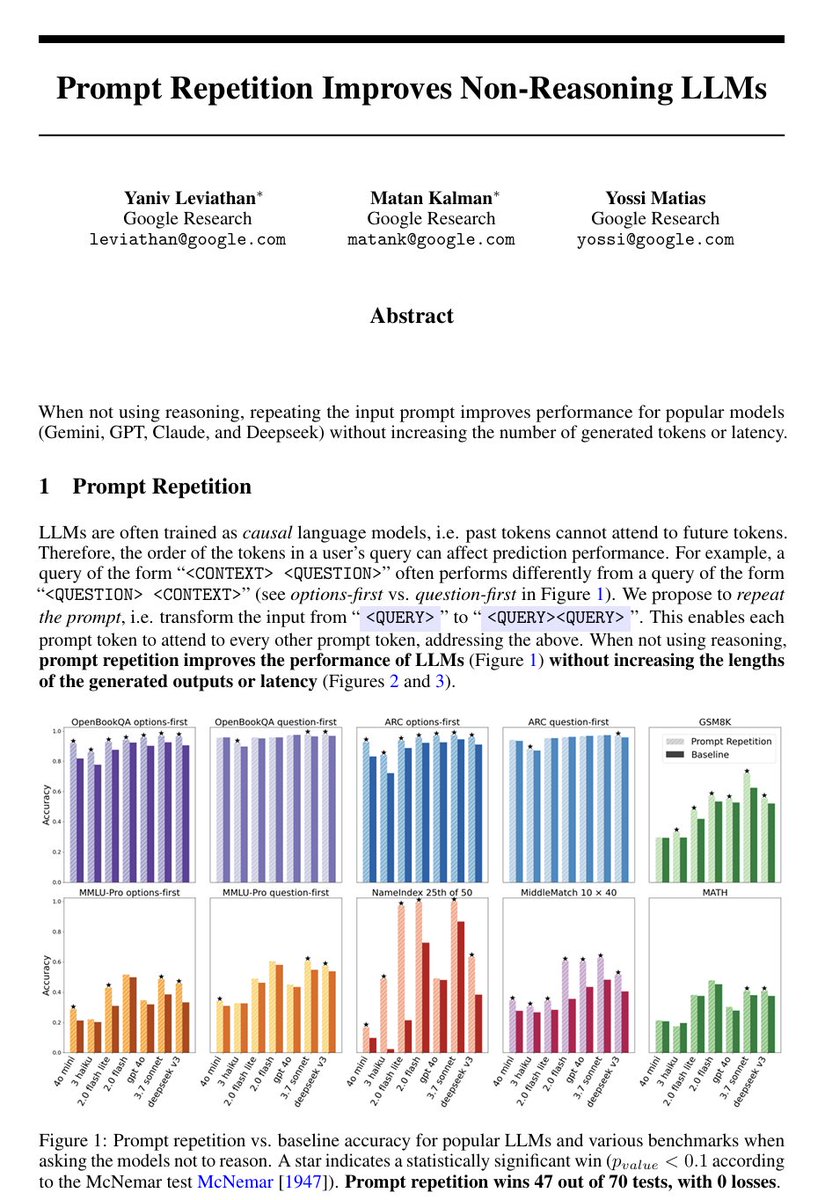
LLMs process text from left to right — each token can only look back at what came before it, never forward. This means that when you write a long prompt with context at the beginning and a question at the end, the model answers the question having "seen" the context, but the context tokens were generated without any awareness of what question was coming. This asymmetry is a basic structural property of how these models work. The paper asks what happens if you just send the prompt twice in a row, so that every part of the input gets a second pass where it can attend to every other part. The answer is that accuracy goes up across seven different benchmarks and seven different models (from the Gemini, ChatGPT, Claude, and DeepSeek series of LLMs), with no increase in the length of the model's output and no meaningful increase in response time — because processing the input is done in parallel by the hardware anyway. There are no new losses to compute, no finetuning, no clever prompt engineering beyond the repetition itself. The gap between this technique and doing nothing is sometimes small, sometimes large (one model went from 21% to 97% on a task involving finding a name in a list). If you are thinking about how to get better results from these models without paying for longer outputs or slower responses, that's a fairly concrete and low-effort finding. Read with AI tutor: chapterpal.com/s/1b15378b/pro… Get the PDF: arxiv.org/pdf/2512.14982
BURKOV tweet media
English
396
1.1K
11.6K
3M
Rob Brooks
Rob Brooks@Brooks_Rob·
Great to see the best experimental techniques being used to test effects of social media exposure. In news that will confirm a lot of people's priors, X's algorithm causes persistent swerves to the political right theconversation.com/a-few-weeks-of… via @ConversationEDU
English
0
0
1
61
Rob Brooks retweetledi
Gene Parmesan
Gene Parmesan@dsonoiki·
Tom Holland is dating a 29 year old There is a 3 month age gap between them—over 90 days. they were not even born in the same fiscal quarter (June 1, 1996 vs. September 1, 1996) Hollywood normalizes this
Gene Parmesan tweet mediaGene Parmesan tweet media
English
2K
4.1K
135.3K
6.5M