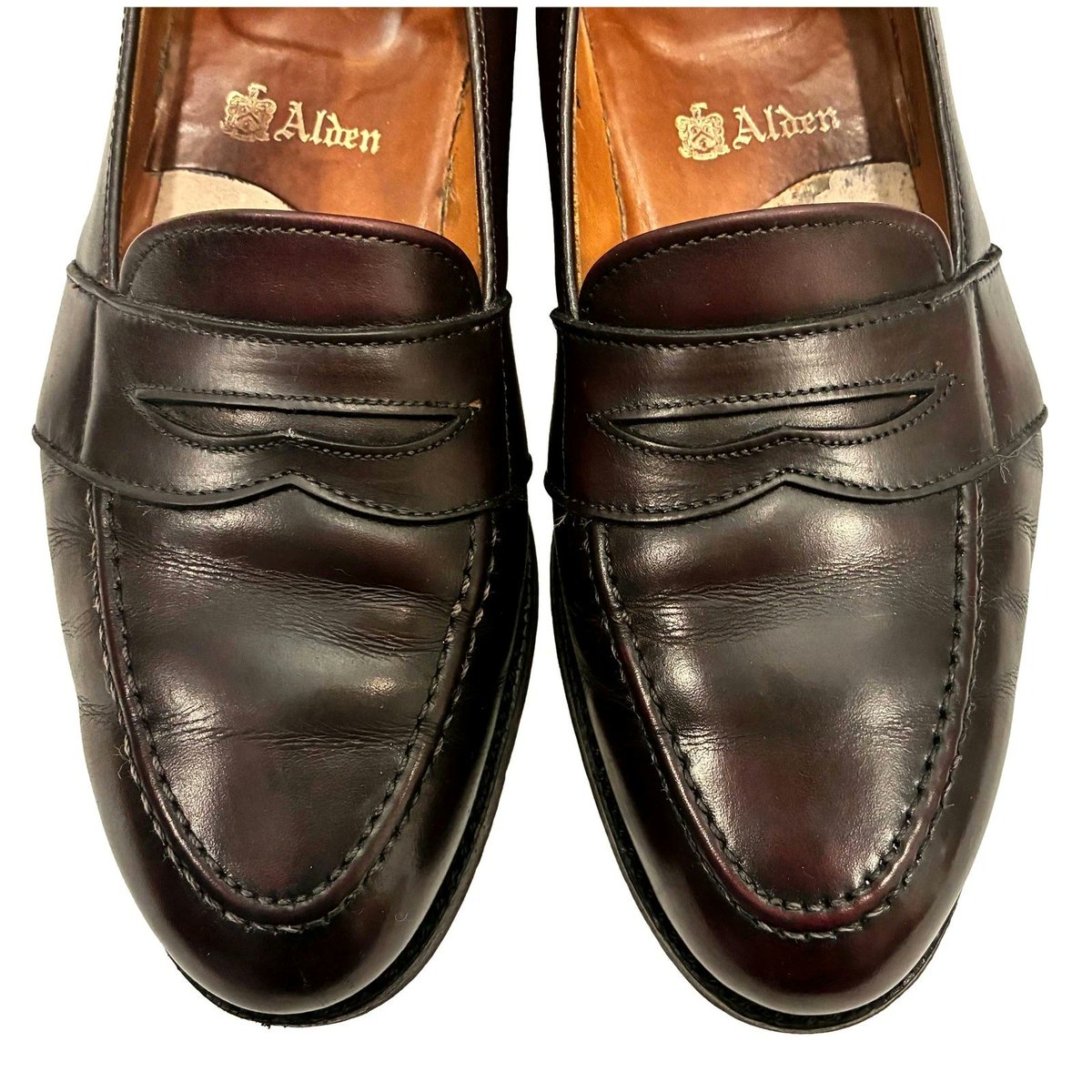
Seeing a lot of people talk about summer penny loafers and recommending GH Bass. Although iconic, most Bass Weejuns are poorly made. You can see the difference in the two photos below.
On the left, we have an old pair of GH Bass Weejuns. On the right, we have a similarly old pair of Aldens.
The Weejuns are made from a type of material known as corrected grain leather, which is a lower-quality hide that arrives at the tannery with scars and marks that naturally developed over the animal's lifetime. Since you need an even surface for shoes, tanneries will sand the surface to remove blemishes, then apply a chemical coating. The problem is that the coating will age poorly over time. In the photo here, they've developed cloudy creases. In some cases, the coating can flake off.
On the other hand, Alden uses full-grain leather, which means the leather retains its natural surface. They are also careful in how they place the pattern pieces onto the hide and subsequently cut the various pieces to produce a shoe. This way, the creases are finer and less pronounced.
Of course, Alden is about 7x more expensive than Weejun, but they are not the only company that uses full-grain leather. A basic Bass Weejun will run you about $175. Meermin's full-grain leather loafers are $230 — just $55 more
Why spend this extra money? Because after a year or two, you will grow dissatisfied with how your Weejuns look. Then you will throw them away and buy something new, only to repeat the process.
On the other hand, if you buy loafers made from higher-quality materials, you will grow fond of the patina that they've developed. Thus, you will splurge on a resole, allowing you to grow ever fonder of your shoes, repairing them as needed, and keeping the same pair of shoes for many decades.
IMO, it's always better to buy less, but buy better. Consider what you really need and then figure out how things are made. Use this information to identify reliable brands and retailers. This is a much better way to shop than to say "The Row is popular right now, so I should buy that" (using the "The Row" here as just a stand-in for whatever seems to be hot at the moment — no shade to them).
The machine that built the chip in this video should mass-humble every human who's ever lived.
ASML's latest EUV lithography system costs $370 million, weighs 180 tons, and requires three Boeing 747s to deliver. It contains over 100,000 individual parts from 5,100 suppliers across 14 countries. It shoots 100,000 molten tin droplets per second with a laser, superheating each one past the temperature of the sun's surface to generate light at a wavelength so short that no natural material on Earth can focus it.
So they had to invent new mirrors. Each one is polished with 100 alternating layers of molybdenum and silicon. The surface tolerance is so extreme that if you scaled a single mirror up to the size of Germany, the tallest imperfection would be 1 millimeter.
Those mirrors took 20 years to develop. The company that makes them, Zeiss, had to build entirely new metrology tools just to confirm the mirrors were flat enough, because no existing measurement instrument on Earth could verify the precision they needed.
The machine prints features at 2 nanometers. That's roughly 10 atoms wide. A human hair is 80,000 nanometers. A red blood cell is 7,000. A single COVID virus particle is 100. These machines are etching functional circuits 50 times smaller than a virus.
TSMC is now mass producing 2nm chips in a Kaohsiung fab so large the cleanroom is twice the size of any competitor's. Each 2nm wafer costs $30,000 to produce. The entire 2026 production run was booked before a single chip shipped. Apple, NVIDIA, AMD, and Qualcomm all reserved capacity years in advance. TSMC is spending $28.6 billion just to build enough fabs to meet demand for this one node.
The chip that comes out of this process is smaller than a fingernail, runs on less power than a light bulb, and contains transistors that wrap gates around nanosheets of silicon only a few atoms thick.
The raw material it started as was sand. The sand cost a fraction of a penny. The civilization that processed it into this started by banging rocks together.