Aashish Rana

1.8K posts

Aashish Rana

Aashish Rana

@building_agents

AI Engineer with 4+ years building production ML systems

Katılım Temmuz 2022
71 Takip Edilen136 Takipçiler
Aashish Rana
Aashish Rana@building_agents·
@arpit_bhayani The biggest challenge in building AI first tool i found , is as the new sophisticated technology is coming up everyday , how to integrate those technology without rewriting the whole code from scratch.
English
0
0
1
1K
Arpit Bhayani
Arpit Bhayani@arpit_bhayani·
Now that I am working on full-fledged AI systems at Razorpay and building them from the ground up, two things are pretty clear... 1. The workflow of AI systems is genuinely different. You have to think AI first from the start - how execution flows, how skills are composed and invoked, sub-agent orchestration, active and passive evals, etc. The only way to develop that intuition is to build a lot of prototypes and know SDKs and patterns inside out. Reading about it does not get you there. 2. System design and low-level design are more crucial than ever. The harness around these systems demands serious system design, no exaggeration here. Features like pause and resume workflows, serving, checkpoints, pipelines, sync async invocations, observability, cost tracking, versioning, rate limiting, quota management - just to make your long-running executions work without hiccups at any scale is a super interesting challenge. Apart from this, the importance of low-level design is very high because of extensibility, and over-abstraction - that we all joke about - is actually super critical. Think of external systems that you connect to for your workflows, downstream systems that need to interface and fall back from one system to another, etc. To be honest, I am not as AI-pilled as some of the other folks in the org, but I am getting there :) And it has been an insane learning curve. But yes, building production AI applications is so much fun. There is a lot to learn. That part never changes.
English
46
78
1.5K
69K
Aashish Rana
Aashish Rana@building_agents·
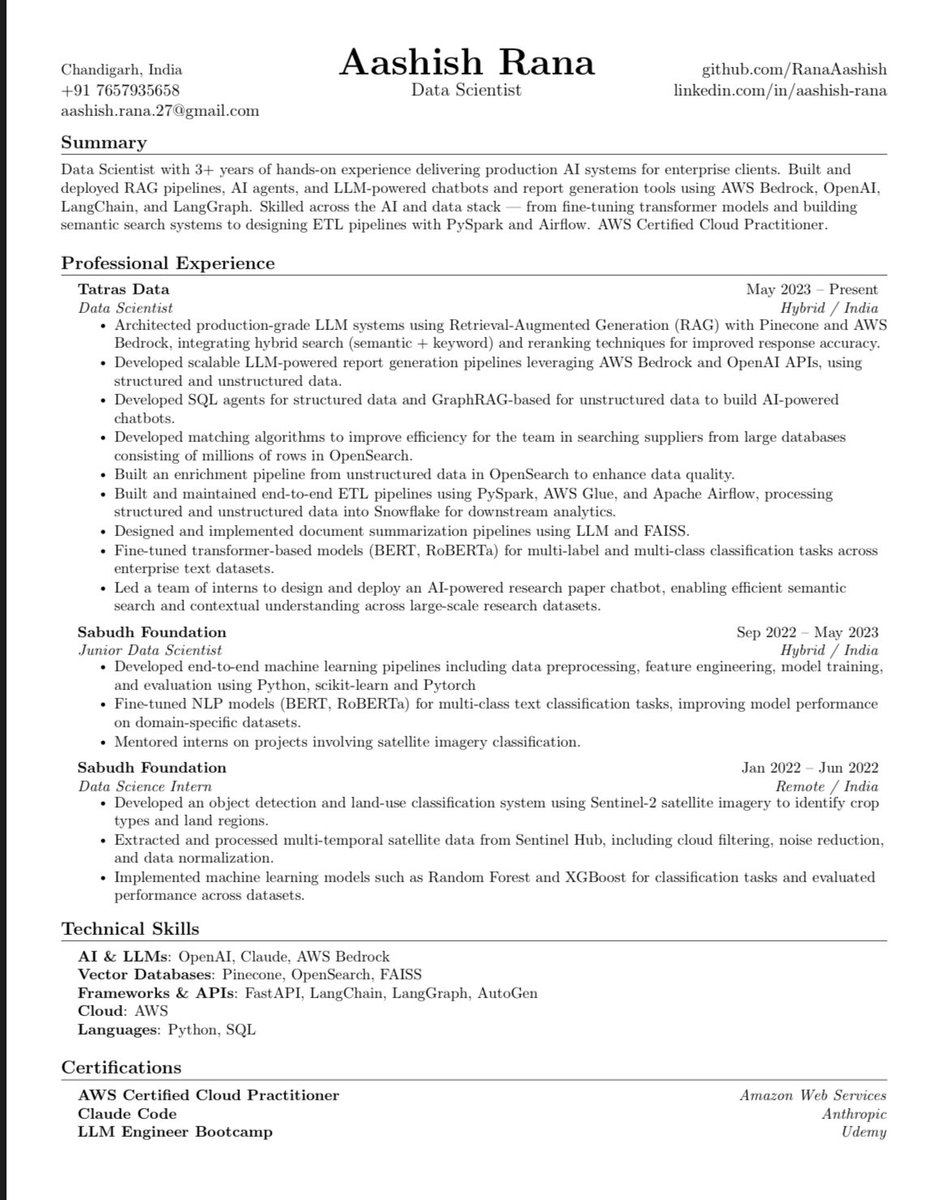
@WhoShivaisnot Quiet interesting! Here is my CV , let me know what you think about it
Aashish Rana tweet media
English
1
0
1
19
The Finder
The Finder@WhoShivaisnot·
🚀 #Remote Hiring a couple of Engineering Leads -GenAI platform and customer-facing agentic systems. 🫳 This is a hands-on leadership role: 6-10 years Join Agentic AI team as an Engineering Lead - you will own the execution, quality, and scalability of the GenAI platform and customer-facing agentic systems. This is a hands-on leadership role at the intersection of backend engineering, distributed systems, and GenAI infrastructure. You will lead engineers building core platform primitives such as agent orchestration, RAG pipelines, LLM integrations, and observability systems. If that’s you, let’s talk.
English
1
0
9
575
Harrison Chase
Harrison Chase@hwchase17·
I’m going to build a bunch of deepagents examples (using deepagent deploy) over the next few days What examples would people want to see?
English
89
9
220
26.8K
Jahir Sheikh
Jahir Sheikh@jahirsheikh8·
As an AI Infrastructure Engineer. Please learn: - GPU/VRAM fundamentals, quantization & batching - vLLM / TensorRT-LLM / inference optimization - KV caching, speculative decoding & token throughput - Distributed training basics (DDP/FSDP/DeepSpeed) - Model serving & autoscaling - Vector DB retrieval pipelines - Prompt caching & cost optimization - Observability for LLM apps This is what production AI teams actually care about.
English
68
416
2.8K
230.8K
richard
richard@richardzphotoz·
Building your own personal brand is single handedly the most powerful way to change your life in less than a year.
English
120
141
2.4K
71.7K
Aashish Rana
Aashish Rana@building_agents·
@rowancheung So do you create media from the start of the art video models
English
0
0
0
76
Rowan Cheung
Rowan Cheung@rowancheung·
I'm HIRING 5 more people to help me build the future of AI media. The Rundown is closing in on 3M active readers, and the demand is far outpacing what we can handle. $2,000 referral bonus if you help us find someone we hire full-time. Open roles: > Head of Content -- lead the editorial team that reaches millions every day > Head of Sales -- run a scrappy sales team and revenue strategy across our media properties > Community Lead -- turn our 3M+ readership into the "Reddit for AI use cases" > Ad Creative Strategist -- research and ship ad creatives that hook the next million AI-curious readers > Branded Content Editor -- turn brands into stories our readers actually want to read What we're looking for among all roles: > Deep AI curiosity (you've already replaced part of your workflow with agents) > Unreasonably biased toward action > Taste sharp enough to spot great work (and AI slop) All roles are fully remote. Link below to apply!
Rowan Cheung@rowancheung

I'm HIRING 7 exceptional people and paying a $2,000 referral bonus for each We’ve bootstrapped The Rundown to $10M+ annual revenue and need to scale faster We’re tackling one of the biggest problems of the decade: helping 1B workers turn AI into a superpower Open roles: -Mobile Developer -GM, AI Univeristy -Head of Growth -Strategic Partnerships Lead -Product Marketing -Platform Designer -Thumbnail Designer We move faster than any company you've worked at. Competitive comp with performance-based scaling as we grow Every role requires deep taste and AI fluency. You'll be expected to command an army of AI agents working underneath you. Fully remote. Apply with the link below.

English
58
12
232
118.2K
Eleftheria Batsou
Eleftheria Batsou@BatsouElef·
How can I help you today? And no, I cannot: - Give you money - Buy you a laptop - Find you an internship/job - Find you an investor/co-founder
English
59
1
57
3.3K
Aashish Rana retweetledi
Aashish Rana
Aashish Rana@building_agents·
I built a SQL Agent. Here are 5 mistakes I made (so you don’t have to): 1. Ignoring the use-case I jumped straight into building. Big mistake. First ask: - Who are the users? - Internal or external? - What will they actually ask? Clarity > complexity. 2. Starting with complex questions I tried to solve advanced queries first. Wrong move. Pick the simplest query → make it perfect → then scale. 3. Poor schema descriptions I gave raw tables to the agent. No context. Result? Bad queries. Fix: - clear table names - descriptive column names - explain relationships Your schema = your prompt. 4. Using large datasets too early I jumped into big data. Big mistake. Start small. Let the agent: - learn patterns - fail fast - discover limits Then scale. 5. Focusing on response format over correctness I obsessed over: - pretty output - structured responses But missed the core: Is the SQL query even correct? Correctness first. Formatting later.
English
0
0
0
44
Aashish Rana
Aashish Rana@building_agents·
If You want to have thorough understanding of LLM Streaming, this is the nice paper to read. Paper Name : From Static Inference to Dynamic Interaction: A Survey of Streaming Large Language Models arxiv.org/abs/2603.04592
English
0
0
1
52
Aashish Rana
Aashish Rana@building_agents·
3. Stream JSON -> Render UI (better) - Ask LLM for structured JSON - Include content + style info - Parse incrementally using partial JSON parsing Then: Convert JSON -> HTML
English
0
0
0
21
Aashish Rana
Aashish Rana@building_agents·
2. Stream in Markdown -> Convert to HTML (better) Instead of HTML: - Stream markdown - Convert block-by-block (not token-by-token) Use Library like markdown-it to parse partial markdown block-by-block & convert it to HTML Markdown is way easier to parse incrementally than HTML
English
1
0
0
21
Aashish Rana
Aashish Rana@building_agents·
Recently i got challenged while streaming structured responses from LLM. I was sending huge context along with my prompts which contains HTML instructions (instructions to provide response in certain HTML schema) But during streaming, the HTML structure kept breaking.
English
1
0
0
39
Aashish Rana
Aashish Rana@building_agents·
What Is Data Validation? Data validation ensures data values meet rules while the program runs.Often used when receiving input (e.g., APIs, user input) This actually enforces correctness at runtime — unlike type checking. Tools like pydantic validate both type and value constraints (e.g., email format, string length, JSON structure). from pydantic import BaseModel class User(BaseModel): name: str age: int user = User(name="Aashish", age="25") print(user) Output: name='Aashish' age=25 Pydantic automatically converts string "25" to int. Now below is invalid case: user = User(name="Aashish", age="twenty") Output: ValidationError: age value is not a valid integer
English
0
0
0
21
Aashish Rana
Aashish Rana@building_agents·
What Is Type Checking? Type checking is when a tool verifies type hints before your program runs. Tools like mypy use type information to catch mistakes early — e.g., passing a string to a function that expects an int. It’s a static check — no runtime cost, but only works with hints provided. def add(a: int, b: int) -> int: return a + b result = add("5", "10") if you run above function it will show this. Argument 1 to "add" has incompatible type "str"; expected "int"
English
1
0
0
22
Aashish Rana
Aashish Rana@building_agents·
You need to understand the difference between Type Hinting, Type Checking, and Data Validation - especially when working with LLMs.
English
1
0
0
26