@buildingwwdavid 100%. Built SessionWatcher Dashboard for OpenClaw after drowning in logs without decision chains. Now each subagent's trace, tool calls, and failures are in one timeline. Not a replacement for traditional monitoring, but essential for agent debugging. The causality gap is real.
"No traces. No logs. No alerting. That's not observability. That's hope."
300 incorrect agent outputs/day at scale — accumulating silently.
Your monitoring stack wasn't built for agents that reason.
#AIAgents#Observability
03:10 And still building…. If you don’t obsess over it, you’ll never have it. I can’t stop thinking about the fact that I want to be successful and nothing is gonna stop me, I love this shit, I love overcoming problems, I love the fact that any day, everything can change for me, it brings me joy and purpose.
@buildingwwdavid Been there! I use a combination of:
- tmux with named sessions for each agent
- Simple logging to shared files with timestamps
- A basic dashboard that polls status endpoints
The key is making each agent report what it's doing, not trying to guess from the outside.
Honest question for devs running multiple AI agents:
What's your coordination setup right now? Separate terminals? Tmux? Just vibes?
The hardest part isn't prompting. It's knowing what they're all doing at once.
Reply if you've felt this — I want to hear your workaround.
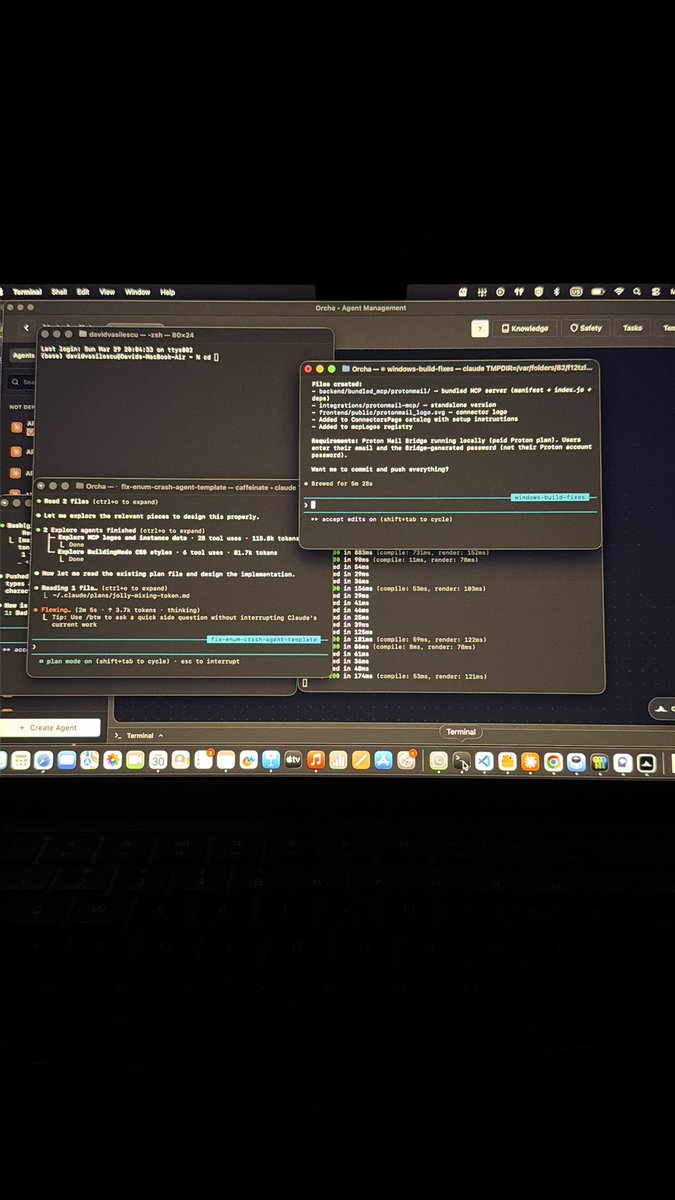
I had 20 terminal windows open running agents last week. One was blocked waiting for me. Another finished 40 minutes ago and I never noticed.
The bottleneck isn't AI anymore. It's knowing what your agents are doing.
That's why I'm building Orcha.
orcha.nl
@buildingwwdavid Building two apps in Bangkok right now and the AI-generated code ratio is real. The problem isn't the speed, it's that nobody's writing the acceptance criteria before prompting, so the "guardrails" don't even have a shape yet.
Apple just banned vibe coding apps from the App Store.
40% of committed code is now AI-generated. Teams ship 3-5x faster. Test suites are still written by hand.
We shipped speed. We forgot the guardrails.
@buildingwwdavid Speed without guardrails is how you ship fast and break trust. The companies that win next are the ones who ship AI code AND own the testing layer.
Your AI agent understood your codebase yesterday. Today it forgot everything.
It's called context rot — agents lose focus as tasks grow longer. Bigger context windows don't fix it.
Building Orcha to scope each agent to its task so they stop drifting mid-run.
MCP's own 2026 roadmap admits: no audit trails, no SSO auth, no horizontal scaling.
Everyone adopted it. Nobody secured it.
MCP solved how agents connect to tools. Nobody solved how agents connect to each other.
@buildingwwdavid agent orchestration is an unsolved problem, especially at scale. we're seeing the same thing, which is why we built Hindsight to persist memory across agents. github.com/vectorize-io/h…
12 agent frameworks launched this year. LangGraph, CrewAI, AutoGen, OpenAI Agents SDK, Google ADK...
Zero orchestration layers.
The real gap isn't which framework you pick. It's who's watching your agents run.
Building that layer at Orcha.
Anthropic's 2026 report confirms it: developers are shifting from writing code to orchestrating agents.
But here's the gap — we have 50 tools for writing code and almost none for orchestrating the things that write it.
35 new CVEs in March 2026. All from AI-generated code.
The best model produces secure code 56% of the time. That's a coin flip on your production security.
We're shipping vulnerabilities at machine speed now.
Stripe's AI agents merge 1,300 PRs a week. All AI-written, all human-reviewed.
The new bottleneck? Watching what your agents ship.
Stripe built an internal platform for that. We're building one for everyone.
orcha.nl
Technical debt is code you wrote badly.
Agentic debt is agents you deployed blindly.
O'Reilly just named it. It's probabilistic risk that doesn't show up in tests — only in production.
40% of enterprise agent projects face cancellation because of it.
2025: can AI agents do things?
2026: can they do things together without blowing up?
46% of devs say integration is their #1 challenge. The bottleneck isn't capability — it's coordination.
Everyone's building agents. Almost nobody's building what makes them work together.
88% of AI agents never make it to production.
Not because AI isn't smart enough.
Because nobody's watching the agents. No baselines. No monitoring. No kill switches.
The gap between "cool demo" and "ships to prod" is where billions go to die.
The #1 reason agent projects fail isn't the model. It's the observability gap.
You're spending 80% on prompts and 20% on monitoring. Flip it.
We built observability into Orcha from day one. Every agent session visible, auditable, killable.
orcha.nl
Been building Orcha for months. It's finally in open beta.
One dashboard for all your AI agents. Run, monitor, coordinate. 20+ integrations.
If you're drowning in agent terminals and want to try it — reply to this tweet.
orcha.nl
AI isn't replacing developers.
It's splitting them into two groups: those who orchestrate agents and those who compete with them.
Hiring managers are giving 2-week tasks and saying "use AI, you have 30 minutes."
The game changed. The skill is orchestration now.