Chris Dankowski

8.1K posts

Chris Dankowski banner
Chris Dankowski

Chris Dankowski

@cdankowski

Sales & AI Strategist at @Salesloft | Replacing Siloed Systems with Autonomous Engines | Helping Founders Scale Without the Headcount

Pflugerville, TX Katılım Şubat 2011
915 Takip Edilen2.6K Takipçiler
Sabitlenmiş Tweet
Chris Dankowski
Chris Dankowski@cdankowski·
I worked with a woman at HubSpot who was an AE there for 10 years. She easily could have moved into management but she didn't want to because she absolutely crushed her role due to having a super dialed in process. One of the main contributors to her success was being able to clearly determine what was real and what wasn't in her pipeline. This is one of the things she'd do to pressure test her Opps to gain that clarity. 🧵
English
74
186
3.1K
718.2K
Chris Dankowski
Chris Dankowski@cdankowski·
Before your first sales hire, answer this one question:Can I hand this person a document on day 1 that tells them exactly what to say, who to target, and how to handle objections?If not, you're not ready to hire. You're ready to build.
English
0
0
4
62
Chris Dankowski
Chris Dankowski@cdankowski·
People stay in sales past their expiration date because it's all they know. You have transferable skills. You just have a branding problem.
GIF
English
1
0
1
33
Chris Dankowski
Chris Dankowski@cdankowski·
The majority of tech companies aren’t rocket ships and unicorns. They’re wannabes with no product-market fit. Stop blaming yourself for missing quota in a broken system. dankow.ski/leave-sales
English
0
1
2
58
Chris Dankowski
Chris Dankowski@cdankowski·
I don't want to sell anything, to anyone, ever again, as long as I live. If you've said this to yourself recently, it's time to build an exit strategy. dankow.ski/leave-sales
English
0
0
0
64
Chris Dankowski
Chris Dankowski@cdankowski·
The best discovery calls feel like conversations, not interrogations. That means you need to walk in with hypotheses, not just questions. Here's my 5-minute pre-call prep using any LLM: Prompt 1 — Context Dump: "I'm an AE selling [your product category] to [prospect's title] at [company]. The company is in [industry], has [X employees], and recently [trigger event if you have one]. My product helps with [core value prop]. Based on this, what are the 3 most likely business challenges this person faces that I could tie back to?" Prompt 2 — Question Generator: "Now give me 5 discovery questions that would help me test whether these challenges are real — without sounding like I'm reading from a script. Make them conversational." Prompt 3 — Objection Prep: "What are the 2 most likely objections this person will raise? For each one, give me a response that acknowledges their concern first, then reframes it." Print it out. Walk into the call with three hypotheses, five questions, and two objection responses. That's not winging it. That's engineering your prep.
Chris Dankowski tweet media
English
0
0
0
58
Chris Dankowski
Chris Dankowski@cdankowski·
Prompt I keep giving founders:"I've closed [X] deals. Ask me questions to extract: how I found buyers, what I said, what objections came up, why deals closed. Then turn it into a repeatable framework." Do this before the hire. Not after.
English
0
0
2
181
Chris Dankowski
Chris Dankowski@cdankowski·
Here's what most founders don't realize until it's too late: The goal isn't to hire people who can sell. The goal is to build a system that generates revenue — and then hire people to run it. Those are completely different problems. One requires a rockstar. One requires an operator. Rockstars are expensive, unpredictable, and leave when a better offer shows up. Operators are scalable, coachable, and build on top of what you give them. The founders who scale sales efficiently aren't the ones who found a magic VP. They're the ones who built an autonomous revenue system first — and hired people to accelerate it. What does an autonomous revenue system actually look like? Signal-based prospecting — The system identifies buyers based on behavior, not cold lists. Job postings, tech stack changes, funding events, hiring signals. Monitored continuously. Automated outbound — Personalized at scale. Not "Hey {FirstName}" personalization. Context-relevant outreach that references a specific trigger. Pipeline intelligence — The system tells you which deals are at risk before they slip. Actual signals: response patterns, engagement gaps, stakeholder coverage holes. Playbook-driven conversations — Every rep follows the same proven framework. Not because you micromanage, but because the framework is documented and trained on. You can get 80% of the way there before you make your first hire. Prompt to start: "I want to build a signal-based prospecting system for my B2B company. My ICP is [X]. Help me identify the top 5 behavioral signals that predict purchase intent, where to source that data, and how to build an automated alert workflow using [tools I have]." Your first sales hire should step into a system — not build one from scratch. Give them the machine. Watch them run it.
Chris Dankowski tweet media
English
0
0
0
86
Chris Dankowski
Chris Dankowski@cdankowski·
"We just need to find the right salesperson."That's what founders say before they understand their real problem is infrastructure.
English
0
0
1
76
Chris Dankowski
Chris Dankowski@cdankowski·
I've talked to a lot of founders in the last year. The pattern I keep seeing: founder closes 10-15 deals on relationships and hustle. Decides it's time to hire. Brings in a VP of Sales or an AE. Nine months later, results are bad, relationship is strained, and the founder is questioning whether they even want to build a sales team. Here's what went wrong. The founder confused their sales ability with a repeatable sales motion. Those are not the same thing. Founders sell through trust, vision, and authority. They don't have to earn the right to talk to a decision maker — they ARE the decision maker calling another decision maker. Your first sales hire doesn't have that. They're starting from zero. And if you haven't documented the motion that actually works, they're building a plane while flying it — on your timeline and your budget. The uncomfortable truth: the failure that looks like "bad hire" is almost always "no infrastructure." Before you post that job req, ask yourself: Can I write down exactly what I say on a first call? Do I know which companies are most likely to buy, based on something observable — not just feel? Is there a documented sequence for reaching a cold prospect? Is there a playbook for handling the top 5 objections? If the answer to any of these is no, you're not ready to hire. You're ready to build. Prompt: "I'm a founder who has personally closed [X] deals. Help me interview myself to extract my sales process. Ask me questions about my best deals: how I found them, what I said, what objections came up, and what made them close. Then synthesize it into a written sales playbook." Build the playbook first. Hire someone to run it.
Chris Dankowski tweet media
English
0
0
0
106
Chris Dankowski
Chris Dankowski@cdankowski·
Single-threaded deals die. Deals with 3+ stakeholders close at 2-3x the rate. But sending the same email to 5 people isn't multi-threading. It's spamming. For each stakeholder: "I'm engaged with [primary contact]. Now I need [this title]. What do they care about? Write a 60-word message that speaks to THEIR priorities, not mine." AI gives you the structure. You add the human nuance.
English
0
0
0
91
Chris Dankowski
Chris Dankowski@cdankowski·
Single-threaded deals die. The data is clear: deals with 3+ stakeholders engaged close at 2-3x the rate of single-threaded ones. But most reps multi-thread the wrong way — sending the same generic email to five people at the same company. Here's how AI helps you personalize at scale: Step 1: Identify 3-4 stakeholders in your deal. Get their titles and, if possible, their LinkedIn bios. Step 2: For each person, use this prompt: "I'm selling [product] to [company]. I'm already engaged with [primary contact's title]. Now I need to engage [this person's title]. Based on their role, what do they most likely care about? What would make them want to take a meeting? Write me a 60-word outreach message that: (1) references the existing conversation without name-dropping awkwardly, (2) speaks to THEIR priorities not mine, and (3) makes the CTA specific to their role." Step 3: Review and adjust. The LLM gives you the structure. You add the nuance — the specific detail from a call, the industry context, the human touch. Multi-threading isn't about volume. It's about speaking each person's language. AI helps you do that without spending an hour per email.
Chris Dankowski tweet media
English
0
0
2
155
Chris Dankowski
Chris Dankowski@cdankowski·
If your ICP is "mid-market SaaS, 50-500 employees" — that's not an ICP. That's a demographic mood board. Signals. Behavior. Buying moments.
English
1
0
5
313
Chris Dankowski
Chris Dankowski@cdankowski·
Most reps think career = ladder. BDR → AE → Manager → Director. The best careers aren't ladders. They're architectures. Foundation: core selling skills Structure: industry expertise + network Design: the unique combo that makes you irreplaceable Prompt: "I'm a [role] with [X years] in [industry]. Help me identify: skills to build in 12 months, experiences to seek even without a promotion, and what makes me unique vs. 1,000 others with my title." Stop climbing. Start building.
English
0
0
2
208
Chris Dankowski
Chris Dankowski@cdankowski·
Most founders make their first sales hire wrong. Not because they picked the wrong person. Because they hired before they built the machine. Here's what actually happens: you close the first 10-15 deals yourself. Mostly on founder relationships, warm intros, and sheer hustle. You think: "I just need someone to do what I'm doing at scale." So you hire a salesperson. Or worse — a VP of Sales. Six months later, they've missed every number and you're questioning whether they're the wrong hire or whether something else is broken. It's almost always something else. The problem: you don't have a repeatable sales motion. You have founder magic. And founder magic doesn't transfer. Before you make that first hire — before you even write the job description — you need three things: 1. A defined ICP with real signal data (not gut feel demographics) 2. A repeatable outbound motion that doesn't depend on you being in the room 3. A documented playbook: what to say, when to say it, how to handle objections The good news: you can build all three before you hire anyone. With AI, you can do it faster than you think. Try this prompt in any LLM: "I'm a founder preparing to make my first sales hire. I sell [product] to [ICP]. I've closed [X] deals, mostly through [channel]. Help me reverse-engineer what I'm doing intuitively into a repeatable sales playbook. Ask me questions to extract the process." The output isn't the playbook. The conversation is. Your first sales hire should accelerate a system — not build one from scratch. If they're building from scratch, they'll fail. And you'll blame the hire.
Chris Dankowski tweet media
English
0
0
0
215
Chris Dankowski
Chris Dankowski@cdankowski·
"Just checking in" is the sales equivalent of "we need to talk." It triggers the same reaction: avoidance. Here's a framework for writing follow-ups that actually get replies — and how to use AI to build them fast: Prompt: "I'm following up with a prospect who went dark after [specific stage — e.g., 'a demo where they seemed engaged']. Their role is [title] at [company]. Give me 3 follow-up email options, each using a different approach: (1) share a relevant insight they haven't seen, (2) reference a change in their company or industry, (3) offer a low-commitment next step that isn't another meeting. Each email should be under 75 words." The key: each option gives the prospect a REASON to reply that isn't "because you need them to." Insight-based: you're adding value. Trigger-based: you're showing awareness. Low-commitment: you're reducing friction. "Just checking in" does none of these. It says "I need something from you and I have nothing to offer." Kill it from your vocabulary. Replace it with a system.
Chris Dankowski tweet media
English
0
0
1
157
Chris Dankowski
Chris Dankowski@cdankowski·
Interview prep hack that separates you from every other candidate: 1. Find company's latest press release → "Top 3 strategic priorities + risks they're acknowledging?" 2. Paste the job posting → "What problems is this team solving by hiring this role? What does great look like in 90 days?" 3. Find your interviewer on LinkedIn → "What do they value in a candidate? What question would show I understand their world?" 4. "Give me 3 things to say that make me memorable — not 'I'm a hard worker' stuff." 30 minutes. Walk in as a strategist, not an applicant.
English
0
1
4
247
Chris Dankowski
Chris Dankowski@cdankowski·
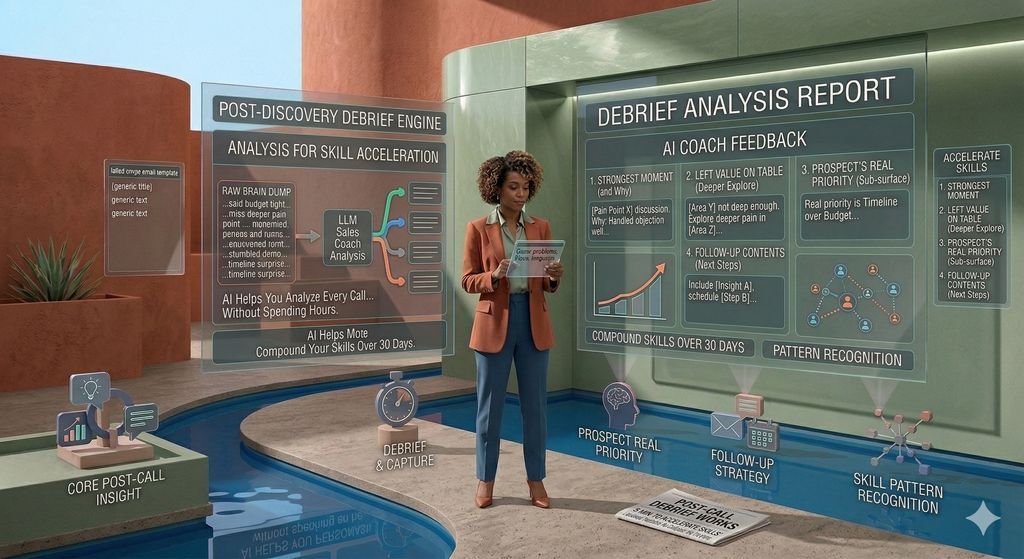
After a discovery call, most reps do one of two things: celebrate that it went well, or cringe that it didn't. Neither makes you better. Here's a 5-minute post-call debrief that compounds over time: Right after the call, brain-dump everything you remember — what they said, what you asked, what surprised you, where you stumbled. Don't organize it. Just get it down. Then paste it into any LLM: Prompt: "I just had a discovery call. Here's my raw brain dump: [paste]. Analyze this call as if you were my sales coach. Tell me: (1) what was the strongest moment in this call and why, (2) where did I leave value on the table — what should I have asked or explored deeper, (3) based on what the prospect said, what's their real priority (not just what they told me), and (4) what should my follow-up include to move this forward?" Do this after every call for 30 days. You'll start seeing patterns in your own selling. Where you rush. Where you don't go deep enough. Where you assume instead of asking. That's not AI replacing your skills. That's AI accelerating your skills.
Chris Dankowski tweet media
English
0
0
2
175
Chris Dankowski
Chris Dankowski@cdankowski·
Stop using AI to write your cold emails. Use it to critique them. Prompt: "You're a B2B buyer who gets 40+ cold emails daily. Rate this email 1-10: would you read it, is the ask clear, does it sound human? Be brutal. Then rewrite the weakest part." AI as a mirror > AI as a ghostwriter.
English
0
0
2
236
Chris Dankowski
Chris Dankowski@cdankowski·
There's a risk in making your first sales hire that nobody talks about. It's not the risk of hiring the wrong person. It's the risk of hiring the right person into the wrong environment. A-players leave bad infrastructure. Quietly. They stop making calls. They start chasing easier deals. They update their LinkedIn. And then they're gone — and you're back to square one, six figures lighter, six months behind. This is why "we hired great talent but couldn't retain them" is such a common startup story. The infrastructure has to come before the hire. Not because you don't trust the person. Because even the best operator can't run a machine that doesn't exist. Here's the minimum viable sales infrastructure before your first hire: Cadences — At least 2 tested outbound Cadences for your top ICP segments. Not templates. Cadences that have been run, iterated, and show some signal. ICP clarity — Signal-based. If your ICP definition is demographic, you're going to burn pipeline on bad-fit accounts. Call framework — Written down. What you ask, in what order, and why. CRM with defined stages — Not installed. Actually configured for your motion with real exit criteria. Objection library — Top 5 objections and the responses that actually work, based on real won deals. None of this is hard to build with AI. It just takes intention. Prompt: "I need to build an objection handling library for my sales team. My product is [X]. Help me identify the 7 most common sales objections I'm likely to face, then for each one give me: the psychological root of the objection, the reframe, and a specific response script." Build the environment first. Then bring in talent to scale it.
Chris Dankowski tweet media
English
0
0
1
175