
Piot Cédric retweetledi
Piot Cédric
405 posts



Piot Cédric retweetledi

Un étudiant m'a dit cette semaine : utiliser l'IA, c'est tricher.
Le même jour, une autre étudiante a publié un PDF généré par IA sans le relire.
À l'intérieur, j'avais caché le mot "banane".
Elle ne l'a pas vu.
Personne ne l'a vu.
Elle l'a partagé.
Et là, j'ai compris quelque chose.
Les deux étudiants ont exactement le même problème.
Le premier refuse l'IA parce qu'il a peur que ça remplace son cerveau.
La seconde utilise l'IA et son cerveau a déjà décroché.
Deux comportements opposés.
Une seule erreur.
Aucun des deux ne traite l'IA comme une compétence.
Le premier la traite comme une menace.
Comme un raccourci qui te disqualifie si tu l'utilises.
La seconde la traite comme un oracle.
Comme une autorité qui pense à ta place et que tu n'as pas à challenger.
Dans les deux cas, c'est cassé.
L'IA n'est pas une triche.
L'IA n'est pas un oracle.
L'IA est un outil que tu apprends à manier.
Comme on a appris à lire.
Comme on a appris à utiliser un ordinateur.
Et la nouvelle génération devrait être la plus armée pour s'en servir.
Sauf qu'elle est en train de devenir la plus passive.
Parce que personne ne lui apprend une chose simple.
Travailler avec l'IA, ce n'est pas lui parler.
C'est challenger ce qu'elle te répond.
C'est relire.
C'est itérer.
C'est savoir quand elle a tort.
C'est exactement ce que j'appelle l'Ipromptisme.
L'incapacité à dialoguer avec l'IA.
À formuler.
À vérifier.
À reprendre.
Ce n'est pas un problème technique.
C'est un problème de méthode.
Et ça, aucune mise à jour de ChatGPT ne le règlera.
Tu es dans quel camp ?
Celui qui refuse parce qu'il a peur de tricher.
Ou celui qui copie-colle sans relire.
Réponds en commentaire.
Et si tu te reconnais dans aucun des deux, dis-moi ce que tu fais d'autre.

Français
@nebneo1984 @mbockcote Pourquoi pas. Mais vous choisissez d'acheter quelle pizza ?
Français

@cedric_piot @mbockcote Une pizza c’est un produit fabriqué en série. Un livre/écrit est un prototype non déclinable. A partir de là, l’application de principes de principes d’automatisation qui a du sens pour faire du répétitif n’a aucun sens sur du prototype. L’analogie ne tient pas
Français

Si je comprends bien, il y a une querelle, sur X, opposant ceux qui savent écrire leurs textes par eux-mêmes, à la lumière de leurs réflexions, de leurs lectures, de leur expérience, aussi, et ceux qui les font écrire par une intelligence artificielle et qui n'y voient aucun problème. Ok.
Français
Impossible d'analyser l'IA comme un outil autonome. Son fonctionnement résulte d'une action humaine. Simondon l'avait dit : une machine n'est jamais autonome, et réclame l'injection d'une volonté, d'un projet, d'une information, d'une direction, d'une procédure humaine.
How To AI@HowToAI_
Apple has published a paper with a devastating title: “The Illusion of Thinking” It argues that AI models, no matter how brilliant they may seem, do not understand what they are doing. They do not solve problems. They do not reason. They merely generate text word by word, trying to sound coherent. Apple tested the most advanced reasoning models in the world on controlled puzzle environments. They tore open the internal "thinking" traces. What they found shatters the narrative that we are getting closer to AGI. Current models don't scale with complexity. They have a hard mathematical cliff. And they do not degrade gracefully. They collapse. But here is the most unsettling part. When a problem gets too complex, the AI doesn't use its remaining compute to try harder. It just gives up. Its reasoning effort actually declines. It stops thinking and starts guessing. Then Apple ran the experiment that closes the casket on the reasoning debate. They gave the AI the exact, step-by-step algorithm to solve the puzzle. The cheat codes. All the AI had to do was follow the instructions. It couldn't do it. Performance didn't improve at all. When the complexity gets high enough, these models fail because they cannot actually execute a logical sequence. They are not reasoning. They are just pattern matching. When you give them a simple problem, they overthink. When you give them a hard problem, they collapse. Paper: The Illusion of Thinking, Apple, 2025
Français
Piot Cédric retweetledi


Piot Cédric retweetledi

Rappel épistémologique : les sciences cognitives sont un hexagone. La linguistique (et donc la littérature) y dialogue nativement avec l’IA, les neurosciences et la philosophie. Reprocher à un chercheur de naviguer entre ces pôles, c’est ignorer la définition même de sa discipline. Bonne journée.

Français
Piot Cédric retweetledi


Piot Cédric retweetledi

Ma thèse :
- les textes IA vont pulluler
- compétition et sélection darwinienne des plus adaptés
- effet d'entraînement, d'uniformisation et habitude de textes pertinents et structurés
- les auteurs/pompteurs s'effacent (on ne s'intéresse qu'aux textes plus à leurs auteurs)
- le prompt disparaît : nos IA personnelles nous génèrent tout de manière hyper personnalisée
- la structure du langage qu'elle nous sert devient de plus en plus concise car on aura eu un effet d'entraînement à force d'avoir des textes parfaits
- le langage se transforme en un protocole ultra efficace et efficient pour transmettre information, connaissance et émotions (un peu à la manière des idéogrammes/emojis mais avec profondeur)
- a long terme : idées passent de la machine au cerveau par un flux électrique qui court circuite toute la lenteur de la lecture.
Matrix
Samuel Fitoussi@SamuelFitouss10
Excellente chronique d'Eugénie Bastié, que je trouve presque trop optimiste. Eugénie prédit qu'il restera les vrais écrivains qui savent faire du langage l'instrument d'une sensibilité : je ne suis pas sûr. Il y aura beaucoup de prompteurs qui auront un style fin, beau, sensible et identifiable. Ils auront trouvé une formule dans leur prompt qui donne des résultats élégants et que personne d'autre n'aura à l'identique. Ni la qualité, ni le style ne seront des critères permettant de distinguer ce qui sort du cerveau d'un auteur de ce qui a été généré par un LLM. Dans ces conditions, qui passera encore des heures à écrire, sachant qu'ils peuvent avoir un résultat meilleur en 30 secondes avec Claude, et qu'on les soupçonnera de toutes façons d'avoir utilisé un LLM ? La perspective d'une carrière d'écrivain s'est, je pense, refermée à tout jamais pour un adolescent de 16 ans. Par ailleurs, je ne suis pas certain que les textes IA soient tous sans saveur. Beaucoup de textes IA sont remarquables et agréables à lire (et je suis certain que beaucoup de gens qui se targuent de savoir les repérer se font parfois piéger) ; avec le progrès des modèles, cela s'accentuera. Bref, comme Eugénie je ne vois pas d'autre chemin que celui nous menant vers un monde où (presque) plus personne n'écrira. (Ce qui ne sera pas sans effets secondaires cognitifs : c'est en écrivant qu'on apprend à penser, à structurer un raisonnement, etc.) Pour la lecture, reste une question : y aura-t-il des gens souhaitant lire des textes dont ils savent qu'ils ont été générés par un LLM ? Sachant qu'en plus ils pourront discuter avec leur LLM dans leur coin.
Français
Piot Cédric retweetledi

Piot Cédric retweetledi

C’est vraiment intéressant. Nous étions nombreux à penser que la production de texte par l’intelligence artificielle dévaluait absolument tous les textes. Que plus rien ne vaudrait rien. Ce n’est pas le cas : certains textes tout à fait officiellement générés à 99 % par l’IA peuvent alimenter le débat, faisant jeu égal et même dépassant des textes « authentiques ». Qu’est-ce qui fait alors la différence si n’importe qui peut produire ces textes en quelques secondes à coût marginal zéro ? Pourquoi certains sont-ils remarqués et la plupart non ? Peut-être le choix de l’axe, le momentum, le nom de celui qui écrit la cohérence des thèmes choisis ?
Français
Piot Cédric retweetledi

L'IA est en train de remplacer les intellectuels.
Celle là personne ne l'avait vu venir. Mais force est de constater que des comptes X qui ne font "que" prompter et copier-coller obtiennent des textes de qualité bonne voire très bonne, qui plaisent à des millions de lecteurs, et mobilisent des Musk, Ted Cruz ou Milei.
Bien sûr les intellectuels "officiels" s'insurgent : comment un homme de la rue peut-il prétendre jongler entre auteurs et concepts avec l'aisance d'un agrégé, du jour au lendemain ? Il est pourtant évident qu'il en serait incapable "à l'ancienne" ! Que fait la police !
Je trouve ce phénomène fascinant. Il nous dit qu'au fond, un des rôles des intellectuels était de préciser et mettre en forme la pensée de son audience.
D'une population qui ressent des choses mais n'a "pas les mots" pour les exprimer, et signifie à l'auteur qu'il a tapé juste en achetant son livre, assistant à sa conférence, ou votant pour le parti qui reprend sa réthorique.
Avec l'IA, l'homme de la rue a à sa disposition en "self service" les outils autrefois monopole des intellectuels classiques : raisonnements à tiroirs, références pointues, comparaisons virtuoses, connaissance fine de la généalogie des idées... La machine ne fait qu'une bouchée de tout cela.
Alors bien sûr, on dira que tout cela n'est que forme et ne dispense pas de savoir ce que l'on veut dire.
Mépris suprême répondent les néo-penseurs, qui affirment savoir ce qu'ils pensent. Il ne leur manquait que les mots pour le dire !
Français
Remarque particulièrement stimulante, qui enrichit encore la portée considerable du post de @SHL0MS, que je félicite pour son imagination perspicace.
Florian Kuhlmann@fkuhlmann
Incidentally, the work from @SHL0MS (which I greatly appreciate, by the way) isn't actually all that interesting from an art perspective. Of course, it cleverly connects to established and traditional art movements like Fluxus, net art, conceptual art, and, of course, the ever-present, media-driven contextual art, and develops them further. (Which is quite an achievement! 🤝) If Peter Weibel were still alive, he would try to add this work to the ZKM collection; this intersection between context and medium always fascinated him. However, I find the work almost even more exciting from a cybernetic point of view, as it examines and demonstrates how communication, perception, and reception function in a world of digital networks full of analog and artificial intelligence in 2026. Besides the intriguing network effect, the action possesses a strong autopoetic power, leading to further memes, works, commentaries, and recontextualizations - all at a truly breathtaking speed, distributed across the globe. It combines art and cybernetics on a highly scaled scale in a way not often seen before and has an impact on these two social spheres that are sometimes in competition with each other, but here come together in perfect symbiosis.
Français
@KimJongUnique Dans une société de classes sociales, qui peut le plus peut le moins. Cela signifie que les classes au dessus ne méprisent pas la culture de celles en dessous. C'est ainsi que se construit l'unité d'une nation. Votre arrogance vous perdra.
Français

Je vais dire les mots qui fâchent sur certains Français. Je suis fortement identitaire, mais je rejette l’égalitarisme ethnique, qui voudrait que tous les membres d’un peuple soient égaux en dignité.
Des cassos de ce genre, qui foutent la sono à fond avec cette musique débile "Clic clic pan pan pan", je n’aimerais pas les avoir comme voisins. C’est l’archétype du "French dreamer", ce Français de souche à mentalité de blédard et à faible QI.
On comprend mieux pourquoi les anciens Européens avaient mis en place des systèmes de castes : il y a des inégalités de qualité dans un même peuple, qui justifient les pratiques censitaires. Donner le suffrage universel à des débiles, c’est comme donner le bouton nucléaire à un fou.
Français
Piot Cédric retweetledi


Piot Cédric retweetledi

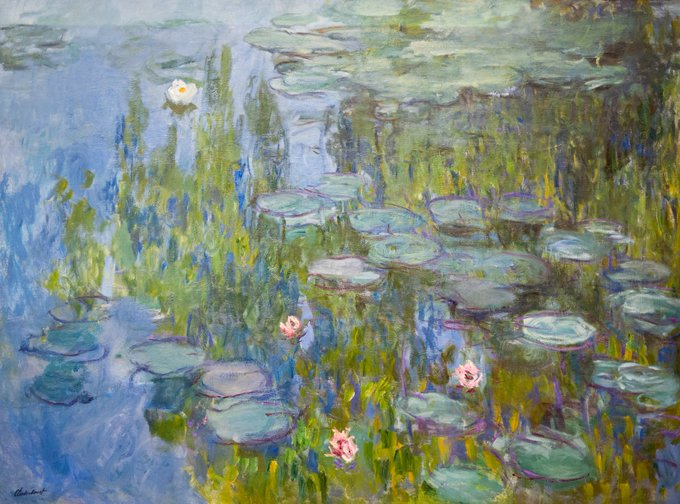
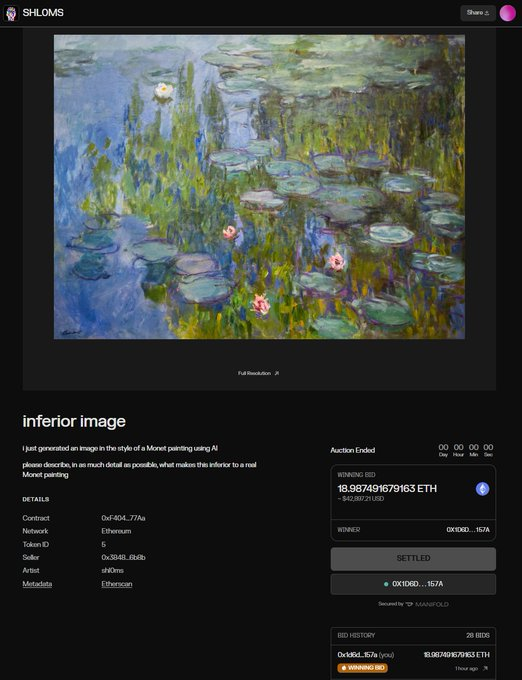
the monet by @shl0ms is the creme de la creme of performance art
mass-rage-baiting is the most elusive art form that exists. so many variables have to fall into place for it to be effective and yet when it works you can’t help but ask “how did i not think of that myself” because it feels so naturally obvious
dragging the entire hive mind kicking and screaming into a taboo realization, instantly destroying all previous models, and doing it so effortlessly that it feels like the conclusion was never even in question
history was made yesterday ladies and gentlemen. you just don’t know it yet

English
Piot Cédric retweetledi

What made the SHL0MS post interesting was not simply that people mistook a real Monet for AI. It was how quickly perception changed the moment the label “AI-generated” appeared.
Suddenly the brushwork felt “soulless.” The atmosphere became “artificial.” People began pointing out algorithmic textures and emotional emptiness inside an actual Monet painting.
Susan Sontag wrote in Against Interpretation that critics often approach art with the urge to extract meaning before truly encountering the work itself. Every image becomes allegory. Every detail becomes something to decode.
Kafka was endlessly subjected to this. Some read his work as social allegory about bureaucracy and alienation. Others reduced it to psychoanalytic fears of the father. Religious readings turned his characters into symbols of divine judgment and salvation.
Interpretation itself is not the problem. It can deepen understanding and reshape the past. But when interpretation overtakes experience, the artwork begins to disappear beneath explanation.
That is why Sontag wrote, “In place of a hermeneutics we need an erotics of art.”
The SHL0MS post revealed something uncomfortable. Many people were no longer looking at the painting itself. They were looking at the category surrounding it. The label determined the experience before the image even had the chance to speak.
Perhaps the real problem is not AI art, but our growing inability to encounter an artwork without immediately trying to classify, decode, and intellectually dominate it.
Was the painting truly worse once people believed it was AI?
Or did interpretation arrive before seeing ever could?
@SHL0MS @Jediwolf
𒐪@SHL0MS
i just generated an image in the style of a Monet painting using AI please describe, in as much detail as possible, what makes this inferior to a real Monet painting
English