
Sabitlenmiş Tweet
Praveen Chandrahas
922 posts

Praveen Chandrahas
@chandrahas9
Free Software Activist, Knowledge Freedom. Swecha | FSMI
Hyderabad, India Katılım Ağustos 2009
349 Takip Edilen409 Takipçiler



Praveen Chandrahas retweetledi

Great, you have a successful MVP. What's the next step for making your product famous. The previous playbooks used to be posting on producthunt and many other saas and micro saas launch pages and reddit and hackernews and make sure you respond to every comment and keep the conversation going. It is generally at that time you realize that building a startup does not mean coding. It is everything other than coding. The SaaS playbook is well defined and we have experts in that. Build SEO, calculate ROAS etc.
But that rate of growth is not enough in this AI world. In this AI world you need to do $10 million ARR on 2 months.
That will not happen with the old playbook.
The hustlers have found a new playbook for this. Supported by the VC money.
They are calling it UGC, user generated content. It is basically influencer marketing.
You see all these posts everyday about some new AI tool and how it's completely changed the life of so many people, that's UGC. You would have been surprised at how frequently the disruptions are happening given the posts from these influencers. You would have assumed the whole world has changed multiple times. Well, the influencers lives certainly changed with the money they are getting from the companies :).
I have been following enough AI people and their posts to know that almost everyone is posting ads without disclosing.
So, let's say you have $1 million dollars. How would you spend to get users for your AI product.
You would identify, the best influencers for your product(high followers, right content etc), reach out over DMs and make an offer. They will post about how great your product is and how it will kill off other products and create fomo for users.
Say your product is $10 but your are giving for $1. Let's say you are able to get 1000 influencers. And each gets you some 10 customers. They all sign up for the discounted $10 plan. Make sure you run this campaign on a particular day. So, on that day you get 10,000 signups and and $100,000 worth of MRR or more than $1 million ARR.
Now announce you are fastest to $1 million ARR and create more fomo and reach out to more influencers and ask them to post about fastest to million dollars and suddenly you are at 10 million ARR.
Now the VCs are behind you to give you a billion dollar valuation.
Congrats!
nutanc@nutanc
I wanted to check if Claude code can one-shot wisprflow.ai. Apparently, it can. I am able to create a Windows and Mac app with just the prompt "Create an alternative for Whisperflow." I might as well just open source it and let others build on top of it. You can improve the prompt a lot more to make it work for many more instances. -typed with vibe coded Whisperflow
English
Praveen Chandrahas retweetledi
My story when I was a teacher. I was known to be a strict professor especially in lab practicals. A few days before the practicals I get a visit from a political person(guess the party :)). Turns out his daughter was taking the exam in a few days and he asked me to be lenient with her. I said no, and I suggested to him that it will be much more beneficial if he had this talk with his kid and asked her to study better. He said she was anyway studying only so that she can get married off after getting the degree, so what does it matter. I told him, it matters. To me and to her. She needs to know that she can succeed in life even without her dad doing wrong things for her. The dad left threatening that he will see what he can do if I don't help.
A few hours later the girl came to my office. She had found out that her dad had come. I explained what had happened and told her that if she needed extra help I can sit with her and coach her more. She was apologetic. The class knew my principles. She said she did not ask her dad to do this and she was sorry. She said she will talk to her dad and will do her best in preparing for the practicals. I said all the best.
She passed.
Maheshwer Peri@maheshperi
This is a true story. A professor in India's premier educational engineering institution caught a student cheating in the exams and suspended him. Next day morning, the boys father who was a senior bureaucrat landed at his home and requested that the matter be forgotten and closed. When the requests and pleadings failed, The professor was warned of consequences. The academic that he was, the professor stuck to his guns. The harassment started. Within a week an income tax notice was served on him seeking details of his foreign travels. A few days later, police landed up investigating a house purchased by the professor in his home town. Later the income tax investigated the sources of funds for that home. In the process of scrutiny, they questioned a few more 'source of funds'. For a professor working in a remote corner of India, this was all too much. He contemplated giving it all up and taking another job. The notices, hearings, responses and harassment continued for about 20 months. Luckily the professor was clean. His foreign travel was official. The house was in a new housing society set up by a group of academics. The management was supportive. 'For 20 months, they robbed me of my sleep', says the professor. On prodding if he would take a similar stand again, he painfully says 'I doubt'! If you indeed want to fight corruption, the starting point has to be the source of corruption - the discretionary powers, arbitrariness and their abuse. It is rampant and completely normal. Remove the discretionary powers and 98% honest people will not worry of harassment when they do what is right! @suchetadalal This story is being retold. Our education ecosystem is subsumed by corruption. And it is normal too..
English
Praveen Chandrahas retweetledi

On #InternationalMotherLanguageDay
Our Corpus App is now localised in Telugu our contribution to #Indic l10n project. Help build strong Telugu & Indic AI by contributing Text, Speech, Video & Image datasets.
🌐 corpus.swecha.org
Android App: play.google.com/store/apps/det…
English
@DrDatta_AIIMS Not really? I have flown multiple times and there are multiple flights. Must be the IndiGo fiasco again?
English

no hyd to Chennai direct flight?
are you kidding me?
English

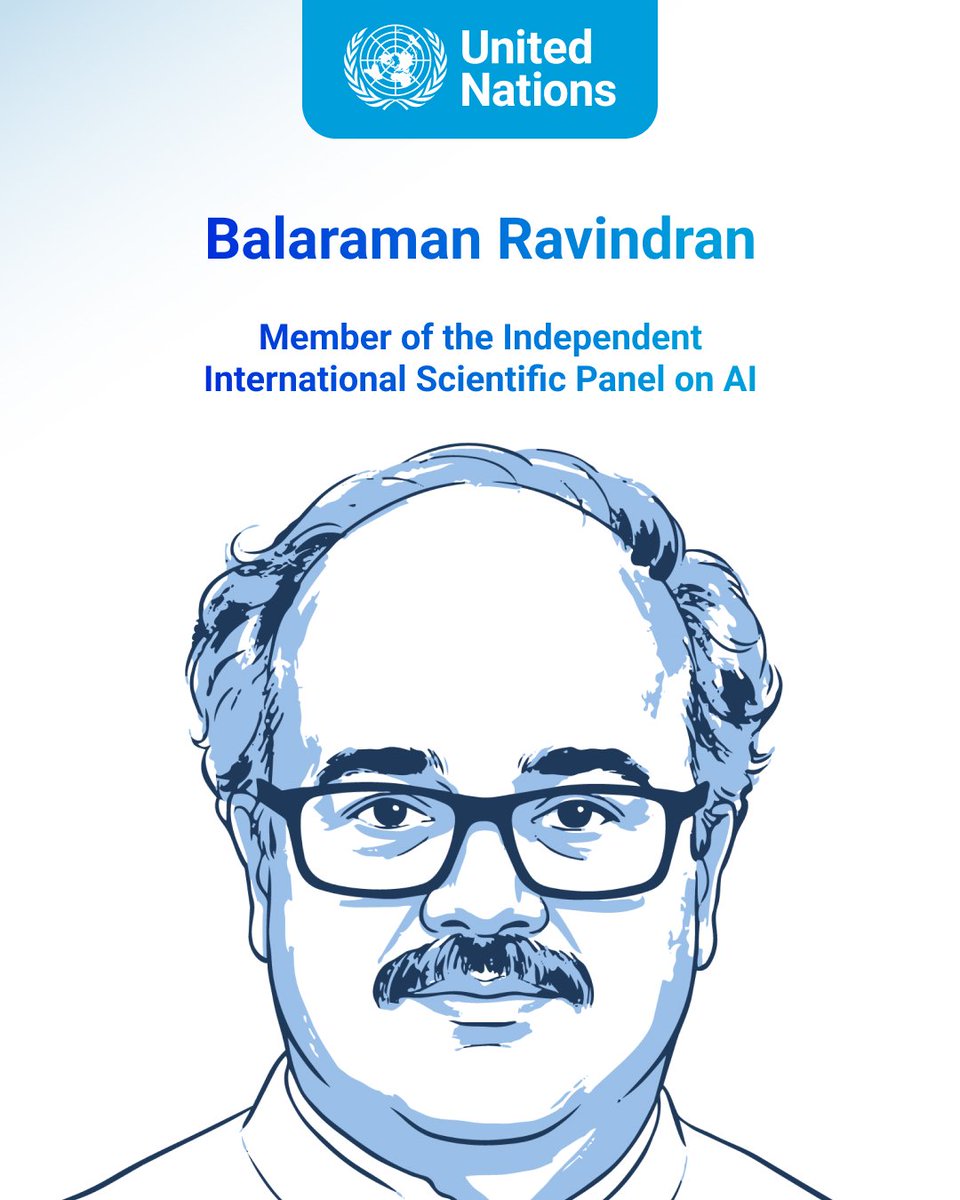
Honoured to be appointed to the Independent International Scientific Panel on AI by the UN General Assembly.
I look forward to working with an esteemed group of scientific leaders in AI on the panel's objectives.
UN Office for Digital and Emerging Technologies@ODET_UN
The UN General Assembly has appointed 40 experts of the Independent International Scientific Panel on AI. 🏛️ This body begins its work as a scientifically-grounded foundation, ensuring global understanding is driven by evidence-based scientific assessments. #DigitalCooperation
English
Praveen Chandrahas retweetledi
Praveen Chandrahas retweetledi
🚨I don’t comment on every tech launch, but after eight years in healthcare AI, I have to ask: is India handing over its healthcare sovereignty to foreign platforms? 🇮🇳
I must share some raw thoughts about the launch of ChatGPT Health (for patients) and OpenAI for Healthcare (for doctors) this week, because the implications are enormous, and we as Indians need to pay attention (which we aren’t!)
In the last 24 hours, OpenAI has initiated a direct play to become the “operating system” for global healthcare data. This is not just about replacing human doctors but about becoming the default interface where your health data, wearables, lab reports, clinical notes, fitness logs (and literally everything related to you) gets stored, organized, interpreted and ultimately monetized!
🚀 Healthcare is now one of the world’s biggest data economies. In India, this market is exploding, well over 500 billion dollars, with digital health leading the way.
In India have more than a billion people (and potential customers). The diversity of cases we see in hospitals is unmatched! TB, rheumatic heart disease, tropical infections, cancers all of them present differently in Indian populations. A treasure trove of clinical information that does not exist anywhere else in the world!
And for decades, most of this data has been siloed and stuck in different places. Fitness apps stored your steps and activity. Hospitals locked up imaging in their PACS. Half our X-rays and ultrasounds are still physical films or printouts lol
AI has changed everything in the last few years.
Today, models can read scans, parse clinical notes, integrate vitals, understand behavior, and connect it all. We have patient health record apps which store all our information, so it’s easier for us to connect them to AI apps through APIs and MCP servers.
The truth is: Whoever controls the layer that stitches this together will control diagnostics, healthcare policy, and population health at scale. I have absolutely no doubt about that!
That is what OpenAI is building. Connect your records. Connect your wearables. Let the platform learn how your body, your disease, your life works. It starts free. Later, you pay for the smarter version.
We have seen this movie before. Google Drive. iCloud. Google Photos. Once your data and your habits live inside a system, how do you ever leave? Right?
But healthcare is not just your email or photos. There is sovereign angle to it. If India’s imaging, clinical records, and behavioral data flow only into foreign platforms, (and yes, many Indian startups have already been forced to share data just to survive), we are reduced to data suppliers, not data owners, and definitely not builders.
If this continues it will be disastrous!!! Our diagnostic standards. Our clinical pathways. Our public health priorities. All of it may eventually be shaped by decisions made outside this country!
I see something every day in practice. Indian TB. Rheumatic heart disease. Infections and patterns Western models still struggle to understand. If we allow foreign entities to own the “brain” trained on this data, we will end up paying for insights generated from our own people.
I have worked, often pro bono, with some of the most brilliant health-tech founders in this country. They are hardworking, creative, deeply committed. But most are just fighting for survival. No one has the runway to build national infrastructure!
An Indian “ChatGPT for Health” cannot be another under-funded startup. We need patient capital. Serious policy support. Digitization of decades of legacy records. Multimodal datasets that connect hospitals, labs, public systems, wearables, and wellness platforms. Long-term governance that balances privacy, equity, and innovation.
And I am not being anti-global. This is not anti-free market. And honestly, anyone who reduces this to that is missing the point!
We absolutely need global collaboration. But the core intelligence built on Indian health data MUST be governed in India.
Because The stakes are massive.
Whoever controls health data and health AI will set the rules for medical care, public policy, and healthcare innovation for the next decade.
If we build our own now, we control our future.
If we wait, we will be locked out and locked in.
The clock is ticking.
So my question is: Are we going to do something about it, or are we going to remain passive users while a few companies in Silicon Valley decide how healthcare for 1.4 billion Indians should work?


English
Praveen Chandrahas retweetledi
Organizations adapting AI is the biggest problem that businesses are facing right now. Even in Ozonetel | oneCXi I face this problem day in and day out. The employees who really use AI to its full potential are minuscule. I can count on my fingertips. We need to overcome this in the right way or we will face the same problems we faced during industrial revolution. India needs to be in the forefront of AI. Wrote a little about it today.
The Ghost in the Machine: How I learned to stop worrying and love the AI
History has a funny way of repeating. It tells us don’t do this. If you do this you will suffer. But like kids in a school or like teenagers rebelling we say, I will do this. This time it will be different. Well guess what, it’s not going to be different.
Thanks for reading Experiments in AI! Subscribe for free to receive new posts and support my work.
Today, we stand at the precipice of the Artificial Intelligence age. The tools available to the average employee right now are nothing short of revolutionary. Yet, a strange paralysis has taken hold. Many organisations and individuals are hesitating, eyeing these tools with suspicion rather than curiosity. And with good reason. People like Sam Altman and Satya Nadella have not helped the cause by pushing AI in places its not needed and hyping it up to the levels of AGI :)
But this hesitation feels eerily familiar, especially when viewed through the lens of India’s economic history. If we are to thrive in this new era, we must confront the uncomfortable truth: the mistake of resisting technological change is one we have made before, and it is one we cannot afford to make again.
Lessons from the Industrial Past
India’s relationship with the Industrial Revolution in the 18th and 19th centuries was complicated, to say the least. While colonial rule actively deindustrialized the nation to serve British interests, there was also significant internal cultural and philosophical resistance to mechanization.
Consider the textile industry. While Britain embraced the power loom and the steam engine, India’s legendary artisanal weaving sector struggled to adapt. There was a deep-seated wariness of machines that threatened traditional livelihoods and social structures. The Charkha (spinning wheel) became a powerful symbol of resistance and self-reliance during the freedom struggle, but in the post-independence economic landscape, a lingering suspicion of rapid, large-scale mechanization contributed to decades of sluggish industrial growth.
We missed the bus because we failed to understand one basic concept:
The machine replaced the muscle.
We tried to glorify the human using his muscles to achieve perfection. While that works for niche products, it cannot survive industrial scale. In fact, even now we glorify the man over the machine as a recent movie shows.
We missed the first bus. We spent decades playing catch-up, protecting obsolete methods instead of innovating. It wasn’t until the economic liberalization of 1991 and the subsequent IT boom that India truly demonstrated its potential to not just adopt, but dominate, a technological wave.
We proved we could adapt. But are we forgetting that lesson now?
The Current AI Paralysis
Fast-forward to 2024. The “steam engines” of our time are Large Language Models (LLMs) and generative AI. The access is unprecedented. For a small subscription fee, or often for free, an employee has access to an intelligence that knows almost every coding language, has read the entire internet, and can draft a strategy document in seconds.
Yet, adoption is lagging behind access.
A significant disconnect exists. While company leaders are rushing to “implement AI,” the workers on the ground are often stalled.
As I have been observing in Ozonetel, the AI “native” employees in the organization are minuscule. I would say there are 3, maybe 4 employees who are using AI properly. The rest are going through the motions though the management is completely convinced on the switch to AI.
The Evidence and the “Copilot” Conundrum
We see this evidenced in the rollout of major enterprise tools. Take Microsoft Copilot, for instance. Microsoft has aggressively integrated AI into its ubiquitous Office suite. On paper, it’s a productivity dream. In reality, the reception has been disastrous.
Reports and user feedback indicate that for many, Copilot hasn’t been the instant magic bullet promised. Why? Part of the blame lies with the tech giants’ approach, shoving features at users without adequate training on how to integrate them into complex workflows. It can feel clunky, sometimes hallucinates, and requires a new way of interacting with software (prompt engineering).
But a larger part of the problem is user resistance. Many employees are not actively trying to bridge that gap. They try it once, it fails to perfectly execute a complex task, and they dismiss it. Frankly, they don’t care.
The fundamental problem is that for an employee, they wanna come in, do their job(which was mostly looking at a screen, move bits here and there) and go home to their life. Now AI means they have to learn something new. They will resist this change.
According to various 2023-2024 reports on the “AI divide,” while global awareness of GenAI is near universal among knowledge workers, regular, highly effective utilization is vastly lower. A Salesforce survey indicated that while many executives are keen, a significant percentage of workers lack the training or the mandate to use these tools effectively. They are ignoring the supercomputer sitting on their desktop.
The Root Error: Replacement vs. Augmentation
Why the hesitation? It boils down to fear, rooted in a fundamental misunderstanding of what this technology is.
Too many people are looking at AI through the lens of Replacement Technology. They see a tool that can write, code, and design, and they immediately jump to: “This thing is here to take my job.” When you view something as your executioner, you will not cooperate with it. You will resist it, hide from it, and hope it goes away.
This is the wrong framing. We need an urgent mindset shift toward seeing AI as Augmentation Technology.
If you are spending four hours a day summarizing endless PDF reports, writing generic outreach emails, or debugging basic code, you are wasting your human potential. AI can do those tasks in minutes. By resisting AI, you aren’t protecting your job; you are insisting on doing drudgery that a machine is better suited for.
It’s like in the movie above, we have a grinding machine. But if you choose to grind by hand for some unseen uptick in taste, who are you doing it for? For yourself, or for the hungry man who needs some idli as breakfast which he can gobble down quickly before going to work.
AI is not here to replace the employee. It is here to help them. As I told above, why should the employee care? They will care if their work becomes better or easier. They know they have to sit in a cubicle from 9-5. How can AI make that time better. The companies which will solve this will make bank.(My brother’s stealth startup is working on exactly this).
The New Paradigm: AI as Your Coworker
To survive this transition, employees need to stop treating AI as a suspicious piece of software and start treating it as a junior coworker.
A very smart, very fast, sometimes naive junior coworker who needs clear instructions.
When you shift to this mindset, the fear evaporates, replaced by utility. The AI handles the “blank page problem,” the data crunching, and the repetitive drafts, freeing you up for higher-level strategic thinking, creative problem solving, and emotional intelligence, things AI is terrible at.
Conclusion: Adapt or Perish
The industrial revolution proved a harsh reality: history does not kindly judge those who refuse to adapt to technological paradigm shifts. The difference today is speed. The industrial revolution unfolded over a century; the AI revolution is unfolding over months.
The historical wariness of change that once held India back cannot be allowed to resurface. The tools are here. They are accessible. The teams and individuals who cling to the old ways of working out of fear or inertia will find themselves obsolete.
Those who embrace AI not as a replacement, but as the ultimate augmentation tool won’t just survive the coming changes. They will define them.
English
Praveen Chandrahas retweetledi
The next step in our Telugu LLM journey, mid training. Before we get into supervised fine tuning, most new methods follow a mid training approach to get the system used to instruction following. Our current pre trained model can just spit out Telugu text. But what we want is a system that listens to us, not some random word generator :)
So we start with mid training. Sharing our approach here. We went with some small talk, news articles, paraphrasing summarization and stories. For some of these, again we had a data problem, so we had to generate some synthetic data. No way around it.
blog.viswam.ai/bridging-the-g…
English
Praveen Chandrahas retweetledi
Once we had a good enough tokenizer(we still need to do lots of research in this. If any one is interested, please connect, IIIT-H profs are also interested), the next step is to build the pre training model. This is where we start to get into "intelligence". The model we get out of this will start spitting out grammatically correct Telugu, though most of it wont make sense :)
More details about how we did the pretraining below.
blog.viswam.ai/from-scratch-t…
English
Praveen Chandrahas retweetledi
🚀 In January, there is going to be a massive AI evaluation and AI in Healthcare workshop which we are going to conduct at multiple places in India viz. Sonipat (Delhi NCR), Jaipur (Rajasthan), Bangalore (Karnataka) and Hyderabad (Telangana).
🔥 This will be at a scale which has not been done before and have really high quality content with exposure to the most frontier medical AI models of the world.
✅ AI is here and the onus to use it responsibly and train the next generation of clinicians is upon us!
➡️ More details soon! Stay tuned! If interested in attending, comment here and our team will send you the registration link and dates personally!
❌ (Do not DM --> Our team does not have access to that!)
English
Praveen Chandrahas retweetledi
This is one time when you actually feel the freedom of your own country. Your country can be corrupt, exploitative or just plain bad. But it is your country and you can fight for it. That's the power of freedom.
You can live in rich country, but if you are a second class citizen, you are a second class citizen. You don't have the freedoms. They have every right to say, it's a visa, we can allow you and we can stop you. You don't have any right. And suddenly your whole life is upended.
That's why I suggest all young students now to stay in India. The world is in a bad place right now, it's better to stay,fight and fix what we have.
Gaurav Sabnis@gauravsabnis
I know two people directly affected by this. Thought they will multitask attending a family wedding (it's wedding season in India) and also renew H1B. Now they are stuck there till June.
English
Praveen Chandrahas retweetledi
Praveen Chandrahas retweetledi
🚨 Fantastic opportunity for young medical graduates (Post MBBS) to work on a global AI for healthcare initiative and help coordinate one of the largest clinical AI evaluation projects in India. 🇮🇳
➡️ We’re looking for a full-time Clinical Research Lead (post-MBBS) to drive MOOVE-India, part of a worldwide effort to rigorously evaluate medical AI with clinicians at the center.
✅ You’ll be working closely with our team at @KCDH_A @AshokaUniv and supervised by few of the world's top healthcare AI leaders:
🔥 @anniehartley_ Prof. Annie Hartley, founder of LiGHT Lab and creator of Meditron, the world's first open source medical LLM (@EPFL @HarvardChanSPH)
🔥 @AnuragAgrawalMD Prof. Anurag Agrawal, one of India’s leading physician-scientists
🔥 Prof. Mona Duggal, Director @icmr_nirdhds spearheading ICMR’s Digital Health Research ecosystem
🚨 THIS IS A FULL TIME ROLE (HYBRID OPTION AVAILABLE - BUT WILL INVOLVE TRAVEL) - ONLY POST MBBS! 🚨
⬇️ If you are interested, comment here and our team will reach out to you with details!
English
Praveen Chandrahas retweetledi
This is such an awesome library. So many startups are waiting to be discovered using only this. If you are student who is interested in doing a startup, please DM me.
SkalskiP@skalskip92
supervision, the open-source library I created 2 years ago, is crossing 30,000 stars on GitHub! thank you to everyone who helped me build this project! it took us 4,000+ commits, 1,000+ PRs and 100+ contributors to do it. link: github.com/roboflow/super…
English
Praveen Chandrahas retweetledi

#AIinConversation #HappeningToday #Day1
Join us today, May 26th, 2025, for Day 1 of our "AI in Conversation" Event with Praveen Chandrahas (@chandrahas9) for a keynote on "Building AI models: Opportunities and Challenges Faced in the Indian Context" at 6 pm IST.
Meet our speaker:
Praveen Chandrahas currently serves as the Secretary of @SwechaFSMI, a non-profit organization dedicated to promoting the Free Software Movement in the Telugu-speaking states of Telangana and Andhra Pradesh. In this role, he has been instrumental in localizing software tools and developing AI solutions tailored to regional needs, such as Telugu text-to-speech systems.
Beyond his work with Swecha, Praveen is the Director of DigiQuanta. He holds positions as the General Secretary of the Forum of IT Professionals and as an Executive Committee Member of the Free Software Movement of India. He has an M.Tech in Computer Science from IIT Madras. His work at IIT Madras included working on the initial architecture for IMPS, which eventually became the basis for UPI (upistory.com).
Please note that the joining link has been sent to your registered email. Please check your inbox for it.

SFLC.in@SFLCin
#AIinConversation #RegisterNow Meet our distinguished speaker, Rebecca MacKinnon, Vice President, Global Advocacy at @Wikimedia Foundation, who will speak on "Free Speech and AI in the Era of Global Uncertainty and Information Warfare" on Day 3, May 28th, 2025, at our "AI in Conversation" Event. Rebecca MacKinnon is Vice President of Global Advocacy at the @Wikimedia Foundation, Wikipedia’s non-profit host. She is the author of Consent of the Networked: The Worldwide Struggle For Internet Freedom (2012), she is co-founder of the citizen media network Global Voices, and founding director of Ranking Digital Rights. From 1998-2004 she was CNN’s Bureau Chief and correspondent in Beijing and Tokyo. She has taught at the University of Hong Kong and the University of Pennsylvania, and held fellowships at Harvard, Princeton, and the University of California. She holds an AB magna cum laude in Government from Harvard and was a Fulbright scholar in Taiwan. Join us on: 🗓️ May 28th, 2025 🕕 6:00 – 7:00 PM IST Register now: form.sflc.in/ai-in-conversa… Stay Tuned! @rmack #AIInnovation #TechLaw #FreeSpeech #ArtificialInteligence #information
English
Praveen Chandrahas retweetledi
Viswam has applied. We have applied for a grant of 14 crore. The goal is to see if we can build an LLM in a million dollars. There is no fun in spending another 100 crores for building and LLM. Others are anyway doing it :)
Harveen Singh Chadha@HarveenChadha
Out of total 67 proposals received by government, 20 proposals are for building LLMs 1. Sarvam 2. Ola 3. Corover Who are the other 17 ? Would be interesting to know
English
Praveen Chandrahas retweetledi
తెలుగులో కంప్యూటర్ తయారీతో మోదలయిన ఈ ప్రయత్నం నేడు తెలుగులో ఏఐ వైపున వేగంగా అడుగులేస్తున్నది!
ఈ ప్రయాణం మొత్తంలో కీలకం--అకుంటిత దీక్షతో, కార్యోన్ముఖులై, అవిశ్రాంతంగా, నిస్వార్థంగా నడిచిన వలంటీర్లు!
6/9
తెలుగు
Praveen Chandrahas retweetledi
Wow, it's been 20 years. I remember as an assistant professor how we got Aurora college students all together and translated thousands of strings in a single day. Like that,Swecha team got colleges across AP and helped build India's first local language OS. Crowd sourcing FTW!
Swecha Telangana | స్వేచ్ఛ తెలంగాణ@SwechaFSMI
ఇరవై వసంతాల స్వేచ్ఛ! 9 ఫిబ్రవరి 2005 - స్వేచ్ఛ ఆపరేటింగ్ సిస్టం విడుదల చేసిన రోజు! #తెలుగు #స్థానికీకరణ #l10n #స్వేచ్ఛసాఫ్టువేర్ 1/9
English
Praveen Chandrahas retweetledi
ఇరవై వసంతాల స్వేచ్ఛ!
9 ఫిబ్రవరి 2005 - స్వేచ్ఛ ఆపరేటింగ్ సిస్టం విడుదల చేసిన రోజు!
#తెలుగు #స్థానికీకరణ #l10n #స్వేచ్ఛసాఫ్టువేర్
1/9


తెలుగు