Ngano

2.8K posts

Ngano banner
Ngano

Ngano

@charlesngano

Hunijui ......

Kisumu, Kenya Katılım Eylül 2012
1K Takip Edilen2K Takipçiler
Ngano retweetledi
Stephen Mutoro
Stephen Mutoro@smutoro·
KEY PHONE HIGH COURT RULING! ⭕️ Your mobile number is now constitutionally protected data ⭕️ The High Court has declared that a registered phone number falls under Article 31(c) & (d)—meaning your private affairs cannot be exposed via “number recycling” ⭕️ The AG has 6 months to fix this as to new rules for reassigning numbers: 1️⃣ Requires VERIFIABLE consent of the original owner 2️⃣ Must exhaust documented verification & public notice before deactivation 3️⃣ Technical safeguards MUST prevent transfer of old personal data to new owners ⭕️ No more exposing your private life to a stranger who inherits your old number #DigitalRights #Privacy #Article31 #DataProtection #ConsumerRights
Stephen Mutoro tweet mediaStephen Mutoro tweet mediaStephen Mutoro tweet media
English
4
36
63
12.9K
Ngano retweetledi
Julians Amboko
Julians Amboko@AmbokoJH·
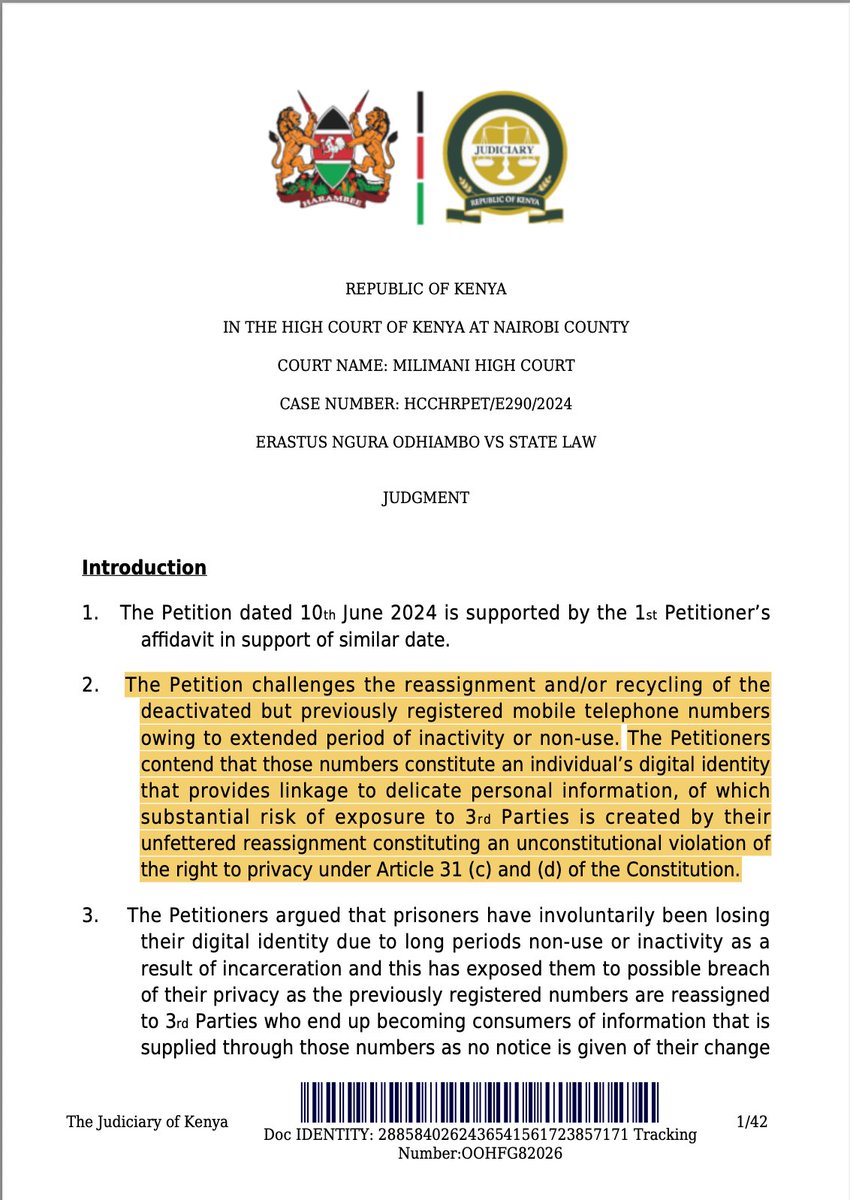
UPDATE: Kenya's High Court declares that registered mobile phone number constitutes a digital identifier linking personal data that relates to an individual’s private affairs hence qualifies for protection under Article 31 (c) & (d) of the Constitution to safeguard the right not have information relating to private affairs unnecessarily required or disclosed. This declaration by the High Court follows a petition challenging the reassignment &/or recycling of the deactivated but previously registered mobile telephone numbers owing to extended period of inactivity or non-use. The High Court has now given the Office of the Attorney General 6 months to take all necessary and appropriate measures to safeguard digital identity associated with the registered mobile telephone number against unfettered deactivation, and subsequent arbitrary reassignment or recycling. The High Court rules that reassignment of cell phone numbers should happen only when/if: 1. There is the previous registered owner’s informed & verifiable consent 2. After expiry of reasonable period following issuance of public notice which must be preceded by through documented verification process aimed at confirming the original registered owner cannot be located or has unequivocally revoked the rights to the number 3. Technical safeguards be put in place and implemented to prevent unauthorized exposure or transfer of personal data linked to previous registered owner to 3rd Parties upon reassignment or recycling of the number
Julians Amboko tweet mediaJulians Amboko tweet media
Julians Amboko@AmbokoJH

A petition has been filed at the High Court challenging the reassignment &/or recycling of the deactivated but previously registered mobile telephone numbers owing to extended period of inactivity or non-use. The petitioner argues that those numbers constitute an individual’s digital identity that provides linkage to delicate personal information of which substantial risk of exposure to 3rd Parties is created by their unfettered reassignment. The petitioner wants a declaration that there exists a personal digital identity & a person's registered phone number forms part of his/her digital identity just like the physical national ID., Passport or Driving license.

English
54
954
1.4K
160.6K
Ngano
Ngano@charlesngano·
20/ **END** What happens when the wind dies, the income dries up, and you're standing on a shore that was never really yours, unable to afford the one you left? That question deserves an honest answer before the ticket is booked. Not after. #Blaxit #AfricanDiaspora
English
0
0
0
19
Ngano
Ngano@charlesngano·
1/ Americans are moving to Africa in growing numbers. Everyone's talking about WHY they're going. Nobody's asking the harder question — how many can actually STAY? 🧵
English
19
0
0
28
Ngano
Ngano@charlesngano·
19/ Once you coast you burn the ship. The romanticized version ends there. The real version asks ...
English
0
0
0
12
Ngano
Ngano@charlesngano·
18/ So where does this leave us? A movement built on genuinely valid grievances. A financial model with too many single points of failure. An AI disruption coming for the core income source. A return path that narrows every year of absence. And no communal granary waiting ...
English
0
0
0
12
Ngano
Ngano@charlesngano·
17/ Meanwhile the African diaspora returning HOME is a completely different story. They come back with capital, credentials, cultural fluency, international networks AND roots already in the ground. They are engines of economic growth.
English
0
0
0
15
Ngano
Ngano@charlesngano·
16/ The people who make it work long term share one thing. They stopped being relocators and became something else entirely. Married into local families. Built genuinely local businesses. Planted real roots. That transition is harder, rarer, and far less glamorous.
English
0
0
0
10
Ngano
Ngano@charlesngano·
15/ I want to be clear — I understand WHY people are going. Racial fatigue is real. The cost of living crisis in America is real. The search for belonging and identity is deeply human and legitimate. I'm not dismissing the motivation. I'm questioning the structural durability.
English
0
0
0
10
Ngano
Ngano@charlesngano·
14/ And let's talk about the content creators specifically. The most successful export of this movement isn't a sustainable life in Africa. It's YouTube content about building a sustainable life in Africa. The algorithm eats very well. Does everyone else?
English
0
0
0
9
Ngano
Ngano@charlesngano·
13/ There's a historical irony worth sitting with. "Burn the ships" is a Western conquest philosophy. Total commitment. No retreat. It only worked for Cortés because he had an army, weapons, and smallpox. The American relocator has a laptop and a WiFi connection.
English
0
0
0
12
Ngano
Ngano@charlesngano·
12/ What does an American have as equivalent? Rural cheap in America still means car payments, utility bills, property taxes, health insurance, cash at every single point. You cannot subsistence farm your way through an American economic crisis.
English
0
0
0
9
Ngano
Ngano@charlesngano·
11/ Here's the truth that will upset people on both sides. When an African loses everything in the city — they go home. Upcountry. There is land. There is family. There is food from the ground. There is community that absorbs them. That is a generational safety net - can't buy!
English
0
0
0
8
Ngano
Ngano@charlesngano·
10/ There's also the pride trap. Most relocators left loudly. Documented everything. Built an identity around having made the leap. Going back feels like public failure. So people stay longer than they should. Burning through remaining resources. Hoping things stabilize.
English
0
0
0
8
Ngano
Ngano@charlesngano·
9/ Speaking of home. Let's talk about going back. Because nobody talks about this part. Long absence from the US is not neutral. Credit history gaps. Rental history gone cold. Professional networks moved on. References expired. America punishes absence. Quietly but consistently.
English
0
0
0
6
Ngano
Ngano@charlesngano·
8/ And unlike losing a job in Atlanta — where you have unemployment insurance, family nearby, a familiar market to re-enter — losing your remote income in Accra is a crisis with no local cushion. You can't downscale, walk into a local job market at your previous salary.
English
0
0
0
26
Ngano
Ngano@charlesngano·
7/ Now here's where it gets uncomfortable. AI is coming for exactly the jobs that built this model. Remote writing. Coding. Design. Data work. Admin support. Marketing. These aren't peripheral to the relocator community. These ARE the relocator community. When that shrinks ...
English
0
0
0
16
Ngano
Ngano@charlesngano·
6/ And local jobs? Let's be honest. They are few, low paying, and not designed for you. The entire sustainability model rests on ONE thing — remote dollar income. You didn't leave the American economy. You made yourself more vulnerable to it. With an ocean in between.
English
0
0
0
13
Ngano
Ngano@charlesngano·
5/ So savings? They erode faster than people admit publicly. The YouTube channel shows the beautiful apartment and the local market. It doesn't show the generator fuel bills, the private borehole costs, the gated estate levies, the private health insurance.
English
0
0
0
7
Ngano
Ngano@charlesngano·
4/ You cannot live just anywhere in Accra, Nairobi, or Lagos as an American. You need reliable electricity. Clean water. Security. That means upscale neighborhoods. And those neighborhoods? Diaspora returnees and the local elite have already driven those prices UP.
English
0
0
0
15