chartpikerrrrrrrrrrr

5K posts

chartpikerrrrrrrrrrr

chartpikerrrrrrrrrrr

@chartpiker

love stocks, bitcoin, lifting, trolling

in ur blockchain, stealin ur coinbases Katılım Haziran 2013
173 Takip Edilen118 Takipçiler
chartpikerrrrrrrrrrr
chartpikerrrrrrrrrrr@chartpiker·
@TheShortBear @KoltonMero Crypto as an asset class and its composition of market participants has changed so so so much since the ICO days. It has never been harder to “fake it til you make it” as a “crypto” “project”. Lots of ETH holders are becoming “community members” and are ngmi.
English
0
0
1
47
chartpikerrrrrrrrrrr
chartpikerrrrrrrrrrr@chartpiker·
@TheShortBear @KoltonMero The critical error made here is treating ETH as an investment rather than as a trade. You can just buy 2.5x as much size at all time highs and never be out of the money, instead of bagging bags to zero (eth’s current and likely future trajectory)
English
2
0
1
299
THE SHORT BEAR
THE SHORT BEAR@TheShortBear·
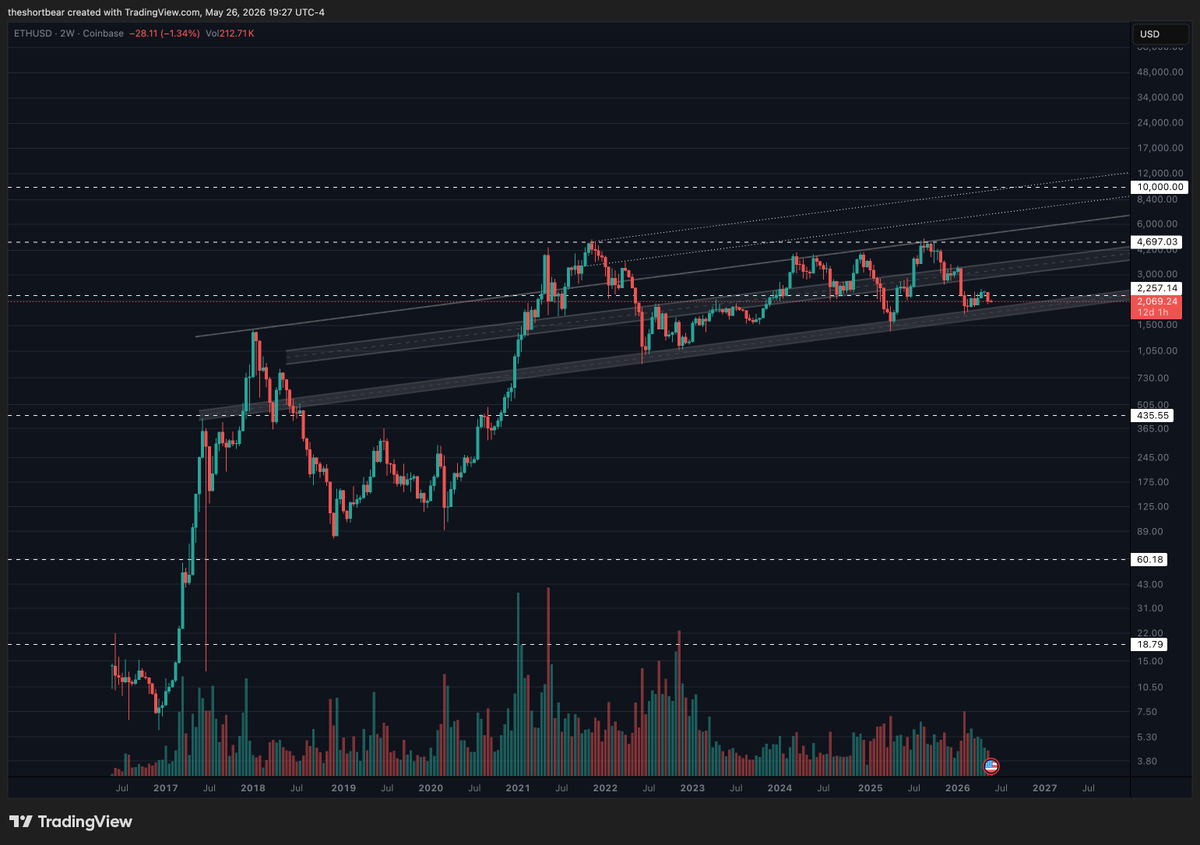
I have never seen so many people capitulating out of $ETH or crypto. Some are writing blogs and essays explaining why it failed, mainly naming how other chains won the race, measured by fees taken in. Some of my thoughts, in these hard times: Time will tell, but I think many people are mistaken in treating $ETH like an end-stage $AMZN, as if the main question is already about mature margins, fees, and cash flows. In reality, Ethereum is still very much earlier in its economies-of-scale phase, with nearly all metrics in the top right corner and growing at mid double digits to tripple. Furthermore, most of the market is focused on the wrong battle: who can become the fastest and cheapest payment processor. Lower fees, higher throughput, faster settlement. But that is likely a race to commoditization, similar to the payment processors crash over the last years. If the only value proposition is speed and cost, then the moat gets thinner over time, easy disruptable. Someone can always be faster. Someone can always subsidize fees lower. Someone can always optimize one narrow use case. The real value may not be in the transaction fee itself. The real value is likely in the amount of economic activity secured by the network, the credibility of that security, the neutrality of the base layer, and the difficulty of replacing it once enough assets, applications, institutions, and users depend on it. That is where Ethereum seems different to me and why so many institutions are choosing $ETH. Most other projects still feel replaceable. They may have better performance in one area, better UX in another, or lower fees in the short term. But if their advantage is mainly technical efficiency, that advantage can be copied, competed away, or made irrelevant. The newest hottest thing today is replacing the hottest thing from last quarter. Ethereum’s bet appears to be much larger: become the most secure, decentralized, credibly neutral settlement layer for the internet economy. Not the cheapest rail. The hardest rail to replace. In the end, the most valuable network may not be the one with the lowest transaction costs. It may be the one people trust most to secure the highest-value assets and applications over the longest period of time. If $ETH can retain its market share while continuing to scale through upgrades that improve speed, throughput, and fees, its potential remains significant, especially if AI agents become truly crypto-native. If it combines all of the above and earn the crown as the leading value-secured network, then $ETH could eventually be viewed as something like a truly decentralized, inflation-adjusting global bond: securing the world’s assets, free from political meddling, and deserving of a premium market cap because of the value it protects on top of the deflationary pressures create incentives to stake, get yield and trust the equivalent of buybacks and griwth in value secured to provide additional value. Keep in mind over 1/3 of $ETH is now staked! In that scenario, $ETH would not just be another asset to hold. It could become one of the only truly neutral and secure bonds for the digital economy. ... But sure, lets compare it to $SOL with 6% inflation, no moat, no security, massive outages, decreasing validator nodes and alike. it just all feels like people are getting lost in short term fees and the easiest valuation attempt rather than what $ETH is actually built for, all while its testing its bottom range and players go full portfolio into AI.
THE SHORT BEAR tweet media
English
155
223
1.6K
206.8K
Romano
Romano@RNR_0·
Btw did you new guys lost so much money yet to the point of coping by saying to yourself at least have both arms, legs and eyes Or was I the only one going through that shit 10y ago?
English
13
1
52
3.7K
Ansem
Ansem@blknoiz06·
my 2026 crypto investment thesis
Ansem tweet media
English
245
68
1.1K
246K
THE SHORT BEAR
THE SHORT BEAR@TheShortBear·
Growing into the winning relationship Holding period and pyramiding/doubling down into a winner or loser have the biggest impact for the aspired master trader. These are not small variables. For the trader who aspires to the top, they are the only true variables. People like to begin with entries. Fine. Entries matter. But the first real work is finding the pockets of edge: small caps, mid caps, large caps, each one becoming over time a liquidity-driven sliding scale forcing the growing trader to shift into a new version of himself. What worked at one size stops working at another. What looked like skill at one level becomes noise at the next. Then comes compounding. Usually through an R system, whether you fully systematize it or compound naturally. Directly or indirectly, you are always measuring risk. You are always deciding how much of yourself to put behind the idea. Then comes noise reduction. Seeing less. Focusing more. Finding structure inside chaos. Learning what not to look at. Learning what not to care about. Putting structural elements (like scanners, prep, automated systems) in place. This is harder than people think, because most traders are not defeated by what they miss. They are defeated by what they cannot stop seeing. Only after that do you earn the right to size exponentially. Adding to winners. Averaging in. Pressing when the trade improves. Holding when the easy exit appears. Accepting that win rate and risk/reward live on a sliding scale, and that every serious trader must eventually decide where he belongs on it. At the end, the game becomes judgment. Can you grade the setup as it moves from bucket to bucket? Can you recognize when a B has become an A, when an A has become an A++, or when the thing you thought was elite was only dressed that way for a few candles? This is most true in deep value. It is also true in parabolic shorts. The opportunity does not arrive fully formed. It reveals itself. Then your sizing and your holding period must adjust to the reality in front of you. So here is the question. Should you wait for the A++ entry when the A is already available? Or would you rather miss the first entry so you can pyramid with greater certainty once the trade begins to prove itself? There is no free answer. There is only the trade-off you can actually live with. Win rates are easy to manipulate. You can raise them by taking profits too early, sizing too small, avoiding discomfort, and calling cowardice discipline. But risk/reward and dynamic sizing are where the real alpha hides. That is where the market wizardry is. Not in being right often. In being enormous when it matters and pushing beyond, by appreciating the power of the true outliers and the range they offer as they reverse (or continue for some breakout strategies). And that privilege is not given cheaply. The ability to push, to pyramid, to become your biggest in the best opportunities, comes only after mastering every earlier step. You do not get to size like a monster because you are excited. You get to size because you have earned precision. You have earned conviction. You have lived through dozens of account pullbacks, recoveries, new highs, false dawns, and near-breaks in belief. Only then can you tolerate a smaller win rate in exchange for a huge winning tail. Only then can you hold the trade long enough for the rare thing to pay you. That part is not technique. That part is earned, respect, held on to like a religion. At the end all that remains is the tail, the tail of the alpha that blows off into account growth. Are you truly able to get to that last stage only depends on building the strong foundation needed to support the monument that might live on in history.
English
23
73
559
30.2K
THE SHORT BEAR
THE SHORT BEAR@TheShortBear·
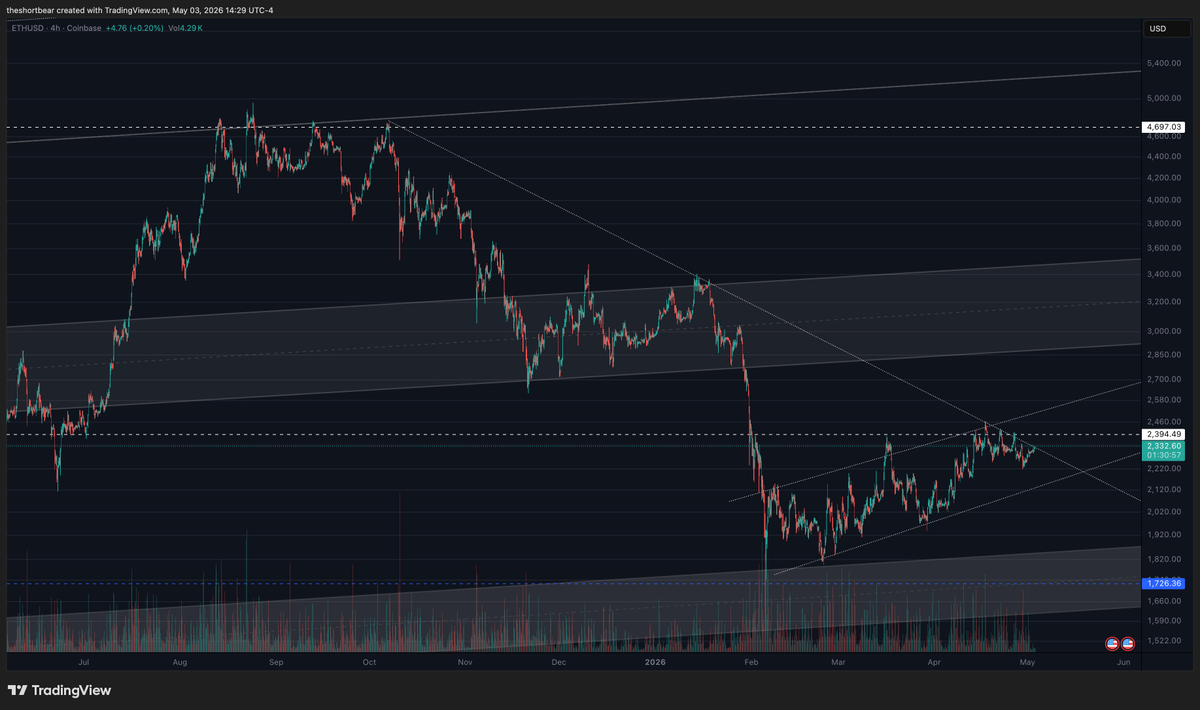
$ETH Important level.
THE SHORT BEAR tweet media
Français
16
16
180
22.1K
Alex Shevchenko 🇺🇦
Alex Shevchenko 🇺🇦@AlexAuroraDev·
10h ago @litecoin experienced a coordinated attack on the chain that resulted in 13 blocks reorg that took more than 3h to generate. During this time attackers were performing double spend attacks on multiple cross-chain swapping protocols. We are investigating the situation.
English
218
421
2.3K
1.2M
TraderHC
TraderHC@traderhc·
Shorts are paying to stay short an asset down 45% from its high. $ETH funding at -3.3% annualized. Open interest flat. That's not a crowded long tape, that's a cleaned-out book. Meanwhile BTC dominance grinding to 57.1% as capital consolidates into the leader. Dominance rising on negative laggard funding has a name in my notes: January 2023. What came next was a laggard squeeze. The line is 2353. ETH closed 20 handles below it. Credit impulse in resolution, factor crowding at 6/100. The macro permission slip for risk re-engagement is signed. I think ETH reclaims 2353 and runs at 2450 this week. Shorts cover first, dominance rolls second. Fail that level into PCE and the leader keeps eating the flows. What's your target?
English
2
0
10
1.8K
peoplewish
peoplewish@Peoplewish·
@Mr_Derivatives Me getting my nips twisted off 4 times trying to short if. 5th times a charm. Monday is the day 😭
English
3
0
9
1.3K
Heisenberg
Heisenberg@Mr_Derivatives·
$CAR What the….
Heisenberg tweet media
English
50
9
287
86.9K
THE SHORT BEAR
THE SHORT BEAR@TheShortBear·
Bought some LEAPS today for $ETH, feels like a spot to try. Good structure, good reaction, 2y out...
English
12
6
253
28K
Dylan Freedman
Dylan Freedman@dylfreed·
I spent months helping @JohnCarreyrou crack the identity of Satoshi. We went far beyond surface-level evidence, collecting hundreds of thousands of internet mailing list posts from 1992-2008. Here are three analyses we performed to find someone who didn’t want to be found:
John Carreyrou@JohnCarreyrou

The mystery of Satoshi Nakamoto, the pseudonymous inventor of Bitcoin, has remained unsolved for 17 years. Not anymore. Read my 18-month investigation to find out who Satoshi really is. nytimes.com/2026/04/08/bus…

English
75
103
900
365.9K
chartpikerrrrrrrrrrr
chartpikerrrrrrrrrrr@chartpiker·
@DeepDishEnjoyer They are also too dumb to understand jokes and primitive memes as that requires second-order thinking. Also geopolitics is too many syllables
English
0
0
3
266
peepeepoopoo
peepeepoopoo@DeepDishEnjoyer·
peepeepoopoo explaining geopolitics and tradfi to a mighty legion of retarded cryptobros using jokes and primitive memes because their attention span is too shot for anything more substantial
English
26
15
886
36.9K
pika2zero
pika2zero@ruggedpikachu·
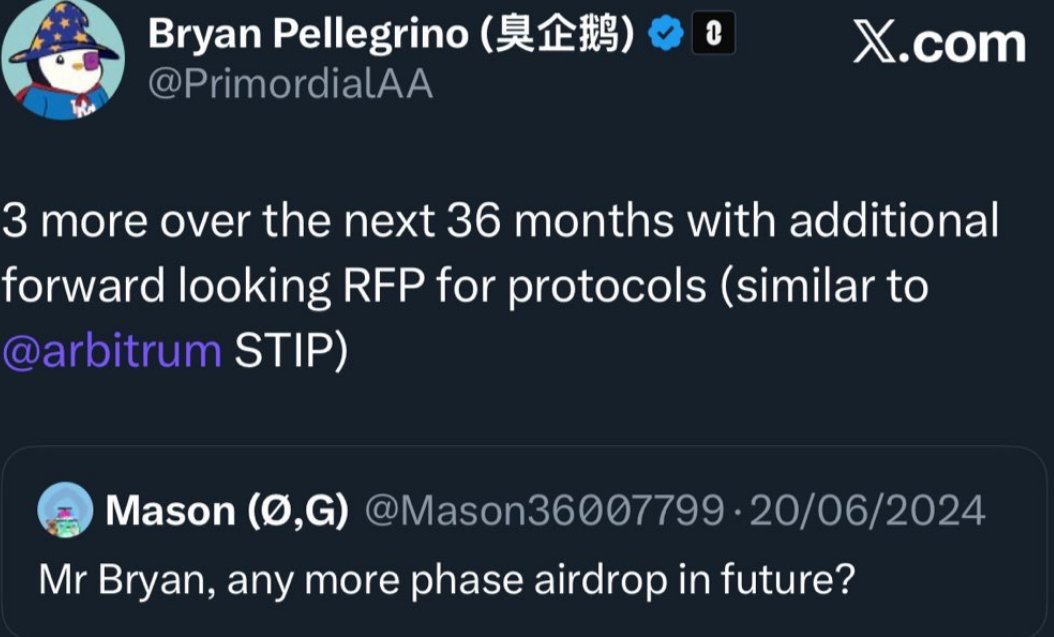
Layerzero promised us 3 more airdrops over the course of three years. Now Bryan comes out and says there will be zero. 2 years later. Farming us for fees the whole time. Never going to use this bridge again. 👌 try across, relay or layerswap instead
pika2zero tweet mediapika2zero tweet media
English
77
39
486
47.1K
THE SHORT BEAR
THE SHORT BEAR@TheShortBear·
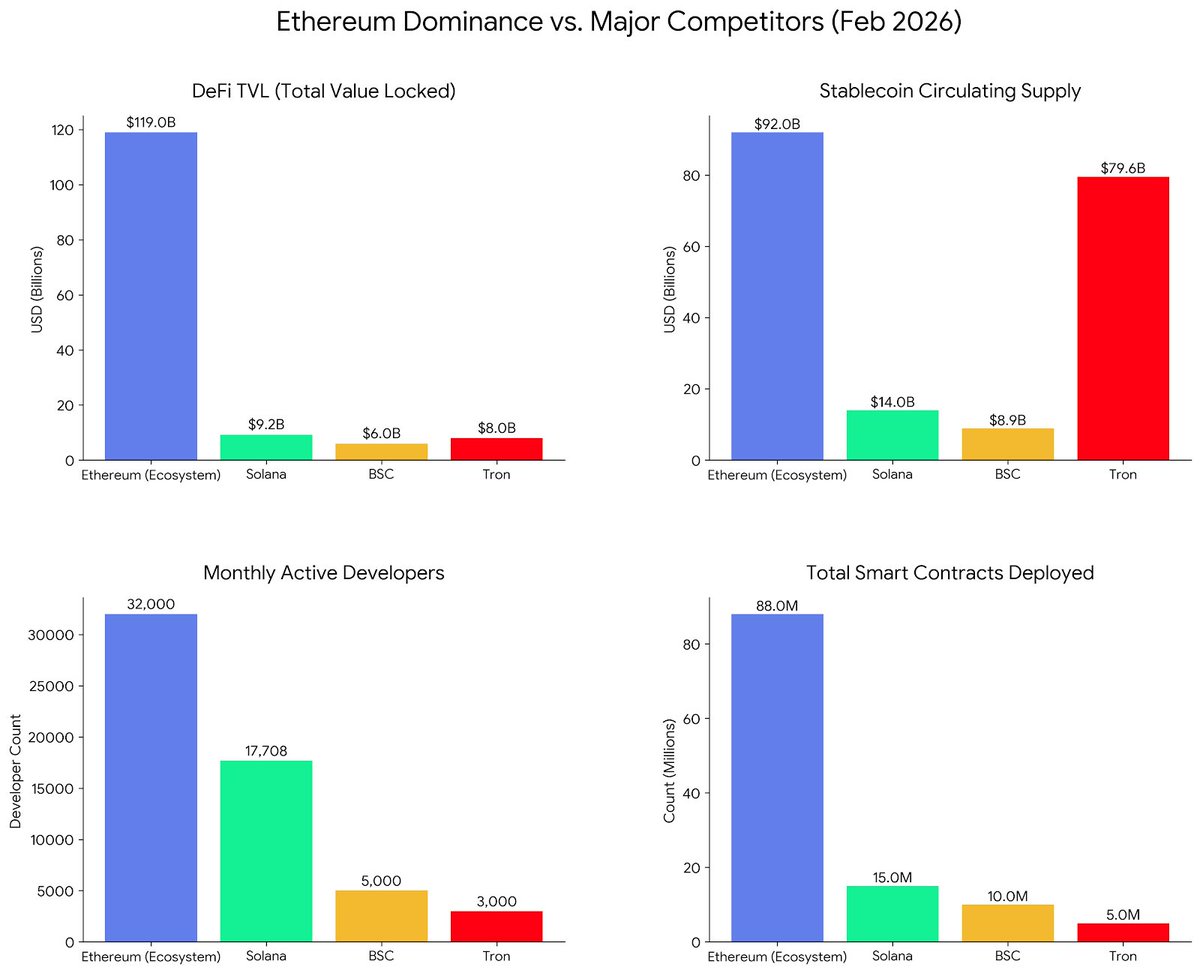
Many Blockchains are being valued through a Throughput basis or Fee-Based Valuation. The focus seems to be the aggregate fees (the total transaction fees collected) or throughput capacity (TPS, transactions per second). This is akin to valuing a marketplace solely on its gross processing fees and checkout speed. It reminds me a lot of the volatility and misunderstanding that economies of scale businesses like $AMZN or $COST would get. But this approach has limitations: 1. Throughput Is a Capacity, Not an Economic Driver Throughput (TPS) measures how much activity a network can handle, but it doesn’t tell us whether that activity has economic substance. High TPS doesn’t necessarily translate to high economic value, just like a highway’s capacity doesn’t mean many cars with valuable cargo are using it. 2. Fee Revenue Can Decline as Adoption Grows Total fees can drop even while usage explodes. Lower fees (e.g., via scaling or efficiency improvements) can widen adoption, bringing more users and utility even as the aggregate fees compress. On some blockchain, fees are down significantly from prior peaks while usage metrics like daily transactions and active wallets have grown massively. 3. Fee Focus Encourages Short-Term Profit Metrics Networks with utility beyond simple transactions (like identity, attestations, or machine agent interactions) may generate value without traditional fee flows. A reliance on fees alone ignores emergent uses, for example AI agent activity or smart contract actions that don’t generate large fees but expand ecosystem lock-in. A better way to Value a Blockchain-Like Network What $ETH actually is A settlement, security, and coordination layer for: -many execution environments (rollups) -many business models -many future use cases not yet monetized Value comes from how much economic activity relies on it, not how much it extracts today. The four real demand drivers 1. Security demand 2. Assets and transactions rely on ETH finality. This is insurance-like value, not revenue. 3. Collateral & monetary premium 4. ETH is staked, posted as collateral, and held long-term → low velocity, balance-sheet demand. (5. ETH owns the right to settle future activity (AI agents, RWAs, machine payments).) 6. Near-zero net issuance + burn = higher value capture per unit of adoption. ETH should be valued as a scarce, yield-bearing coordination asset securing a growing share of digital economic activity, not as a fee-maximizing transaction network, and current models systematically underprice that. This mirrors how scale-first businesses like Amazon were long misvalued when judged on near-term margins rather than expanding reach. By relentlessly compressing unit prices, they grew usage, entrenched themselves in critical workflows, and unlocked future profit pools. This is a network effect x economies of scale story, just like prior examples it is focused on creating infrastructure, not in locking in dollars right away at the cost of dominance. $ETH is slowly but surely becoming more efficient and cheap to run all while being more secure, cared for and built on. If you can build faster, cheaper and more secure via $ETH, why chose another chain? Level 2s make sure any very specific need is covered and becomes a sort of App store for the secure environment. The more project leaders, business leaders and users join, the bigger the network effect and the more exponential the growth. Monetizing becomes a final state but through low margins and massive scale. This is the only way to secure the network fully and make it the absolute leader. $ETH remains the clear leader:
THE SHORT BEAR tweet media
Jamie Coutts CMT@Jamie1Coutts

Crypto's 2025 scorecard reveals a two-speed economy. Utility grew through the drawdown: stablecoins +50%, settlement +18%, P2P volumes +31%, apps +36%. Speculation collapsed: chain fees -77%, transactions -51%, revenue -49%, DAUs -16%. While not for the first time (2022 was similar), utility diverges from speculation in a downturn. The rails kept growing. The marginal speculator left for AI. The problem: blockchains are still priced on speculative throughput. That's the revenue that pays the bills, and it fell off a cliff. The fix requires bringing more assets on-chain: tokenised equities, fixed income, RWAs. The Clarity Act is the bridge but that's a coin flip for passing in 2026 (polymarket.com/event/clarity-…). AI agents will be the other massive driver, but the flows are not yet there yet to convince capital markets that it is real. The window for catalysts to converge is mid-2026. If Clarity passes and AI agent transaction volumes emerge, the re-rating case is strong. If neither materialises, the two-speed economy persists: stablecoins and tokenisation still grow, but more slowly, and valuations grind lower. Watch both.

English
22
11
116
28.8K