

Emily Wearing
431 posts

Emily Wearing
@chem_em
University of Michigan Chemistry | PhD Candidate in the Schindler Lab | B.S. in Chemistry from Cal Poly SLO | she/her
Katılım Eylül 2019
553 Takip Edilen610 Takipçiler

I'm really excited to see this out now in JACS! Morpholine synthesis from common amino alcohols using an affordable commercial reagent! Let's freaking go!!!
pubs.acs.org/doi/10.1021/ja…
English
Emily Wearing retweetledi

Congratulations @ChristheChang postdoc Cheng Yang @ChengChem, named a @DamonRunyon Fellow for his work to develop methionine sulfoxide labeling approaches. #CancerResearch
Well done, Cheng! Here’s the announcement: bit.ly/4dSpLfi

English
Emily Wearing retweetledi

Our latest work published in Science is featured on the University of Michigan’s main website today! @UMich @MichiganChem A great way to highlight the importance of chemistry and the success of our research! umich.edu
English
Emily Wearing retweetledi

Hey to all you great Chemists: come be my colleague at @MichiganChem!
chemistryjobs.acs.org/job/40427/univ…
English
Emily Wearing retweetledi

What a bittersweet moment! Thank you Melanie and @Sanford_Lab for the wonderful past 5 years ✨Couldn’t have asked for a more welcoming and supportive group & advisor 💖
Thank you to my family, friends, @MichiganChem, and all of my mentors who made this possible!
#PhDone 🎓🍾🇵🇷


English

Emily Wearing retweetledi

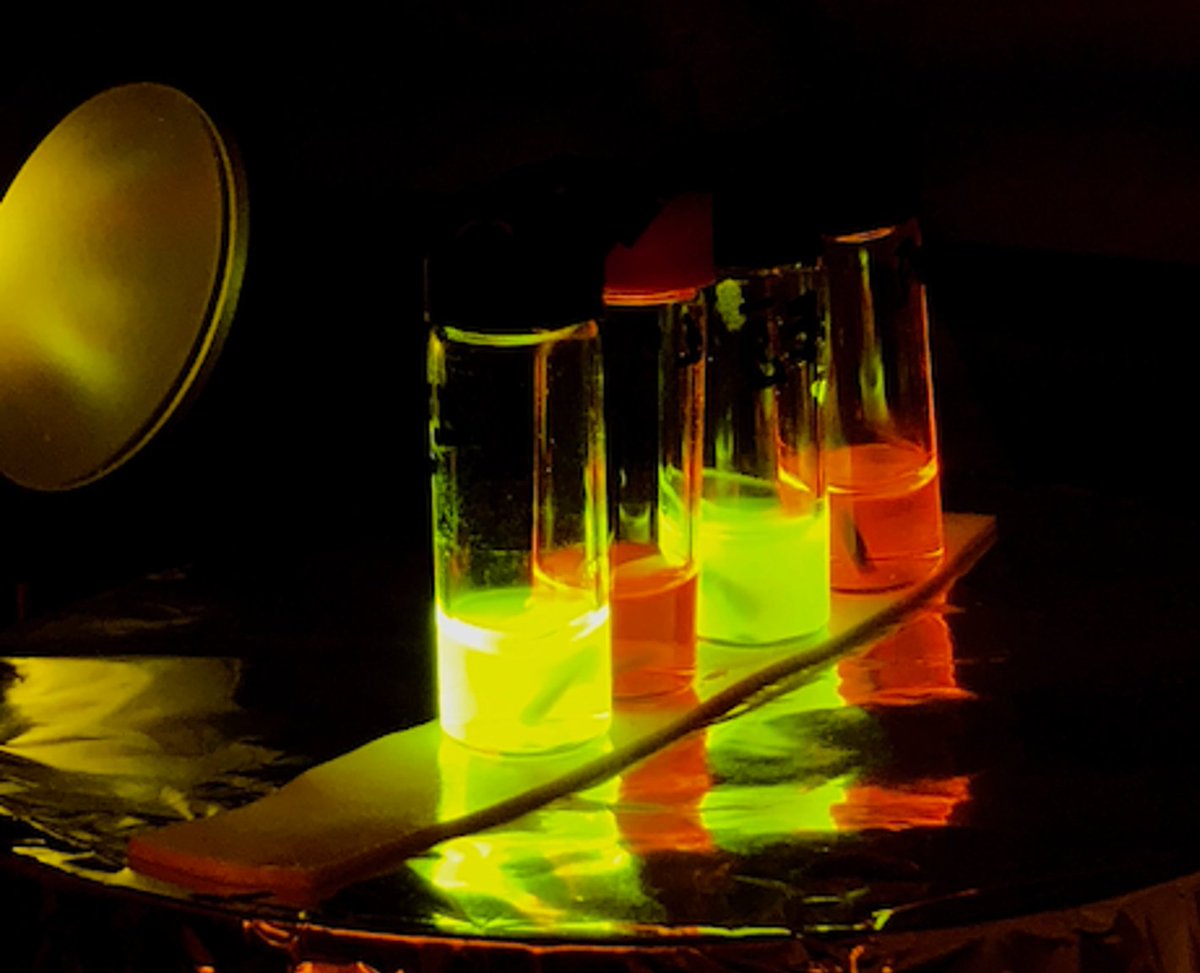
Using visible light to make pharmaceutical building blocks
University of Michigan chemists have discovered a way to use visible light to synthesize a class of compounds particularly well suited for use in pharmaceuticals.
The class of compounds, called azetidines, had been previously identified as a good candidate to build therapeutic drugs, but the compounds are difficult to produce in chemical reactions. Now, a team led by @UMich chemists @chem_em and @SchindlerLab have developed a method to produce a specific class of azetidines called monocyclic azetidines using visible light and a photocatalyst. Their results are published in the journal @ScienceMagazine.
Approximately 60% of pharmaceutical drugs contain building blocks in the form of compounds called nitrogen heterocycles. Nitrogen heterocycles are structures of atoms organized in a ring that contain at least one nitrogen atom, the most common of which have five- and six-membered ring systems. These systems are often used as building blocks in pharmaceuticals.
“These building blocks are very accessible and you can put them together like Legos to build compounds that we can then use for chemical or medicinal testing. But the problem is that a lot of these five or six membered ring systems are not as stable as you’d want them to be,” Schindler said.
“The ring systems can break down in the body after a patient has ingested a therapeutic drug. Because the compound can be metabolized by the human body, what you give initially to a patient may not necessarily be what you would find in the body after the patient has taken it, and that is a problem.”
Instead, researchers suggest using monocyclic azetidines, a more stable four-membered ring system. But, says Emily Wearing, lead author of the study who recently earned her doctorate from Schindler’s lab, the key reactions chemists use to produce azetidines have specific challenges.
The reactions either can’t be widely applied or they only produce azetidines with specific substitution patterns. Researchers want to produce azetidines with different substitution patterns because this allows researchers to try a variety of the molecule as building blocks in drug synthesis and drug screening.
Further, the U-M researchers used a method called a [2+2]-cycloaddition to create monocyclic azetidines. This method usually requires photoexcitation, or the excitation of atoms or molecules in a compound through the absorption of energy, according to Schindler. In other words, the reaction needs light.
In the reaction, the researchers used two classes of compounds called acyclic imines and alkenes, which are highly desirable as starting materials because they can be easily varied to produce different products, Wearing says. However, when you use light to excite the imine, the acyclic imine decays from the excited state before it can undergo the cycloaddition, Schindler says.
Previously, there has been a successful example of this reaction, Wearing says, but it used ultraviolet light, which presents safety challenges, and it used different imines and alkenes.
“This also means access to these highly desirable monocyclic azetidine building blocks is much more limited using this approach,” Wearing said. “The use of visible light versus UV light is an important benefit, but our key discovery was being able to use a visible light approach to produce monocyclic azetidines.”
Their method uses visible light and a photocatalyst to allow access to the required excited state intermediates in what’s called an aza Paternò-Büchi reaction. To determine exactly why the reaction worked, Schindler’s lab teamed up with the lab of Heather Kulik, associate professor of chemical engineering at @MIT.
Her lab ran a computational analysis that found using specific classes of the imines and alkenes starting materials would facilitate a better match in energy between those starting materials, which lowered the barrier for reaction. They also analyzed what factors led to high yields of azetidines.
When researchers develop a new reaction like this, they also need to show that it can work for many combinations of substrates, according to Seren Parikh, a graduate student in Schindler’s lab. He and postdoctoral research fellow Yu-Cheng Yeh showed that the team’s reaction could work on multiple versions of imine and alkene compounds.
“Someone might show that a new reaction works, but if it only works on a single compound, it is not useful to anyone because pharmaceutical companies are likely wanting to use the reaction on their unique compound,” Parikh said. “What we can do is show that the reaction works on a diverse range of substrates to essentially prove that the reaction is worth the pharmaceutical company’s time to try.”
Parikh and Yeh were able to show that they could produce six biologically relevant azetidine compounds, including using the reaction to attach an azetidine to an estrogen derivative, a natural steroid in the human body. Yeh also used this method to synthesize analogues of penaresidin B, which has been shown to be toxic to tumor cells. This is the first total synthesis of this natural product using the [2+2]-cycloaddition
“The synthesis of these azetidine compounds are examples to demonstrate that this synthetic methodology can be applied to make complicated molecules and medicine-like molecules,” Yeh said.
Understanding what makes this chemical reaction work will allow the group and the field of medicinal chemistry to design related reactions in the future. New work can build upon this design principle to access other azetidines to be incorporated into new pharmaceuticals, Schindler says.
“Now we can access these types of building blocks that people have wanted for a long time, but couldn’t directly access,” she said. “The process we have developed can now be used in the future as basically a blueprint for future reaction development.”
English
Thank you for covering our recent work! Using visible light to make pharmaceutical building blocks news.umich.edu/using-visible-…
English
Emily Wearing retweetledi

Researchers demonstrated a novel azetidine assembly method by synthesizing an analog of penaresidin B, an alkaloid found in sea sponges: cen.acs.org/synthesis/rule… .
English
Emily Wearing retweetledi
Thank you to C&EN and Brianna Barbu for a great piece covering this story today: cen.acs.org/synthesis/rule…
English
Emily Wearing retweetledi
This has been a long time in the making! A great collaboration with @KulikGroup as part of @CciMonet at @MichiganChem @MIT and @UBC - overcoming inherent challenges in the photochemical excitation of acyclic imines! science.org/doi/10.1126/sc…

English
Emily Wearing retweetledi

Our collaboration with @SchindlerLab is out in @ScienceMagazine!
We found that tuning frontier orbital energies enables the generalization of this powerful photo-catalyzed reaction!
science.org/doi/10.1126/sc…
Congratulations to @chem_em, @ggterrones, @KevlishviliIlia and @CciMonet!
English
I am very excited to share our (@SchindlerLab @KulikGroup) paper in @ScienceMagazine reporting our new aza Paternò-Büchi reaction of acyclic oximes and alkenes! Thank you to all the authors Yu-Cheng Yeh, @serenparikh, @ggterrones and @KevlishviliIlia
science.org/doi/10.1126/sc…
English
Emily Wearing retweetledi
Excited and honored to take on this new role on behalf of my team at @UBC as a Canada Research Chair in Synthetic Solutions for Bioactive Compounds! Thanks to everyone who supported my lab over the past eleven years!
English
Emily Wearing retweetledi

🚨 Our first Science paper 🚨
We report the isolation and reactivity of the first “inaccessible” 5-membered heteroaryne! 120+ year challenge! Congrats @jennahumke @belli_roman @ErinPlasek @Sal_K_3 @annabelly24 @CortnieRoberts @UMNChemistry @ScienceMagazine science.org/doi/10.1126/sc…
English

Thank you Courtney! Joining your group was the best decision I ever made. Thanks for the endless support, encouragement, and mentorship! 👩🔬
English
The PhD has been fun, the Boehringer internship has been a blast...
But Dr. Ortiz, Process Chemist - Vertex just has a really nice ring to it ☺️
English
@mramirez9409 @UMNChemistry @UMNews Congratulations Melissa! I can't wait to see the exciting science from your lab 🥳🧪
English

Ecstatic to share that I’ll be starting the Ramirez laboratory in the Department of Chemistry at the University of Minnesota, Twin Cities this January 2025! 🧪 🧪 @UMNChemistry @UMNews


English
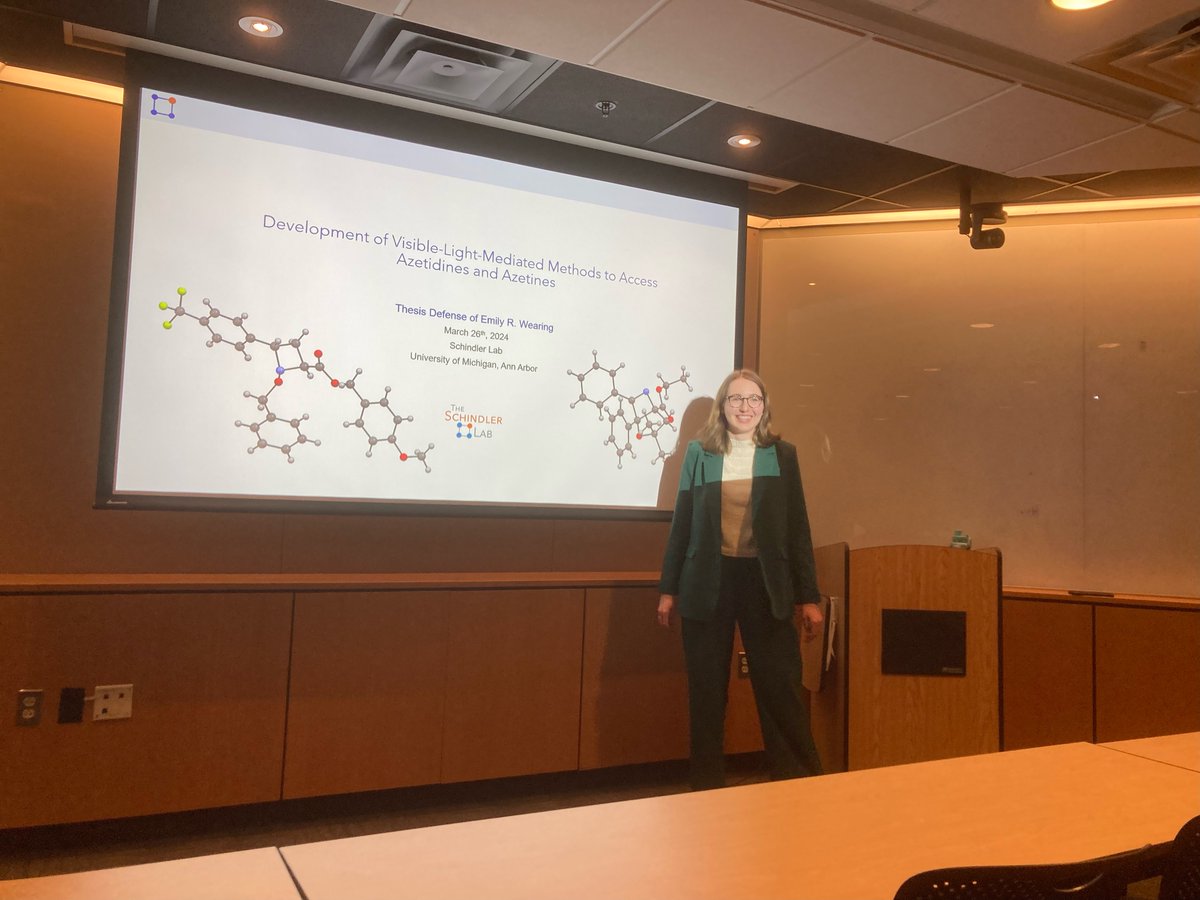
So excited to have defended my dissertation this week! I am very thankful for @SchindlerLab and the incredible experience I have had in the group and at @MichiganChem. Thank you to everyone who came to see my work and support me!
English