
Sabitlenmiş Tweet
Chileanor
1.3K posts


Chileanor
@chilleanor
worlding-a-world-through-language
possible world Katılım Eylül 2019
739 Takip Edilen60 Takipçiler
Chileanor retweetledi

Dan is another brilliant young philosopher with a great deal to offer: this excellent essay gets right to the point "Powerful people often speak the truth; the powerless often speak nonsense; and very often nobody—neither the powerful nor the powerless—has a clue what is going on, which is why we need rigorous, trustworthy, truth-seeking epistemic institutions in the first place."
Dan Williams@danwilliamsphil
In a new essay, I argue that the widespread embrace of an ethos of “speaking truth to power” too often produces intellectual inquiry that is lazy, self-deceived, and self-defeating: conspicuouscognition.com/p/speaking-tru…
English
Chileanor retweetledi

A Oxford PhD student got flagged for submitting AI-generated work.
His advisor called it the most sophisticated research process he had seen in 20 years.
The student had not used AI to write a single word.
Here is the workflow that got him reported.
He starts every essay with a diagnostic he calls brutal. He dumps his rough argument into Claude and asks one question: what are the three weakest logical jumps in this reasoning, and where would a hostile examiner attack first? The AI does not write his essay. It destroys his draft, and then he rebuilds from whatever survives.
Most students using AI are doing the opposite. They hand Claude a topic and ask it to write. He hands Claude his thinking and asks it to find every place where that thinking falls apart. The difference between those two approaches is the difference between outsourcing your brain and sharpening it.
The second step is the one that made his advisor go quiet. He uploads the five most important papers in his field alongside his draft and asks Claude what claims in his argument contradict or oversimplify what these authors actually found. Most PhD students cite papers they have skimmed once. He cites papers he has been forced to genuinely reckon with, because Claude keeps catching the places where he got them wrong.
The final move is almost unfair. Before he submits anything, he pastes his conclusion and runs one more prompt. He asks what a philosopher of science would say is missing from this argument and what assumptions he is making that he has not defended. His essays come back from reviewers with phrases like unusually rigorous and demonstrates rare critical depth, and his committee has no idea that the depth came from a machine asking him harder questions than any human in his department was willing to ask.
The academic integrity hearing lasted three hours. The panel asked him to rebuild his methodology from scratch in the room. He opened his laptop and showed them exactly how the workflow ran, prompt by prompt. They did not just clear him. They gave him the highest grade in the department's history and asked him to present the process to faculty.
Here is what that story actually means. What took most PhD candidates six months of back-and-forth with advisors, he was compressing into a single session because he had figured out something almost nobody else has. AI does not make your thinking better by replacing it. It makes your thinking better by attacking it faster than any human critic ever would.
He was not using AI to write. He was using it to think harder than he could alone.
The tool is the same one everyone has. The workflow is the part nobody is teaching.
English
Chileanor retweetledi

Google CEO tries to tell University students to love AI.
They tell him to BOO off.
This is what most people think of the hated AI, we don't want it.
English
Chileanor retweetledi

Something unexpected, and slightly worrying, is happening.
Ten days ago, I posted a preprint introducing the concept of LLMorphism: the biased belief that human cognition works like a large language model.
The preprint received an unusual amount of attention.
Hundreds of comments on social media and forums.
Reels on Instagram and TikTok.
YouTube videos.
Infographics for students.
And now it has even made it to Forbes.
It seems that I got some sort of zeitgeist.
Many people were already thinking about this.
Many people had already experienced it.
But they were missing a name and a theoretical framework.
So, here it goes:
LLMorphism is what happens when people start to see themselves as language models.
The psychological mechanism is analogical trasfer combined with metaphorical availability: LLMs become an available metaphor for cognition, and people project that metaphor back onto themselves.
The machine becomes the model of the human.
And this worries me because the risk is not only that we overestimate machines.
It is also that we underestimate ourselves: our embodied experience, our goals, our emotions, our responsibility, and our capacity for understanding.
*
Full paper in the first reply.
English
Chileanor retweetledi

Academia is cruel because it selects for people obsessively interested in a narrow topic, but what’s actually rewarded is the ability to pivot fluidly to whatever’s new and fundable.
English
Chileanor retweetledi

Chileanor retweetledi

Chileanor retweetledi


Chileanor retweetledi


Chileanor retweetledi

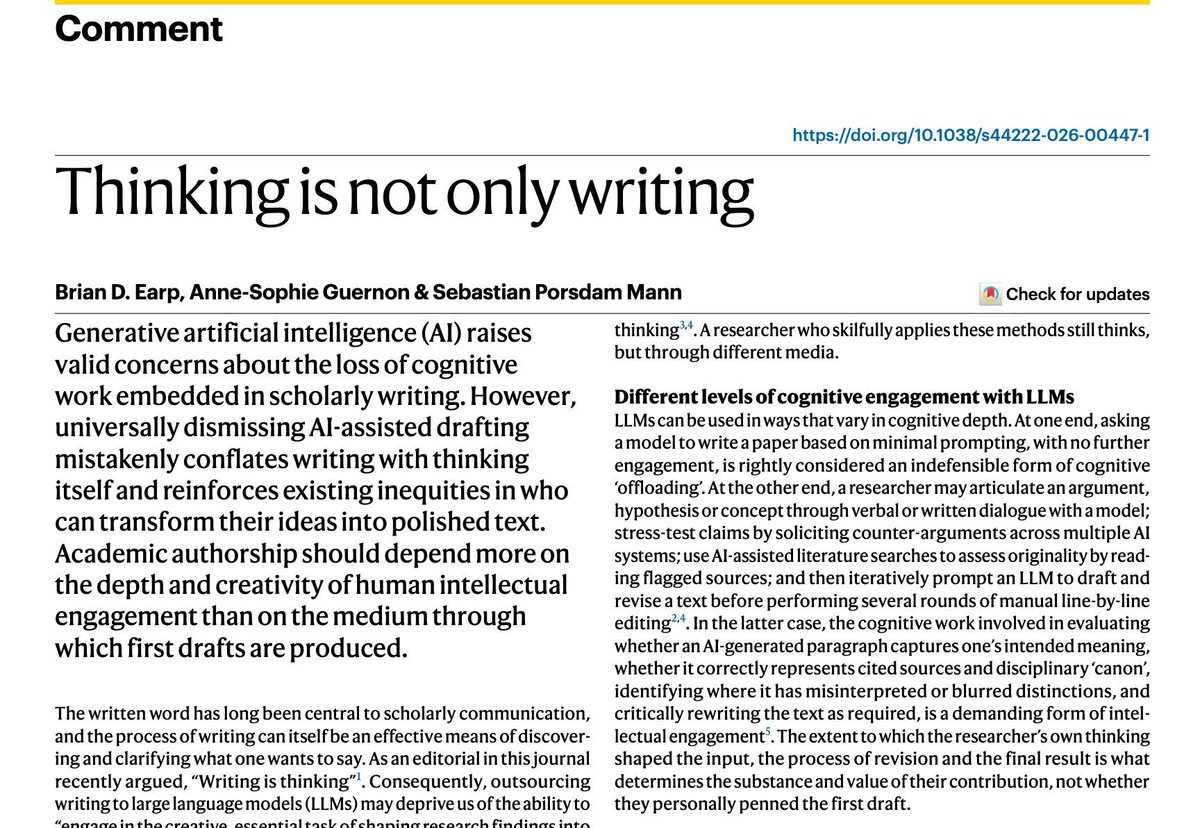
"Writing is thinking." This phrase went viral recently (from lnkd.in/gYj2c9uE), often quoted in the context of objections to use of AI in drafting academic prose. In Nature Reviews Bioengineering we respond: "Thinking is not only writing." Preview below. Shareable full access link: rdcu.be/fiuYi
English
Chileanor retweetledi

Harvard Business Review research reveals that excessive interaction with AI is causing a specific type of mental exhaustion ( or "AI brain fry"), which is particularly hitting high performers who use AI to push past their normal limits.
A survey of 1,500 workers reveals that AI is intensifying workloads rather than reducing them, leading to a new form of mental fog.
While AI is generally supposed to lighten the load, it often forces users into constant task-switching and intense oversight that actually clutters the mind.
This mental static happens because you aren't just doing your job anymore; you are managing multiple digital agents and double-checking their work, which creates a massive cognitive burden.
The study found that 14% of full-time workers already feel this fog, with the highest impact seen in technical fields like software development, IT, and finance.
High oversight is the biggest culprit, as supervising multiple AI outputs leads to a 12% increase in mental fatigue and a 33% jump in decision fatigue.
This isn't just a personal health issue; it directly impacts companies because exhausted employees are 10% more likely to quit.
For massive firms worth many B, this decision paralysis can lead to millions of dollars in lost value due to poor choices or total inaction.
Essentially, we are working harder to manage our tools than we are to solve the actual problems they were meant to fix.
---
hbr .org/2026/03/when-using-ai-leads-to-brain-fry

English

“There are two possible approaches to the question of what is just. One theory says that the answer depends upon the answer to a further question, namely: What counts as excellence in a human being?
The liberal rejects that notion of justice. He says that justice has a call upon institutions which is independent of any particular notion of what the good life is.”
—Ronald Dworkin on John Rawls' Liberalism
English
Chileanor retweetledi

"If the benefits of the increased productivity can be shared equally, it will be a wonderful advance for all of humanity."
Geoffrey Hinton conveyed an urgent message about the risks of artificial intelligence in his Nobel Prize banquet speech in December of 2024. Have we heeded his warning?
English
Chileanor retweetledi
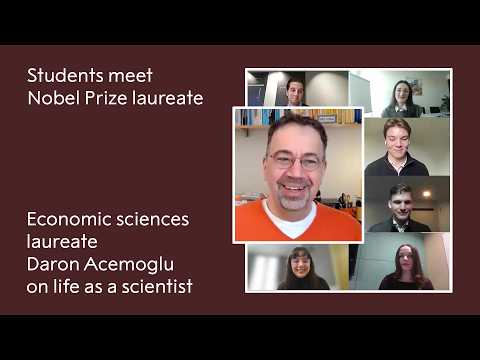
"Don't let other people write your paper."
Economic sciences laureate Daron Acemoglu spoke to nine students around the world and shared his best career advice.
Watch the full conversation: youtu.be/K3_B4CyGpdo?si…
YouTube
English
Chileanor retweetledi
G.A. Cohen — the funniest philosopher ever to live — gives his best impression of his supervisor at Oxford, Gilbert Ryle.
English
Chileanor retweetledi
Dunning-Kruger Tweet of the day! Congratulations!
English
Chileanor retweetledi
"It’s entirely possible that Claude is, in fact, having conscious experiences of some sort."
No it isn't. It's not complicated. The "hard" problems of philosophy simply don't apply. We know how Claude generates its output. It's entirely impossible that consciousness is involved.
Dr. Émile P. Torres (they/them)@xriskology
Is Richard Dawkins' recent article about AI consciousness silly? Yes. He seems to fall victim to the very cognitive tendency he claims gave rise to religion: a hyperactive agency detection device. BUT, the question of AI consciousness is complicated. I explain why here:
English