Chloé de Canson

162 posts

Chloé de Canson

Chloé de Canson

@chloedecanson

formerly assistant prof in philosophy @wijsbegeerte • now bedbound w myalgic encephalomyelitis/long covid

Katılım Ocak 2024
72 Takip Edilen176 Takipçiler
Chloé de Canson retweetledi
Robin McKenna
Robin McKenna@rbnmckenna86·
This paper argues in defence of doing your own research, based on several case studies of successful research carried out by patient activists. It contains some related reflections on expertise and the difference between credentials and having knowledge. #abstract" target="_blank" rel="nofollow noopener">tandfonline.com/doi/full/10.10…
English

2
11
27
1.5K
Chloé de Canson retweetledi
ME/CFS Science
ME/CFS Science@mecfsskeptic·
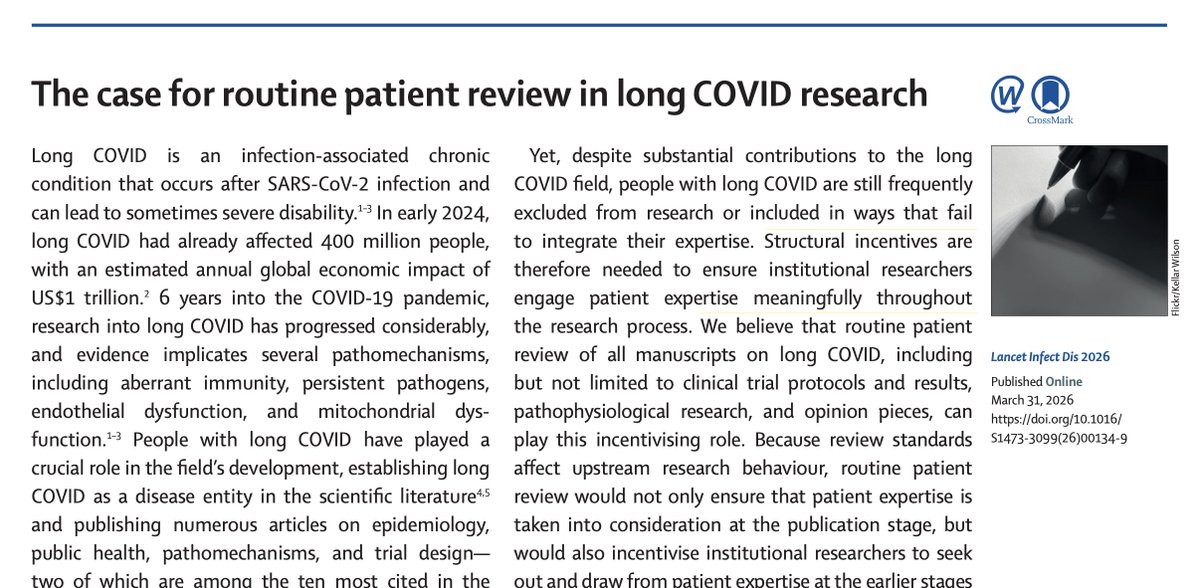
1) A new article in The Lancet Infectious Diseases calls for "routine patient review of all manuscripts on long COVID, including but not limited to clinical trial protocols and results, pathophysiological research, and opinion pieces"
ME/CFS Science tweet media
English
2
11
34
1.6K
Chloé de Canson
Chloé de Canson@chloedecanson·
@SalvMattera And I don’t want to wait until we do to run trials, so imo we can’t just dismiss patient reported outcomes at this stage, to supplement candidate biomarkers)
English
0
0
0
8
Chloé de Canson
Chloé de Canson@chloedecanson·
@SalvMattera I dont want to speak for the rest of the authors but the examples you give are exactly the kind of thing I imagine patient reviewers would bring up and that’s why I think it’s important. (I do think the first point abt objective endpoints is tricky bc we don’t have biomarkers yet
English
1
0
0
9
Salvatore Mattera
Salvatore Mattera@SalvMattera·
I broadly agree with the sentiment - almost all research on Long COVID is trash - but the key concern raised (researchers conflating PEM with fatigue) doesn't touch on the real issues. Those are: (1) Lack of objective endpoints. This leads to trials like the fluvoxamine trial where we can't tell if the drug actually does something for LC, or if they were just treating undiagnosed depression. (2) Conflicts of interest, like Putrino telling people a magnet hat literally made by two of his co-authors can treat their brain fog. (3) Extremely basic, science 101 stuff, like lack of placebo control. The lumbrokinase trial falls into this bucket. If it shows positive results, it will likely just be due placebo effect. (4) Poor definitions of Long COVID, such as researchers using medical billing codes that are widely known to understate the scope of the problem. Conflating PEM and fatigue can be a real problem in a trial that tests GET and/or CBT. But that problem could be better solved by measuring objective biomarkers.
Chloé de Canson@chloedecanson

Many Long COVID scientists fail to meaningfully draw on the insights of patient-researchers. In our Comment for @TheLancetInfDis, we propose a solution: make all Long COVID papers undergo pre-publication patient review. 1/

English
5
4
41
2.1K
Chloé de Canson
Chloé de Canson@chloedecanson·
@liamsLCjourney There’s more than social media engagement though: some of them have patient co-authors, patient advisers, etc. One could be on social media and ignore all feedback; and conversely, one could not be on social media but very actively engage with patients
English
0
0
2
41
Liam's LC/ME Journey
Liam's LC/ME Journey@liamsLCjourney·
@chloedecanson @TheLancetInfDis I'm thinking of doing a quick analysis. It should be decently straightforward to pull the top paper publishers in Long COVID and ME and then figure out how active they are on social media.
English
1
0
1
65
Chloé de Canson
Chloé de Canson@chloedecanson·
Many Long COVID scientists fail to meaningfully draw on the insights of patient-researchers. In our Comment for @TheLancetInfDis, we propose a solution: make all Long COVID papers undergo pre-publication patient review. 1/
Chloé de Canson tweet media
English
6
34
81
12.5K
Chloé de Canson
Chloé de Canson@chloedecanson·
@liamsLCjourney @TheLancetInfDis There is a lot of variability. Some fields and some researchers are a lot better than others on this point. It would be an interesting thing to measure!
English
1
0
1
101
Liam's LC/ME Journey
Liam's LC/ME Journey@liamsLCjourney·
@chloedecanson @TheLancetInfDis I'm new to the disease academia world - how common is it for researchers to engage with patients? The engagement of LC/ME researchers with the community seems incredibly low, but I'm curious what the base rate is in general for other conditions.
English
1
0
5
196
eIisa
eIisa@mildTin·
@chloedecanson I dont think your 20 people deciding who gets to be in this field is optimal for the lc patient population
English
1
0
0
111
eIisa
eIisa@mildTin·
Thousands of papers on LC are published annually, the admin infrastructure needed to build a parallel patient review system would be incredible. How many science literate patients are there who are mild enough to regularly review papers. This also adds 1y+ to every publication
Chloé de Canson@chloedecanson

Many Long COVID scientists fail to meaningfully draw on the insights of patient-researchers. In our Comment for @TheLancetInfDis, we propose a solution: make all Long COVID papers undergo pre-publication patient review. 1/

English
2
2
12
2K
Dreamy Run
Dreamy Run@dreamy_run·
@chloedecanson @TheLancetInfDis And patient consultants/reviewers should be paid for their work. Poor, sick people shouldn't be expected to volunteer our time.
English
1
0
5
173
Chloé de Canson
Chloé de Canson@chloedecanson·
@mildTin Many papers are already rejected! At a top journal, the acceptance rates are in the single digit percentages. Yet people try very hard to be published there. But if researchers agree to be in the field only if they can ignore our needs, I’m not sure we need them that much
English
1
0
4
101
Chloé de Canson
Chloé de Canson@chloedecanson·
@mildTin That’s not my experience. I could find you twenty people willing and capable of reviewing a paper on LC within two weeks by tomorrow. And I’m just one person! I think tapping in the existing patient org infrastructure has a lot of potential
English
2
0
4
116
Chloé de Canson
Chloé de Canson@chloedecanson·
@mildTin As for the need for science literacy: the aim isn’t to have patient reviewers who are experts in the technical details of the paper (there are peer-reviewers for that), but to ensure that research reflects patient insights and meets patient needs
English
1
0
2
59
Chloé de Canson
Chloé de Canson@chloedecanson·
@mildTin As we argue in the paper (see also the thread), the anticipation of patient review creates an incentive to engage with patients from the very start of the research project, to avoid a situation where the paper is rejected based on patient comments at the review stage
English
2
0
5
108