Christian Kaiser

1.5K posts

Christian Kaiser

Christian Kaiser

@chrisk0

Maximizing the evidence for my own existence. Cogito ⇔ sum.

Scotts Valley, CA Katılım Şubat 2009
442 Takip Edilen289 Takipçiler
Christian Kaiser
Christian Kaiser@chrisk0·
Instead of switching to “founder mode” to work around having hired untrustworthy managers, spend some of your time to pay attention to how your managers operate. Sniff out the self-interested ones, fire them and hire ones who will consistently operate in service of the company. That strategy will actually scale and not disempower your great managers.
English
0
0
0
47
Christian Kaiser retweetledi
Yann LeCun
Yann LeCun@ylecun·
@GReal1111 @Andercot Yes, variational Bayesian inference and what Karl Friston calls active inference through the free energy principle are essentially the same thing. The zero-temperature limit is deterministic inference by energy minimization.
English
2
9
45
9K
Christian Kaiser
Christian Kaiser@chrisk0·
Controversial opinion: If you allow career-focused people to be hired or grow quickly at your company, you shouldn’t be surprised when a few years down the road, your entire leadership team is great at optimizing their career, and *maybe* also at moving your business forward.
English
0
0
1
123
Christian Kaiser retweetledi
Prof. Feynman
Prof. Feynman@ProfFeynman·
Direction is more important than speed.
English
200
3.8K
16.7K
1.3M
Christian Kaiser retweetledi
Adam Grant
Adam Grant@AdamMGrant·
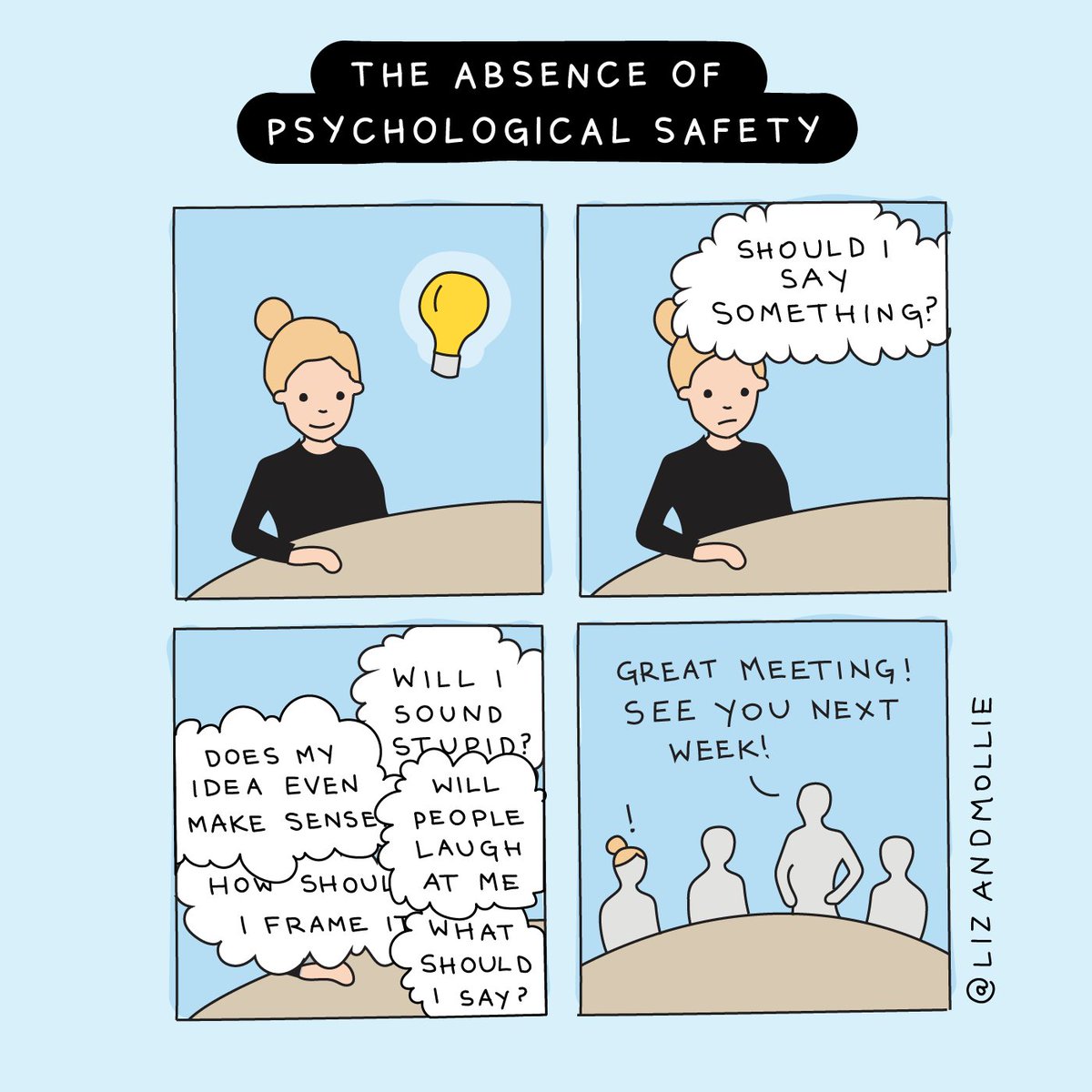
Don't confuse psychological safety with "safe spaces." Safe spaces treat people as fragile and dissenting ideas as threats. Psychologically safe environments build the capacity to embrace and learn from respectful disagreement. Exposure to diverging views is fuel for growth.
Adam Grant tweet media
English
59
811
3K
729K
Christian Kaiser
Christian Kaiser@chrisk0·
@ylecun “Even *within* the human species It's wrong: it's *not* the smartest among us who dominate the others.” True. At scale, people who can *leverage* the smartest humans dominate. But there’s only a limited supply of smart humans who will serve unethical goals. Machines won’t care.
English
0
0
0
56
Yann LeCun
Yann LeCun@ylecun·
Once AI systems become more intelligent than humans, humans we will *still* be the "apex species." Equating intelligence with dominance is the main fallacy of the whole debate about AI existential risk. It's just wrong. Even *within* the human species It's wrong: it's *not* the smartest among us who dominate the others. More importantly, it's not the smartest among us who *want* to dominate others and who set the agenda. We are subservient to our drives, built into us by evolution. Because evolution made us a social species with a hierarchical social structure, some of us have a drive to dominate, and others not so much. But that drive has absolutely nothing to do with intelligence: chimpanzees, baboons, and wolves have similar drives. Orangutans do not because they are not a social species. And they are pretty darn smart. AI systems will become more intelligent than humans, but they will still be subservient to us. They same way the members of the staff of politicians or business leaders are often smarter than their leader. But their leader still calls the shot, and most staff members have no desire to take their place. We will design AI to be like the supersmart-but-non-dominating staff member. The "apex species" is not the smartest but the one that sets the overall agenda. That will be us.
English
540
543
3.3K
1.2M
Christian Kaiser retweetledi
Zach Tratar
Zach Tratar@zachtratar·
Embra was one of the first AI Agents startups. Today, we are renaming AI Agents to AI Commands, and narrowing our focus away from autonomous agents. While autonomous agents took off in popularity, we found they were often unreliable for work, inefficient, and unsafe. 🧵
English
37
78
646
433.8K
Christian Kaiser retweetledi
Chip Huyen
Chip Huyen@chipro·
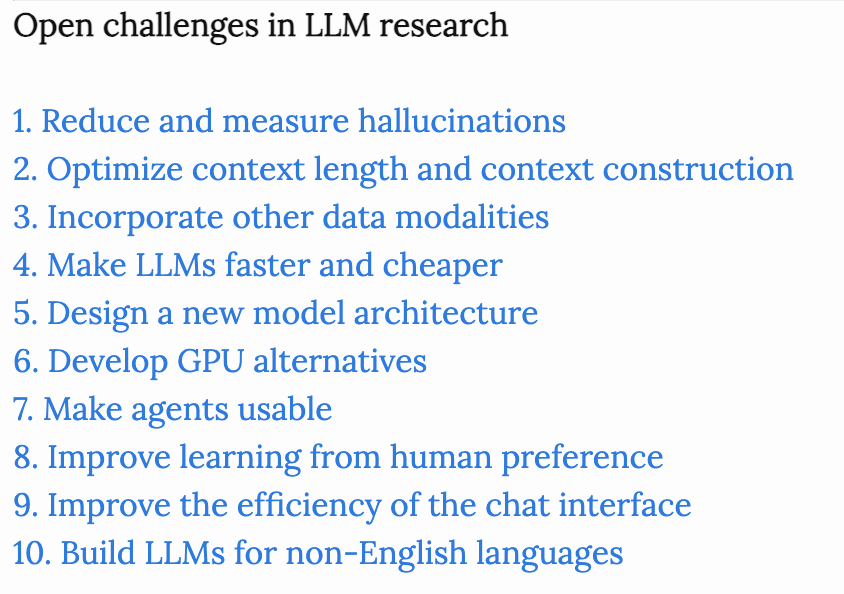
Open challenges in LLM research The first two challenges, hallucinations and context learning, are probably the most talked about today. I’m the most excited about 3 (multimodality), 5 (new architecture), and 6 (GPU alternatives). Number 5 and number 6, new architectures and new hardware, are very challenging, but are inevitable with time. Because of the symbiosis between architecture and hardware – new architecture will need to be optimized for common hardware, and hardware will need to support common architecture – they might be solved by the same company. I referenced a lot of papers here, but I have no doubt that I still missed a ton. If there’s something you think I missed, please let me know! huyenchip.com/2023/08/16/llm…
Chip Huyen tweet media
English
52
395
1.9K
335.4K
Christian Kaiser retweetledi
Lancelot Da Costa
Lancelot Da Costa@lancelotdacosta·
Excited to announce that our review paper on the free energy principle was just accepted in Physics Reports, the most prestigious journal in all of physics 🪐. This is a momentous achievement for our community🥳. Please share: sciencedirect.com/science/articl…
English
9
72
295
34.1K
Christian Kaiser retweetledi
Sasha Luccioni, PhD 🦋🌎✨🤗
As always, @emilymbender tells it like it is: "We pinky promise to be good, now please go away while we continue to practice massive data theft while creating poorly engineered “everything machines” that can’t possibly be evaluated." 🙌🙌🙌. Spot on! @emilymenonbender/ensuring-safe-secure-and-trustworthy-ai-what-those-seven-companies-avoided-committing-to-8c297f9d71a" target="_blank" rel="nofollow noopener">medium.com/@emilymenonben
English
1
27
74
10.3K
Christian Kaiser retweetledi
Suhail
Suhail@Suhail·
There are *many* unsolved problems with AI still. If you start now, have the right team, and have some compute resources, you’ll be early. It may seem like everything is taken or over competed for but most of the hard problems are still quite hard.
English
31
76
606
131.4K
Christian Kaiser retweetledi
Esther Crawford ✨
Esther Crawford ✨@esthercrawford·
Like seemingly everyone on this app I have plenty of opinions about Twitter > X and figure now is a good time to open up a bit about my experience at the company. I tweeted for years into the void for the love of it like many of you, but after selling my startup to Twitter in 2020 I finally got to see it from the inside. Up close it was both amazing and terrible, like so many other companies and things in life. As someone with a maniacal sense of urgency built into me, Twitter often felt siloed and bureaucratic. Dumb power plays, reorgs and team name changes for the sake of someone’s ego were distractions that occurred too regularly. You couldn’t just be a builder — you also needed to be a politician. I was shocked by how old and bespoke the infrastructure was, but there was little will to think beyond quarterly earnings calls because we were all beholden to the masters of mDAU and revenue growth as a public company. It often felt like things were held together with duct tape and glue, and that many people had just accepted that a small product change could take months or quarters to build. Management had become bloated to accommodate career growth and the company culture felt too soft and entitled for my own taste. Healthy debate and criticism was replaced by a default refrain of “no, that can’t be done” or “another team owns that so don’t touch it”. Teams could spend months building a feature and then some last-minute kerfuffle meant it’d get killed for being too risky. Just talking directly to customers could turn into a turf war and create deadlocks between functions. I recall one such episode where a teammate spent a month trying to get clearance to reach out to some creators. He went through 3 layers of management and 6 different functional teams. In the end 4 executives were involved in the approval. It was insanity, and unfortunately I saw several top performers get burnt out and demoralized after exhausting experiences like that. Most people were good at their jobs but it was nearly impossible to fire poor performers — instead they got shuffled around to other teams because few managers had the will or resources to figure out how to get them out. A high performance culture pulls everyone up, but the opposite weighs everyone down. Twitter often felt like a place that kept squandering its own potential, which was sad and frustrating to see. The person who was best at cutting through the BS and inspiring a vision during my tenure was Kayvon Beykpour, but he wasn’t fully empowered to run the company since he wasn’t the CEO. Despite those real issues, I was lucky enough to work with some of the most talented people in the business at Twitter in product, design, engineering, research, legal, BD, trust & safety, marketing, PR and more. Often it was a small cross-functional team of intrinsically motivated people who made the biggest impact by challenging some core assumption. Those teams were very fun to be on but they felt like the exception rather than the rule. The months of waiting for the deal to close in 2022 were particularly slow and painful; it felt like leadership hid behind lawyers and legal language as all answers about the company’s future notoriously included the phrase “fiduciary duty”. Colleagues openly talked about how Twitter was being sold because leadership didn’t have conviction in their own plan or ability to fix longstanding problems. Although I didn’t know much about Elon I was cautiously optimistic – I saw him as the guy who built incredible and enduring companies like Tesla and SpaceX, so perhaps his private ownership could shake things up and breathe new life into the company. My take on what’s happened since then is full of lived nuance. When people ask why I stayed it’s easy to answer: optimism, curiosity, personal growth and money. From the beginning I saw that some changes Elon was going to make were smart and others were stupid, but when I’m on a team I uphold the philosophy of “praise in public and criticize in private”. I was far from a silent wallflower. I shared my opinions openly and pushed back often, both before and after the acquisition. I made peace with the fact that I didn’t have psychological safety at Twitter 2.0 and that meant I could be fired at any moment, and for no reason at all. I watched it happen repeatedly and saw how negatively it impacted team morale. Although I couldn’t change the situation I did my best to shine a light on folks who were doing important work while being an emotionally supportive leader for those who were struggling to adapt to the more brutalist and hardcore culture. In person Elon is oddly charming and he’s genuinely funny. He also has personality quirks like telling the same stories and jokes over and over. The challenge is his personality and demeanor can turn on a dime going from excited to angry. Since it was hard to read what mood he might be in and what his reaction would be to any given thing, people quickly became afraid of being called into meetings or having to share negative news with him. At times it felt like the inner circle was too zealous and fanatical in their unwavering support of everything he said. When individuals encouraged me to be careful about what I said I politely thanked them and said I would not be taking their advice. I had no interest in adding to a culture of fear or walking on eggshells around Elon. Either he would respect me for being real or he could fire me. Either outcome was okay. I quickly learned that product and business decisions were nearly always the result of him following his gut instinct, and he didn’t seem compelled to seek out or rely on a lot of data or expertise to inform it. That was particularly frustrating for me since I believed I had useful institutional knowledge that could help him make better decisions. Instead he'd poll Twitter, ask a friend, or even ask his biographer for product advice. At times it seemed he trusted random feedback more than the people in the room who spent their lives dedicated to tackling the problem at hand. I never figured out why and remain puzzled by it. I don’t think things had to be as difficult or dramatic as they turned out to be but I can’t say I’d bet against Elon or count him out. He’s smart and has enough money to make a lot of mistakes and then course correct when things go awry. As the largest shareholder he can tank the value in the short-term, but eventually he’ll need things to turn around. His focus on speed is incredible and he’s obviously not afraid of blowing things up, but now the real measure will be how it get reconstructed and if enough people want the new everything app he is building. I learned a ton from watching Elon up close – the good, the bad and the ugly. His boldness, passion and storytelling is inspiring, but his lack of process and empathy is painful. Elon has an exceptional talent for tackling hard physics-based problems but products that facilitate human connection and communication require a different type of social-emotional intelligence. Social networks are hard to kill but they’re not immune from death spirals. Only time will tell what the outcome will be but I hope X finds its footing because competition is good for consumers. In the meantime, I have a lot of empathy for the employees who are working tirelessly behind the scenes, the advertisers who want a stable platform to sell their stuff on, and the customers who are experiencing chaotic updates. It’s been a madhouse. Twitter moved at the speed of molasses and suffered from bureaucracy but now X is run by a mercurial leader whose instinct is driven by the unique and undoubtedly weird experience of being the biggest voice on the platform. Many of you know me from the sleeping bag incident where I slept on a conference room floor, so I figure, let’s talk about that too. Going viral was an odd and interesting experience. I was attacked by people on the left and called a billionaire bootlicker, while simultaneously being attacked by people on the right for being a working mom who was demonized as an example of a woman choosing her career over her family. Thankfully I can laugh at myself and I don’t take armchair keyboard ideologues too seriously. Being the main character on the timeline, even for a few minutes, requires a thick skin and a strong sense of self. The real story is pretty simple. I was given a nearly impossible deadline for his first project and as the product lead I would never ask anyone to do anything I wasn’t willing to do myself. So I worked round the clock alongside an amazing team spanning many timezones, and we delivered it on schedule – truly against the odds. It was intense but also fun. Those first few months were wildly crazy but I wanted to be there and I have no regrets. Showing up and giving it your all should, in most cases, be celebrated. Obviously you can’t work at that pace forever but there are moments where bursts are mission critical. I’ve pulled many all-nighters in my career and also when I was a student for something that mattered to me. I don’t regret putting in long hours or being ambitious, and feel proud of how far I’ve come from where I started thanks in part to that type of work ethic. I think of life as a game, and being at Twitter after the acquisition was like playing life at Level 10 on Hard Mode. Since I like taking on difficult challenges I found it interesting and rewarding because I was growing and learning so rapidly. I realize our society today trends toward polarization but when it comes to this app, its owner, and its future, I am neither a fangirl nor a hater — I’m an optimistic pragmatist. This may really irritate the internet but you cannot pigeonhole me into some radical position of either loving or hating every change that’s occurred. I escaped my fundamentalist upbringing and am a free thinker these days. Everyone can be seen as both a hero or a villain, depending on who is telling what angle of the story. Elon doesn’t deserve to be venerated or vilified. He’s a complicated person with an unfathomable amount of financial and geopolitical power which is why humanity needs him to err on the side of goodness, rather than political divisiveness and pettiness. I disagree with many of his decisions and am surprised by his willingness to burn so much down, but with enough money and time, something new & innovative may emerge. I hope it does. Sometimes I get asked about how I felt when I got laid off, and the truth is it was the best gift I’ve ever received. Sure the headlines and punchlines wrote themselves but I was battle hardened by then. I knew that I’d worked in a way where I could walk out with my head held high. I have no bitterness about the Product Management team being dismantled, and it made sense for me to exit as nearly all of the remaining PMs were let go. Going on a sabbatical afterward has been exactly what I needed to decompress and I’m finally feeling rested and relaxed. I’m a creative and a builder, so sooner than later I’ll jump back into a high intensity company but I’m grateful for this season of thinking, reading, traveling and being with people I love. After having time to reflect I believe more than ever that the very best outcomes flow from great leadership that combines the head and the heart. I’d be remiss if I didn’t note that in all of this there is also a cautionary tale for anyone who succeeds at something — which is that the higher you climb, the smaller your world becomes. It’s a strange paradox but the richest and most powerful people are also some of the most isolated. I found myself frequently looking at Elon and seeing a person who seemed quite alone because his time and energy was so purely devoted to work, which is not the model of a life I want to live. Money and fame can create psychological prisons which may worsen mental health conditions. We’ve all seen high profile cases of celebrities who end up with some combination of depression, paranoia, delusions of grandeur, mania and/or erratic behavior. Living in an echo chamber is dangerous and being at the top makes a person even more susceptible to being surrounded by yes people when nearly everyone around you is on the payroll and somehow stands to benefit from being in your orbit. Figuring out how to keep “better angels” around in the form of family, friends, and teammates is critical to staying on the rails and enduring intense ups and downs. Everyone needs to hear hard truths sometimes and if you fire all the people who speak up then the reality distortion field may just turn into a vortex. I was drawn to Twitter because I’m obsessed with the problem of loneliness and connection between people. I find it fascinating & troubling that humans are getting lonelier as we simultaneously create a world that’s both safer and wealthier. I don’t believe that trade-off has to exist, which is why I keep returning to that theme in my personal and professional life. I realize this is too long of a tweet but Twitter was a weird and special place on the internet, and I’m grateful to have played a teeny tiny role in its story and evolution. I’m here for whatever comes next — on this app and in new places. Consumer social is very much alive and at a fascinating juncture, so I’ll be watching and participating and sharing hot takes because I don’t want to, and probably can’t, turn that part of me off. Perhaps X becomes a resounding success. Or it fails epically. Either way, I expect it will continue to be a very entertaining ride. 🫡
English
1.3K
2.4K
16.3K
5.5M
Christian Kaiser
Christian Kaiser@chrisk0·
@norootcause Well, I started in 2015 and, after a pause for a few years, I’m still on it. ;-)
English
1
0
2
29
Christian Kaiser
Christian Kaiser@chrisk0·
@norootcause Anyway, happy to share my own learnings in this field. There are a bunch of challenging, but super exciting engineering problems in here that, if solved, would really move the needle. I might be overstating this but seems a bit like the 1960s/70s in CS.
English
1
0
1
27
Christian Kaiser
Christian Kaiser@chrisk0·
@norootcause Re: Andy Clark’s new book - just leafed through it. Seems like a lot of great material that ties the theory to concrete examples of aspects of the human experience. As such, it’s super valuable. But it doesn’t seem to be a nuts-and-bolts technical treatment.
English
1
0
1
32