

Thorne&Advisor
46 posts


When Extraordinary AI Earnings Become Ordinary
The debate over whether AI exuberance is overdone is less about today’s valuations than about whether future earnings can remain extraordinary. Price-to-sales ratios and trillion‑dollar caps are symptoms. The real issue is whether the profit pools they imply can survive once AI spend collides with budgets, competition, and organizational absorption limits.
Wall Street does not just trade on growth; it trades on the second derivative of growth. As long as AI earnings are not only rising, but accelerating, the narrative justifies almost any multiple. The moment that second derivative rolls over, when growth is still positive but decelerating under the weight of budgets and scrutiny, the same metrics that once looked visionary start to look fragile.
That is the risk embedded in today’s AI darlings. Sustaining extraordinary earnings requires enterprises to keep raising AI as a share of revenue, vendors to maintain pricing power despite intensifying competition, and each incremental dollar of AI opex to deliver robust, provable productivity gains. If finance chiefs begin treating AI as a governed operating expense, capped, tiered, and tied to hard ROI, earnings that looked structural may reveal themselves as cyclical. The technology may endure. The second derivative that Wall Street is paying for may not.
Chief Nerd@TheChiefNerd
🚩 Chamath Says His Company’s Token Costs are Doubling Every 45 Days With Only a 5% Productivity Improvement “I don't know how many other companies will actually go through this reckoning now, but the point is, everybody in the next three or four years will for sure go through it.”
English
The AI Absorption Constraint.
When Infinite Intelligence Meets Finite Budgets.
For two years, investors have priced artificial intelligence as if the economy could absorb limitless machine intelligence at machine speed. The whole AI trade rests on that assumption. If the total addressable market for “intelligence” is effectively infinite and refusing to spend is an existential mistake, then budgets are almost incidental. You spend because you must.
But what if that is the wrong model?
Across big enterprises, a different pattern is emerging. AI coding agents and copilots were rolled out to thousands of workers; annual AI budgets vanished in a few months; token-based invoices arrived long before hard productivity numbers did. Popular tools are being wound down or downgraded not because they fail technically, but because cost curves and benefit curves have drifted too far apart. These are not engineering problems. They are balance-sheet problems.
The real bottleneck is not the supply of intelligence. It is the rate of absorption. Firms do not ingest machine cognition the way servers ingest electricity. Productivity gains only show up when workflows are redesigned, staff retrained, compliance rewritten, and managers trust the system enough to let it replace human effort. Those are institutional processes. They move on human time, not GPU time.
Once you see that, the fashionable prisoner’s-dilemma framing starts to collapse. The AI arms-race story says: overspend now or be left behind forever. That logic only holds if each marginal dollar of AI spend produces a roughly proportional gain in profit.
If the marginal token delivers mostly marginal convenience, nicer drafts, faster summaries, slightly cleaner code, then the “existential” threat evaporates. AI stops looking like a war of survival and starts looking like what it will ultimately be: a metered operating expense fighting for its place on the P&L.
That is Amara’s Law in real time. We are overestimating AI’s short-run economic effect while still likely underestimating its long-run one. The problem is that markets have capitalized the long run as if it were already here, while enterprises are only at the beginning of the messy, slow process of reorganizing around the technology.
In a market where the AI bottleneck trade has sucked the oxygen out of the room, pulling capital and multiples toward chips, data centers, and model vendors, the moment AI spend hits real financial constraints is pivotal. AI moves from sacred strategy to governed line item.
Demand stops tracking technological possibility and starts tracking budgets, hurdle rates, and organizational capacity. That means slower S-curves, more cyclicality, and a sharper distinction between hype and cash flow.
No one is questioning that AI is a profound innovation. That the TAM of intelligence is infinite. But the rate of absorption into the real economy is a constraint completely discounted away.
The revolution is still coming. But the trade has to be repriced around a less romantic question: not how much intelligence we can manufacture, but how much intelligence our institutions can profitably absorb.
@jason@Jason
When we can't stop talking about the progress in AI for six months, you know something very, very impactful is happening In 50 years they're going to study the year 2026
English
Canada Must Face Trump’s America First Turn, Carney is.
America First is not an improvisation, it is a conscious return to a Hamilton-Clay tradition of using trade, finance and industrial policy to build national capacity rather than outsource it. Trump’s doctrine treats trade, credit, infrastructure and strategic industry as instruments of sovereignty, not neutral rules, and Bessent’s economic security is national security line is the clearest implication of that vision.
The Bessent doctrine means the US will no longer subsidise other countries’ industrial policies with American demand, capital markets and security guarantees. The post-Cold War rules-based order was never objective, it embedded a system that left the US exposed while others banked the gains. The doctrine is a refusal to let the US be economically wiped off the board while pretending the old order is still working.
That is why the renegotiation of U.S.-Canada trade should not be feared. USMCA was written for an era that is no longer relevant, and Washington has now said so by declining to renew the agreement in its current form while keeping it in force pending new terms and annual reviews.
PM Carney’s New York pivot is a pragmatic response to that reality. He said the world has changed, that Canada must consolidate strength at home and diversify abroad, and that it should catalyse one trillion dollars of investment in energy, transportation, data and defence. Pipelines, export corridors and energy infrastructure sit at the centre of that shift because Canada increasingly sees that sovereignty now rests on the ability to feed, fuel and defend itself and its allies.
Canada also needs to stop treating its natural abundance as a political grievance and start treating it as a competitive advantage. For years, Canadian elites complained about deindustrialisation and failed industrial policy while presiding over regulatory regimes that made it harder to build pipelines, LNG terminals and large-scale industrial projects.
Yes, the economic elite were asleep at the switch, and Bessent has made the same critique of the broader North Atlantic policy class, arguing that comfort, consumption and faux efficiency displaced resilience and production. But the lesson of this moment is not to keep litigating the failure. It is to pivot.
That is what Carney is doing as he returns from the Middle East to a world where events from Venezuela to Iran have pushed energy and resource security to the top of global statecraft, while China’s grip on supply chains and critical minerals has shattered the illusion of neutral interdependence.
The likely result is Fortress North America, not as autarky but as a harder continental system built around trusted supply chains, energy abundance, industrial capacity and strategic reciprocity. Canada should not fear that outcome.
It should move quickly to shape it, because Carney’s pivot suggests Ottawa understands the old order is gone, and Bessent is already implementing the American side of the replacement, one that President Trump has envisioned for decades.
Rapid Response 47@RapidResponse47
Canadian Prime Minister Mark Carney on NATO defense spending: "It's not just [President Trump] is winning the argument — he has won the argument."
English

The Clarity Act.
The incompetence of DC will not stop innovation. Next time you hear Senators complain about the rules, remember they had a chance to set them and true to form they could not achieve a consensus to put the USA on the front foot. Now regulators will set the rules of the game.
The SEC is about to flip the script: crypto tokens will no longer be treated as securities once a project becomes decentralized. This "Regulation Crypto" overhaul includes a four-year safe harbor and allows startups to raise $75M without full registration.
SEC plans crypto rule changes for exchanges and broker dealers in 2026 regulatory agenda theblock.co/post/407468/se…
English
For those that want the economic road map. Watch Sec Bessent speech. It’s all there.
Treasury Secretary Scott Bessent's America 250 Address: Economic Statecraft, Tariffs, and the Dollar - YouTube youtube.com/watch?v=9Oz6Iy…
YouTube
English

English
Yes, Alberta finally needs a leadership role in Canada Industrial policy. It’s finally happening. My thoughts. 👇
@BNNBloomberg @LindsBiscaia
English
Trump’s Oil Doctrine: Turning Off the Enemy’s Tap
Donald Trump’s second term is quietly rewriting the global oil map, and the capture of Nicolás Maduro is the hinge on which much of that reordering turns.
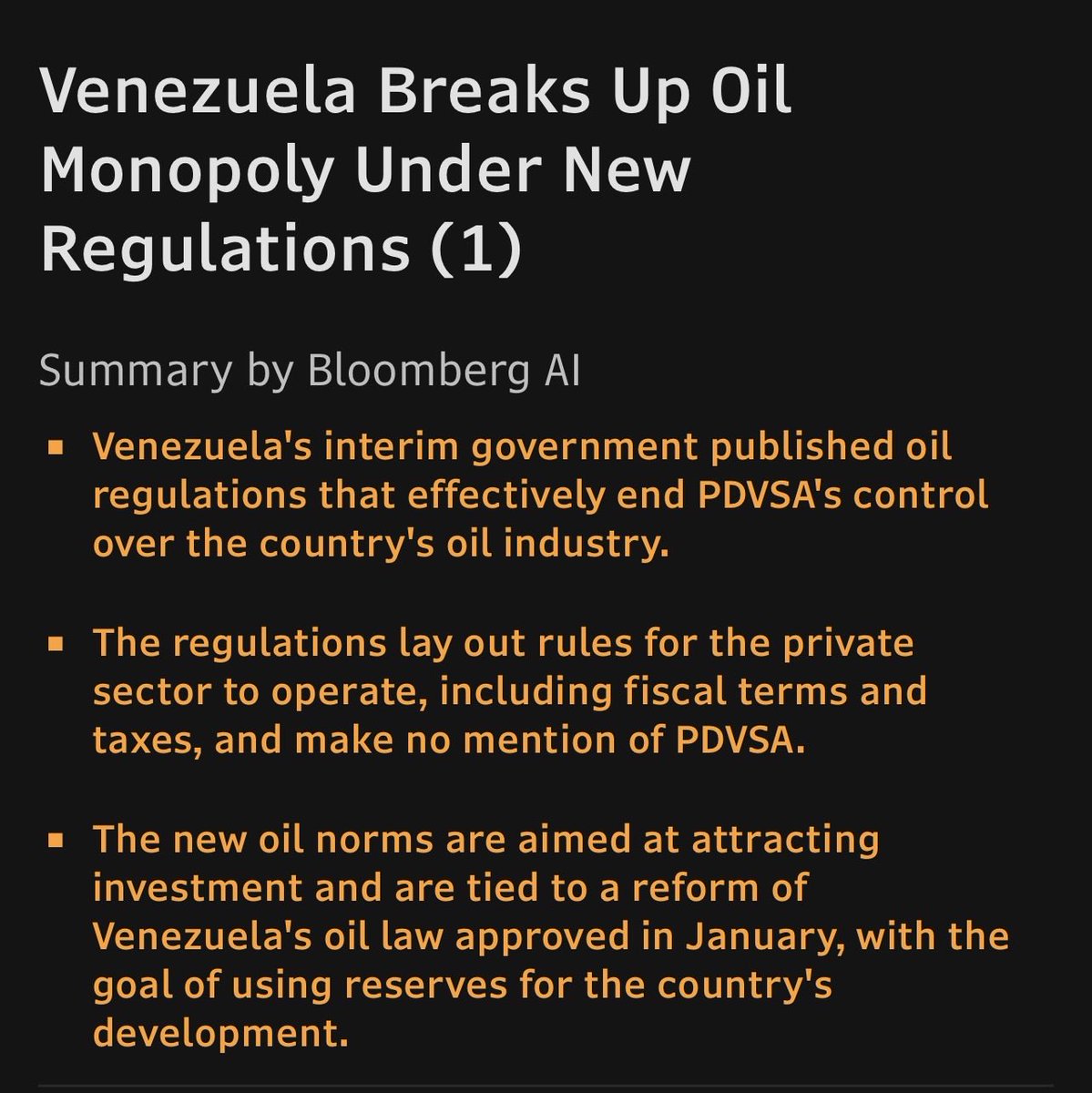
By toppling a Chinese‑financed petro‑client and forcing Caracas to dismantle PDVSA’s monopoly, Washington has begun to realign Venezuelan barrels toward the United States and away from Beijing’s cut‑rate embrace.
Under Maduro, PDVSA was not a company so much as a political machine, an instrument for patronage at home and an oil‑for‑loans conduit abroad. China happily extended credit against future shipments of heavy Venezuelan crude, locking in cheap supply while Venezuela’s infrastructure decayed and output collapsed.
Trump’s strategy reverses that logic. Sanctions relief is now contingent on opening the sector to private capital, contractual discipline, and Western oversight. The state still owns the resource, but it no longer dictates every allocation decision.
That shift speaks to a broader Trump doctrine: let private actors, not commissars, allocate the factors of production. In Venezuela, that means upstream rights, marketing decisions, and investment flows migrate from PDVSA bureaucrats to firms exposed to profit and loss.
For the U.S. Gulf Coast, built to run heavy sour crude, that is a strategic windfall. Barrels that once moved on opaque terms to Chinese refiners can instead feed American capacity under transparent, market‑driven contracts.
Zoom out, and Venezuela is one theater in a larger effort to hard‑wire American security into its energy policy. Trump’s posture toward the Strait of Hormuz, combining naval presence with financial pressure on Iran and its proxies, is designed to reduce the ability of hostile regimes to threaten global shipping or weaponize supply disruptions. The same logic that opens Venezuela to markets undercuts state sponsors of terrorism who have long financed mischief with oil revenues.
For China, the long‑term ramifications are stark. A world in which pariah producers are captured, liberalized, or disciplined by Western pressure is a world where Beijing buys less “politics‑proof” cheap oil and more market‑priced barrels subject to U.S. influence.
The costs and benefits of this strategy will be debated for years, but one fact is already clear: Trump is aligning the plumbing of the global energy system with the strategic interests of the West, and that realignment will be felt for generations, not news cycles.
English
S&P 500 to 8400 this year. Bitcoin, Gold, the Memory Trade, Parabolic charts, earnings seasons, Iran, Trumps America , The big pivot, and yes Canada being an attractive place for capital.
@BNNBloomberg
bnnbloomberg.ca/video/shows/th…
English

Trumps Wresting the Oil Map From Beijing
Donald Trump’s second-term national security doctrine is, at bottom, America First applied to the hard geography of energy. It starts not with speeches, but with a toppled strongman and a wrested petrostate: Venezuela and Nicolás Maduro.
What has stunned markets is not the arrest itself but the speed of the oil response. Consensus energy experts insisted that meaningful Venezuelan output gains would take years, requiring stable governance, new capital, and major repairs to crumbling infrastructure. Instead, within months of Maduro’s removal, Venezuela is exporting hundreds of thousands of barrels of oil a day to the United States, with total production up roughly 20 percent.
Most of that crude used to move quietly to China. A flow that was supposed to be structurally stranded has been rapidly redirected, blindsiding a research community that treated Venezuelan capacity as a distant upside rather than an immediate geopolitical lever.
Yet many of the same analysts who missed this turn still dismiss Trump’s strategy as incoherent. That criticism now says more about their priors than about the policy. In Trump’s framework, this is not regime change for its own sake; it is America First energy policy.
The goal is clear: secure supply for American industry, deny easy lifelines to hostile powers, and turn the world’s petrostates into assets aligned with U.S. interests rather than subsidies to Beijing.
A socialist petrostate that had drifted into China’s embrace has been structurally reoriented so that what once functioned as an off-books gift to a rival now underwrites American workers and American factories.
Then comes the plot twist. While barrels are being redirected in the Western Hemisphere, steel and concrete are being shattered along China’s overland and maritime escape routes. Strikes on a critical bridge along the China–Iran corridor, hits on Iran’s deep-water port outside the Strait of Hormuz, pressure on Kharg Island, the hub of Iran’s oil export system, and a calibrated assault on Iran’s financial wiring all fit the same doctrine.
An America First strategy that treats energy routes and balance sheets as instruments of national power naturally looks to these chokepoints, and to the Strait of Malacca beyond, as the next layer of leverage over Beijing’s lifelines.
The only real question now is what’s next for Kharg Island and its surrounding routes, and whether Trump is prepared to turn that critical export hub into the latest reminder that, in this era, energy geography bends toward American power, not Chinese wishful thinking.
English
Catch me live on @BNNBloomberg at 9AM ET to discuss stock futures, U.S.-Iran tensions, AI/tech momentum, and overall market sentiments.
bnnbloomberg.ca/video/live
English
US controls the Strait of Hormuz 🇺🇸
Don’t kid yourself. 👇
Department of War 🇺🇸@DeptofWar
🇺🇸🇺🇸🇺🇸
English

Semiconductors: What Happens When the Second Derivative of Earnings Revisions Turns Negative?
The AI trade has become the defining structural tailwind for global semiconductors, but the market is no longer pricing “chips and capex”, it is pricing earnings revisions, and increasingly, the second derivative of those revisions.
Mega-cap leaders such as NVIDIA and Broadcom now trade on forward price/earnings multiples in the low-to-mid twenties, levels that look almost restrained given their centrality to AI infrastructure. Those valuations reflect hard earnings visibility, entrenched moats, and balance sheets that can fund the next leg of AI build-out without leaning on fantasy. In other words, investors are paying for cash flows they can already see.
Orbiting them is a far more speculative cohort. Turnarounds like Intel routinely screen on forward multiples north of 100 times, not because the market has forgotten how to divide, but because the earnings denominator remains anaemic. Here, investors are paying up for a path rather than a point estimate, a hoped-for recovery that may or may not materialise on the timetable embedded in the price.
This bifurcation feeds straight into the sector’s flagship ETFs. Cap-weighted vehicles such as SMH are effectively leveraged bets on the lower-multiple leaders, delivering blended forward valuations in the mid-20s. Equal-weighted strategies like XSD democratise portfolio weight across the constituency and, in doing so, import more of the triple-digit-multiple hopefuls, aggregate forward P/E drifts into the low-30s. Modified cap-weighted products like SOXX sit uneasily in between, less concentrated than SMH, not as valuation-agnostic as XSD.
For much of the past year, one force has allowed this structure to hold together, relentless positive earnings revisions. Semiconductor forecasts for 2026 and 2027 have marched higher quarter after quarter, keeping forward multiples from looking egregious even as trailing P/Es inflate. Samsung’s latest quarter, profits up nearly twenty-fold yet the shares sell off, is the live case study. The level of earnings and the first derivative of growth are extraordinary, the market is already trading the change in the pace of upgrades.
That is the crux of the current regime. When semiconductors become a second-derivative earnings-revision trade, the risk is not that numbers stop going up, but that they go up more slowly, or start to slip. History is not kind to that moment. When the second derivative of revisions turns negative, valuation compression usually follows, multiples contract even as absolute EPS remains high, leadership narrows to the most credible cash-generators, and breadth expressions suffer.
In this context, equal-weighted and revision-beta strategies such as XSD are structurally more exposed. They own more of the names whose premium valuations rely on upgrades continuing at an unsustainable pace. Cap-weighted vehicles like SMH, anchored in leaders with still-reasonable forward multiples and more durable free-cash-flow, are better positioned to absorb a slowdown in revisions without forcing a wholesale rethink of the AI thesis.
The AI-driven semiconductor opportunity is still real, but it is no longer enough to be directionally right on demand. Investors now need to be directionally right on revisions, and acutely aware of what happens when the second derivative finally turns against them.
IMHO, $NVDA and $AVGO leadership will now be reestablished.


English

Sausage‑Making the Peace Dividend
Achieving a peace dividend is like making a sausage, the finished product looks clean, but the process is messy, sequential, and often unsettling to watch.
The mainstream media and headline‑chasing markets gravitate to a childish narrative in which “peace” is achieved in a single stroke, one strike, one summit, one photo‑op, and risk miraculously disappears overnight. History, and Hormuz, say otherwise.
World War II is the classic rebuttal, Germany and Japan surrendered in 1945, but true stability and prosperity only emerged after years of occupation, containment, and hard‑edged enforcement of a new order.
The U.S. hitting Iran hard after attacks on commercial ships in the Strait is not random escalation, it’s one step in the necessary enforcement cycle that underpins any durable peace dividend. First, credible force re‑establishes rules and restores deterrence. Then, critical trade arteries, here, the narrow channel that carries a huge share of global oil, are demonstrably protected. Only after that do insurance premia, volatility, and valuations settle into a lower‑risk regime.
In strategic terms, the Strait of Hormuz is not a coin‑flip. The United States Navy ultimately controls the chokepoint, Iran’s effort to weaponize shipping has already failed at the structural level.
That does not mean the news flow will be calm or comforting, it means the noise, retaliatory threats, sporadic skirmishes, political theatre, is part of the grinding process by which a new equilibrium is enforced.
Investors who understand this should resist the temptation to trade every headline as if it were a regime change.
The long‑run architecture is clear, a dominant guarantor of sea lanes, a weakened spoiler, and a gradually re‑priced tail‑risk on global trade. Ignore the noise, focus on who writes the rules of the strait, and who just proved they can enforce them.
Sky News@SkyNews
The head of NATO has said the latest round of US strikes on Iran were "absolutely necessary". Mark Rutte is currently with leaders of the alliance - including Donald Trump - in Ankara for a two-day summit which began yesterday. trib.al/lFKiPZ5 📺 Sky 501 and YouTube
English
Food for thought.
America Was Being Played — Trump Saw It First
The technocrats call it the Bessent Doctrine. That flatters the technocrats by implying the idea began only once they were willing to name it. The real revelation now, finally stated out loud, is simpler and blunter: America was being played. Trump saw that early, long before the policy class was prepared to admit it. Bessent’s role has been different: to supply the intellectual architecture, drawing on the older American tradition of Hamilton and Henry Clay to explain why economic sovereignty matters.
Thomas Nagel helps clarify the error. In a very different context, he wrote that “objectivity of whatever kind is not the test of reality. It is just one way of understanding reality.” Applied here, the lesson is that the rules-based order was never reality itself. It was one historically contingent framework, shaped by technocratic assumptions about tariff reduction, frictionless capital, and just-in-time efficiency. Those assumptions were presented as universal reason even as they produced deindustrialization, supply-chain fragility, and strategic dependence for the United States.
Hegel supplies the historical drama. The thesis was the original U.S.-led postwar settlement: a liberal order built to stabilize allies and secure American leadership. The antithesis emerged when that order hardened into a false universal, constraining the sovereign that created it while rivals exploited its rules for their own advantage. The synthesis is the Trump-Bessent correction. Trump supplied the early political recognition that the system was rigged against American production and sovereignty. Bessent has translated that intuition into the language of Hamilton and Clay: economic security is national security; the nation that cannot build what it needs is neither sovereign nor secure.
So call it the Bessent Doctrine if you like. But it is better understood as Trump’s early insight, finally given the grammar of the American System. And the insight itself is now impossible to avoid: America was being played.
Santiago Capital@SantiagoAuFund
Homey don’t play… Opinion | America Was Being Played. The Bessent Doctrine Says Those Days Are Over. - The New York Times nytimes.com/2026/07/07/opi…
English