Chris Wasden

8.2K posts

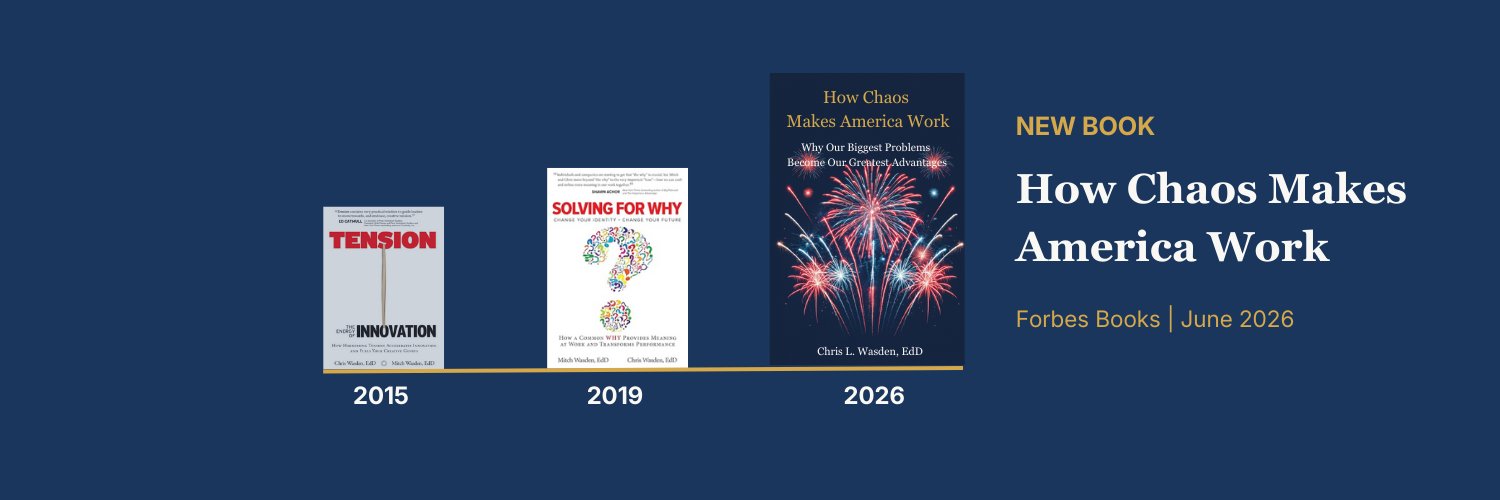
Chris Wasden banner
Chris Wasden

Chris Wasden

@chriswasden

3x author on tension & transformation | CSO @DarioHealth | Data over dogma | https://t.co/GDFEkwPhFq

Midway, UT Katılım Ağustos 2008
695 Takip Edilen716 Takipçiler
Sabitlenmiş Tweet
Chris Wasden
Chris Wasden@chriswasden·
A decade of framework thinking. Three books. One thread. 2015: Tension is the energy of innovation 2019: Change your identity, change your future 2026: America's biggest problems are becoming our greatest advantages America's Stubborn Allure — coming June 2026 from Forbes Books. Data over dogma.
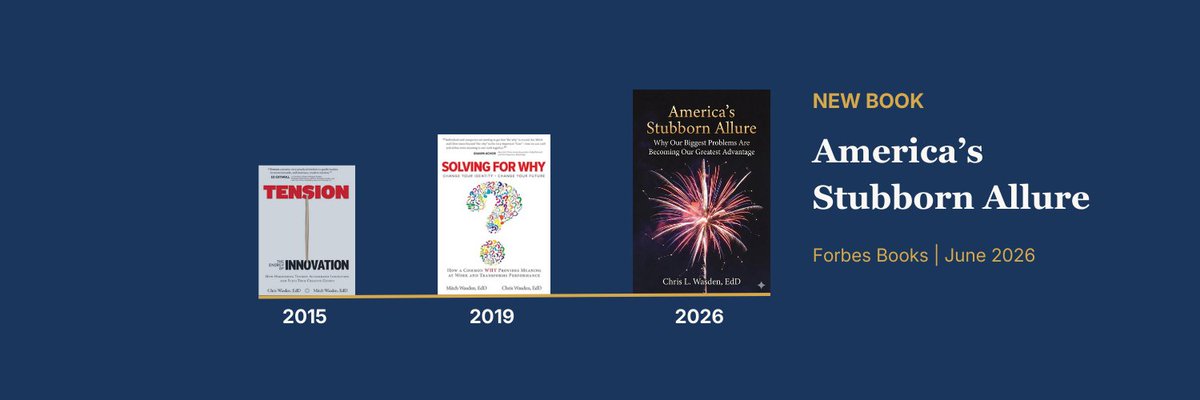
Chris Wasden tweet media
English
1
0
4
151
Chris Wasden
Chris Wasden@chriswasden·
Banning AI doesn't stop it. It stops the people who want to regulate it, leaving only the people who don't.
English
0
0
0
5
Chris Wasden retweetledi
Camus
Camus@newstart_2024·
A woman just said what a lot of people have been thinking but rarely say out loud. She’s tired of the “boss bitch / bad girl” energy that pretends men and women are exactly the same and can do everything equally. Her point: we’re equal in value, but we’re not the same. Women need more fat, more sleep, and we’re generally less stress-resilient than men. We run on a 28-day cycle while men run on a 24-hour one. The houses we live in, the roads we drive on, the entire infrastructure of society — most of it was built by men. Instead of seeing each other as competition, she says, we should recognise how beautifully we complement one another. And the next time you feel like looking down on men, remember the hard work your father, grandfather, and great-grandfather put in. A bit of respect costs nothing. It’s a refreshingly honest take in a world that loves to pretend biology doesn’t matter. What do you think — are we better off celebrating the differences between men and women, or pretending they don’t exist?
English
150
899
5.4K
172.8K
Chris Wasden
Chris Wasden@chriswasden·
CMS set ACCESS payment rates so low that clinician-labor-dependent care models can't participate. That's not a bug.
English
0
0
0
7
Chris Wasden
Chris Wasden@chriswasden·
The data leads somewhere The Economist doesn't want to go. And that tells you more about The Economist in 2026 than it does about Iran.
English
0
0
0
18
Chris Wasden
Chris Wasden@chriswasden·
Bernie Sanders wants to ban AI data centers to stop billionaires from controlling the technology. The companies that already have data centers keep theirs. The startups and universities that might compete with them can't build. His moratorium doesn't constrain Big Tech. It gives them a moat. open.substack.com/pub/chriswasde…
English
0
0
0
11
Chris Wasden
Chris Wasden@chriswasden·
The digital health graveyard is full of FDA-cleared products that couldn't hold a patient's attention past week one.
English
1
0
1
11
Chris Wasden retweetledi
Bjorn Lomborg
Bjorn Lomborg@BjornLomborg·
Climate campaigners tell you green is cheap It isn't Global green transition cost is now $14+ trillion, rising with over $2 trillion/year (2% of global GDP) 105x our spending to avoid hunger Still, CO₂ emissions set another record last year assets.bbhub.io/professional/s…
Bjorn Lomborg tweet media
English
98
727
1.5K
50.3K
Chris Wasden retweetledi
James E. Thorne
James E. Thorne@DrJStrategy·
Food for thought. Trump, Hormuz and the End of the Free Ride For half a century, Western strategists have known that the Strait of Hormuz is the acute point where energy, sea power and political will intersect. That knowledge is not in dispute. What is new in this war with Iran is that the United States, under Donald Trump, has chosen not to rush to “solve” the problem. In Hegelian terms, he is refusing an easy synthesis in order to force the underlying contradiction to the surface. The old thesis was simple: the US guarantees open sea lanes in the Gulf, and everyone else structures their economies and politics around that free insurance. Europe and the UK embraced ambitious green policies, ran down hard‑power capabilities and lectured Washington on multilateral virtue, secure in the assumption that American carriers would always appear off Hormuz. The political class behaved as if the American security guarantee were a law of nature, not a contingent choice. Their conduct today is closer to Chamberlain than Churchill: temporising, issuing statements, hoping the storm will pass without a fundamental reordering of their responsibilities. Trump’s antithesis is to withhold the automatic guarantee at the moment of maximum stress. Militarily, the US can break Iran’s residual ability to contest the Strait; that is not the binding constraint. The point is to delay that act. By allowing a closure or semi‑closure to bite, Trump ensures that the immediate pain is concentrated in exactly the jurisdictions that have most conspicuously free‑ridden on US power: the EU and the UK. Their industries, consumers and energy‑transition assumptions are exposed. In that context, his reported blunt message to European and British leaders, you need the oil out of the Strait more than we do; why don’t you go and take it? Is not a throwaway line. It is the verbalisation of the antithesis. It openly reverses the traditional presumption that America will carry the burden while its allies emote from the sidelines. In this dialectic, the prize is not simply the reopening of a chokepoint. The prize is a reordered system in which the United States effectively arbitrages and controls the global flow of oil. A world in which US‑aligned production in the Americas plus a discretionary capability to secure,or not secure, Hormuz places Washington at the centre of the hydrocarbon chessboard. For that strategic end, a rapid restoration of the old status quo would be counterproductive. A quick, surgical “fix” of Hormuz would short‑circuit the dialectic. If Trump rapidly crushed Iran’s remaining coastal capabilities, swept the mines and escorted tankers back through the Strait, Europe and the UK would heave a sigh of relief and return to business as usual: underfunded militaries, maximalist green posturing and performative disdain for US power, all underwritten by that same power. The contradiction between their dependence and their posture would remain latent. By declining to supply the synthesis on demand, and by explicitly telling London and Brussels to “go and take it” themselves, Trump forces a reckoning. European and British leaders must confront the fact that their energy systems, their industrial bases and their geopolitical sermons all rest on an American hard‑power foundation they neither finance nor politically respect. The longer the contradiction is allowed to unfold, the stronger the eventual synthesis can be: a new order in which access to secure flows, Hormuz, Venezuela and beyond, is explicitly conditional on real contributions, not assumed as a right. In that sense, the delay in “taking” the Strait, and the challenge issued to US allies to do it themselves, is not indecision. It is the negative moment Hegel insisted was necessary for history to move. Only by withholding the old guarantee, and by saying so out loud to those who depended on it, can Trump hope to end the free ride.
James E. Thorne tweet media
English
2.2K
7.1K
24.3K
3.9M
Chris Wasden
Chris Wasden@chriswasden·
WHY "I DON'T NEED AI" IS A RED FLAG • It signals your workload has slack • It means nothing urgent competes for your time • It reveals a job scoped to current tasks, not possibilities • It puts you in the 83% dabbling, not the 5% transforming • It's the modern version of "I don't need a spreadsheet" • It tells your employer you're doing $50/hr work at $250/hr pay • It guarantees someone, your boss, your board, your market, will eventually notice ONE-LINER: The people who desperately need AI are the ones with TOO MUCH to do. If your hours are comfortable, that's not a flex. It's a warning sign.
English
0
0
0
8
Chris Wasden retweetledi
Ken Cao-The China Crash Chronicle
Europe Forgot the Lesson of 1938 And It’s Happening Again. NATO’s Biggest Weakness? Fear of Dictators. For 80 years, democracies have claimed they learned the lesson of appeasement. History says otherwise. From the Munich Agreement to today’s conflicts, the same pattern keeps repeating: authoritarian regimes push forward, and democratic nations hesitate, negotiate, and retreat. Meanwhile, the United States continues to carry the burden of global security while its allies free ride. This video breaks down why NATO allies have grown increasingly timid, how economic dependence and political incentives drive appeasement, and why this mindset is making the world more dangerous—from Ukraine to the Strait of Hormuz to the South China Sea. History has already shown the cost of weakness. The question is: will democracies finally learn, or repeat the same mistake again?
English
14
88
349
22.9K
Chris Wasden
Chris Wasden@chriswasden·
Every policy domain has the same fingerprint: a captured term polls 20-75 points higher than the specific policy it carries. The word installs the policy. Questioning the policy feels like opposing the value.
English
1
0
0
16
Chris Wasden
Chris Wasden@chriswasden·
78% of Democrats incorrectly believe socialism permits private homeownership. That is not ignorance. That is the downstream consequence of captured language operating for decades.
Chris Wasden tweet media
English
0
0
0
2
Chris Wasden
Chris Wasden@chriswasden·
A physician using AI to cut 2 hours of daily documentation didn't get more efficient. They discovered 25% of their job was never really doctoring.
English
0
0
0
9
Chris Wasden
Chris Wasden@chriswasden·
88% of employees use AI. Only 5% use it well enough to gain a day and a half of extra output per week. The other 83% tried ChatGPT once and moved on.
English
0
0
0
5
Chris Wasden retweetledi
Kirk Rollins
Kirk Rollins@nicoraytruth·
Why Mormonism may be true.. a take from a pragmatist
English
96
223
1.5K
194.9K
Chris Wasden
Chris Wasden@chriswasden·
78% of Democrats incorrectly believe socialism permits private homeownership. That is not ignorance. That is the downstream consequence of captured language operating for decades.
English
0
0
0
4