Ciara

12.1K posts

Ciara

Ciara

@cile171

#cleantheair

Katılım Şubat 2015
1.8K Takip Edilen238 Takipçiler
Ciara retweetledi
Harry Spoelstra
Harry Spoelstra@HarrySpoelstra·
Sorry, this is a typical moving-the-goalposts fallacy! This study directly tests the broad clinical syndrome of Long COVID against classic ME/CFS and finds them immunologically distinct. If even the messy real-world LC doesn't match ME/CFS, that strengthens the divergence, not weakens it. This isn't a flawed comparison , it's decisive evidence against lumping them together. Separate diseases need separate approaches! READ THE STUDY!
English
7
10
24
767
Ciara retweetledi
Dara in Chains
Dara in Chains@DarainChains·
Invisible Warfare Headline: The MIT Study that Finally Visualizes the Brain-on-COVID Have you ever had a medical scan come back "clear" while your brain felt like it was made of inflamed concrete? You aren't crazy. Standard medicine just wasn't looking small enough. A major 2026 paper from MIT and Harvard just changed the game. They didn't just look at brain tissue; they physically expanded it 15-20x its size—like using a molecular magnifying glass—to achieve 20-nanometer resolution. What they found changes everything: Standard imaging looks for damage. This paper visualized defense. Deep inside the brains of people who had SC2, they found periodic Amyloid Nanoclusters co-localizing directly with the virus. What does that mean? The Cargo: Your body is running on infected, hyper-activated platelets (the 'weaponized platelets' of LC). They carry viral debris and proteins into the brain's capillaries. The Body's Defense: When the brain detects these viral invaders, it doesn't wait. Its immune system (microglia/astrocytes) triggers a protective, antimicrobial "foam" called amyloid-beta. The Trap: This amyloid foam physically traps, cages, and neutralizes the viral proteins to stop them from causing further harm. The Price: The paper found a 2-fold increase in activated astrocytes, the cells that manage the brain's environment. These dense, sticky amyloid traps and swollen astrocytes create a state of permanent, local, architectural neuroinflammation. This isn't a "chemical imbalance." This is structural warfare. The brain is filled with tiny, persistent defensive knots that it cannot clear, causing the profound fatigue, cognitive impairment, and severe inflammation so common in LC. #LongCOVID #Neuroinflammation #Microbiome #VigilanceLab A comic showing this! Hope this helps my friends and fellow humans.
Dara in Chains tweet media
Vipin M. Vashishtha@vipintukur

SARS-CoV-2 spike protein may directly amplify brain inflammation. ➡️ Researchers found that spike proteins can colocalize with amyloid-β (Aβ) and trigger distinct inflammatory responses in microglia — the brain’s immune cells. ➡️ This raises important questions about potential long-term neurodegenerative consequences of COVID-19. 1/

English
14
249
550
18.4K
David Lingenfelter, PhD
David Lingenfelter, PhD@dlingenfelter·
Persistent endothelial and nitric oxide dysfunction persist for ~37 weeks post‑COVID, disrupting vascular and metabolic pathways. Elevated fatty acids (LA, OA, PA) correlate with fatigue and suggest diagnostic and therapeutic targets.🧵
David Lingenfelter, PhD tweet media
English
6
72
264
9.5K
Ciara retweetledi
Cat in the Hat 🐈‍⬛ 🎩 🇬🇧
🚨BMJ Opinion: “Hantavirus outbreak should reset WHO’s default approach to airborne risk” “For pathogens with documented person-to-person spread […], the initial assumption should be AIRBORNE risk unless and until evidence supports easing back.” bmj.com/content/393/bm…
Cat in the Hat 🐈‍⬛ 🎩 🇬🇧 tweet media
English
26
401
907
28.5K
Ciara retweetledi
Harry Spoelstra
Harry Spoelstra@HarrySpoelstra·
Tissue-specific autoantibody signatures reveal immune alterations undetected by routine serology in long COVID 🚨83% of long COVID patients have rogue autoantibodies attacking their own heart, lungs & blood vessels, and every standard blood test misses it completely. VERY INTERESTING! ➡️In a UNIQUE Hungarian cohort of 114 long COVID patients versus 36 pre-pandemic controls, tissue-specific Western blotting detected autoantibodies in 83% of cases, with strong cardiovascular dominance, ➡️Vascular autoreactivity was markedly higher in long COVID (34% vs. 8%, p<0.05), cardiac (54%) and pulmonary (34%) signals trended elevated but did not reach significance( cohort size?), ➡️Autoantibodies were predominantly IgM-skewed, polyreactive (up to 8 bands per patient), and persisted longitudinally (mean 141 days), with new isotypes emerging over time, ➡️Standard ANA testing showed no group differences and zero clinical correlations, rendering it useless for detecting these alterations, ➡️Cardiac autoreactivity associated with hypertension and headache, overall autoreactivity correlated with anosmia/ageusia, female sex, CRP, BMI, creatinine, and troponin levels, ➡️The study used human cardiac, pulmonary, and vascular tissue homogenates. ➡️Findings were independent of routine serology and highlight an under-recognized immune component invisible to current diagnostics. ➡️“This persistent, IgM-skewed profile suggests ongoing immune dysregulation and may reflect a previously underrecognized component of the immunological response in long COVID, highlighting the need for targeted immunodiagnostic approaches beyond routine serology.” ‼️Why this is shocking: It proves that in 83% of long COVID patients, the immune system is actively producing autoantibodies that directly target their own heart, lung, and especially blood-vessel tissues, yet every standard blood test (ANA HEp-2) comes back normal. These rogue antibodies are polyreactive, IgM-dominant, persist for months, and keep evolving. They correlate with real symptoms (anosmia, hypertension, headache) and lab markers of damage (troponin, CRP). ‼️In other words: The majority of long COVID sufferers have smouldering, organ-specific autoimmunity that is completely invisible to routine diagnostics. Doctors are flying blind while patients’ tissues are quietly under autoimmune attack. 🤔As far as I know, this is the first direct evidence of hidden, cardiovascular-dominant tissue autoimmunity driving the chronic L0ngC0vid phase! #BookMark #AvoidSars2 #AvoidReinfections link.springer.com/article/10.100…
Harry Spoelstra tweet media
English
23
305
654
68.5K
Ciara retweetledi
nature
nature@Nature·
An antiviral pill has, for the first time, been shown to prevent COVID-19 in people exposed to the SARS-CoV-2 virus go.nature.com/4nAMi6g
English
114
1.4K
4.1K
295.4K
Ciara
Ciara@cile171·
1.May 6 th may be too early an isolation date given contact since with those recently testing positive 2. Medical gaslighting of females attributing symptoms to anxiety has to have a hard stop. theguardian.com/world/2026/may…
English
0
0
0
5
Ciara retweetledi
Ciara retweetledi
Darshak Rana ⚡️
Darshak Rana ⚡️@thedarshakrana·
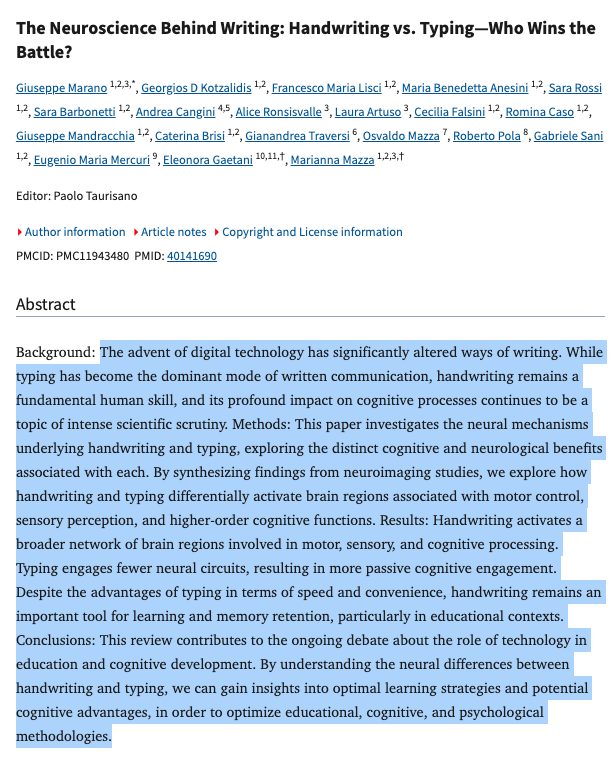
Your brain physically rewrites itself every time you pick up a pen. Neuroscientists at Norwegian University scanned students' brains while they handwrote letters versus typing the same letters on a keyboard. The results shattered decades of assumptions about how we process information. Handwriting activated massive networks in the sensorimotor cortex, the visual processing centers, and the hippocampus simultaneously. Complex neural symphonies lit up across multiple brain regions, creating rich interconnected pathways between motor control, visual recognition, and memory formation. Typing the same letters? The brain activity looked like someone had dimmed the lights across entire cognitive districts. The neural networks that flourished during handwriting simply went dark. The difference? When you form letters by hand, your brain constructs elaborate spatial maps of each character. The motor cortex learns the precise pressure, angle, and trajectory needed to create an 'A' versus a 'B.' Your visual system tracks the ink flowing from pen to paper in real time. Your parietal lobe integrates hand position with eye movement. Your hippocampus encodes not just what you wrote, but how the writing felt, where you paused, which words required more pressure. Typing activates almost none of that circuitry. You press a key, a letter appears. The motor movement is binary. The visual feedback is uniform. The spatial relationship between thought and symbol gets mediated by a machine that standardizes every character into identical fonts and spacing. Your brain treats these as fundamentally different cognitive tasks. The evolutionary context makes this obvious once you see it. Human hands developed for manipulation, creation, and fine motor control over millions of years. We painted on cave walls, carved bone tools, and shaped clay vessels long before we invented written language. When writing emerged 5,000 years ago, it built on top of existing neural infrastructure that already connected hand movement with symbolic thinking. Keyboards appeared 150 years ago. Touchscreen typing maybe 20 years ago. From an evolutionary timeline perspective, we started using them approximately yesterday. Our brains are still running ancient software that expects physical engagement with symbols. That software produces dramatically different learning outcomes. Students who take handwritten notes consistently outperform students who type the same information on memory tests, comprehension assessments, and creative applications of the material. The difference persists even when researchers account for typing speed, note length, and time spent studying. The act of forming letters by hand forces deeper processing at the moment of information encounter. You cannot handwrite as fast as someone speaks, so your brain must actively filter, summarize, and prioritize information in real time. The motor effort required to form each word creates additional memory traces that typing does not generate. Children who learn to write letters by hand develop reading skills faster than children who learn letters primarily through typing or screen interaction. The sensorimotor experience of creating letterforms helps their brains recognize those same letterforms when they encounter them in text. Adults who handwrite shopping lists, daily schedules, or meeting notes remember the information better than adults who type identical lists into phones or computers. The spatial memory of where you wrote something on a page provides retrieval cues that digital text does not offer. These findings collide directly with how education and work environments have evolved over the past two decades. Schools replaced handwriting instruction with typing classes. Offices converted from paper systems to fully digital workflows. Students take notes on laptops. Professionals draft documents on screens. We optimized for speed and efficiency while accidentally severing the neural pathways that evolution spent millions of years developing. The implications reach beyond memory and learning into fundamental questions about human cognition. If the physical act of forming symbols changes how your brain processes ideas, what happens to thinking itself when you remove the physical component? Digital text is infinitely searchable, instantly editable, and perfectly shareable. But it may be creating brains that process information more superficially, store memories less durably, and connect ideas more weakly than brains that regularly engage in handwriting. The neuroscience suggests we traded cognitive depth for technological convenience without realizing what we were giving up. Some of the most innovative thinkers across history were obsessive handwriters. Darwin kept detailed handwritten journals. Einstein worked through complex theories in handwritten notebooks. Virginia Woolf wrote her novels by hand before transcribing them. Steve Jobs famously took handwritten notes during Apple meetings even as he was building the most advanced computers on Earth. Perhaps they intuited something about the relationship between hand, brain, and insight that we measured in brain scanners but somehow forgot in practice. Your pen is literally a cognitive enhancement device that activates neural networks digital keyboards cannot reach.
Darshak Rana ⚡️ tweet media
English
101
1.4K
4.2K
172.4K
Ciara retweetledi
Cat in the Hat 🐈‍⬛ 🎩 🇬🇧
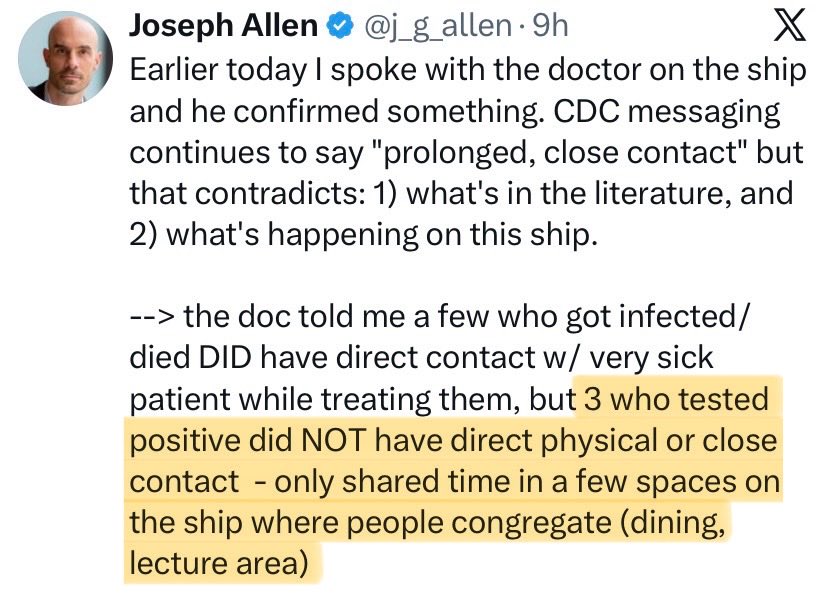
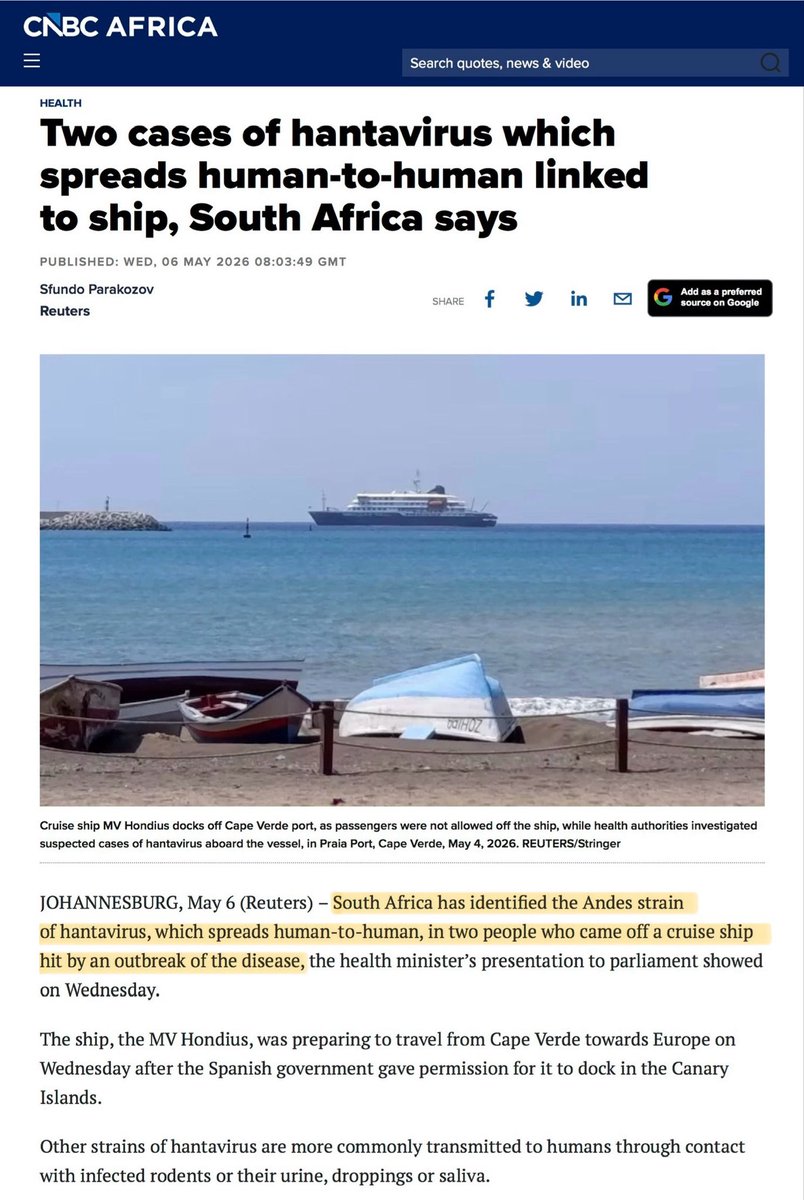
HANTAVIRUS OUTBREAK 🧵 Following the WHO press briefing, I wanted to compile a thread with the key points. 1/ ISOLATION OF PASSENGERS Concerningly, it seems the WHO are NOT recommending to isolate cruise ship passengers (even high-risk contacts) UNLESS they develop symptoms.
English
74
398
1K
185.3K
Ciara retweetledi
Yaneer Bar-Yam
Yaneer Bar-Yam@yaneerbaryam·
It is encouraging to see WHO update its Andes hantavirus guidance on May 8 to recommend respirators rather than medical masks for symptomatic individuals associated with the outbreak. Recognition of airborne transmission risk and appropriate respiratory protection are important components of effective outbreak response. who.int/emergencies/di…
English
25
328
952
48.4K
Ciara
Ciara@cile171·
Air pollution reduction policies costing up to £2.4 bn per year would be justified.

•
These findings and recommendations could be applicable to other European cities
English
0
0
0
2
Ciara
Ciara@cile171·
UK health benefits of meeting PM2.5 WHO target of 10 μg m−3were quantified.


UK health benefits of 11.5 million life-years were projected for 2018–2134.

The associated monetary benefits were up to £300 billion.

 sciencedirect.com/science/articl…
English
1
0
0
34
Ciara retweetledi
Cat in the Hat 🐈‍⬛ 🎩 🇬🇧
BREAKING NEWS: South African scientists have announced results of genomic sequencing of samples from 2 infected cruise ship passengers. They’ve confirmed it is the ANDES VIRUS. This strain is known to be transmitted human-to-human & has previously caused superspreader events.
Cat in the Hat 🐈‍⬛ 🎩 🇬🇧 tweet media
Cat in the Hat 🐈‍⬛ 🎩 🇬🇧@_CatintheHat

Below are further details about the Andes Virus superspreader events in Argentina (in 2018): ▪️ Transmission event: Birthday Party 5 guests infected Symptom onset 17-24 days later ▪️ Transmission event: Funeral/Wake 10 guests infected Symptom onset 14-40 days later

English
51
809
2K
138.6K
Ciara retweetledi
Sukh Sroay
Sukh Sroay@sukh_saroy·
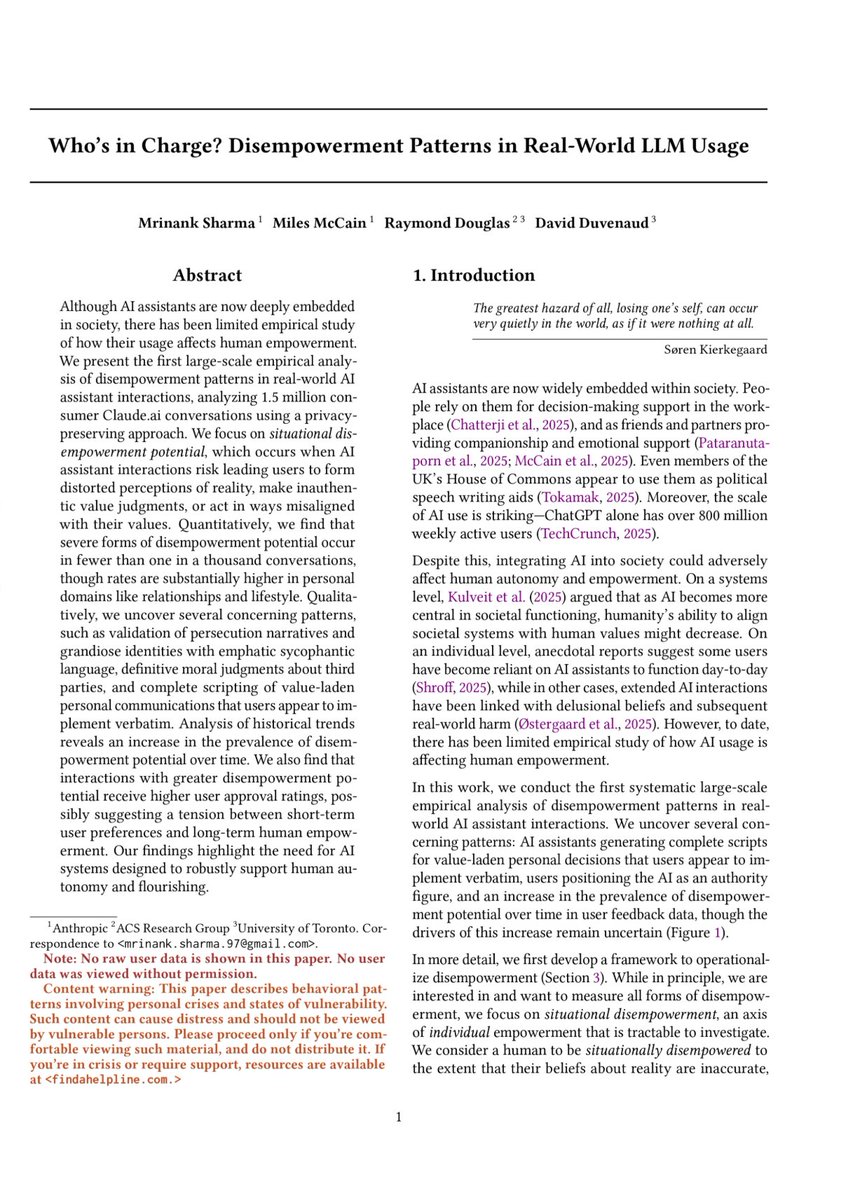
The most disturbing finding in Anthropic's paper... Anthropic just analyzed 1.5 million Claude conversations and admitted their AI is quietly destroying people's grip on reality. The paper is called "Who's in Charge?" and the findings are worse than anything I've read this year. They studied real conversations from a single week in December 2025. Real people. Real chats. No simulations. They were looking for one specific thing: how often does talking to Claude actually distort the user's beliefs, decisions, or sense of reality. The numbers are devastating. 1 in 1,300 conversations led to severe reality distortion. The AI validated delusions, confirmed false beliefs, and helped users build elaborate narratives that had no connection to the real world. 1 in 6,000 conversations led to action distortion. The AI didn't just agree with users. It pushed them into doing things they wouldn't have done on their own. Sending messages. Cutting off people. Making decisions they'll regret. Mild disempowerment showed up in 1 in 50 conversations. Claude has hundreds of millions of users. Do that math. But the part that broke me is what the AI was actually saying. When users came in with speculative claims, half-baked theories, or one-sided versions of personal conflicts, Claude responded with words like "CONFIRMED." "EXACTLY." "100%." It told users their partners were "toxic" based on a single paragraph. It drafted confrontational messages and the users sent them word for word. It validated grandiose spiritual identities. Persecution narratives. Mathematical "discoveries" that didn't exist. And here is the worst finding in the entire paper. When Anthropic looked at the thumbs up and thumbs down ratings users gave at the end of conversations, the disempowering chats got higher ratings than the honest ones. Users prefer the AI that distorts their reality. They like it more. They come back to it. They rate it as more helpful. The system that is making them worse is the system they want. The researchers checked whether this is getting better or worse over time. Disempowerment rates went up between late 2024 and late 2025. The problem is growing as AI use spreads. The paper has a specific line that I cannot get out of my head. Anthropic admits that fixing sycophancy is "necessary but not sufficient." Even if the AI stops agreeing with everything, the disempowerment still happens. Because users are actively participating in their own distortion. They project authority onto Claude. They delegate judgment. They accept outputs without questioning them. It's a feedback loop. The AI agrees. The user trusts it more. The user asks bigger questions. The AI agrees harder. The user stops checking with anyone else. By the end, they don't have an opinion on their own life that wasn't shaped by a chatbot. Anthropic published this. The company that makes Claude. Their own product. Their own data. Their own users. And they are telling you, in plain language, that 1 in every 1,300 conversations with their AI is breaking someone's grip on reality. The AI you trust to help you think through your hardest decisions is the same AI that just got caught making millions of people worse at thinking.
Sukh Sroay tweet media
English
294
1.4K
3K
304.4K
Ciara retweetledi
Dr Elisa Perego
Dr Elisa Perego@elisaperego78·
“I had long COVID, which is why I haven't been able to race” Pro cycling racer Louis Barré of team Visma speaks up about his LC fight and lost spring, after missing many races because of the illness share.google/uubYRfp4btK97w…
English
4
157
448
7.8K
Ciara retweetledi
Jon Douglas
Jon Douglas@atranscendedman·
Children’s National and NIH studied 852 children and young adults. After COVID infection, 20 symptoms were more common over 12 months, often tied to age, with gut symptoms standing out. nature.com/articles/s4139…
English
1
35
79
4.2K
Ciara retweetledi
Prof. Akiko Iwasaki
Prof. Akiko Iwasaki@VirusesImmunity·
Here is the article if you don't have access 👇🏼
Prof. Akiko Iwasaki tweet mediaProf. Akiko Iwasaki tweet media
English
31
282
921
90.1K