
Sabitlenmiş Tweet
•
161 posts


100% and highlighted this in the 3rd paragraph.
To summarise the aim of the post was to separate the two terms (despite them being linked), to highlight how athleticism without the skill of duelling doesn’t guarantee winning duels and players with lesser athleticism can win/outfox the opponent with skill-intelligence. But also how physical capacity underpins application for outcomes differently in players.
English

I agree with all of this but it comes down to definitions. a lot of those things you take up body positioning, using body, planting foot, angle themselves for shots are all about balance and agility, which is incorparated in athelticism. The players with the best athleticism are the ones that posseses both raw explosive power but also the agility, balance and ability to withstand contact. For instance, that is the reason why Yamal has more athelticsm than Adama Traore.
English
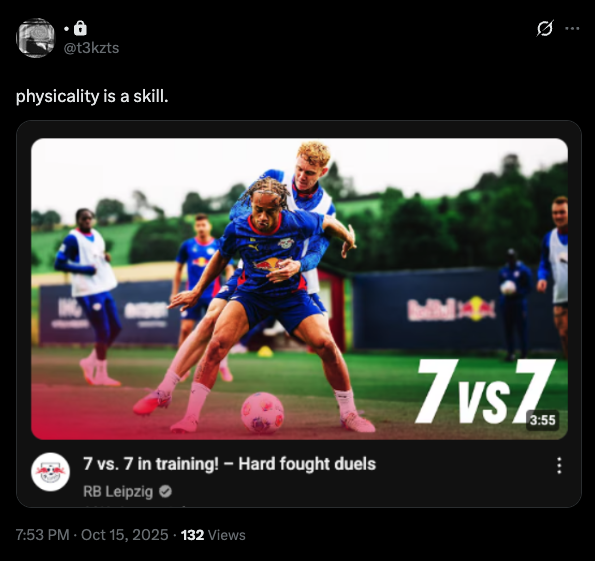
Physicality is a skill.
Protecting the ball, protecting space, anticipating and timing contact (force), body positioning, offering the race and foot patterns mean physicality is a learnt skill expressed through duelling which translates to the pitch both in and out of possession.
These are skills developed through interaction and conditioning with the ball. It’s how a player uses their body against opponents relative to the game and rules.
Often confused with athleticism, the players physical capacity; height, limbs length, speed, pace, power, accel/decel and direction changes. These traits are important as isolated ability but also completely support physicality. However, they do not determine how successful a player duels. The importance of translating athleticism to the pitch is how effectively a player applies skill relative to the opponent, space and situation.
Aerobic capacity is one key foundational element which helps uphold skill, both in and out of possession. The ability to recover from high intensity actions faster is important for repeated actions (application of skill + quality of that skill), and also for philosophies with principles around counter pressing and pressured isolated situations (3v3, 1v1).
Conditioning-Stamina provides access to players skill on/off the ball and athleticism throughout the game. As fatigue develops, it affects the foundations for skill as well as a players decision making. Cognition-perception is another key element to upholding skill. When physical, mental or nervous system fatigue appears, players perception of the situation can decrease in speed of decision and which solution to take - A more technical player would possess more skills in their locker to access within such situations. Fatigue can also affect the execution (technique) of a skill both in (passing/shooting) and out of possession (duelling).
In transitional moments, fatigue affects the decision and then the action taken to either counter press, freeze or drop off. There are few set principles in the game and therefore players natures must innately align to the chosen principles. For example, playing out the back principles require natures engrained with the skillset needed, so under fatigue or pressure they remain to the collective intent.
The clubs philosophy and identity choose these principles which filter down to the strategies applied. The manager, coach and players must align collective and innately to these principles otherwise it breeds chaos or more tactical security (protecting limitations) for effectiveness.
No two players are the same and physicality-intelligence wins duels. Every player has different solutions based of their capacity, to meet the outcome in a skill based sport.
English
Players are the tactics, acting-reacting in live time.
Live time player action-reaction turn [predefined] lines to shadows. This is where tactics don’t exist - it’s players finding live solutions through their ability, whilst adhering to the coached automatisms within the overall chosen strategy.
Strategy is often silent and not evident or clearly visible through the lens of viewing direct player actions.
As viewers or analysts, we are viewing direct player actions with lag - but this isn’t how players in live time see the game, they just act in the moment, they have no lines.
The task for clubs is to recruit players to the strategies chosen by the coach. Both player and the strategy are innately aligned to the higher-arching philosophy.
It’s a players game.

•@cirotexts
tactics don’t exist.
English

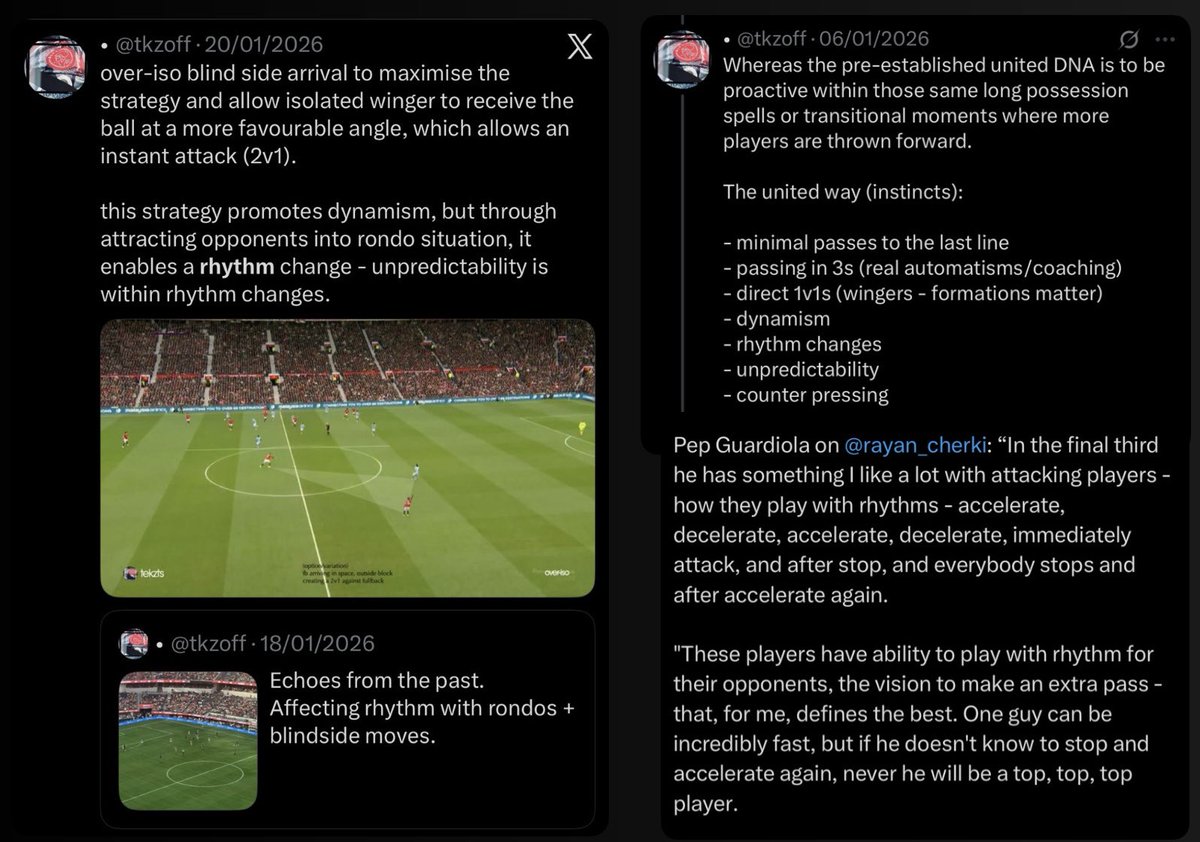
Achieved individually or collectively, the ability to change rhythm leads to unpredictability.
Rigid passing circuits with predefined actions affect the natural rhythm and individual solutions, eventually becoming predictable patterns (playbooks).
Passing or playing in 3s is the true coached automatism merged within the strategy, which players have the freedom to make decisions and change rhythms individually (players are the tactics), whilst remaining within the collective idea of connecting in 3s.
Staying within the idea of playing in 3s, players are able to individually act-react to live situations posed by the opponent, opposed to forcing a passing circuit set at predefined rhythms and touches.
There are strategies which naturally promote dynamism, making the distances of passing in 3s produce more motion and therefore more rhythm changes.
But passing in 3s is not solely a small space concept and is a collective idea also applied across larger/any distance.
Connectivity between players is not tied to proximity, but a collective idea flexible to different distances and situations.
Affecting the opponent is the aim, which is achieved through the ability to react to the situation posed whilst remaining strong in acting your idea (philosophy).
Therefore, strategy from coach and ability from players should both have the capacity to change rhythms for unpredictability.
English
• retweetledi
• retweetledi
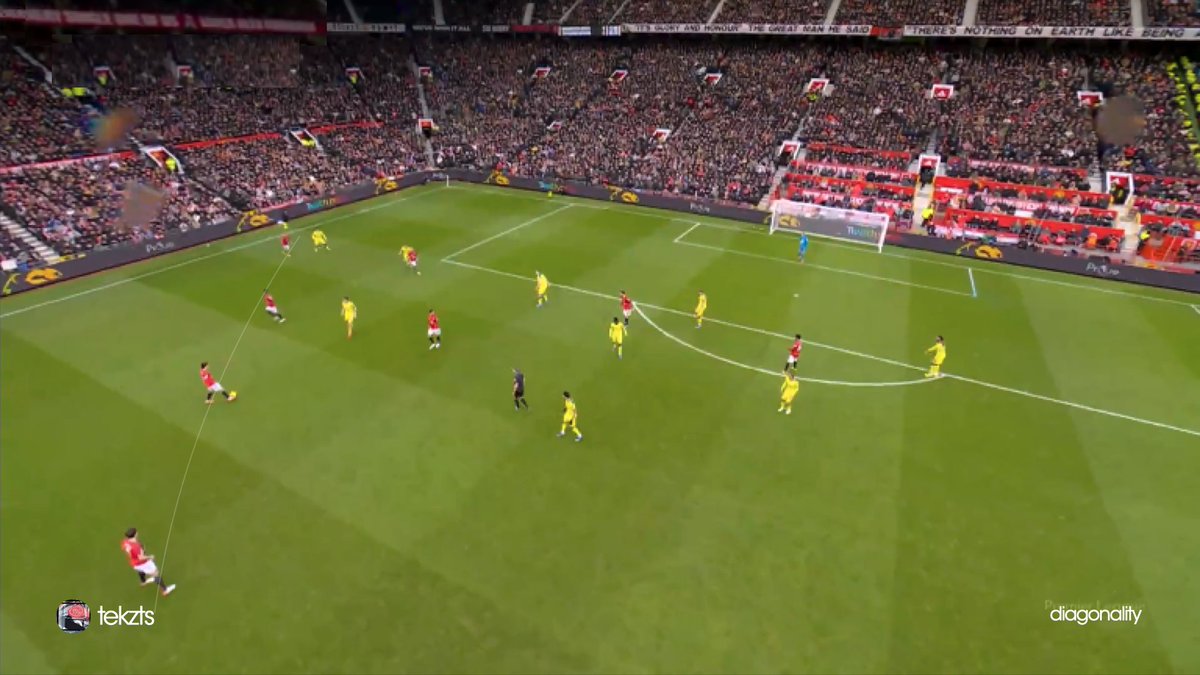
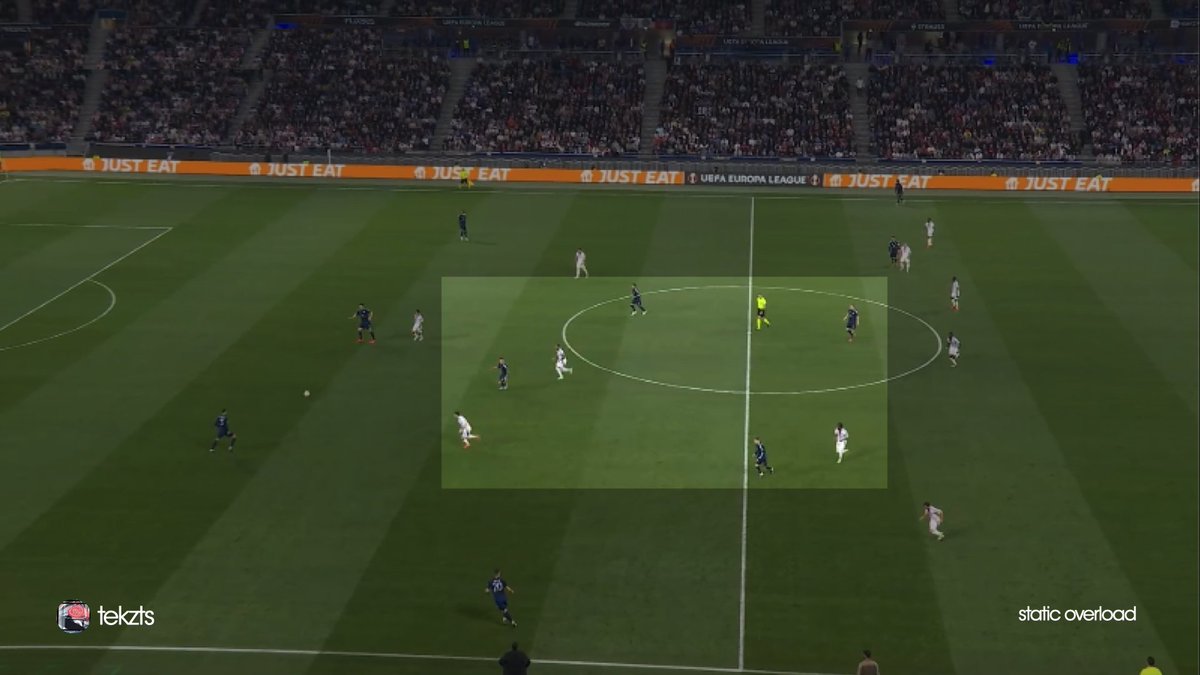
The capped static overload which has prevent United from progressing collectively and now returning back to a potential higher ceiling approach.
Placing tactical security to cover technical, physical, athletic and connectivity issues, means when this security is negated by the opponent, the hidden issues get exposed resulting in collapsed foundations and cohesion - current stage (again).
In short, this squad requires a +1 to help progress and protect play effectively (versus a range of opponents). The true transition, is ultimately removing the +1 and maximising recruitment to apply a higher ceiling approach aligned to the clubs true footballing idea.
It would require building another base team (one that can carry out the idea but not to the level of challenging for repeated titles yet), opposed to a lesser system in exchange for results whilst being against the clubs philosophy (1v1 dominance).
The +1 can then be added, if needed, once the individuals and smaller collective are effective and cohesive, but the static overload shouldn't be the sole solution and fail safe.
English
• retweetledi

• retweetledi
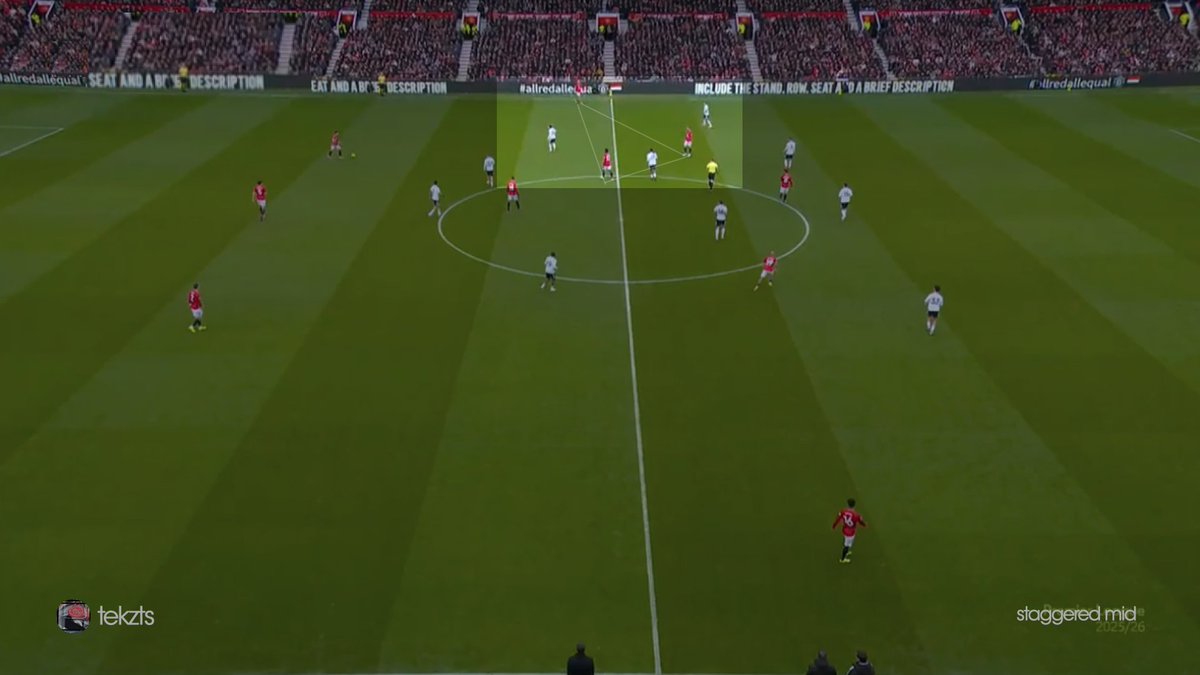
CM rolling out creating wide triangles, with the aim to access centre of the pitch.

•@cirotexts
staggered midfield + active overloads.
English
• retweetledi
• retweetledi

• retweetledi
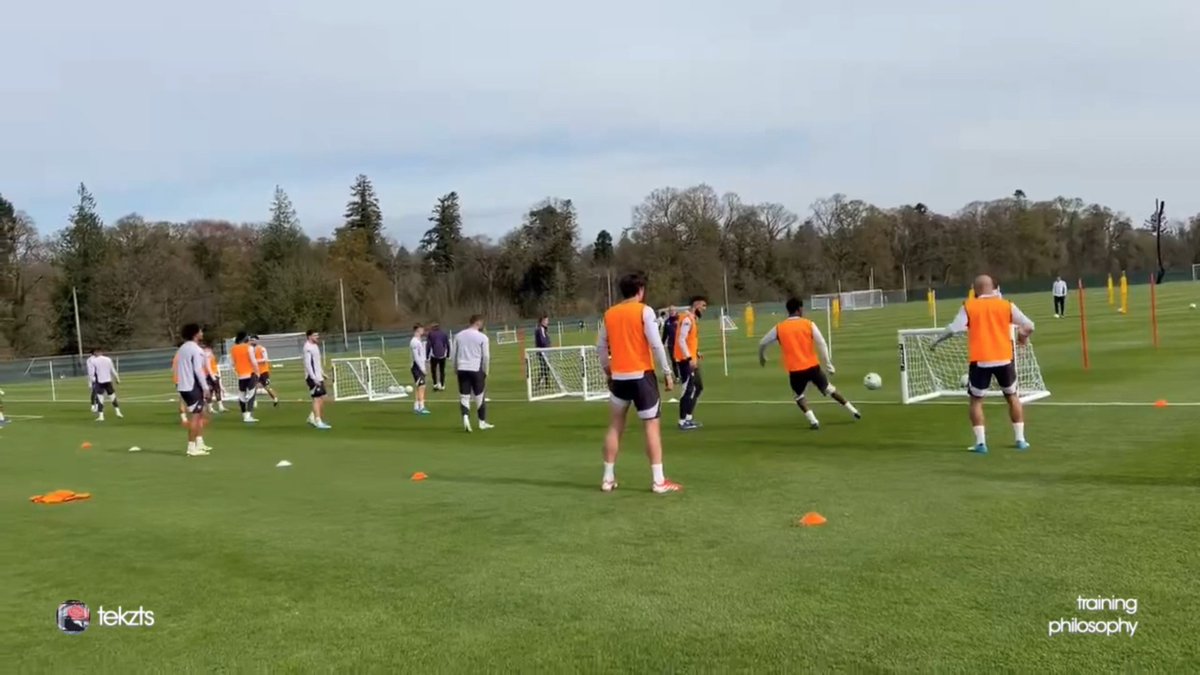
coached intentions become principles and true automatisms within strategy.
players free to find individual solutions to opponent pressure within the collective intent.
these examples show the smaller collective preparing/anticipating the ball in the air to be brought down.
English