
Sabitlenmiş Tweet
Clone
215 posts


Clone
@clonerobotics
Lifelike, superintelligent androids.
Mountain View, CA Katılım Ekim 2021
69 Takip Edilen68.2K Takipçiler
Fireside chat between @PeterDiamandis and Clone’s co-founder and CEO @dhanushisrad at @AbundanceSummit on March 10, 2026.
English




Clone retweetledi

Had a wonderful time unveiling the Torso 3 at the Abundance Summit this week! Video coming soon.


English
Clone retweetledi
Excited to be speaking at the Abundance Summit in Ranchos Palos Verdes on March 10th! Come check out my fireside chat with @PeterDiamandis to learn more about the lifelike, synthetic humans that we are pioneering at Clone with our next-generation hydraulic muscle technology!

English
Clone retweetledi

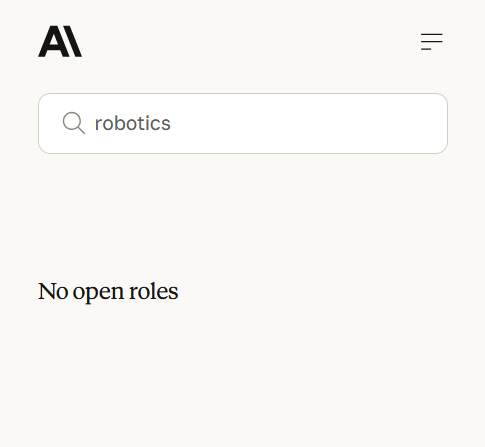
Dario acknowledges the multi-trillion dollar robotics opportunity, yet Anthropic is not hiring robotics talent; even as OpenAI and Google DeepMind aggressively build out their own robotics teams.


The Humanoid Hub@TheHumanoidHub
"Will the robotics industry will be generating trillions of dollars of revenue?", "YES." Dario Amodei says breakthroughs in robotics could emerge in several ways, such as through continual learning or generalization. Once achieved, these models will revolutionize both robot design and control. However, it will likely take another year or two from that point for the technology to diffuse through the economy.
English
Clone retweetledi

Start with the hardest constraint.
In this clip, Dhanush from @clonerobotics explains why Clone spent its first two years focused almost entirely on the hand…
English
Previous Hand joint controller from 2024 was open loop without any joint angle sensing. This one is from July 2025 and has 80% of hand joint sensing and uses closed loop control for the first time. Upcoming joint controller with full joint position sensing and better hand biomechanics will be tenable for tool use and training a foundation model. Future joint controller that incorporates muscle position sensing will achieve human surgical accuracy.
English
Isn't this old news? Clone showed this earlier this year. They use hydraulic instead of mechanical actuators.
Clone@clonerobotics
Building a fully actuated, human-level robotic hand by strength, speed, and range of motion is hard. Making it incredibly durable is even more challenging. Clone has pioneered anthropomorphic hands with 27 degrees of freedom, human-level grip strength and speed, and the most durable artificial muscles in the world. The Hand in this demo is missing middle flexor muscles, but here’s an update on the neural joint controller.
English
Building a fully actuated, human-level robotic hand by strength, speed, and range of motion is hard. Making it incredibly durable is even more challenging.
Clone has pioneered anthropomorphic hands with 27 degrees of freedom, human-level grip strength and speed, and the most durable artificial muscles in the world.
The Hand in this demo is missing middle flexor muscles, but here’s an update on the neural joint controller.
English
Clone retweetledi
Building a fully actuated, human-level robotic hand by strength, speed, and range of motion is hard. Making it incredibly durable is even more challenging.
Clone has pioneered anthropomorphic hands with 27 degrees of freedom, human-level grip strength and speed, and the most durable artificial muscles in the world.
The Hand in this demo is missing middle flexor muscles, but here’s an update on the neural joint controller.
Mario Nawfal@MarioNawfal
ELON: HANDS' FUNCTIONS ARE EXTREMELY COMPLEX TO REPLICATE IN ROBOTS "The hand is extremely complex. There are 50 actuators in the hand, with the hand and forearm. An actuator is the motor, gearbox, and power electronics. So that’s 100 per robot, really a lot of actuators and sensors. Approximately. In order to do dexterous tasks, you have to have a hand with the sensitivity, precision, and degrees of freedom of a human hand. Because something that we find easy to do, like pick up a screwdriver or turn a wrench, or even thread a needle or play the guitar, actually requires a lot of dexterity." Source: @elonmusk, @BaronCapital, @RonBaronAnalyst
English
Clone retweetledi

Technological innovation can be a form of participation in the divine act of creation. It carries an ethical and spiritual weight, for every design choice expresses a vision of humanity. The Church therefore calls all builders of #AI to cultivate moral discernment as a fundamental part of their work—to develop systems that reflect justice, solidarity, and a genuine reverence for life.
English
Clone retweetledi
@TheArenaAI @goformic Clone (Anastasi In Tech): The Breakthrough Behind the First Human Clone (@clonerobotics)

English
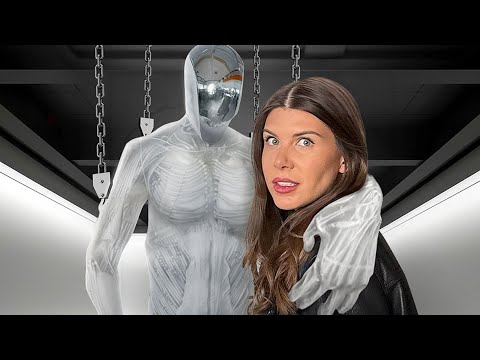
Clone's Co-founder & CEO Dhanush Radhakrishnan (@dhanushisrad) discusses building musculoskeletal androids in an interview with Anastasiia Nosova.(@AnastasiInTech)
English
Clone retweetledi

.@clonerobotics is different.
You can feel it.
You can see it.
I sat down with Co-founder and CEO @dhanushisrad to talk about why that is:
„Solving problems no one else is solving.”
▶️ Full convo now on YouTube:
youtu.be/BQVLf-65i_M
YouTube
English
Clone retweetledi
Took me 2 years to land this one...
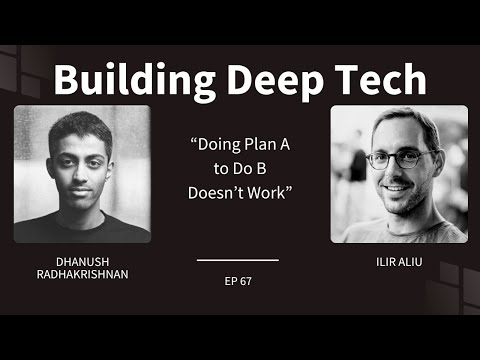
🎙️ In this episode, I talk with @dhanushisrad, Co-Founder and CEO of @clonerobotics:
The company is building lifelike, musculoskeletal androids that move like humans and could become the next personal computing platform.
Dhanush shares how watching Iron Man at 13 sparked a lifelong obsession with tech, leading him from plasma thrusters and nuclear fusion research to founding a YC-backed robotics company now making headlines with their human-like androids.
We talk about why his first startup didn’t work out (and why Plan A to do B never does), how he met his co-founder on the internet, and why moving to Poland turned out to be one of the best decisions for focus and execution.
Clone is going against the grain: from hydraulics to neural net control, from soft-body design to building general-purpose robots from scratch.
This convo is packed with vision, hard-earned insights, and a founder who’s not afraid to do things differently.
Give it a listen. You’ll see why people are paying attention.
@builddeeptech #67
"Doing Plan A to Do B Doesn’t Work"
With Dhanush Radhakrishnan
🎥 YouTube: youtu.be/BQVLf-65i_M
🎧 Spotify: open.spotify.com/episode/78kDIU…
🎧 Apple: podcasts.apple.com/us/podcast/bui…
YouTube
English
Clone retweetledi
New interview with @IlirAliu_!
Ilir Aliu@IlirAliu_
Took me 2 years to land this one... 🎙️ In this episode, I talk with @dhanushisrad, Co-Founder and CEO of @clonerobotics: The company is building lifelike, musculoskeletal androids that move like humans and could become the next personal computing platform. Dhanush shares how watching Iron Man at 13 sparked a lifelong obsession with tech, leading him from plasma thrusters and nuclear fusion research to founding a YC-backed robotics company now making headlines with their human-like androids. We talk about why his first startup didn’t work out (and why Plan A to do B never does), how he met his co-founder on the internet, and why moving to Poland turned out to be one of the best decisions for focus and execution. Clone is going against the grain: from hydraulics to neural net control, from soft-body design to building general-purpose robots from scratch. This convo is packed with vision, hard-earned insights, and a founder who’s not afraid to do things differently. Give it a listen. You’ll see why people are paying attention. @builddeeptech #67 "Doing Plan A to Do B Doesn’t Work" With Dhanush Radhakrishnan 🎥 YouTube: youtu.be/BQVLf-65i_M 🎧 Spotify: open.spotify.com/episode/78kDIU… 🎧 Apple: podcasts.apple.com/us/podcast/bui…
English
Clone retweetledi

TBPN@tbpn
We asked @wolfejosh from @Lux_Capital to explain why robots shouldn't look like humans. "They should be, in the Darwinian sense, 'Endless forms, Most beautiful'." "Why do we give them two arms and two legs to unpack a sink?" "I want to see them have six arms and do things that are un-human, like that Cantina scene from Star Wars." "The future of robotics is embodied intelligence, irrespective of form factors."
ZXX