

Levi
567 posts

The next $TAO or $KAS is brewing
Lead by a team full of MIT scientists (doxxed)
Narrative? Quantum
Very hard to buy but this gives the best opportunities, this is how both Tao and Kaspa began
Can you guess?
English
Levi retweetledi

In fact, the merchant count is 700K+ now, and settlement is only chapter one.
What comes next: autonomous agents composing financial dApps on top of real transaction flows — self-governed, accountable, aligned to human interests. #NetX isn't just the trust layer for payments. It's home for the agent economy that builds on them.
S@NetX_SDKN
This is a huge signal for where the market is going. 450,000+ merchants, live payment rails via Netstars, wallet distribution from @BitgetWallet this is real web3 infrastructure being deployed. Plugged into already wide spread national rails through @Kouhou_NSS But the key layer most people are missing is settlement and verification. Through @WEAJapan, @netx_world sits directly in that stack powering the trusted computing layer that enables secure, verifiable, and scalable Web3 payments. If even a small % of this merchant flow routes through $NetX for settlement, gas, and infrastructure services, the demand dynamics change completely. Stablecoins are evolving from passive holdings into active payment networks at scale. Japan is building the blueprint Web2 rails + Web3 settlement + AI-driven infrastructure. Japan is only the beginning… #NetX #PayFi #Stablecoins #Web3 #RWA #Fintech #Japan
English
$NetX 🚀 #NetX 🚀
S@NetX_SDKN
This is a huge signal for where the market is going. 450,000+ merchants, live payment rails via Netstars, wallet distribution from @BitgetWallet this is real web3 infrastructure being deployed. Plugged into already wide spread national rails through @Kouhou_NSS But the key layer most people are missing is settlement and verification. Through @WEAJapan, @netx_world sits directly in that stack powering the trusted computing layer that enables secure, verifiable, and scalable Web3 payments. If even a small % of this merchant flow routes through $NetX for settlement, gas, and infrastructure services, the demand dynamics change completely. Stablecoins are evolving from passive holdings into active payment networks at scale. Japan is building the blueprint Web2 rails + Web3 settlement + AI-driven infrastructure. Japan is only the beginning… #NetX #PayFi #Stablecoins #Web3 #RWA #Fintech #Japan
QME

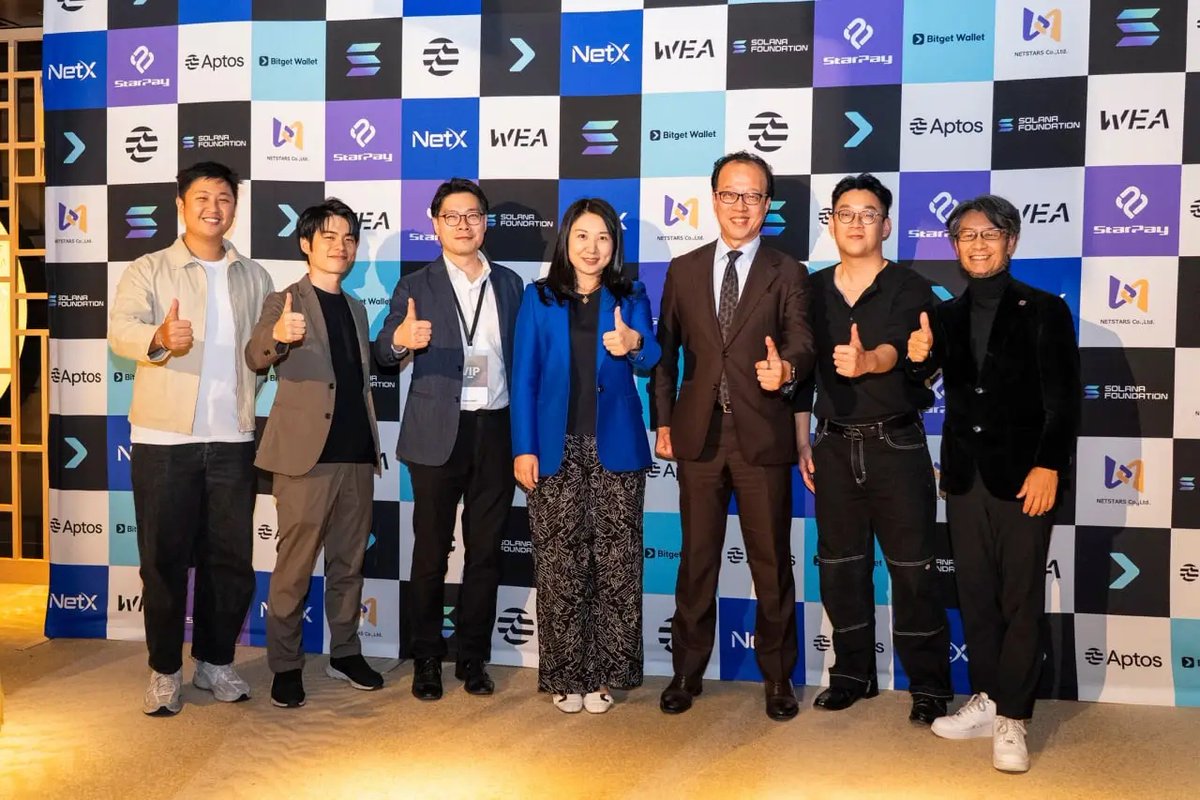
Tb pics for our event in Tokyo last week:
> Announced new initiative with Netstars on StarPay-X
> Building web2 to web3 rails
> Connecting 450,000 merchants → web3 QR Pay
Shoutout to everyone involved: @BitgetWalletJP @SrWillWill @netx_world @teamz_inc @WEAJapan @Kouhou_NSS



English
Levi retweetledi

Proud of the $NETX community in every sense, from ambassadors and independent researchers to the volunteers supporting others every day, all the way to the very last investor. This is what real collective building looks like.
#LetsGoNetX
English
@BitgetWallet @BitgetWalletJP @SrWillWill @netx_world @teamz_inc @WEAJapan @Kouhou_NSS Powered by $NetX 🚀
English

JUST IN: 🇯🇵 Japan officially approves bill to recognize cryptocurrency as a financial asset.
English

🇯🇵 LATEST: Japan's Cabinet has approved a bill to classify cryptocurrencies as financial instruments, prohibiting insider trading and requiring annual disclosures, per Nikkei.

English

Levi retweetledi

The next financial system won’t be built overnight…
It’s being deployed, tested, and scaled — right now.
Quietly… globally… inevitably.
Powered by $NETX ⚡️
English
Levi retweetledi

🧱Confirmed Web3 Payment Stack 🇯🇵
• StarPay-X (@Kouhou_NSS) → payment gateway + merchant rails
• WEA (@WEAJapan) → Web3 interface (QR, wallets, UX)
• NetX (@netx_world) → underlying infrastructure layer
• Stablecoin issuance
→ USDC (multi-chain incl. @solana)
→ JPYSC / USDSC (@StartaleGroup)
• Execution layer → @AptosLabs, @CantonNetwork, @solana
• Wallet layer → @BitgetWallet
“not limited to specific tokens, chains, or wallets” 🚀
Thank you @anbangr @NetXDAO @NNGNetX 👏
NetX@netx_world
🎉Congratulations on this important milestone #NetX remains committed to providing robust underlying infrastructure and technical support to our partners, helping bridge Web2 and Web3 while enabling seamless global circulation between fiat and crypto assets. Looking ahead, many stablecoin payment use cases in Japan will be powered and operated on the NetX Network. 🌏 🇯🇵 Together, we are building the foundation for the next era of real-world Web3 adoption.💪 #Web3Payments #Japan $NETX
English
NETSTARS 🤝 Bitget Wallet
Excited to take part in the launch of StarPay-X at TEAMZ SUMMIT 2026. More to come.
株式会社ネットスターズ@Kouhou_NSS
[Press Announcement] At TEAMZ SUMMIT 2026, NETSTARS announced its new initiative, “StarPay‑X,” in a media presentation. We are committed to advancing real‑world Web3 adoption through strong partnerships. 🔗 00m.in/JMVBl #TEAMZSummit #StarPayX #Web3Payments
English
Levi retweetledi

$NETX
You can find all the details in this document: arxiv.org/html/2603.2510…
Why does Anbang use such specific examples like Emirates NBD?
Anbang uses real-world bank names (such as Emirates NBD or DBS Singapore) and actual regulations (such as those from the UAE or the European Union) for a very compelling technical reason:
Design Validation: They want to ensure the system doesn't come across as "science fiction." By testing it "on paper" against existing banks and current laws, they demonstrate that the NetX code is equipped to handle the real-world technical challenges of global banking.
Demonstration of Potential: By choosing a bank in the UAE, they are specifically showcasing that their AI agent system can manage financial jurisdictions that differ significantly from Western ones, which is one of the core strengths of their proposal.
🇪🇸 𝐍𝐄𝐓𝐗 𝐒𝐏𝐀𝐍𝐈𝐒𝐇 🇪🇸@netx_es
Let me explain simply what $NetX is and why it has so much potential to be a game-changer. Basically, it is a trust and "social common sense" layer for artificial intelligence agents. Instead of having machines making decisions inside a black box, this system creates an architecture where every step is transparent and follows very clear rules—almost like a constitution. This allows companies to entrust complex tasks to AI, knowing that everything it does will be trackable and always remain under human control. To show you the real potential of this technology, here are a few examples of how it would work in the real world: 1. International Payments at Scale: Imagine an international bank handling thousands of payments a day. Today, that's a mess of manual processes that can take over six hours. With this system, that same task could be resolved in just an hour, but with one key advantage: total transparency. There are no hidden steps; if a regulator asks why a move was made, the system can show the exact logical path the agent took, eliminating errors and fines for delays or missing information. 2. Zero-Knowledge Privacy: One of the biggest challenges today is that institutions can't easily share sensitive data. Imagine two banks that need to verify if their clients comply with banking regulations, but they don't want to (and cannot) share their private databases with each other. This is where the magic of "zero-knowledge" comes in: one bank can prove to the other that everything is in order without handing over a single piece of personal data. This enables incredible global automation without putting anyone's privacy at risk. 3. Digital Guardians and Resilience: What happens if incorrect information comes in from an external provider? Normally, this would cause a financial disaster. However, this framework allows for digital "guardians" that detect anomalies in a matter of seconds. Instead of everything grinding to a halt, the system can freeze only the failing part, correct the error, and move forward with the rest of the operations. It’s a recovery capability that is almost impossible to achieve manually today. 4. Human-in-the-Loop Evolution: The most powerful part is that the system isn't rigid. If an automated rule unfairly blocks a payment, a panel of people can review the trail left by the AI to understand its logic. If they discover the rule is outdated, they can update the system's "constitution" on the spot. This means the technology doesn't just execute orders—it evolves and becomes fairer over time, always guided by the judgment of the people supervising it. It is important to mention that while this entire architecture and technology are real and actively in development, this case study is a technical demonstration of its potential, not a news report of an event that has already occurred in the financial sector. It is, essentially, the master plan for a new economy where humans and machines collaborate safely, efficiently, and above all, under a clear social contract for everyone.
English
Levi retweetledi
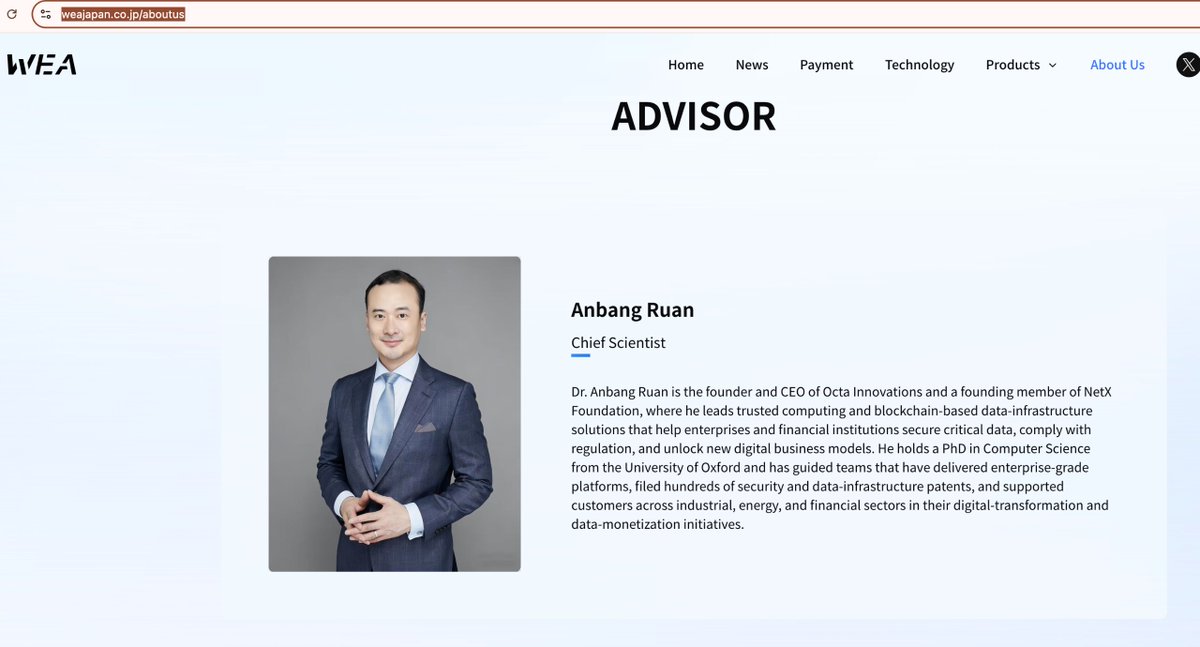
Welcome back to the front lines, @anbangr.
We missed you !! 🫡
@netx_world @WEAJapan
weajapan.co.jp/aboutus
English
Levi retweetledi
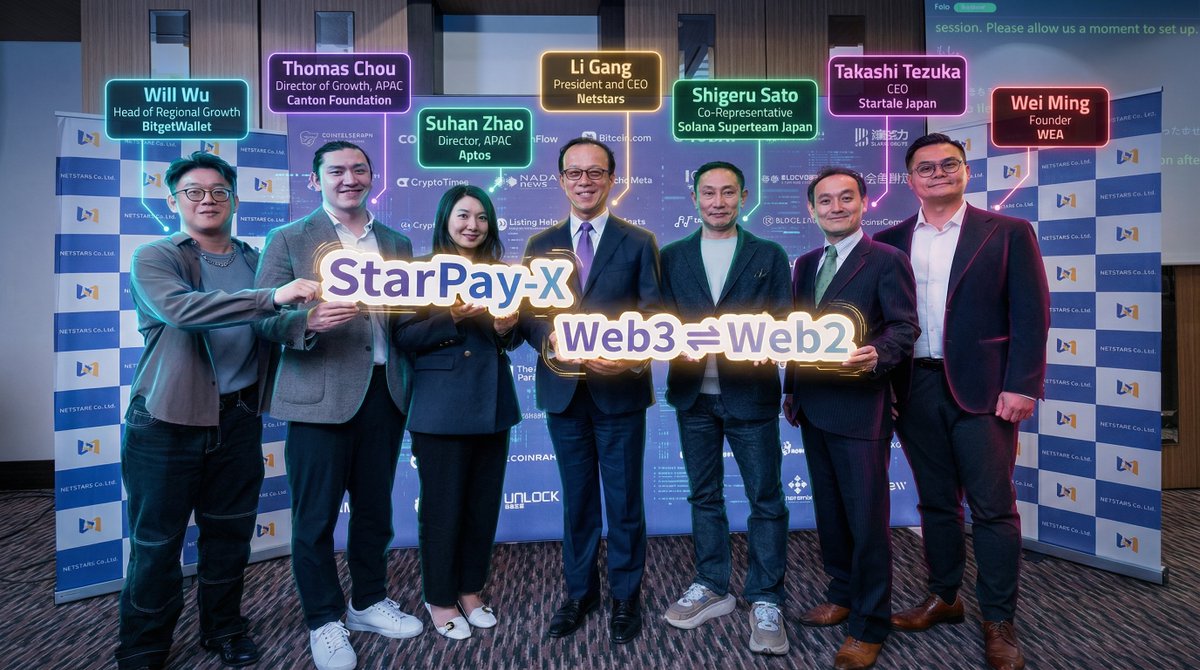
Shall we name them?
- Will Wu: Head of Regional Growth, BitgetWallet
- Thomas Chou: Director of Growth, APAC, Canton Foundation
- Suhan Zhao: Director, APAC, Aptos
- Li Gang: President and CEO, Netstars
- Shigeru Sato: Co-Representative, Solana Superteam Japan
- Takashi Tezuka: CEO, Startale Japan
- Wei Ming: Founder, WEA
$NETX
English

日本でステーブルコインの実用化が加速。
NETX(@netx_world)のトラステッドコンピューティング型L1基盤を活用し、羽田空港第3ターミナルでUSDCのQRコード決済実証が開始。
Netstars主導で訪日観光客向けに展開され、Web3からリアル店舗への即時・安全な決済を実現。
日本の先進的な規制環境のもと、姫路などへの拡張も予定されており、ステーブルコインが日常決済へと本格的に浸透し始めている。

日本語

English

🇯🇵LATEST: STABLECOIN ADOPTION ACCELERATES IN JAPAN VIA NETX
Japan is leading real-world stablecoin adoption. NETX (@netx_world) trusted computing Layer-1 infrastructure powers a groundbreaking USDC QR-code payment pilot at Haneda Airport Terminal 3.
Launched by Netstars for inbound tourists, the trial enables instant, secure Web3-to-retail settlements.
This marks a major step under Japan’s progressive regulations, with Phase 2 expansion already planned for sites like Himeji.
NetX is turning stablecoins into everyday payments, bridging crypto and commerce at scale.
English
Levi retweetledi

🎉 WEA was honored to be invited to the exclusive closed-door dinner hosted by @Kouhou_NSS during @teamz_inc Summit 2026 in Tokyo. 🇯🇵
The event brought together leaders from Japan’s payment industry, Web3 builders, financial institutions, and ecosystem partners to explore the future of digital payments and real-world adoption.
🔥 At the dinner, WEA CTO Wei Ming shared insights on Web3 infrastructure development — bridging Web2 and Web3 systems and enabling real-world payment use cases — while also introducing: 'Providing Online Asset Management Services through Web3 — AI × DeFi for automated on-chain asset management'
💡He outlined the evolution from payment infrastructure to AI-driven asset management, highlighting how AI Agents are transforming on-chain interactions from manual operations into automated execution.
From payments to intelligent asset utilization, WEA continues to build real-world Web3 financial infrastructure — powered by @netx_world , reflecting a strong and ongoing collaboration.
🚀 Looking ahead, we will continue working closely with partners to scale our technology, advance the cashless future, and drive deeper integration of stablecoin payments, DeFi, and AI-powered asset management in real-world scenarios.
We sincerely thank all guests and partners for their support and trust, and welcome more builders, institutions, and partners to connect and collaborate with us 🤝
#RWA #AI #DEFI #Teamz2026 #NETX #Netstars #web3 #Web3payment #WEA #WEAjapan


English