Nikita Sajai (she/her)

20 posts

Nikita Sajai (she/her) banner
Nikita Sajai (she/her)

Nikita Sajai (she/her)

@cornellNS623

Cornell '22 | Computational Biology | Pawlowski Lab 🌽

Katılım Eylül 2020
15 Takip Edilen6 Takipçiler
Nikita Sajai (she/her)
Nikita Sajai (she/her)@cornellNS623·
#CUinTheLab I hope to research green energy in the future, which will likely involve the use of many of the lab tools we learned about, including R and other scientific equipment, and good communication skills, such as visually-appealing, concise, and informative graphic design.
English
1
0
0
0
Nikita Sajai (she/her)
Nikita Sajai (she/her)@cornellNS623·
Human health: Climate change will increase the population's risk to water-borne and vector-borne diseases, as it is linked to increased flooding due to and more intense monsoon seasons. Besides disease, other impacts are loss of clean water and population displacement
English
0
0
1
0
Nikita Sajai (she/her)
Nikita Sajai (she/her)@cornellNS623·
Biodiversity: Climate change threatens India's unique ecosystems including the Himalayas, mangrove forests, forests, and grasslands.
English
1
0
1
0
Nikita Sajai (she/her)
Nikita Sajai (she/her)@cornellNS623·
According to the National Intelligence Council, India "is already experiencing changes in climate and the impacts of climate change, including water stress, heat waves and drought, severe storms and flooding, and associated negative consequences on health and livelihoods."
English
1
0
1
0
Nikita Sajai (she/her)
Nikita Sajai (she/her)@cornellNS623·
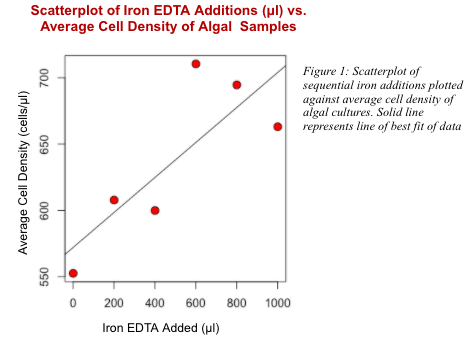
Although there is a moderately strong, positive association between iron additions and average algal cell density, this correlation is not significant, so iron is not demonstrated to be a limiting nutrient for the growth of C. reinhardtii.
Nikita Sajai (she/her) tweet media
English
0
0
0
0
Nikita Sajai (she/her)
Nikita Sajai (she/her)@cornellNS623·
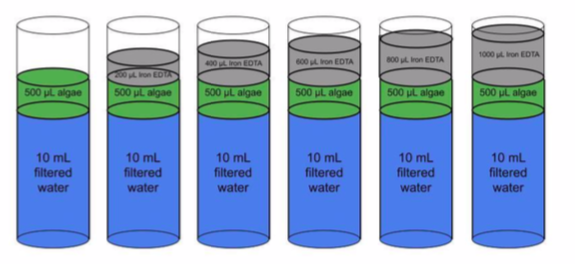
In this study, varying amounts of iron nutrient solution or Iron EDTA were added to samples of C. reinhardtii in filtered lake water (0 μL, 200 μL, 400 μL, 600 μL, 800 μL, and 1000 μL) and the resulting optical density of the algal growth was measured with a spectrophotometer.
Nikita Sajai (she/her) tweet media
English
1
0
0
0
Nikita Sajai (she/her)
Nikita Sajai (she/her)@cornellNS623·
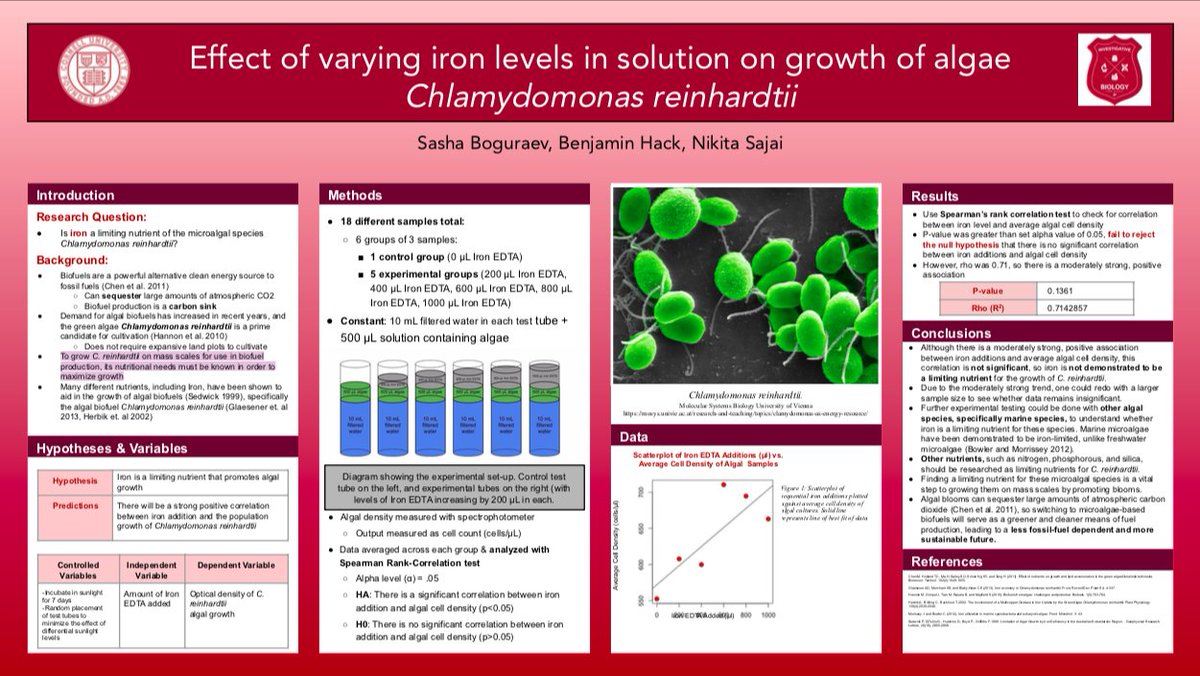
Our group investigated whether iron is a limiting nutrient of the microalgal species Chlamydomonas reinhardtii. Biofuels are a powerful clean energy source. To grow C. reinhardtii on mass scales for use in biofuel production, its nutritional needs must be known. #CuSciStory
Nikita Sajai (she/her) tweet media
English
1
1
0
0
Nikita Sajai (she/her)
Nikita Sajai (she/her)@cornellNS623·
The data, which was analyzed with ANOVA and t-test, revealed that the selected microalgae species was suitable for use in #wastewatertreatment, as it significantly reduced chemical pollutant levels.
English
0
0
0
0
Nikita Sajai (she/her)
Nikita Sajai (she/her)@cornellNS623·
The photobioreactor or algal fuel cell was built with the isolated microalgae Leptolyngbya sp. JPMTW1, and its operation was tested by evaluating select parameters of the #wastewater, such as pH and EC, before and after treatment.
English
1
0
0
0
Nikita Sajai (she/her)
Nikita Sajai (she/her)@cornellNS623·
Through this analysis, the researchers discovered that the soil microbe community heavily influenced which #antibioticresistant genes prevailed in certain wetlands, and they found a positive correlation between soil moisture and temperature and ARG abundance.
English
0
0
0
0
Nikita Sajai (she/her)
Nikita Sajai (she/her)@cornellNS623·
The study was conducted across 32 wetlands in the #TibetanPlateau, which was relatively untouched by humans until about 50 years ago. The researchers analyzed soil samples by testing for their physical-chemical properties, and then by extracting soil microbe DNA samples.
English
1
0
0
0
Nikita Sajai (she/her)
Nikita Sajai (she/her)@cornellNS623·
The biggest take-away from the study was that top predators facilitate species diversity by preventing prey species from hoarding resources. [3/3]
English
0
0
0
0
Nikita Sajai (she/her)
Nikita Sajai (she/her)@cornellNS623·
Paine and his team studied marine rocky intertidal zones and the effects of removing the top predator (Piaster) from a north temperate subweb and compared it to an undisturbed control area of the habitat. [2/3]
English
1
0
0
0
Nikita Sajai (she/her)
Nikita Sajai (she/her)@cornellNS623·
#metadata_info_tab_contents" target="_blank" rel="nofollow noopener">…w-jstor-org.proxy.library.cornell.edu/stable/2459379… This paper sought to answer why longitudinal and latitudinal species gradients come about in relation to #speciesdiversity at a local level and how predators check dominant species and promote local species diversity. #CUInthelab [1/3]
English
1
0
0
0