
Employees owning 3–20% of a public company isn’t a feel‑good fringe idea—it’s one of the most underused tools we have to boost performance and democratize capitalism.
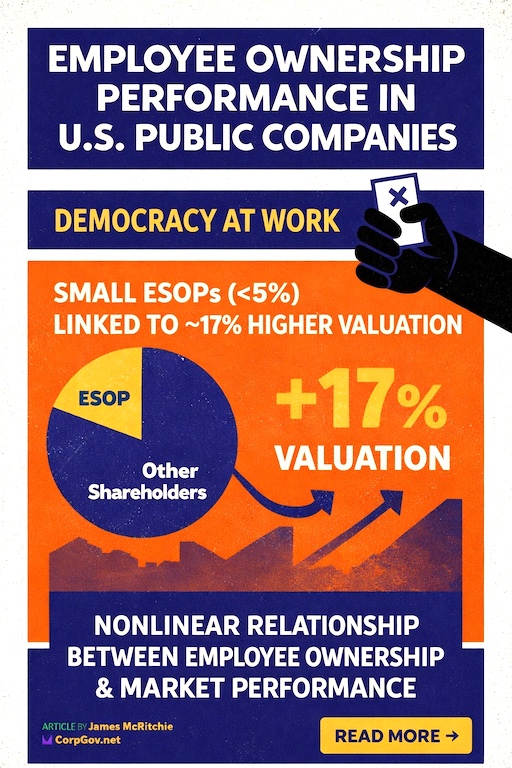
Across the best empirical studies of U.S. public firms, small but meaningful employee ownership stakes and broad‑based stock options are associated with higher valuations and, in many cases, better productivity—especially when workers actually vote a real block of shares. Yet boards and regulators still treat the distribution of those incentive shares as “ordinary business,” and Big Tech issuers like Meta and Amazon resist disclosing who really owns what.
In my new piece at CorpGov.net, I dig into what the data actually say about ESOPs, broad‑based options, and “labor voice” in governance—and why my current best guess is that an economy where employees own 3–20% of large public companies (without control capture) and can vote those shares alongside other elements of workplace democracy will work best. I also map the evidence gaps that are holding the field back and explain why shareholder proposals on incentive‑share transparency are a necessary next step.
If you care about the future of corporate governance, worker power, or the survival of political democracy in a system too often dominated by corporate power and autocratic control, this is a conversation we can’t keep punting to the next generation.
corpgov.net/2026/03/employ…
#corpgov #ESOT #ESOP #employeeownerhip #workerownership #productivity #incentives #ownership
English