Cozy 🦥

319 posts

Cozy 🦥 banner
Cozy 🦥

Cozy 🦥

@cozyfinance

Keep your crypto cozy 😌 Protection against hacks, exploits, and more.

Katılım Ağustos 2020
4 Takip Edilen11.7K Takipçiler
Cozy 🦥
Cozy 🦥@cozyfinance·
@Ecminings we never left. thanks for pointing it out, discord has been cleaned up.
English
0
0
1
18
john
john@Ecminings·
@cozyfinance Are you guy’s coming back because I noticed your discord server is full of scammers and spammers
English
1
0
0
14
Cozy 🦥 retweetledi
Cozy 🦥
Cozy 🦥@cozyfinance·
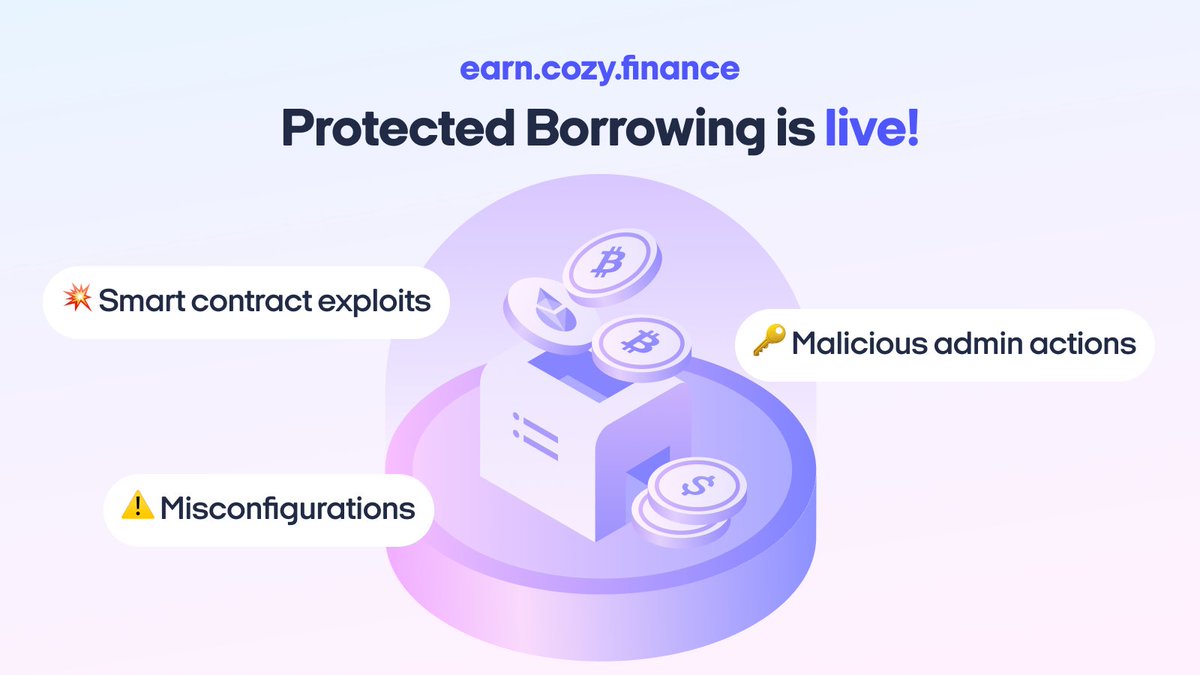
Introducing protected borrowing on Cozy Earn. Borrow USDC against WBTC, cbBTC, and wstETH with defined criteria for qualifying infrastructure failures. Most DeFi borrowing makes one risk obvious: if your collateral falls and your LTV gets too high, you can be liquidated. What usually stays implicit is infrastructure risk. Oracles fail. Contracts break. Keys get compromised. Critical dependencies break. When that happens, users can end up with losses from a system failure they did not cause, and no clear framework for repayment. This is not hypothetical. In 2020, Compound liquidated 121 properly collateralized borrowers after a faulty Coinbase Pro price feed. In 2022, Rari Fuse lost $80M to a reentrancy exploit and left collateral depositors exposed. Protected borrowing makes that risk boundary explicit. If a qualifying infrastructure failure affects an eligible collateral vault, Disaster Reserve funds may be used toward repayment, subject to eligibility criteria, exclusions, terms, and reserve availability. A clearer answer to what happens if the infrastructure fails is now live on Cozy Earn. Review terms before borrowing. Not insurance or a guarantee. Repayment applies only in certain qualifying infrastructure-failure scenarios and may be partial or unavailable.
Cozy 🦥 tweet media
English
3
3
9
2.6K
Cozy 🦥
Cozy 🦥@cozyfinance·
Borrowing is now live on Cozy Earn Use WBTC, cbBTC, or wstETH to borrow USDC from the Cozy USDC vault
English
1
3
7
762
Cozy 🦥
Cozy 🦥@cozyfinance·
The real cost of Resolv was not just the ~$23M extracted. It was the race to exit once depositors stopped knowing where the loss would land. As of today, Resolv holds $95M in assets against $173M in liabilities. The depositors who left early were right to leave. We saw a similar pattern with Stream / xUSD last year. The initial loss was bad enough. But the bigger damage came from how uncertainty propagated through lending markets and curator vaults after the fact. That is the deeper problem with bad debt in DeFi. If losses are socialized immediately, every lender gets marked down at once. But if losses are not fully realized yet, early exiters can still get out while the hole is still sitting somewhere in the system, and the last holders are the ones who eat it. Affected vaults behaved differently after Resolv. Some were hit immediately. In others, automated curator liquidity services continued supplying capital to broken USR markets for hours after the exploit. Omer Goldberg of Chaos Labs found that most of the bad debt in Gauntlet's vaults was created after the initial exploit. Others were drained because users believed the bad debt had not been fully crystallized yet. But the depositor incentive was the same in both cases: leave before you find out which system you're in. And this panic does not stay contained. It spreads to vaults without obvious exposure. It spreads to protocols without direct exposure. It becomes a system-wide question of trust. Risk curator protocols lost roughly $2.5B in TVL within three days, including vaults with no Resolv exposure. Everyone deciding they no longer want to be around when accounting catches up. The second-order damage from incidents like Resolv is larger than the exploit itself. This is endemic to a deeper problem in DeFi lending: a lack of predictability and transparency around loss realization. The cost of exiting is usually low. The downside is highly uncertain. And in the worst case, that downside can be total loss. Last year, we proposed a solution to Euler: turn off bad debt socialization and repay bad debt atomically instead. The idea is simple: when bad debt is realized, a dedicated sidecar of assets is drawn down immediately to repay it — automatically, by burning staker shares, with no governance vote and no manual intervention. Users can see the size of that buffer onchain at any time. So instead of guessing where losses will land, they can evaluate the coverage directly. That changes the incentive entirely. If users know bad debt will be repaid automatically from a visible pool of assets, they do not have to worry about racing for the exits before accounting catches up. That mechanism is live in production on Cozy Earn. And we hope to see more curators adopt this model. As many have pointed out over the last 24 hours, the constant risk of large losses and the trust-breaking setbacks from these incidents paint a pessimistic picture of DeFi's future. But if lending markets move toward systems where risk is more transparent and recourse or balance protection is more predictable, we may get more orderly behavior in stress events instead of reflexive bank runs. If you want to lend with a clearer protection model, visit Cozy Earn. If you are a curator or protocol that wants to improve your offering on this dimension, reach out. We have spent the last several years building infrastructure for exactly these cases.
YAM 🌱@yieldsandmore

Please check if you're deposited into any of these Morpho vaults and WITHDRAW, some of them still have liquidity. There's no reason to wait for the curators to force remove the Resolv markets and hope that they cover the (potential) bad debt, protect yourself. Most of the vaults will force remove the Resolv markets in approx. 2 and half days (timelocks), socializing the bad debt across depositors. List of vaults with withdrawable liquidity: @gauntlet_xyz Seamless USDC Base: $10.26M of deposits, $9.88M of liquidity, 381k of exposure (3.7%) Link: #overview" target="_blank" rel="nofollow noopener">app.morpho.org/base/vault/0x6… @gauntlet_xyz USDC Core Mainnet - $20M in deposits, $7M in liquidity, $5M of exposure (25%) Link: app.morpho.org/ethereum/vault… @kpk_io USDC Yield Mainnet: $2.65M in deposits, $2.35M in liquidity, 221k in exposure (8.3%) Link: #overview" target="_blank" rel="nofollow noopener">app.morpho.org/ethereum/vault… @Re7Labs USDC Mainnet: $2.14M in deposits, $1.66M of liquidity, 450k of exposure (20%) Link: #overview" target="_blank" rel="nofollow noopener">app.morpho.org/base/vault/0x1… @Extrafi_io USDC Base- $1.26M in deposits, $834k of liquidity, 433k of exposure (34%) Link: app.morpho.org/base/vault/0x2… @MEVCapital USDC Mainnet: $7M in deposits, $969k in liquidity, $52k of exposure (0.73%) Link: #overview" target="_blank" rel="nofollow noopener">app.morpho.org/ethereum/vault… KeyRock USDC Mainnet: $2.47M in deposits, $1.36M in liquidity, 36k of exposure (1.4%) Link: app.morpho.org/ethereum/vault… These vaults have no liquidity,: Gauntlet USDC Frontier, Resolv USDC, 9Summits USDC, Apostro Resolv USDC, Clearstar Yield USDC, Clearstar USDC Reactor It's still worth trying to withdraw, others might repay or deposit, you never know. Use @antonttc's tool to spam the withdraws: github.com/antoncoding/au… Most of the vaults above with liquidity available have lent against wstUSR AFTER the incident, which makes it significantly less likely that @ResolvLabs cover any bad debt here. Please withdraw. Good luck!

English
6
4
38
10K
Cozy 🦥 retweetledi
tony 🦥
tony 🦥@tonysheng·
both @cozyfinance, @SteakhouseFi and @LidoFinance have first loss capital put up for their curated vaults and if you're a curator that wants to do the same, @cozyfinance has infrastructure you can use to easily set it up for your vaults
Noah@TraderNoah

Have we considered forcing curators and other underwriters to put up risk capital like every other marketplace lending business outside of crypto does? Crazy business practices at play…

English
2
1
4
857
Cozy 🦥
Cozy 🦥@cozyfinance·
earn.cozy.finance Lend with layers of protections And soon, borrow with protection too
English
0
0
1
170
Cozy 🦥
Cozy 🦥@cozyfinance·
A mispriced oracle led to a 350+ ETH loss realized by borrowers who were wrongfully liquidated Aave is going to reimburse these users out of pocket but the details are still unknown Cozy Earn's disaster reserve would handle this elegantly, repaying users predictably
Omer Goldberg@omeragoldberg

1/ stETH CAPO Misconfiguration Today, a misconfiguration on Aave's CAPO oracle caused wstETH E-Mode liquidations, resulting in a loss of 345 ETH. No bad debt was incurred, and all affected users will be fully reimbursed. More below.

English
2
0
3
1.6K
Cozy 🦥
Cozy 🦥@cozyfinance·
Cozy Earn has crossed 2M TVL in under a week since launch Yields are higher than market with the most lender protection for a vault of its kind
English
2
1
7
637
Cozy 🦥
Cozy 🦥@cozyfinance·
In Cozy Earn, assets staked by the curator to cover first losses are programmatically drawn from to repay bad debt It's the only lending system that aligns incentives between curators and lenders with deterministic repayments to cover user losses x.com/Defipeniel/sta…
DΞFI PΞNIΞL (🧠,🧠)@Defipeniel

@cozyfinance First-loss protection in DeFi lending is an interesting model… curious how it performs under real stress.

English
1
1
3
692
Cozy 🦥 retweetledi
Cozy 🦥
Cozy 🦥@cozyfinance·
Introducing Cozy Earn DeFi lending with actual recourse. First-loss capital backs every vault. Losses hit protection layers before they reach you. Live now.
English
13
6
41
11.3K
Cozy 🦥 retweetledi
Certora
Certora@Certora·
Security isn’t only about preventing exploits. It’s also about how systems absorb damage when something goes wrong. Cozy’s risk infrastructure, first-loss capital and protection layers, complements the prevention stack. Congrats to the @cozyfinance team on the launch of Cozy Earn. Proud to support the protocol’s security. 🫡
Cozy 🦥@cozyfinance

Introducing Cozy Earn DeFi lending with actual recourse. First-loss capital backs every vault. Losses hit protection layers before they reach you. Live now.

English
7
5
10
2.4K
Cozy 🦥
Cozy 🦥@cozyfinance·
first loss capital is essential but not enough for defi lending. that's why in cozy earn there's a vault that covers excess bad debt AND a disaster reserve that's held in uncorrelated assets without the same exposures as the lending vault x.com/defiprime/stat…
defiprime@defiprime

@cozyfinance First-loss capital layers are the right primitive for institutional DeFi adoption. The question is how protection pool sizing holds up during correlated drawdowns. Interesting design.

English
1
0
3
369