Credence

1.5K posts

Credence banner
Credence

Credence

@credencefund

Paper trades, Not financial advice. I love stocks. Do your own research. Don’t follow me into trades.

Irvine, CA Katılım Temmuz 2023
236 Takip Edilen371 Takipçiler
Sabitlenmiş Tweet
Credence
Credence@credencefund·
What you won’t see or hear on the news. Credence. Why is silver soaring? The banks are in trouble. These details are public: Berkshire (BRK) sold 260 million shares of $BAC at $41, for proceeds of $10.6B. But Berkshire still owns more than $30 billion worth of $BAC. But probably not for long: here's what's not public, yet. Berkshire has also sold all of its commercial banks, except Citi, since early 2020. Sold 100% of its 346 million shares in $WFC; Sold 100% of its 150 million shares in $USB; Sold 100% of its 60 million shares in $JPM; Sold 100% of its 12 million shares in $GS. And Buffett isn' the only well-connected asset manager to dump every American bank. Dalio's Bridgewater (the largest hedge fund in the world) dumped over $100 million of Bank of America and virtually every bank stock too, including: JP Morgan (JPM), Bank of America (BAC), Wells Fargo (WFC), Goldman Sachs (GS), Morgan Stanley (MS), Bank of Hawaii (BOH), PNC Financial (PNC), Citizens Financial (CFG), and Capital One Financial (COF). Why? The reason: there's a $1 trillion+ hole in the commercial banks' balance sheets. No one currently at the Fed Reserve is willing to talk about these issues, but here's what Thomas Hoenig, former vice chairman of the Federal Reserve, said: "Guys, I only want to know one question, how long before you fail? Not how complicated you can make the formula to confuse me and certainly confuse the public." Hoenig is not just any central banker. He was the head of the St. Louis Fed for 20 years ('91-2011) and has long been among the 2-3 most respected central bankers, ever, at the Fed. What Hoenig warned about is: current regulations do not match economic reality. "Risk-weighted capital flat-out misleads, the only thing a real bank investor wants to know is how much real equity capital is there. That tells the investor how prepared the bank is to absorb a shock, no matter where it comes from on the balance sheet." Buffett is a “real” bank investor. So is Dalio. But, as you can tell by $BAC's share price, which is trading at near all-time high multiples, most of the public is not. In fact, NOBODY in the mainstream media has bothered to tell the public anything about the truly enormous scope of these problems. I wonder why... How bad is it? Quoting from the St. Louis Fed's Bank Capital Analysis report of June 30, 2022: Since 2019, banks increased securities holdings by $2.0 trillion, increasing the share of securities as a percentage of total assets to 33.7% in the second quarter of 2022 from 17.8% Let me make sure you understand what that means. It means that fully one-third of the reserves of our biggest banks are deeply “underwater.” That's because they bought $2 trillion worth of long-term bonds (and mortgages) at interest rates around 1%. The real market value of these assets has plummeted because of rising interest rates. It was soaring losses on these assets, which led to the run on deposits in the spring of 2023 at Silicon Valley Bank, Signature Bank, and First Republic Bank. These banks didn't fail because they made bad loans. They failed because they owned long-dated Treasury bonds. Total losses on those bank failures were $40 billion. How in the hell did this happen? Mr. Hoenig explained: "It's a political process. It's not a market process. The market no longer determines capital in the financial, especially in the banking industry. It's now politicians, lobbyists, and the regulators who have to battle it out among themselves." "Therefore, you get these non-market solutions like risk-weighted capital. And banks are incentivized to increasingly leverage their balance sheets. And, thanks to the ‘financial repression' of the COVID era, when the Fed's bond buying binges took long term rates to below 1%, there was an enormous amount of interest rate risk in the U.S. bond market back in the summer of 2020."
English

2
1
5
2.4K
Credence retweetledi
unusual_whales
unusual_whales@unusual_whales·
Unemployment in Canada has hit 6.9%.
English
223
227
2.7K
165.2K
Credence
Credence@credencefund·
@michaeljburry @aakashgupta – Did you work with other investors or activists (e.g., lead/co-ordinate engagement)? – And do you still have any involvement or influence with those governance decisions today?
English
0
0
0
29
Credence
Credence@credencefund·
@michaeljburry @aakashgupta When you say you “got GME to buy back 1/3 of its stock and change its board,” can you clarify your role in that process? – Were you directly communicating with the board/management to push for those specific decisions (buybacks & board changes)?
English
1
0
0
1K
Aakash Gupta
Aakash Gupta@aakashgupta·
Burry is mass-publishing the accounting case for his put options on Nvidia and Palantir while the rest of the market is still debating whether the capex cycle has legs. The math he’s referencing is specific. The Big Four hyperscalers just guided $650-700 billion in combined 2026 capex, a 60%+ increase from the $381 billion they spent in 2025. Amazon alone committed $200 billion, so far above the $146 billion consensus that the stock lost $450 billion in market cap over nine straight sessions. Burry’s core thesis is the depreciation trick. Nvidia’s GPU architecture runs on a 3-year cycle, with each generation delivering 2-3x more compute per watt. The H100s shipping today are economically obsolete by 2027. But the hyperscalers are depreciating them over 5-6 years. Burry estimates this gap understates depreciation by $176 billion between 2026 and 2028, inflating reported operating income by 20%+ at companies like Oracle and Meta. That’s the “accounting tricks” he’s referencing in the tweet. He did the math. The cash flow picture backs him up. Amazon is projected to go negative FCF in 2026, somewhere between -$17 billion (Morgan Stanley) and -$28 billion (BofA). Alphabet’s free cash flow is expected to collapse 90%, from $73.3 billion to $8.2 billion. The Big Five raised $108 billion in bonds in 2025 alone, more than 3x the average of the prior nine years. JP Morgan projects $1.5 trillion in tech debt issuance ahead. They’re repackaging data center debt as asset-backed securities, $13.3 billion this year, a structure with a history that includes Enron and 2008. The depreciation cliff is the part the market hasn’t priced. The five hyperscalers plan to add $2 trillion in AI-related assets by 2030. At 20% annual depreciation, that’s $400 billion per year, which exceeds their combined 2025 profits. And AI services currently generate roughly $25 billion in direct revenue against $650 billion in infrastructure spend. Four cents per dollar invested. But here’s where you have to be careful with Burry. He shorted Tesla at $180. It went to $1,200. He called the housing crisis two years early and nearly went bankrupt waiting for the trade to work. He bought puts on Nvidia and Palantir, capped-downside bets, because even he knows his timing is unreliable. The pattern with Burry is always the same: the structural analysis is correct, the timing is wrong, and the market can stay irrational long enough to wipe out the trade before it pays. He sees the depreciation cliff. He sees the accounting inflation. He sees the debt structures. All of that is real. The question is whether AI revenue scales fast enough to fill the gap before the write-downs hit. AWS alone runs at $142 billion annualized, growing 24%, with a $244 billion backlog. Google Cloud’s backlog surged 55% to $240 billion. These companies are monetizing capacity as fast as they install it. Burry is building the bear case in public so the crowd does the work for him. That’s the trade. Whether it pays depends on something Burry has never been good at: timing the moment when the music stops.
Cassandra Unchained@michaeljburry

A question I have for $ORCL, $GOOG, $META, $MSFT, $AMZN, $NVDA, $CAT, and all the rest, “When does the spending for AI data center buildout actually end?” It is consuming all your cash flow, you are borrowing, you are financing in ways you never have, apparently because it is so urgent, because it scales? But if it scales, when does it end? Now you are engaging in accounting tricks to hide expense, to protect earnings, as the impact is so severe. You will be tortuously adjusting your earnings in a new and sinister ways. When does it end?

English
122
286
2.5K
833.1K
Credence
Credence@credencefund·
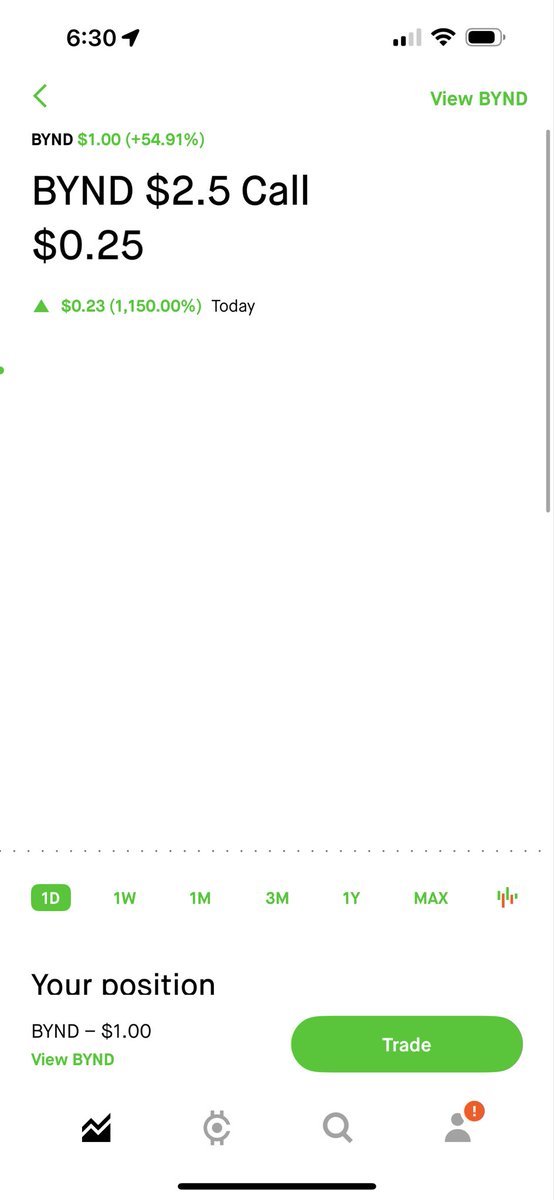
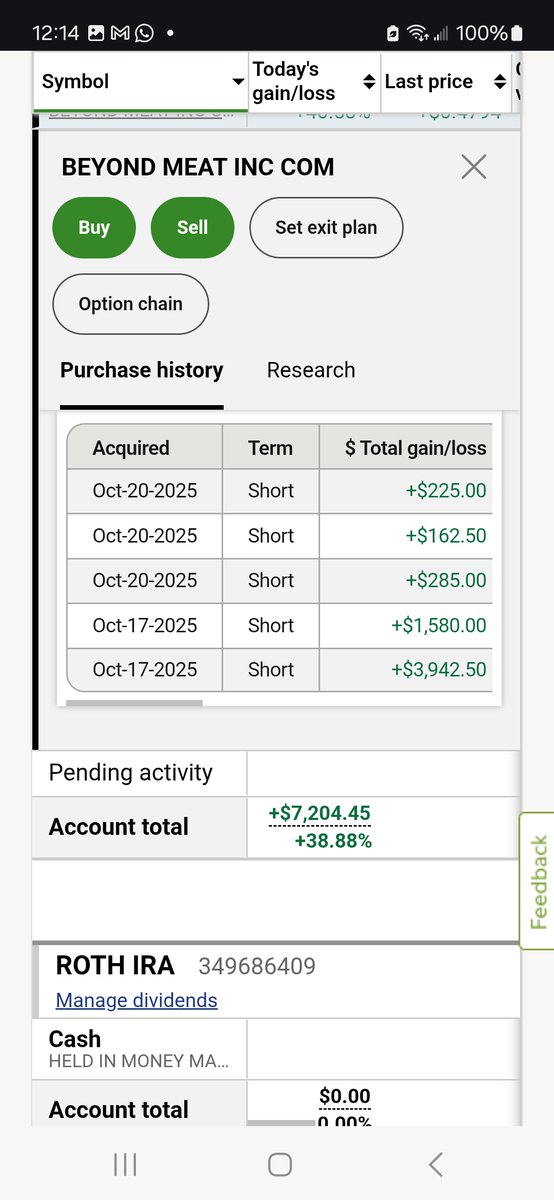
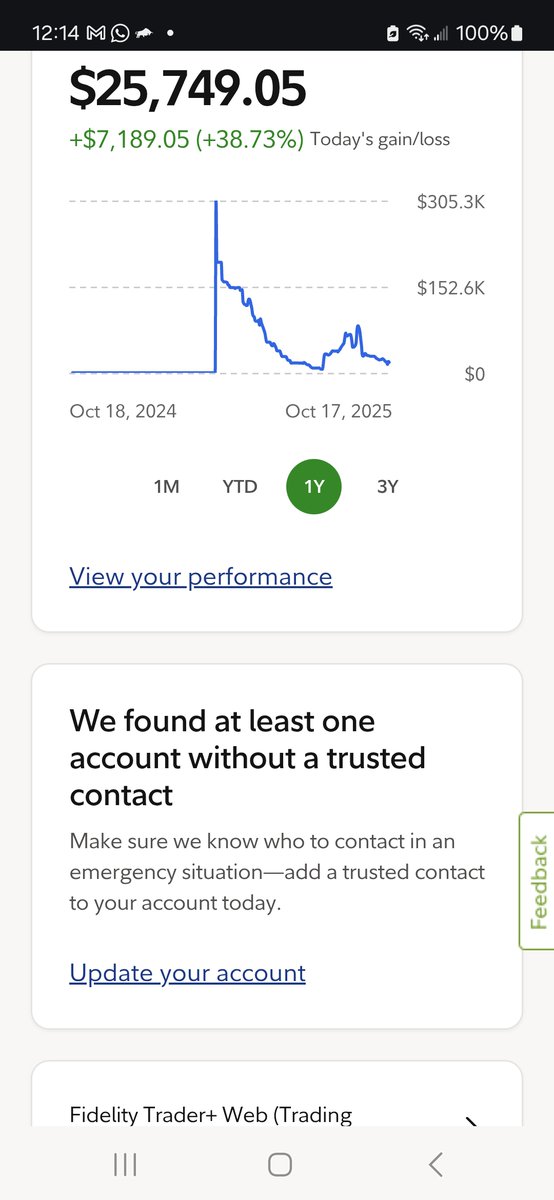
@RobinhoodApp I just woke up to find my $BYND $2.50 Calls (10/24) sold at $0.06 without my permission. They’re now trading over $0.25 — that’s nearly a 1,000% difference. What’s going on? This is unacceptable — I did NOT authorize this sale.
Credence tweet mediaCredence tweet media
English
20
11
110
18.1K
Credence
Credence@credencefund·
@CamaroClassic @RobinhoodApp I never set up any stop loss nor a limit sell, even tho it says that it wasn’t from me. That’s why I made this post, I had no decision making on this sell. I’ve never seen anything like this before. It just makes no sense to me.
English
1
0
2
238
VoiceOfLemur 🔺
VoiceOfLemur 🔺@VoiceOfLemur·
@credencefund @RobinhoodApp my fav are: 1. TD Ameritrade 2. CharlesSchwab 3. Sofi - social trading These are actual trading companies, with regulations and securities. Those platforms never go down, never block you from trading.
English
2
0
1
196
Daniel Kane
Daniel Kane@Thekaner1964·
@credencefund @RobinhoodApp When are you people going to delete your Robin Hood app?I don't understand there in a criminal empire , they're literally designed to steal your money , they're in bed with all the market makers..
English
1
0
3
666
VoiceOfLemur 🔺
VoiceOfLemur 🔺@VoiceOfLemur·
@credencefund @RobinhoodApp i still can’t understand why someone with trading experience ever uses @RobinhoodApp?! They did it more than once, they are against retail. Sad that retail doesnt care and still use that crap 💩
English
1
0
14
1.1K
Credence
Credence@credencefund·
@CamaroClassic @RobinhoodApp That’s what I’m raging about, I never set that sale. What’s crazier is it was executed as soon as market opened.
English
2
0
1
827
Credence
Credence@credencefund·
@TraderTurdz @RobinhoodApp Even then it’s still no reason for my calls to be sold, or do you think what they did is justifiable?
English
0
0
0
727
$uljo
$uljo@Suljo534070·
@credencefund @RobinhoodApp I think that’s horse shit , that’s the excuse to sell ppls calls and cause brokers to glitch out , right when a new squeeze play pops up , isn’t that convenient 🤬
English
2
0
0
129