Crispin F-L

727 posts

Crispin F-L banner
Crispin F-L

Crispin F-L

@crispinfl

Dr Crispin Fletcher-Louis, Doctoral Supervisor Univ. Gloucestershire, UK; https://t.co/U2YMR0DKCz; https://t.co/O95UTWSjVt

Katılım Haziran 2009
374 Takip Edilen765 Takipçiler
Crispin F-L
Crispin F-L@crispinfl·
@scottrswain @chrisryankugler I don't think an allusion to Isa 53 would be heard by readers in gentile Philippi, but perhaps it was influential at earlier Pre-Philippians stage of the Christ Hymn's composition.
English
0
0
4
126
Chris Kugler
Chris Kugler@chrisryankugler·
I’m inclined to think that @crispinfl is right about Greco-Roman mythology as the primary context of Phil 2.6-8. But I do think that Isaiah begins to be important from 2.9 to 2.11; but the latter is less perceptible if we are only looking at LXX. He is working directly from Hebrew.
English
1
0
2
970
Tyler McNabb (Tý)🇻🇦
Tyler McNabb (Tý)🇻🇦@TylerDMcNabb·
In that chapter I propose that there was in fact a Paul–John connection. However, I do not argue what might be expected—that Paul influenced John—but rather the other way around. That is, I propose, with some degree of critical caution, that John influenced Paul. Or to put it somewhat differently, I contend that John is not a Pauline Gospel; rather, Paul is a Johannine theologian. -Michael Gorman
English
5
2
17
2.6K
Crispin F-L
Crispin F-L@crispinfl·
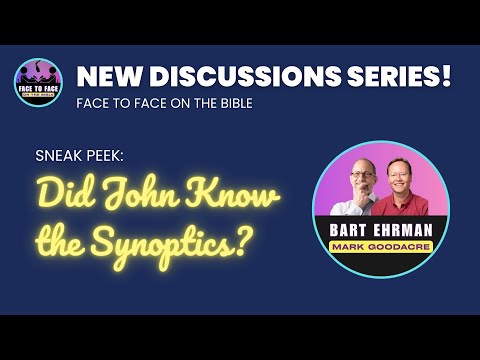
For once I agree with Bart Ehrman. Really hard to believe John knows and is reliant on the Synoptic gospels (as Mark Goodacre claims). youtu.be/REXnpEy8T_I
YouTube video
YouTube
English
0
2
5
865
Crispin F-L
Crispin F-L@crispinfl·
Yes Chris, I broadly agree with that. And for your analogy to Ezek 1, we have a nice parallel in Ben Sira 50:5-7, where the high priest comes out of the sanctuary and is both likened to a heavenly bodily in clouds and is also identified with the Glory of Ezek 1:26-28, so that he is effectively identified, to use your language, as the visible manifestation of the Most High. No?
English
1
0
7
274
Chris Kugler
Chris Kugler@chrisryankugler·
On Daniel 7 and Bauckham 2023 (@crispinfl and @LorenStuckenbru) The treatment of the Hebrew, Masoretic tradition of Dan 7 is fine, but Jews then and scholars now could be forgiven for thinking that the son of man receives obeisance/worship (at least by the subjugated nations) befitting the one God of Israel/Ancient of Days. He's right to see in the Theodotionic Daniel tradition a deliberate change of vocabulary at 7.14 to make it clear that the son of man is not "worshipped." But his treatment of the Old Greek tradition of Dan 7 appears to me strained. That tradition was, in my view, like Theodotion Dan 7, trying to guard against what the scribes/editors regarded as breaches of exclusivist Jewish monotheism--i.e. a reading of Dan 7 in which the son of man, as distinct from YHWH, receives obeisance/worship befitting YHWH. Theodotion Dan 7 made a crucial change in vocabulary at 7.14 and the Old Greek tradition simply conflated the two figures, producing something like the vision of Ezekiel 1 (where God simply looks something like a son of man etc.). This latter tradition of Daniel 7 (in Old Greek or in an Aramaic Vorlage?) was known to the author of Revelation 1.12–16 and (in my view) 4 Ezra 13. In other words--without wishing to state this as baldly as e.g. Rowland sometimes did--there existed a tradition of Dan 7 near the time of Jesus in which the son of man figure of Dan 7 simply was the manifestation (?)/visible theophany (?)/ embodiment (?) of the Ancient of Days/Israel's God.
English
2
1
16
1.7K
Crispin F-L
Crispin F-L@crispinfl·
In some parts of the Hebrew Bible, monarchy is to politics as the making and worship of idols is to religion.
English
1
0
2
395
Crispin F-L
Crispin F-L@crispinfl·
Fantastic line up of Gloucestershire University Biblical Studies research seminars this spring. DM me if you'd like to attend any.
Crispin F-L tweet media
English
0
0
7
388
Chris Kugler
Chris Kugler@chrisryankugler·
Low Christologists: “God” language is common and insignificant. Also Low Christologists: Paul can’t have regarded Jesus as fully God because he (almost) never uses “God” language of him.
English
4
4
45
6K
Crispin F-L
Crispin F-L@crispinfl·
@FindingTrinity yes, I think probably there is a sense in which after 3:6, the man and woman are (potentially) defiling.
English
0
0
1
46
Dr Colin Green ن
Dr Colin Green ن@FindingTrinity·
@crispinfl I'm tempted to describe it as a purity issue, defiling the temple. Perhaps something at Qumran might use a purity narrative about it.
English
1
0
0
61
Crispin F-L
Crispin F-L@crispinfl·
Here, in 11 points, is how I propose Genesis 2–3 was originally intended: 1. Genesis 2–3 is a sequel to Genesis 1; part of the prelude to later texts, esp. Genesis 6, 9 and Exodus 25–40. Our chapters explain the incursion of evil into God’s good creation (cf. Gen 6) and the need for a restoration or completion of the creation of the image of God in humanity (cf. Gen 9 and Exod 28, where the high priest is God’s living divine cult statue—his image). 2. Prior to their transgression, the first humans were shown and had some knowledge of the difference between good and evil. This can be seen both in the way Yahweh God shows them that some trees are “good for food” (2:9), but that there is one tree that is, so to speak evil (2:17), and in the human’s ability to partner with God in the search for a good, not a bad, companion (Gen 2:18–24). 3. Before their transgression, the first humans were already “divine,”: see, e.g., what is said about their being made in God’s “image (צלם)” in Genesis 1, from the manner of their formation and conduct, as recipients of God’s own breath (Gen 2:7), their being made for immortality, and their role as partners with God in creation, in managing the garden and naming parts of creation (2:19–20), as God had in 1:5, 8, 10. 4. Before their transgression, the first humans are “divine” in a specific, limited, sense. They are created to be divine in dependence, for their being and conduct, on their creator, as his image and likeness. They are not “gods,” and in everything they are to serve Yahweh God’s interests, not acting for their own self-aggrandizement or separation from their origin and source. 5. They have a job to do and chapter 2 begins a story that, had they been obedient to their maker, would have resulted in the completion of their being made and installed in a house, or temple, as his divine cult statue(s), adorned with the gold and precious that would have come in from the world beyond the garden (2:10–14, cf. Exodus 25–40; 1 Kgs 6–8). 6. The wily serpent offers the woman a faux deification, by which they will become “like gods” knowing good and evil (3:5); a poor substitute for the extraordinary divine identity and knowledge they already have—their disobedience is a tragedy. 7. In succumbing to the shabby alternative to what they already have, the couple deny—or attack—themselves. So, their act of disobedience is suicidal, as God had predicated (Gen 2:17). Their act of disobedience is both an affront to God and a form of self-harm: succumbing to the serpent’s offer entails a denial of, or a forgetting of, the fact they are already created by God to be like him, as his divine cult statue no less, with the knowledge of good and evil already theirs. 8. So, Eighthly, the dramatis personae and the consequences of the couple’s action anticipate the outward forms of idolatry, as those were experienced in Israel’s history and scriptures (cf. esp. the Asherah and Bronze Serpent in 1 Kings 18:4). So, for example, after their disobedience they feel shame, the state that in the Hebrew Bible is predicated for idol worshippers. And, in several ways they become like that to which they have given their worshipful allegiance—the tree and the serpent (cf. 2 Kgs 17:15; Isa 41:24; 44:9; Jer 2:5; Pss 115:4–8; 135:15–18; Hos 9:10). 9. Their transgression and its consequences is a tragedy that anticipates the essential, structural (il)logic of idolatry, as that is described and analysed as a tragedy in other scriptures: see esp. Ezekiel 16:1–22; Exodus 28–34; Isaiah 46; Wisdom of Solomon 15. 10. It is not said, in the Hebrew of Genesis 3:22, that the humans have become “like (Yahweh) God”—something they had been created to be in Genesis 1. Rather, there are three intended possible meanings of the unusual Hebrew הֵן הָאָדָם הָיָה כְּאַחַד מִמֶּנּוּ לָדַעַת טוֹב וָרָע. - In one sense, the human has become “separate from” (מִמֶּנּוּ = “out of, away from us”—cf. LXX, Vulg) the divine partnership that God had originally intended them to be a part of. - Secondly, in a sense the human has become alone in the world by himself (מִמֶּנּוּ = “from, by, himself”—so Symmachus’s Greek translation: ἴδε ὁ Αδὰμ γέγονεν ὁμοῦ ἀφ̓ ἑαυτοῦ, γινώσκειν καλὸν καὶ πονηρόν “Behold, Adam is now in a position to know good and evil all by himself,” Targum Onqelos הָא אָדָם הֲוָה יְחִידַי בְּעַלְמָא מִנֵּהּ לְמִידַע טַב וּבִישׁ “Behold, Adam has become alone in the world by himself, knowing good and evil,” cf. R. Akiva apud Genesis Rabbah 21:5; Mekhilta de R. Ishmael Veyehi Beschalach 7:10). Adam has become an independent, but fearful and insecure, moral arbiter. - Thirdly, in another sense, the human now has a new identity since in several ways he has become like the idolatrous tree (כְּאַחַד מִמֶּנּוּ “as one from it”) and serpent. In all these ways, especially the second and third, he has lost the identity, the being, he had as one who was created to be God’s image and likeness. There has been an ontological loss—a fall—from a divine humanity to a tree-like and serpentine mortal. 11. This all means that in the light of the way events turned out, the Tree of the Knowledge of Good and Evil provided a test, which the couple failed. Had they resisted the serpent’s lies, they would have grown in moral understanding and character, grown in the knowledge of the difference between good and evil and how the former should be chosen over the latter. As it is, they now experience (“know” in that sense, cf. Gen 4:1; Ezek 25:14; Isa 47:8) evil with some lingering experience and memory of the “good”.
English
1
3
18
2.8K
Crispin F-L
Crispin F-L@crispinfl·
@FindingTrinity I would say they become very badly, barely recognisable statues of the living God. They become, instead, in the likeness of the tree and the serpent. So, yes, they have to be banned from God's sacred space, as you suggest ...
English
1
0
1
74
Dr Colin Green ن
Dr Colin Green ن@FindingTrinity·
@crispinfl Crispin, is your thinking that the pair become impaired "statues" or that they cease to be such "statues" altogether, and is this why they have to be barred from God's temple-garden, so as to avoid a false idol being in his temple?
English
1
0
0
84
Carl Knaack
Carl Knaack@KnaackCarl·
@crispinfl Is there going to be a recoding of your presentation?
English
1
0
1
62
Crispin F-L
Crispin F-L@crispinfl·
How come Ben Sira 17:7 (early 2nd cent. B.C.) says that in Eden God filled Adam “with knowledge of understanding … and good things and bad he showed them”? Come here me explain how Ben Sira is witness to the original, lost meaning of the tragedy in Genesis 2–3: Gloucestershire Uni. ICBI Seminar, Wedn. 28thJan, 4:00–5:30pm GMT. DM me for login details.
English
2
0
8
959
Crispin F-L
Crispin F-L@crispinfl·
@PracticalTheolo And, yes, “the onus is on the other person to understand what you're arguing.” That’s how intelligent debate works.
English
1
0
0
37
Anthony Burgoyne
Anthony Burgoyne@PracticalTheolo·
@crispinfl This is the squid ink argumnent - dump a 517 page doc, and make it sound like the onus is on the other person to understand what you're arguing. If you understand the argument, you should be able to summarize it.
English
2
0
0
74
Anthony Burgoyne
Anthony Burgoyne@PracticalTheolo·
The answer's pretty obvious: "every tongue confess that Jesus Christ is Lord, to the glory of God the Father." Note this is a bizarre thing to say if Jesus is God.
✝️TheHolyArk@TheHolyArk

@PracticalTheolo Unitarians aren't Christian Romans 10:9 "if you confess with your mouth the Lord Jesus and believe in your heart that God has raised Him from the dead, you will be saved" Matthew 6:24 "No one can serve two lords" How can you serve Jesus as Lord & serve God too if Jesus isn't God?

English
10
0
14
794
Crispin F-L
Crispin F-L@crispinfl·
@PracticalTheolo It’s a 1000 page doc. And I didn’t ‘dump’ it. It took 10 years of careful research and writing. But you’d know this if you’d done me the courtesy of checking the book’s website.
English
1
0
0
58
Anthony Burgoyne
Anthony Burgoyne@PracticalTheolo·
@crispinfl Just goofy. If you have an argument, you're welcome to present it.
English
1
0
0
41
Crispin F-L
Crispin F-L@crispinfl·
@PracticalTheolo gosh, you're a quick reader - you've read all 517 pages of the argument (to end of Divine Heartset ch. 9) already?!
English
1
0
0
40