CLT

3.3K posts

CLT banner
CLT

CLT

@critlegthinking

A blog dedicated to the radical critique of law and politics // See also @2counterpress: open access publisher of the critical humanities

UK and beyond Katılım Kasım 2010
153 Takip Edilen5.1K Takipçiler
CLT
CLT@critlegthinking·
Iran and the 'state of exception' by Costas Douzinas It seems that we have entered a period of endless war. The undeclared American war “Epic Fury” (the name of the attack on Iran) and Israel’s new murderous campaign has replaced the “cosmopolitan order of rules” heralded by those who saw the “end of history” after the fall of communism. The “perpetual peace” of Kant and Habermas has been replaced by “perpetual war and its threat.” We live in a “global state of exception.” A situation where governance, military strategies, and armaments are closely linked to the needs of capitalism. At the beginning of the century, the “rogue state” and the “failing state” were the ideological terms that justified attacks and invasions by the major powers and the neo-colonial occupation of regions and states. Today, references to these distinctions have been limited. Ream more >>> criticallegalthinking.com/2026/03/03/ira…
English
0
2
5
3.1K
CLT
CLT@critlegthinking·
'Greenland and the Spectre of Dispossession' by @MothaStewart When it came to grabbing territory, the British had effective techniques by the 1960s. Morning-tea at Downing Street could accomplish what a U.S President’s incontinent media posts have been threatening to do with much froth and fury since 2019. The creation of the British Indian Ocean Territory (BIOT) by detaching the Chagos Archipelago from Mauritius was secured when the Mauritian premier Sir Seewoosagur Ramgoolam met Sir Harold Wilson, Britain’s Labour Prime Minister, one morning in 1965. The dispossession of the Chagossians should now serve as a cautionary tale for Greenland, and also cause us to question the primacy being attributed to NATO’s security in current political posturing. In what follows I argue that Greenland, like the Chagos Archipelago, might find itself dismembered and carved up to serve the security interests of Europe. The path to dispossession is being built on the fallacy that the Arctic zone presents a security threat to the U.S and Europe. The true peril, however, comes from the interconnected vulnerabilities of climate destruction and the proliferation of nuclear weapons ... Read More criticallegalthinking.com/2026/01/20/gre…
English
0
0
0
188
CLT
CLT@critlegthinking·
'Greenland between a Rock and a Hard Place' by Christine Schwöbel-Patel @CSchwobelPatel Amid US President Trump’s looming take-over of Greenland and attempted coercion of Western allies to agree to this, Western liberal international lawyers and commentators are busy reaffirming Danish sovereignty over the territory. However, an anti-colonial international law intervention during this time of inter-imperial rivalry is not to stand with Denmark, but to stand on the side of the right to Greenlandic self-determination ... Read More criticallegalthinking.com/2026/01/19/gre…
English
0
0
0
141
CLT
CLT@critlegthinking·
'Gaza, Venezuela and International Law' by Costas Douzinas After the genocide in Gaza, we did not expect 2026 to be a year of peace. The biggest desire of Trump, “the great peacemaker,” was to win the Nobel Peace Prize. But his first statements after the attack on Venezuela and Maduro’s abduction show that the peacemaker was just a mask behind which hid a warmongering old man who was as excited about the military operation as a child who had just opened his New Year’s gifts. “It was an excellent plan and many excellent military personnel and excellent people,” Trump told the New York Times. “It was a brilliant operation.”  The legal language was left to others—ministers and government officials—who explained that Maduro would be “brought to justice” for corruption, drug trafficking, and narco-terrorism. Oil and minerals shine brighter than the Nobel Prizehttps://criticallegalthinking.com/2026/01/08/gaza-venezuela-and-international-law/ ... Read More criticallegalthinking.com/2026/01/08/gaz…
English
0
0
2
116
CLT
CLT@critlegthinking·
'Why Human Rights fail Global Southern Women' by Celiwe Mxhalisa | 8 Dec 2025 Following a tumultuous start to her role as first lady of the United States of America, wherein she was accused of destroying ‘family values’ and promoting ‘militant feminism’, Hillary Clinton delivered a much-lauded speech condemning Chinese abuses of human rights and calling for the protection of women. This speech came sixteen years before she would gloat over her role in the assassination of Libya’s Gaddafi and 29 years before she joined the line of people ‘condemning Hamas’ for ‘brutally’ attacking Israeli women. The usurpation of Libya’s president plunged the country into a state of disaster, marked by the infliction of harm against women on a mass scale and a thriving slave trade. She never condemned the well-documented, systemic abuses of Palestinian women and girls at the hands of Israel nor did she revise her statements in light of the fact that certain Hamas sexual violence claims have since been debunked. There is a clear discrepancy between Clinton’s words and conduct. This inconsistency provides an impetus for the broader question as to whether all women’s rights are synonymous with human rights. This reflection argues that the international human rights regime is incapable of adequately protecting women in the Global South. This is because a) the human rights regime epistemologically excludes Global Southern women from the categories ‘human’ and b) perpetuates European dominance. In addition to advancing these claims in the next two sections, this reflection will detail instances wherein the human rights regime failed to afford Global Southern women adequate protection. Read More: criticallegalthinking.com/2025/12/08/why…
English
0
3
1
167
CLT
CLT@critlegthinking·
'Rap vs. The State (in a time of genocide)' by Siraj Izhar We know the genocide in Gaza is a collective work, a sort of F35 genocide whose parts come from an imperial collective, a collective of old colonial states now led by the USA. So the denial of genocide, at least of its naming, is also shared by these states across the Imperial collective. Within this sharing of denial, the Gaza genocide dredges out the particularities of the colonial history of each of its participating states in their ‘post colonial’ present. Here in Britain the genocide in its denial has led to possibly the largest and most sustained social mobilisation in its history. A scale of mobilisation met by a scale of repression that has opened up its contradictions of state. A post Empire Britain constituted as a liberal democracy, yet as a liberal state that overlays a colonial state with its imperial trajectory. Rap opens up the faultlines between them. Through rappers such as Bob Vylan and Kneecap, an insurgent rap tells us why the scale of killing in Gaza is not only bound with our own repression but also coincides with a rising fascism at home. Rap entwines these. The writing here is to show us how and why. If the disciplines of discourse are exhausted by horror and impunity, rap by its strictures of rhyme and ‘slanguage’ carves open raw space in a time when the disintegration of the liberal state is on show as openly as the transparency of a genocide. Read more: criticallegalthinking.com/2025/11/17/rap…
CLT tweet media
English
1
0
2
151
CLT
CLT@critlegthinking·
Event: Law and/as Process We are pleased to invite you to the first seminar in the new series, Law and/as Process, organised by the Centre for Critical Thought. With Professor Jason Beckett (The American University in Cairo) and Dr Gian-Giacomo Fusco (Kent Law School). This event will take place online on Wednesday, 19 November at 5:00 PM (UK time). Event link here: criticallegalthinking.com/2025/11/10/eve…
English
1
3
3
244
CLT
CLT@critlegthinking·
'Discretionary Symbolism: An Analysis of Trump’s Policies for Latin America and Beyond' by Marcus de Matos. The international policies of the second Trump administration have caused quite an upheaval. From raising trading tariffs to (supposedly) ending wars efforts – while at the same time bombing small boast and sanctioning judges, it has not been easy to understand it. In many European countries it is now common to find institutional analysis explaining the current Trump administration international strategy as breaking apart from most of the historical US formal alliances and commitments. But I want to contribute with these reflections proposing something different: these policies are not breaking apart from previous US international strategies. They are, in fact, reenacting it. And Trump’s strategies to Latin America illustrate that well ... Read more ... criticallegalthinking.com/2025/11/04/dis…
CLT tweet media
English
0
0
0
105
CLT
CLT@critlegthinking·
Blog Carnival: Aesthetics and Counter-Aesthetics of International Justice by Isobel Roele 'The politics of aesthetics are at the heart of Rob Knox and Christine Schwöbel-Patel’s energetic edited collection Aesthetics and Counter-Aesthetics of International Justice brings together a diverse group of scholars, practitioners, and artists. The editors approach the aesthetics of international justice in terms of tactics that can be deployed for good and ill. ...' Read more: criticallegalthinking.com/2025/10/29/blo…
CLT tweet media
English
0
2
1
226
CLT
CLT@critlegthinking·
CONOR GEARTY With greatness sadness we heard of the untimely and sudden death of Conor Gearty at the age of 67. Conor was the professor of human rights law at the LSE. He was born in Ireland and this led to his lifelong interest in terrorism, state crimes, violations of human rights and social justice. He was a leading scholarly voice on the abuses of anti-terrorism law, publishing Liberty and Security (2013) and Homeland Insecurity: The Rise and Rise of Anti-Terrorism Law (2024) ... Read on criticallegalthinking.com/2025/09/15/con… by Costas Douzinas #LSELaw @BirkbeckLaw
CLT tweet media
English
0
0
2
380
CLT
CLT@critlegthinking·
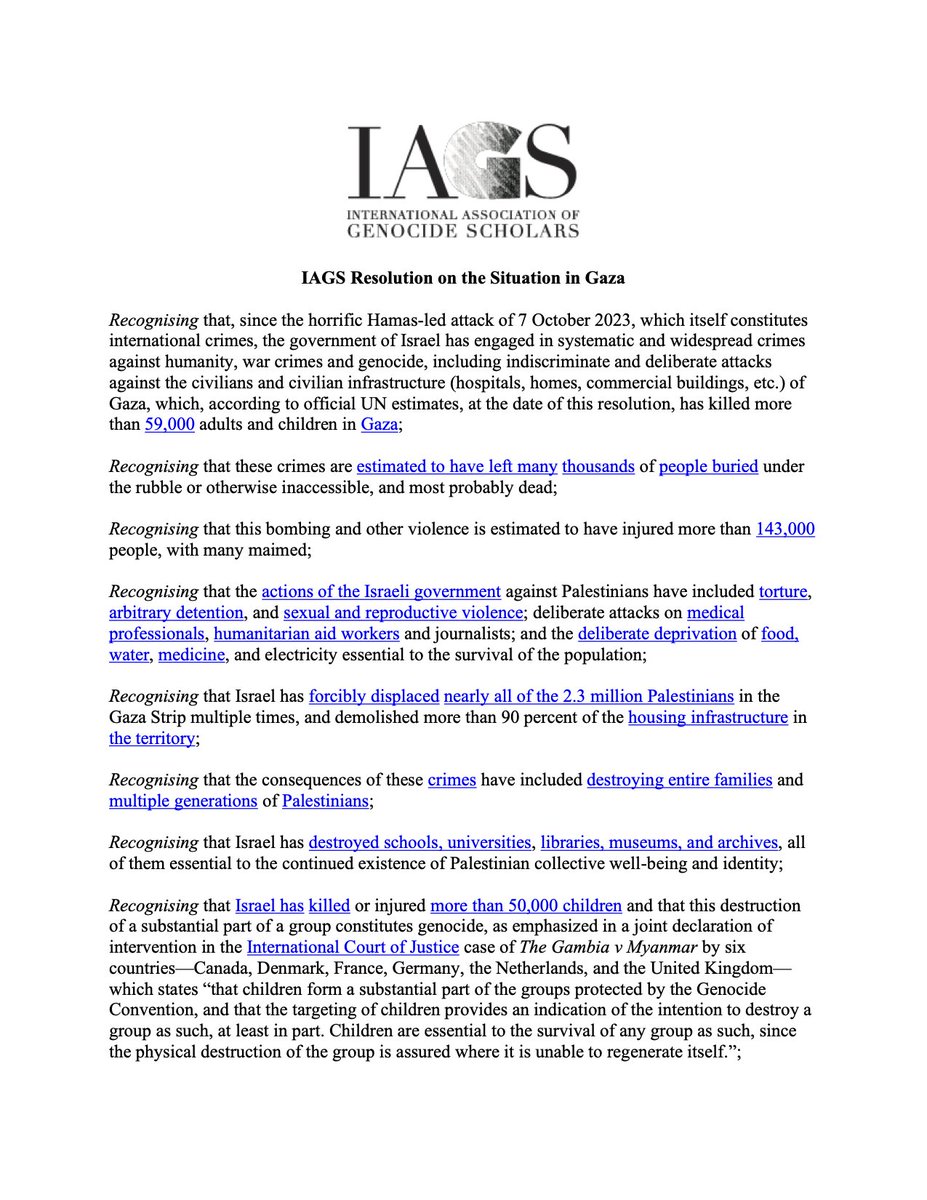
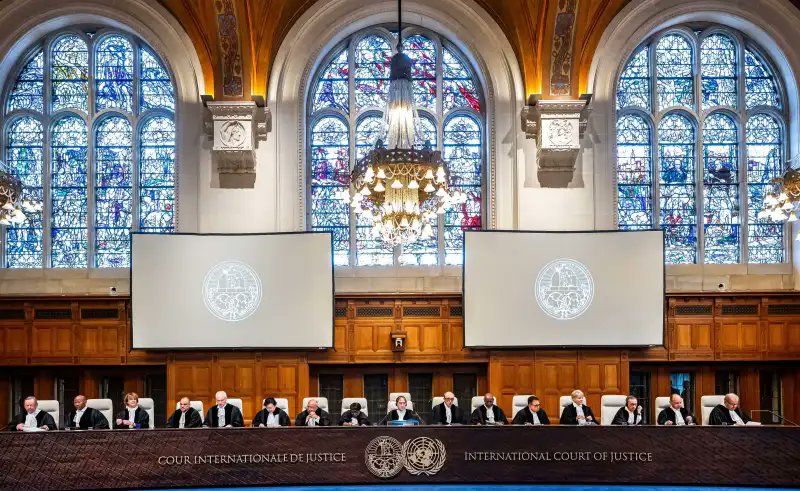
International Association of Genocide Scholars (IAGS) Resolution on the Situation in Gaza declares 'that Israel’s policies and actions in Gaza meet the legal definition of genocide in Article II of the United Nations Convention for the Prevention and Punishment of the Crime of Genocide (1948)'. genocidescholars.org/wp-content/upl…
CLT tweet mediaCLT tweet mediaCLT tweet media
English
1
13
15
1.8K
CLT
CLT@critlegthinking·
'Speed Limit: What does it mean to regulate #AI?' by Nathan Moore (@BirkbeckLaw) Elena Esposito argues that artificial intelligence is misnamed and that a more accurate descriptor would be ‘artificial communication’. Here, communication is closely connected to the idea of being informed: a communication is pertinent to the extent that it informs the addressee of something that is novel or not previously known to them.  However, we need to be careful because Esposito, following the work of Luhmann, does not consider communication to involve the conveying of something ‘in the mind’ of the sender into the mind of the addressee.  Rather, the addressee is akin to a system that, we might say, is triggered or irritated by a communication to produce a change of state in its own system.  Such a change is information, closely aligning to Bateson’s definition of information as ‘the difference that makes a difference’. Consequently, if AI produces a change of state in a human addressee then communication has taken place.  It is enough that something changes in the mind of the addressee – there does not need to be anything corresponding to it in the mind of the sender.  Esposito’s point is that there does not need to be a sending ‘mind’ at all.  All that is required is for the addressee to encounter something that is, relative to its own system, sufficiently relevant and novel to induce a change in the recipient.  As such, communication is addressee-sided. As convincing as this analysis is, the difficulty resides in the more general problem of determining just what we mean by ‘intelligence’ ... Read more >> criticallegalthinking.com/2025/07/31/spe…
CLT tweet media
English
0
1
1
218
CLT
CLT@critlegthinking·
'No Hearing, No Harm? Rethinking Jurisdiction and Protection in UAE v Sudan' by Parthiban babu and Sai Ramani Garimella On 5 May 2025, the International Court of Justice (ICJ) removed the case of UAE v Sudan from its docket, declaring it “manifest” that it lacked jurisdiction under Article IX of the Genocide Convention (Order, para 14). Sudan alleged that the United Arab Emirates materially supported the Rapid Support Forces in Darfur, facilitating genocidal violence. It sought urgent provisional measures, its first application to the Court under the Convention. The Court’s response broke from its recent procedural posture in genocide litigation. In The Gambia v Myanmar and Ukraine v Russia, the ICJ held oral hearings and considered provisional measures despite unresolved jurisdictional objections. In UAE v Sudan, by contrast, the Court relied on the UAE’s reservation to Article IX to conclude that jurisdiction was excluded, and struck the case from the General List without hearing argument, testing Sudan’s legal reasoning, or assessing the urgency of the situation (Order, paras 13–15). While jurisdiction is undoubtedly a precondition to adjudication, the Court chose not to examine Sudan’s claim that the reservation was vague, incompatible with the Convention’s object and purpose, or separable under Article 44 of the Vienna Convention on the Law of Treaties (VCLT). It thus used the existence of a contested reservation to foreclose procedural engagement altogether. Read more: criticallegalthinking.com/2025/07/15/no-…
CLT tweet media
English
0
1
2
273
CLT
CLT@critlegthinking·
'How to Reanimate Rotting Brains in the Age of AI' by Tim Christaens As artificial intelligence (AI) seeps into our daily lives, its impact on our thinking capacities is becoming increasingly clear. AI is replacing our jobs, increasing government and corporate surveillance, and luring vulnerable internet users into rabbit holes of loneliness and psychosis. In particular, large language models (LLMs), such as ChatGPT, have rapidly become part of our daily routines. A lot of workers use LLMs every day to write e-mails, summarise reports or brainstorm ideas. More and more people are forming opinions on all kinds of topics by discussing them with an LLM. Many use ChatGPT and its equivalents as personal assistants to coordinate their calendars, as secretaries to write their emails or student essays, or even as 24/7 therapists when access to mental health care is becoming scarcer and more expensive... Read more: criticallegalthinking.com/2025/07/14/how…
CLT tweet media
English
0
3
2
209
CLT
CLT@critlegthinking·
'Illegality and Law-full-ness', by Stacy Douglas A week before the 13th Berlin Biennale’s opening in June 2025, a social media account took to criticizing Biennale curator Zasha Colah’s contention, made in a recently published interview, that “there is no censorship in Germany”.[1] The social media response was a result of some activists’ and artists’ perception that the curator was claiming that there is no legally-instantiated censorship in Germany. Individuals experiencing suppression of their words, especially those finding themselves out of work or targeted for being critical of Israel’s ongoing destruction of life in Gaza, took issue with the statement. My intervention here is to defend Colah’s assertion about the distinction between legally-articulated censorship and a more amorphous political culture of fear, discipline, and obedience, not because of a semantic difference, but because there is a strategic need for clarity. In most liberal democracies, it is somewhat straightforward to take a state to court when they explicitly infringe on stated citizens’ civil and political rights (of course, citizens’ economic unfreedom under liberal capitalism remains impenetrable in this arrangement); it is less easy to fight an unspoken, silent target. Moreover, while this is a pressing issue in contemporary Germany, conceptual clarity on what we mean by “legal” and a caution about fetishizing the law, is an important lesson for the global left more broadly. Read more: criticallegalthinking.com/2025/07/08/ill…
CLT tweet media
English
1
4
6
681