⌛Physics Friday⏳
Do you know what the coldest naturally occurring place in the universe is?🌌
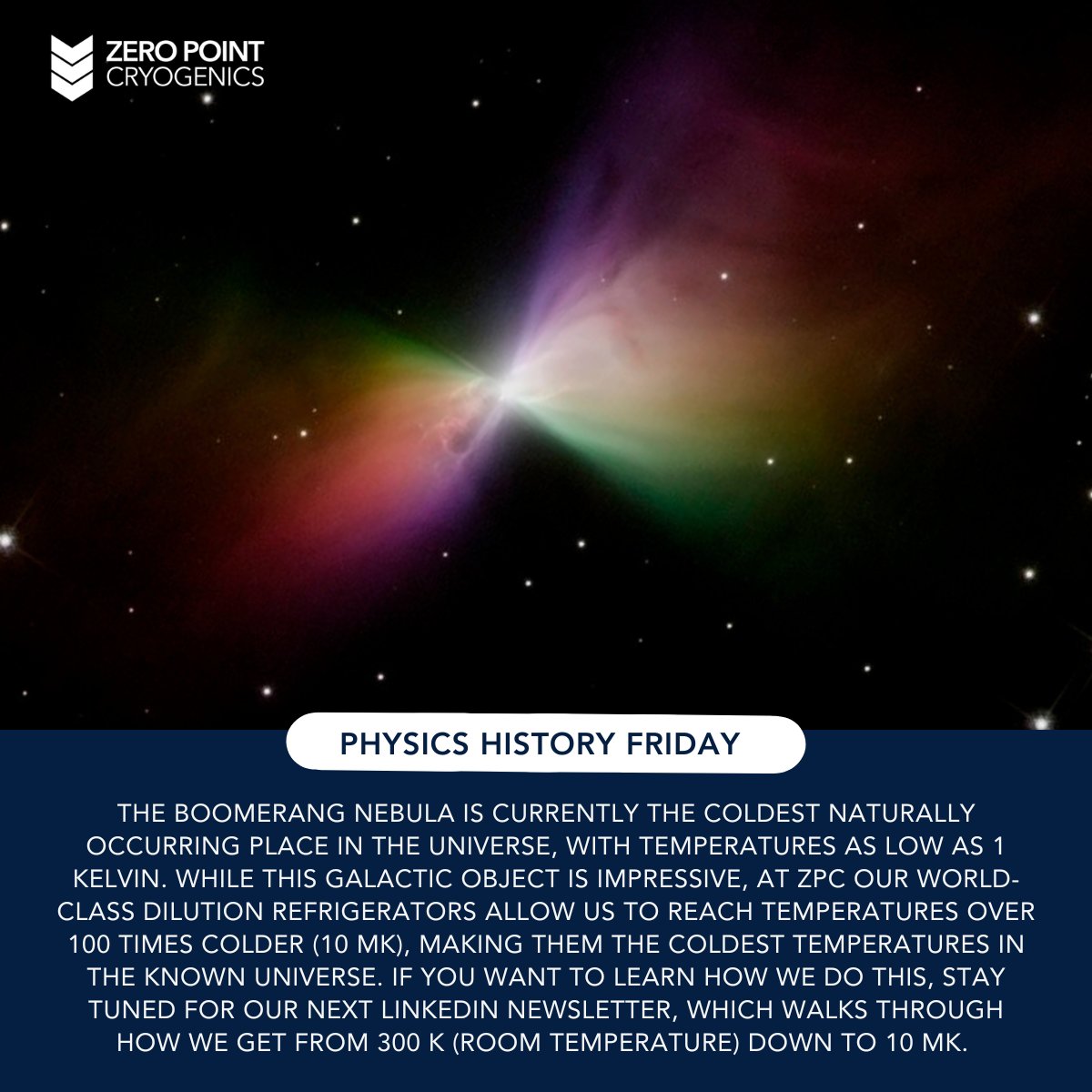
The Boomerang Nebula is the coldest naturally occurring place in the universe, with temperatures as low as 1 Kelvin (-272 degrees Celsius, or -458 degrees Fahrenheit). It reaches this temperature through rapid adiabatic expansion, the Joule-Thomson effect, where gas (from a dying star) rushes outward, and in this case, creates a planetary nebula. The Boomerang Nebula is unique because it's losing mass about 100 times quicker than other similar stars. The reason as to why is still not confirmed, though data from the ALMA radioscope array suggests that it may be a result of a cosmic collision.
The Cosmic Microwave Background (CMB) Radiation is the 2.7 K leftover heat from the Big Bang and is the average temperature of empty space. Typically, the average nebula (10 K to 10,000 K) is cooled by the CMB, however, the Boomerang Nebula's expansion is so powerful that it's actually absorbing the CMB radiation. It is currently the only place in nature that acts as a "heat sink" for the rest of the universe.
While this galactic object is impressive, at ZPC our world-class dilution refrigerators allow us to reach temperatures over 100 times colder (10 mK), making them the coldest temperatures in the known universe. If you want to learn how we do this, stay tuned for our next LinkedIn newsletter, which walks through how we get from 300 K (room temperature) down to 10 mK.
#BoomerangNebula #Cryogenics #Science #PhysicsFriday #ColderforLonger #ZeroPoint
English