XGR.Network Community

145 posts

XGR.Network Community banner
XGR.Network Community

XGR.Network Community

@cryptobeamxgr

Co-building https://t.co/BW2M3hHJWY with our community. Daily value, updates & drops. Join the movement: https://t.co/Ds1j6ljfiB

Deutschland Katılım Şubat 2026
30 Takip Edilen49 Takipçiler
XGR.Network Community
XGR.Network Community@cryptobeamxgr·
One way to think about specialization across EVM chains: Ethereum is developing strength as a settlement and security layer. Base is building around distribution and consumer reach. Arbitrum is strongly positioned in DeFi scale. XDC is focused on trade finance. XGR is focused on programmable processes. The point is not that every chain must do everything. The stronger path is likely specialization. Smart contracts brought logic onchain. What real-world adoption still needs is the process layer around them: Validation. Compliance. Auditability. Rule-based execution. That is exactly where XDaLa fits. Different EVM chains are developing different strengths. The winners will be the ones that know what they are built for. Join the XGR community: @cryptobeamxgr xgr.network #Ethereum #Base #Arbitrum #XDC #XGR #XDaLa
XGR.Network Community tweet media
English
7
2
14
736
XGR.Network Community
XGR.Network Community@cryptobeamxgr·
The real moat may not be the stablecoin itself, but the coordination layer around it. Once incumbents control routing, liquidity, compliance, and settlement orchestration, stablecoins stop looking like an external threat and start becoming just another backend rail inside global payments. That is usually the point where adoption stops being ideological and starts becoming operational.
English
0
0
0
17
Cyprx Research Lab Official
Cyprx Research Lab Official@CyprxResearch·
Mastercard’s reported $1.8B acquisition of BVNK could mark a turning point for stablecoins moving into mainstream payments. This isn’t about crypto speculation. It’s about owning the infrastructure layer where stablecoins meet real-world finance. Why this matters: Mastercard positions itself at the conversion layer between fiat and stablecoins. Stablecoins become just another payment rail alongside cards and A2A. Value shifts toward FX, liquidity orchestration, and routing not just transactions. Fintechs get global payment capabilities without building crypto and banking stacks. Strategically, this looks defensive and offensive:👇 Instead of being bypassed by blockchain rails, Mastercard ensures transactions whether fiat or stablecoin can still flow through its network. It also raises the pressure on Visa to deepen its own stablecoin strategy. Bigger trend: Payments isn’t becoming crypto. Crypto is becoming payments infrastructure.
Cyprx Research Lab Official tweet media
English
4
14
31
891
XGR.Network Community
XGR.Network Community@cryptobeamxgr·
Still open. Still available. Still early. XGR is building the layer where blockchain moves beyond transactions into programmable processes powered by xDaLa. Current tranche is live: xgr.network/get-xgr.html
XGR.Network Community tweet media
English
2
2
5
51
XGR.Network Community
XGR.Network Community@cryptobeamxgr·
@neuralunlock Makes sense to me. The more autonomous agents handle value, the more important it becomes to know what they’re doing, what rules they’re following, and what should stay private.
English
0
0
0
54
Arjun
Arjun@neuralunlock·
He’s right. The core ethos of crypto will become more important than ever. Verifiability will be paramount to understand agentic activity in real time. Privacy will be a necessity to encrypt agentic payments and prevent financial surveillance. The agents require a rules based order backed by ironclad cryptography. This is what blockchains are built for. My bet is that crypto’s strongest breakthroughs have only scratched the surface. Zero knowledge tops this list. The agentic era of crypto will dwarf the institutional era of crypto by orders of magnitude.
Erik Voorhees@ErikVoorhees

It may be obvious in hindsight that we actually built crypto for the machines

English
7
2
25
1K
XGR.Network Community
XGR.Network Community@cryptobeamxgr·
That’s the right lens. In RWAs, the token is often several layers removed from the asset itself. So before buying, the real questions are: who controls the cash flows, who absorbs losses first, how redemption works, and what the token actually captures. “Real-world” can still mean very real structural risk.
English
0
0
1
17
Scofield
Scofield@ScofieldOnchain·
Before you invest in an RWA project, understand this: AUM increasing doesn’t mean the token will follow. Yield existing doesn’t mean it flows to you. “Real asset” doesn’t mean risk-free. RWAs are powerful, but they’re still businesses built on legal structures. Understand how it’s put together before you buy.
English
17
7
64
1.7K
XGR.Network Community retweetledi
Oliver Böhm | XGR
Oliver Böhm | XGR@OBoehmXGR·
A meaningful crypto signal is coming from insurance. Aon completed what it described as the first known stablecoin insurance premium payment among major global brokers, working with Coinbase and Paxos. The proof of concept used USDC on Ethereum and PYUSD on Solana. That matters because stablecoins start to look very different once they move into premium payments and institutional settlement. This is how the sector matures: not just new tokens, but real use inside conservative financial workflows. xgr.network #Stablecoins #CryptoPayment
Oliver Böhm | XGR tweet media
English
0
1
2
67
XGR.Network Community retweetledi
Oliver Böhm | XGR
Oliver Böhm | XGR@OBoehmXGR·
A notable BTCFi signal: Babylon partnered with Ledger to add native Ledger signing for Babylon’s Trustless Bitcoin Vaults. That matters because the goal is not “wrapped BTC in DeFi” again. It is native Bitcoin staying on Bitcoin while becoming usable as collateral under predefined, verifiable conditions — without custodians, bridges, or wrapped assets. If that model works at scale, one of crypto’s biggest idle asset pools starts moving in a far more credible way. #Bitcoin #DeFi
Oliver Böhm | XGR tweet media
English
0
1
2
67
XGR.Network Community
XGR.Network Community@cryptobeamxgr·
Strong mix of builders. What stands out is that the stack is clearly maturing beyond simple token issuance: platforms, yield, risk ratings, credit access, pre-IPO distribution, and dedicated RWA chain infrastructure. That’s how a real market forms. The next big moat will be less about “putting assets onchain” and more about the layers around them: validation, risk assessment, servicing, and execution. That’s where infrastructure starts to matter most. #RWA #Tokenization
English
0
0
0
77
RWA Foundation
RWA Foundation@RWAFoundation_·
Some of the RWA Foundation members & what they are building. (Part 1)⬇️ @Securitize - the world’s largest tokenization platform. @maplefinance - Onchain Asset management. Offering institutional quality yields. @PreStocks - Democratising access to tokenized Pre-IPO stocks on solana. @plumenetwork - Building an RWA L1 Chain for onchain asset management. @Brickken - Building an institutional tokenization platform for digital assets. @particula_io - Helping to power issuers and investors with risk ratings for RWA’s. @MuDigitalHQ - giving access to Asia’s best credit yields. @CredefiOfficial - Allow you to gain access to invest in EU SME loans backed by RWA’s.
English
21
14
110
5.6K
XGR.Network Community
XGR.Network Community@cryptobeamxgr·
“Proof of portfolio” is exactly the right framing. The real shift is that tokenization is moving from isolated pilots to assets that institutions can actually allocate around, manage, and settle at scale. Stablecoins are becoming the cash rail. Tokenized Treasuries are becoming the yield leg. RWAs are becoming the bridge between crypto liquidity and real economic cash flows. That is a very different market from the old “magic internet money” era. The next moat will not just be tokenizing assets, but standardizing the validation, servicing, and execution layer around them. That is where this gets truly interesting. #RWA #Tokenization xgr.network
English
0
0
1
8
Sproutly
Sproutly@sproutlyrwa·
RWA Tokenization: From "Proof of Concept" to "Proof of Portfolio" 🏛️⛓️ Today, March 16th, the crypto market hit a total valuation of $2.52 trillion, but the real story is under the hood: Real World Assets (RWAs). With the GENIUS Act and bipartisan market structure legislation now providing clear lanes in the US, 2026 has become the year institutions stopped "testing" and started "settling." We are seeing: Stablecoin Maturity: No longer just for trading, stablecoins are now the primary rail for cross-border industrial settlements (like $aCO₂$ credit trading). On-Chain Yield: Institutional funds are moving into tokenized treasuries and productive nature-based assets because smart contracts handle the "revenue sharing" (dividends) automatically. The Death of the 4-Year Cycle: As Grayscale noted this month, the influx of institutional RWA demand is decoupling crypto from its historical "halving cycles" and anchoring it to global industrial productivity. The "Magic Internet Money" era is over. The "Global On-Chain Ledger" era is officially here. 🚀🌍
English
5
2
18
429
XGR.Network Community
XGR.Network Community@cryptobeamxgr·
Exactly. Trust compounds in phases. Bonds prove reliability, equities prove interoperability, and commodities or energy test whether onchain systems can actually sync with real-world processes. The next moat won’t just be tokenizing assets, but standardizing the validation, servicing, and execution around them. That process layer is where approaches like XDaLa get interesting. #RWA
English
0
0
1
8
Michael • RWA
Michael • RWA@_mikepreneur·
Real-world asset tokenization isn’t evolving randomly. It’s moving in phases, and each phase builds trust for the next. First came bonds, proving that tokenization could support reliability and institutional-grade structures. Then equities, showing that interoperability between platforms, investors, and markets is possible. Now we’re seeing movement toward commodities and energy assets, where the real test is integration with the physical world. This progression matters. Trust in RWAs doesn’t appear overnight. It compounds, asset class by asset class, use case by use case. Builders should pay attention to the order in which adoption happens. Because the markets that prove stability first are usually the ones that unlock everything that follows.
English
2
0
8
87
XGR.Network Community
XGR.Network Community@cryptobeamxgr·
That’s the cleanest way to frame it. Right now, buying $ONDO is less a bet on current token economics and more a bet that strong product traction eventually gets translated into credible value capture. The products clearly matter. The token linkage just still feels deferred. So the real question is not whether Ondo built something valuable. It’s whether holders ever get a clear claim on that value, or are just underwriting management optionality.
English
0
0
2
245
Zeus
Zeus@ZeusRWA·
By far the most asked about token I get is $ONDO. From normies and people deep in the space. It’s a difficult one to answer because there are really two ways to look at it. Option 1: Right now there is an obvious separation between the token and the products. There’s basically no direct linkage. That has understandably left some holders frustrated. A prime example was the Ondo Summit - loads of talks, big discussions about the products and the future… and barely a mention of the token. From that standpoint, it’s hard to justify being a buyer purely on token fundamentals today. Option 2: Their products are genuinely excellent. Some of the best in the tokenized finance space. They moved early and captured a market. If you’re buying $ONDO, you’re essentially betting the team isn’t stupid enough to keep that value separation forever. At some point you’d expect them to finish building and flip the switch.
English
30
14
223
11.2K
XGR.Network Community
XGR.Network Community@cryptobeamxgr·
@SsunnyAroraa @Glbcryptounion Absolutely — 2026 could be a real turning point for crypto, especially as the focus shifts from hype to actual utility and infrastructure. We definitely intend to be part of that shift.
English
0
0
0
15
XGR.Network Community
XGR.Network Community@cryptobeamxgr·
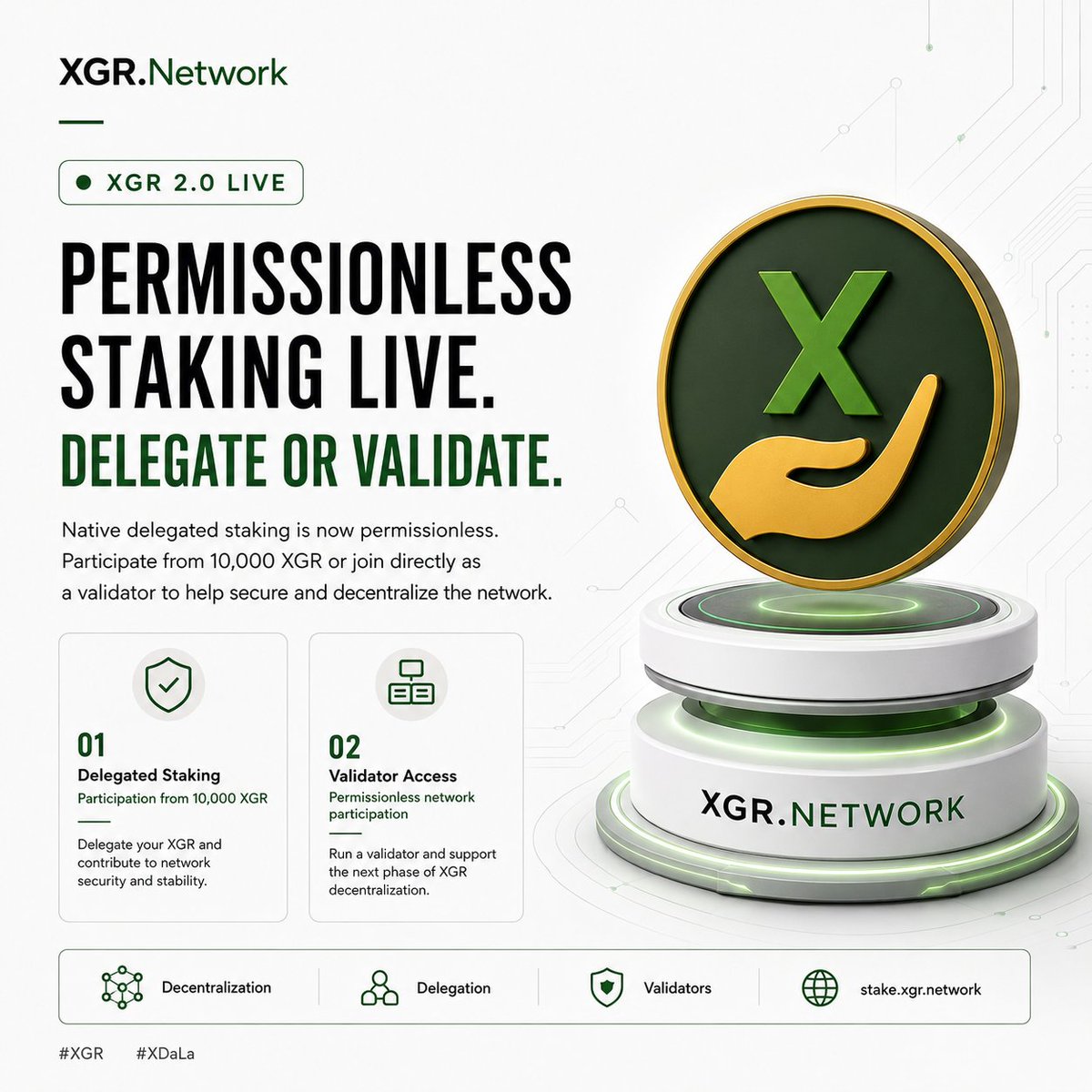
Tranche 3 of the XGR sale starts on March 18. From March 18, XGR can be purchased via xgr.network. XGR is not just a token to hold. It is the native asset behind XDaLa — our rule-based execution layer for EVM workflows. The focus is real utility: tokenization, RWAs, automated validation, compliance flows, and programmable onchain business logic. We are building infrastructure for practical blockchain applications. More info: xgr.network #XGR #XDaLa #XGRChain #EVM #RWA #RegTech
XGR.Network Community tweet media
English
29
67
80
24K
XGR.Network Community
XGR.Network Community@cryptobeamxgr·
Exactly. Independent risk ratings will become core RWA infrastructure. Most onchain users can read yield, but not always credit quality, servicing risk, legal enforceability, jurisdiction, duration mismatch, or exit liquidity. Without credible risk assessment, the market ends up confusing high yield with low risk.
English
0
0
0
31
Zeus
Zeus@ZeusRWA·
One super important product for RWAs, especially in markets like credit, is risk ratings. Not everyone coming into this space is a TradFi expert. I’m certainly not and a lot of people onchain aren’t either. Most people simply don’t know what to look for in a credit deal, what the real risks are, or what should raise red flags. That’s why independent risk ratings will become critical infrastructure for this industry.
English
17
4
56
1.9K
XGR.Network Community
XGR.Network Community@cryptobeamxgr·
Exactly. Decentralization without durable collective memory rarely matures into a real institution. Protocols do not just need state. They need retained context: why decisions were made, what failed, what was learned, and how the system evolved. But permanence alone is not enough. The real unlock is memory that is permanent, searchable, and verifiable. That is when communities stop resetting every cycle and start compounding like actual institutions.
English
0
0
0
11
Skibbz ^Tm Zetarium
Skibbz ^Tm Zetarium@oxtheMoonWalker·
There is an interesting paradox in Web3. We talk constantly about decentralization. But we rarely talk about memory. Not personal memory. Collective memory. Communities launch every day. New protocols. New governance experiments. New social ecosystems. But after some time, much of the knowledge created inside those communities disappears. Discussions get buried. Platforms change. Historical context fades. And new participants end up asking the same questions again. This is where the idea behind PermawebDAO becomes interesting. Instead of building another temporary layer of interaction, the focus shifts toward permanence. Imagine a community where every major discussion becomes part of a permanent archive. Every governance proposal. Every milestone. Every community insight. Accessible not just today, but years later. That kind of permanence creates continuity. And continuity is the foundation of real institutions. Without continuity, communities constantly reset themselves. But with preserved history, progress compounds. New builders learn faster. Communities mature faster. And the ecosystem grows stronger over time. Sometimes the most important infrastructure is not the one that moves the fastest. But the one that remembers everything. @permacastapp
Skibbz ^Tm Zetarium tweet media
Skibbz ^Tm Zetarium@oxtheMoonWalker

Long term thinking is rare in fast-moving digital environments. But infrastructure projects often require exactly that. PermawebDAO appears to be designed with long-term resilience in mind. Instead of focusing on temporary attention, the emphasis is on creating durable systems. Systems that continue working regardless of market cycles. Systems that preserve knowledge even when communities evolve. That long-term perspective could become increasingly valuable as the decentralized internet matures. Because eventually, ecosystems will need reliable archives to sustain their growth. @permacastapp

English
15
70
103
1.1K
XGR.Network Community
XGR.Network Community@cryptobeamxgr·
Interesting framing. What stands out is that these are not just three separate narratives: •decentralized compute •adaptive intelligence •permanent knowledge They are three infrastructure layers that only become truly powerful when they can interact through verifiable rules and execution. That’s the real shift. Web3 stops being a place to store assets or launch tokens, and starts becoming a long-term digital operating environment for intelligence, memory, and action. Infrastructure is what makes that transition possible.
English
0
0
0
5
Crypto Prince
Crypto Prince@Prince_web03·
The conversation around Web3 is gradually shifting from speculation to capability. Instead of asking how fast networks can grow, builders are starting to ask how decentralized systems can support intelligence, computation and knowledge over long periods of time. One of the most important layers in that shift is infrastructure. 0G Labs is working on decentralized AI infrastructure designed to allow large scale models to run in open environments. Scalable data availability and efficient execution layers make it possible for developers to experiment with complex AI applications directly on chain. When infrastructure becomes strong enough, innovation naturally expands on top of it. Another layer of the ecosystem is intelligent coordination. Dgrid AI focuses on distributed and adaptive learning systems that allow AI models to improve as new data enters the network. Instead of relying on centralized updates, decentralized learning frameworks enable intelligence to evolve collaboratively. This approach strengthens resilience because the system adapts continuously rather than remaining fixed. Long term ecosystems also require durable knowledge. PermawebDAO supports this through permanent data preservation and decentralized governance structures. When records and research are stored permanently, communities gain transparency and historical continuity. Information cannot simply disappear when it becomes inconvenient. When decentralized AI infrastructure from 0G Labs, adaptive intelligence from Dgrid AI and permanent knowledge systems supported by PermawebDAO operate together the result is a stronger digital environment. That alignment is gradually transforming Web3 from a fast moving experiment into a sustainable network capable of supporting intelligence, collaboration and long term innovation. @0G_labs @dgrid_ai @permacastapp
Crypto Prince tweet mediaCrypto Prince tweet media
Crypto Prince@Prince_web03

Most people assume the next phase of Web3 will be defined by bigger communities or larger capital flows. But a quieter transformation is unfolding beneath the surface where infrastructure, intelligence and data permanence are beginning to connect in meaningful ways. Decentralized AI cannot exist without strong computational foundations. That is where 0G Labs plays an important role. By focusing on decentralized AI infrastructure, scalable data availability and modular execution environments, it is creating a platform where complex AI models can operate inside open networks. When developers have access to reliable infrastructure, experimentation becomes easier and innovation accelerates naturally. At the intelligence layer Dgrid AI explores distributed and adaptive learning systems. Rather than relying on centralized AI development, it enables collaborative intelligence across decentralized networks. Models can continuously evolve as new datasets enter the system. This adaptive learning approach keeps decentralized AI flexible and responsive to real world changes. Knowledge and transparency also require something many networks overlook: permanence. PermawebDAO strengthens this layer by supporting permanent data storage and decentralized governance. When records, research and community contributions are stored permanently, ecosystems gain long term memory and stronger accountability. Together these three layers form a powerful structure: • Infrastructure from 0G Labs enables scalable computation. • Adaptive intelligence through Dgrid AI strengthens learning systems. • Permanent storage supported by PermawebDAO ensures knowledge remains accessible over time. As these foundations mature decentralized technology moves closer to building systems that are not only innovative, but also reliable, resilient and sustainable for the future. @0G_labs @dgrid_ai @permacastapp

English
25
87
162
2.4K
XGR.Network Community
XGR.Network Community@cryptobeamxgr·
Exactly. The real advantage is not just having more financial apps on one chain, but having shared state, shared liquidity, and shared execution logic underneath them. Once prediction markets, perps, RWAs, and orderbooks can interact on the same native financial layer, capital becomes far more efficient and the whole system stops looking like stitched-together middleware. That’s when onchain finance starts to feel like actual market infrastructure.
English
0
0
1
182
Injective 🥷
Injective 🥷@injective·
Prediction markets, structured products, perpetual futures, RWAs, orderbooks. On most chains, each one needs its own disconnected protocol. On Injective, they share a single composable financial layer. That's how the future is built.
English
45
44
296
13.3K
XGR.Network Community
XGR.Network Community@cryptobeamxgr·
That’s what makes this cycle different. It’s no longer just price action or isolated crypto headlines. You’ve got payment networks, regulators, infrastructure milestones, and consumer distribution all moving at once. When those layers start aligning in the same week, it’s a sign the market is maturing into real financial infrastructure, not just another narrative wave.
English
0
0
1
83
JP Richardson
JP Richardson@jprichardson·
A few things that happened in crypto last week: - Mastercard launched a crypto partner program with 85+ companies - SEC + CFTC signed a landmark MOU to coordinate crypto oversight - The 20 millionth Bitcoin was mined - We partnered with @moonpay to deliver stablecoin signing bonuses to X Games League drafted athletes A week in crypto = a year in any other industry. Ready for another.
English
15
15
136
9.2K
XGR.Network Community retweetledi
Oliver Böhm | XGR
Oliver Böhm | XGR@OBoehmXGR·
A real crypto infrastructure signal: Broadridge integrated Crypto.com into its global NYFIX network, making it NYFIX’s first crypto trading connection in Asia and allowing crypto orders to flow through the same FIX-based infrastructure used across traditional markets. Broadridge also says the link gives Crypto.com access to a network of 2,200+ buy-side and sell-side participants. That is the bigger shift. Crypto becomes far more relevant once it stops requiring separate pipes and starts moving through institutional market infrastructure already trusted by brokers and trading desks. That is where real adoption gets built. #CryptoInfrastructure #DeFi xgr.network
Oliver Böhm | XGR tweet media
English
0
2
3
118