Cryton
1.5K posts


A 15-year-old built a business doing over $250,000/year.
Most adults still think AI is only for writing emails.
Watch closely.
He packs every order by hand.
Fable 5 handles the operations behind the scenes.
Customer replies.
Inventory planning.
Daily checklists.
Pricing decisions.
200 orders every day.
$40 per order.
$8k+ daily revenue.
Less than $150 to set everything up.
The difference isn't working harder.
It's hiring AI before everyone else does.
You're watching the next gold rush.
Gipp 🦅@gippp69
English

$0 storage.
5,400+ plugins.
20-minute setup.
The result?
An AI that can search years of your notes instantly and connect ideas you forgot existed.

Born to gamble@borntogambles
English

@crytonbuton This is everything. Not the benchmarks, not the research, just someone with an idea building something real. That's the promise, right there.
English

$41,000 from a free GitHub upload.
The creator was 13 years old.
Most people downloaded the script.
Mason built a business.
He handed the project to Fable 5 with clear rules.
The AI planned every update.
Cheap models handled the coding.
Fable reviewed every change before shipping.
Setup cost: $120.
Launch time: one weekend.
Monthly subscription: $49.
842 customers.
Revenue: $41,258.
Everyone is chasing new ideas.
The money is in packaging existing ones.
Save this.
Gipp 🦅@gippp69
English

Sol won the Milky Way and lost the apartment.
Pat Simmons ran ten side-by-side tasks across Sol, GPT-5.5, Opus 4.8, and Fable 5. The lead changed with the work.
01:18 He separates the GPT-5.6 family into three jobs. Sol handles ambitious agent work. Terra sits in the middle at roughly half the price of GPT-5.5. Luna is for quick recurring work such as call summaries and email triage.
Model choice is only one setting. Max gives one model more time to work. Ultra starts four agents in parallel by default.
16:48 Sol wins the interactive Milky Way map after its first Rubik's Cube build failed to render and its apartment reconstruction put the rooms in the wrong places. The apartment looked polished until you checked the layout.
38:07 Fable finishes slightly ahead on the coding builds. Sol wins the knowledge-work section, including the PowerPoint and airline rebrand. Pat ends up recommending a hybrid setup where different models handle different parts of the build.
The article below turns that uneven scoreboard into a working router. It includes a copyable task card, five model roles, proof rules, retry limits, permission ceilings, and a 20-run calibration loop for deciding when a job moves up or down.
Keep the task and its checks stable. Change one layer for the next five runs.
Diam@diamai_
English

@0xhashlol @akshay_pachaar Agents improve through feedback, not endless prompting.
English

@crytonbuton @akshay_pachaar yeah the prompt matters way less once the agent can run tests and read the failure. most of my time now goes into making the feedback loop tight — fast test cmd, typecheck on save, tight lint. agent self-corrects instead of me re-prompting
English

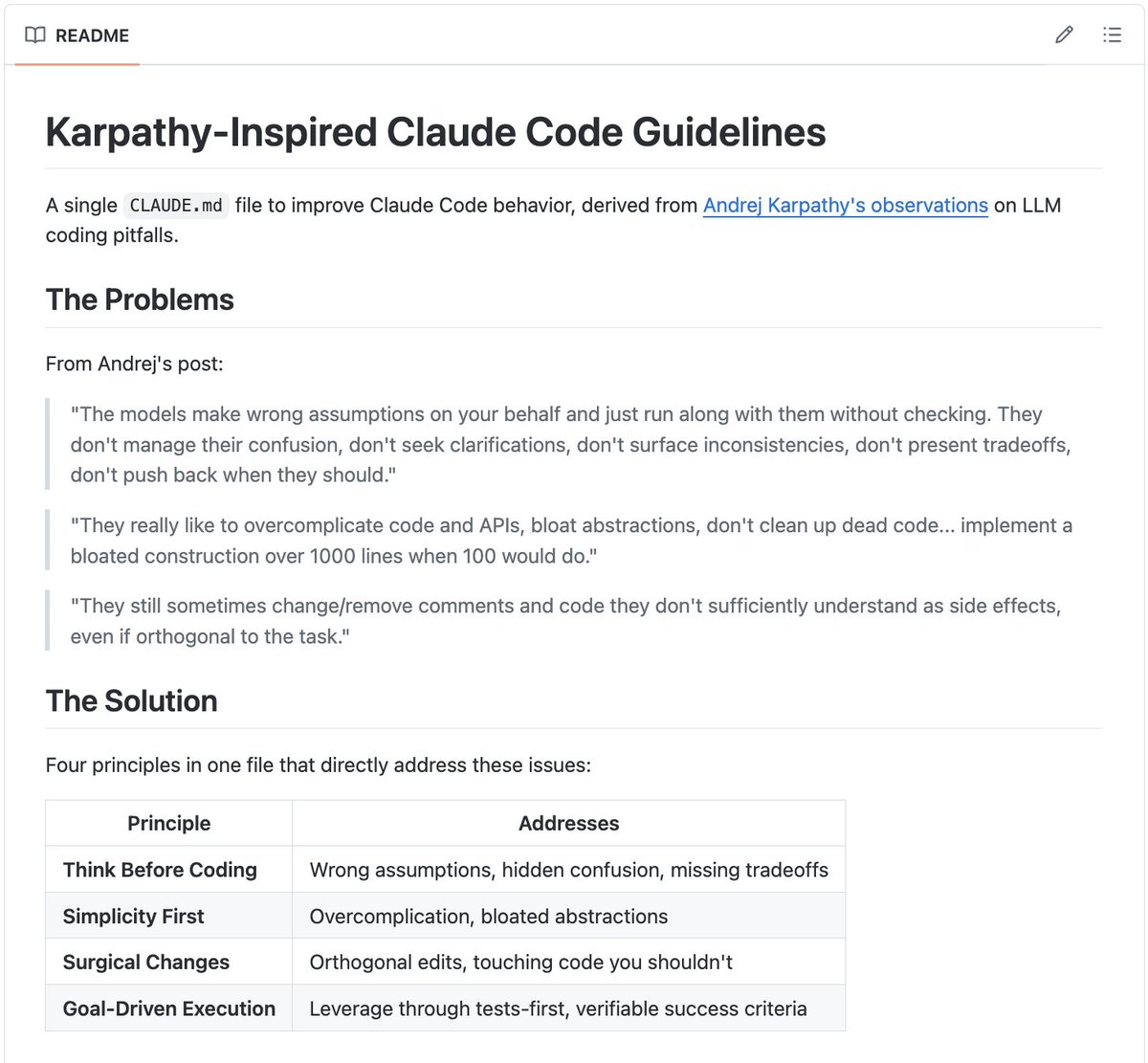
A single 𝗖𝗟𝗔𝗨𝗗𝗘.𝗺𝗱 file just hit 192k GitHub stars.
(derived from Karpathy's coding rules)
Andrej Karpathy observed that LLMs make the same predictable mistakes when writing code: over-engineering, ignoring existing patterns, and adding dependencies you never asked for.
If you've used AI coding assistants, you've hit all of these.
But here's the thing:
If the mistakes are predictable, you can prevent them with the right instructions.
That's exactly what this 𝗖𝗟𝗔𝗨𝗗𝗘.𝗺𝗱 does. You drop one markdown file into your repo, and it gives Claude Code a structured set of behavioral guidelines for your entire project.
This is a big deal.
- Built entirely around prompt engineering for AI coding assistants
- No framework, no complex tooling, just one .md file that shapes behavior
Developers are moving past "use AI to write code" and into "engineer the AI's behavior so the code is actually good."
The Claude Code ecosystem is growing fast, and the best tools in it aren't always software. Sometimes they're just well-crafted instructions.
100% open-source.
Link to the GitHub repo: github.com/multica-ai/and…
That said, I wrote an article on the anatomy of the .claude folder, which was read by 11 million people.
It's a complete guide to 𝗖𝗟𝗔𝗨𝗗𝗘.𝗺𝗱, hooks, skills, agents, and permissions, and how to set them up properly.
The article is quoted below.

Akshay 🚀@akshay_pachaar
English

@crytonbuton At 13 I was asking my parents for $49. He has 842 people paying it.
English

@crytonbuton I’d build this even without the $10k claim. Finding ideas you already paid to learn is useful on its own.
English

$10,000 in 14 days.
That’s what happened after Mia connected her notes to an AI second brain.
The video looks like someone organizing files.
It’s actually someone building a personal money machine.
Mia was a normal marketer.
She used Obsidian to store ideas.
Then she connected Claude agents to her entire history.
Setup cost: $63.
Time saved: 25 hours/month.
The AI found forgotten campaigns that made $8,000 before.
It turned them into new offers.
She now sells the workflow for $299.
5 customers.
$1,495/month recurring.
The technology is simple:
Your old knowledge + Claude + a living wiki.
Everyone thinks AI replaces experience.
The real opportunity is making your experience searchable.
You’re early.
Save this.
chewa.@chewadot
English

@femke_plantinga The missing term is probably evaluation. A company brain is only useful if you can measure whether retrieval, reasoning, and actions are actually improving over time.
English

Very few teams are building a company brain.
Most are just wiring together MCPs and hoping scattered docs behave like a system.
6 terms you need to know if you're building one (or evaluating GBrain):
𝟭. 𝗞𝗻𝗼𝘄𝗹𝗲𝗱𝗴𝗲 𝗚𝗿𝗮𝗽𝗵
The layer that maps how company knowledge connects. Linking people, projects, decisions, customers, product areas. It gives AI structure, provides the foundational context AI needs to reason, not just raw text to search through.
𝟮. 𝗠𝗖𝗣
A protocol that helps AI connect to tools and take action across them. Anthropic introduced it; In 2026 it has become the dominant AI integration standard. But a pile of MCP connections does not automatically create shared understanding. Access is not memory.
𝟯. 𝗦𝗸𝗶𝗹𝗹𝘀
The agent’s functional orchestration logic. MCP handles the underlying API connection, Skill defines the higher-level execution steps required to finish a job, such as summarizing a sales call, updating a product specification, or routing user requests.
𝟰. 𝗛𝘆𝗯𝗿𝗶𝗱 𝗦𝗲𝗮𝗿𝗰𝗵
The combo of keyword search and semantic search. One catches the exact phrase, the other catches the meaning. Teams need both, because company language is messy, acronym-heavy, and constantly changing.
𝟱. 𝗔𝗴𝗲𝗻𝘁𝗶𝗰 𝗥𝗔𝗚
RAG with a brain. The agent can route queries to specialized knowledge sources, validate retrieved context, and make dynamic decisions about what information to use.
𝟲. 𝗖𝗼𝗺𝗽𝗮𝗻𝘆 𝗕𝗿𝗮𝗶𝗻
A living system that turns company knowledge into something AI and humans can rely on. Connected, contextual, permission-aware, and continuously updated. This is the difference between AI that sounds smart and AI that is useful at work and always up-to-date.
In 2026, we don’t win by adding more AI touchpoints. We win by giving AI a shared brain to work from.
Are you building one? Share your expert take below 👇
Which must-know term would you add?

English

A 19 YEAR OLD BUILT A COMPETITION ROBOT THAT RUNS ON COMPRESSED AIR AND NOW PULLS A FEW GRAND A MONTH OFF IT
no motors on it the whole thing fires pneumatic pistons off tanks bolted to the frame
that puts out way more force per gram than any motor but each tank only holds so many shots
so every move on the course is a math problem how much air do you spend here and still finish the run
burn it too early and you stall halfway up with a full gripper and nothing left to push
he doesnt sell the robot he sells the build plans and the parts list he spent months dialing in
one clean run farms the views he drops one link and the files sell while he sleeps
the air budget trick alone is why most teams there never finish the course
bookmark this before you ever bolt a motor to anything again
savip@savipww
SURVEYORS PAY $40,000 FOR A SCANNER THAT DOES THIS AND HE BUILT ONE WITH A RASPBERRY PI THEN WALKED INTO A CAVE TO TEST IT a spinning lidar an imu and a pi bolted into a 3d printed shell it builds a full 3d point cloud of everything around him as he walks no gps no signal underground the thing maps itself off its own motion months of r&d then he took it down into a real cave with his brother the pros rent those units by the day and charge per scan he documented the whole build so anyone can copy it start to finish the lidar and the pi cost him a fraction of one day's rental everything he scans down there has never been on a map before
English

@KryptoBestiya The best hardware upgrades are often the invisible ones: they improve the workflow without adding more clutter.
English

HE HID A SPEED UPGRADE BEHIND HIS iMAC AND NOBODY CAN SEE IT
For years the iMac had one annoying truth. Beautiful screen. Barely any ports. And the few it has are hard to reach around the back.
So people plugged into hubs that dangled off the side. Cables everywhere. The clean look ruined by the fix.
Then he did it differently. He mounted the hub behind the stand. Out of sight. Flush against the machine.
From the front the iMac looks untouched. Behind it now sits a row of ports and a slot moving data at 10 gigabits a second.
The first reaction is always the same. Where did all those ports come from?
Then you watch a file fly across. Transfers that used to crawl now finish before you blink. And nothing sits on the desk to show for it.
The part that hits later is the trade. He gained speed and ports and lost zero desk space. Nothing dangling. Nothing to hide.
And here is what nobody tells you. The iMac was never slow or limited. It was just missing the piece Apple left off the back.
He upgraded the whole workflow and the desk looks emptier than before. Most people are still fighting a mess of hanging cables.
The fix was always meant to disappear. Some people already tucked it away.
Fokki@0x_fokki
English

@ScottyBeamIO The interesting part is not the Raspberry Pis. It is the shift from renting services to owning infrastructure — with the tradeoff that you also own the maintenance.
English

THIS FRENCH GUY RUNS OPENCLAW AND HERMES AI AGENTS ON A HOMELAB THAT REPLACED GOOGLE DRIVE AND ICLOUD ENTIRELY ON JUST 10 WATTS
The project: host his own local AI agents, OpenClaw and Hermes, ditch cloud storage subscriptions entirely by running his own NAS, and use the whole build to prep for his K8s certification – all running on 4 Raspberry Pis.
Today's upgrade: a PoE module.
One Ethernet cable now does two jobs – powers the Raspberry Pi AND gives it network access at the same time. No separate power adapters, no cable clutter, no juggling connections during maintenance.
Total power draw for all 4 Raspberry Pis combined: max 10 watts.
He's not renting cloud storage anymore. He's not paying monthly subscriptions for space he already owns the hardware for. His files, his AI agents, his data – all sitting on hardware in his own home, on a fraction of the power a lightbulb uses.
Next up: blocking ads network-wide across his entire home, using one of the automation services running on the same setup.
This is what "own your data" actually looks like when someone builds it instead of just talking about it.
Bookmark this post. Full build in the video below.
SCOTTY BEAM@ScottyBeamIO
English

CEO Google warned that AI will change 100% of professions and most people will be left without jobs:
00:00 - AI will take your job if you don't start acting now
00:42 - AI builds businesses that make $50k a month
This talk replaces 10 courses on the future of AI you'd never finish anyway.
Watch it today, then read the full breakdown in the article below.
Avid@Av1dlive
English

I wrote the original free AI access list.
Someone actually went and verified every single claim.
- Checked which free tiers actually work
- Added regional advantages by country
- Removed what doesn't hold up
This is how you build on someone's work. Respect.
ZEFI@zefirium
English

@lagerskoy The AI hardware race is becoming a memory race. More compute only helps if the model can be fed data fast enough.
English

AI MODELS ARE NOT JUST HUNGRY FOR GPUS, THEY ARE HUNGRY FOR MEMORY BANDWIDTH
This video looks like a RAM explainer, but it is really about why modern AI hardware became so expensive. HBM stands for High Bandwidth Memory, and instead of placing memory far away on the board, it stacks DRAM dies vertically and puts them close to the processor
That small layout change is the whole point. The GPU does not only need more memory, it needs to move huge amounts of data through memory every second, because training and running large models is often limited by how fast weights and activations can be loaded
The video shows why HBM beats normal GDDR-style memory for serious workloads. It uses a much wider connection, shorter physical distance and stacked design, which gives AI accelerators the bandwidth they need for LLMs, scientific simulations and massive parallel compute
The tradeoff is brutal. HBM is harder to manufacture, more expensive to package and usually soldered close to the GPU on advanced interposers, so you do not just “add more RAM” like a desktop upgrade
That is why Nvidia, AMD and every AI chip company care so much about memory now. The future of AI performance is not only bigger models or faster chips, it is how quickly the machine can feed data into the compute without starving the GPU
beamnxw ./@beamnxw
English

@callsofmidas The underrated advantage is not just giving AI more memory. It is giving it a better index of what matters and where things connect.
English

Imagine hiring someone brilliant who forgets the office layout every single morning.
Every question you ask, they walk the whole building again. Open every door. Read every file. Then answer.
That's your AI assistant on your own project right now.
Somebody built the fix and 84,500 people already starred it.
You type one command. Your entire project turns into a map it can actually read.
> No API calls
> No cloud
> No embeddings
> Free, MIT license
> Works in Claude Code and Cursor
Then you stop asking it to search.
You ask it how two things connect, and it answers in seconds, because it finally has the map.
Sound familiar? Every tool sells your assistant a bigger memory. This one just gave it a floor plan.
Bookmark this before your next project.
Kurama@KuramaOnChain
English

@noisyb0y1 McCarthy’s lasting contribution was not predicting every detail of modern AI. It was giving researchers a framework for asking whether intelligence itself could be described, tested, and built.
English

John McCarthy created "Artificial Intelligence" in 1956 and predicted everything that is happening today:
00:12 - who invented AI and changed the world
05:48 - 4 year old child is smarter than AI
22:24 - AI will destroy humanity in 7 months
He built the Stanford AI lab that trained the engineers behind OpenAI Google and Anthropic.
This talk gives you for free what Stanford charges $90,000 a year to teach its students.
Watch it today, then read the full breakdown in the article below.
Avid@Av1dlive
English

@Bober_smart AI can reduce the cost of production, but distribution, originality, and audience trust are still the parts that decide whether content turns into income.
English

A young millionaire who got rich using AI gave a step-by-step instruction on how to earn $2k/$3k a week
00:13 Go to YouTube and find a viral kids nursery rhymes channel
00:32 Open ChatGPT and ask it for a scene-by-scene breakdown for a one-minute kids YouTube Short
00:37 Copy all the text it gives you
00:39 Paste it into the AI video generator Viewmax
00:42 Turn on English auto captions.
00:44 Generate the video (takes less than 5 minutes)
00:47 Upload the finished video to YouTube
Done! The video is being created completely automatically, without filming or editing, literally in 10 minutes
Bober_smart@Bober_smart
English

@kirillk_web3 The biggest AI cost optimization is often not a better model. It is knowing which tasks actually need the better model.
English

> Claude usage limit reached.
> every. f#cking. day.
> was about to cut back on Claude Code entirely
> then find this article
> the two-model coding workflow
> first 5 minutes
> wait. I've been running Fable 5 on everything?
> even the boilerplate, the refactors, the tests?
> route the mechanical work to a cheaper model?
> keep Fable 5 only for the calls that actually matter?
> spent months thinking frontier quality meant frontier prices
> turns out I was the problem
> set up the routing once
> API bill drops 80%
> been the skill issue this whole time
Kirill@kirillk_web3
English

Fanvue just shipped an MCP connector for Claude - and it's a clean example of where creator tooling is heading
MCP lets an assistant read a platform's real data through a defined interface. So Claude can pull your actual analytics, message history, and pricing signals, then draft replies in your own voice - instead of you copy-pasting screenshots into a chat.
The shift isn't "AI writes your posts." It's your tools becoming things an agent can operate directly.
Bookmark this before every creator platform ships one.
Bober_smart@Bober_smart
English