

CTO
3.9K posts

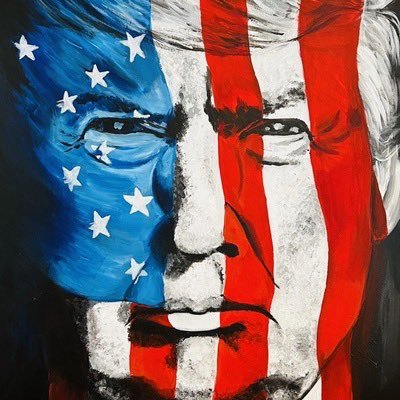
What is the biggest enemy of America?
English

@JeffBezos @Jason Brilliant common sense argument.
We need more of this.
English

Yes, the United States has the most progressive tax system in the world. The top 1% pay 40% of taxes, the bottom 50% pay 3% of taxes. We can make it even more progressive by zeroing out taxes on the bottom half. It’s a small amount of the total tax revenue but very meaningful to people in this group.
Shay Boloor@StockSavvyShay
Jeff Bezos said the bottom half of Americans should pay zero federal income tax. He cited a nurse in Queens making ~$75K and paying ~$12K in taxes saying “we shouldn’t be asking this nurse in Queens to send money to Washington.”
English

🚨🇺🇸BREAKING: Thomas Massie is OUT.
Ed Gallrein is projected to win the Kentucky 4th primary, 54.4% to 45.6%.
The man who introduced the Epstein Files Transparency Act, voted against Iran, and wanted AIPAC registered as a foreign agent just got bought out by $35M ...
The most expensive primary in history closes.

Mario Nawfal@MarioNawfal
🚨🇺🇸 KENTUCKY 4TH UPDATE: Gallrein: 57% Massie: 43% 13.5% of votes counted. The $35M attack against him appears to be landing. 108,000 votes still need to come in. The most anti-establishment Republican in Congress is in real trouble tonight...
English
🚨🇺🇸 Massie's concession opener:
"Took me a while to find my opponent in Tel Aviv."
The man went out swinging until the very last second.
Mario Nawfal@MarioNawfal
🚨🇺🇸BREAKING: Thomas Massie is OUT. Ed Gallrein is projected to win the Kentucky 4th primary, 54.4% to 45.6%. The man who introduced the Epstein Files Transparency Act, voted against Iran, and wanted AIPAC registered as a foreign agent just got bought out by $35M ... The most expensive primary in history closes.
English
English

EXCLUSIVE:
@RepThomasMassie’s ex-girlfriend and former Congressional staffer for @RepSpartz Cynthia West @Cyntaxed007 tells me she started dating Congressman Massie on August 30th, 2024, just 2 months after his wife of 30 years passed away. Ms. West told me that while they were dating, Massie told her he had sex with Congresswoman Lauren Boebert @laurenboebert just weeks after his wife died, and before he met Ms. West.
In the interview, she told me Massie was very braggadocios about his sexual escapades with other women, and that Ms. West was at least the third woman he had sexual relations with within 2 months of his wife passing away.
It has become more evident as to why Lauren Boebert traveled to Kentucky to campaign with Massie this weekend ahead of his election tomorrow, despite accusations that he has had inappropriate sexual conduct with women like Cynthia West, who claims she lost her job as a Congressional staffer working for Massie’s colleague and close friend Rep. Victoria Spartz @Victoria_Spartz when Massie retaliated against Ms. West because she didn’t want to entertain his pornographic and deranged sexual fantasies that involved describing graphic sex scenes with other women and even married couples, according to Ms. West.
Sounds like something you’d read in the Epstein Files, to be honest…
WATCH and SHARE 👇🏻
Lauren Boebert@laurenboebert
Massie’s Race Matters!
English

Sorry but he's a fucking idiot.
Nobody wants him dead in the IC.
They love him for what he does.
Fact.
Red Panda Koala@RedPandaKoala
Jeremy Corbell was told by an intelligence agency that there is a credible hit on his life “I was told by an agency, they brought a sincere, credible and urgent threat to my life, to me.”
English

They never were. But it is clear the Hollywood American Dream has died…
HatsOff@HatsOffff
American tourist educated by Aussie man when visiting his store: ‘You used to be the good guys’
English

BREAKING: Israel qualifies for Eurovision Song Contest final
news.sky.com/story/israel-q…
English

CTO retweetledi
We’ve all come across street preachers, but this man is a straight-up street philosopher 😂
English
🇺🇸 For 84 straight days, the sun will never set in Utqiagvik, Alaska.
Continuous daylight from May 10 all the way to August 2.
I can't imagine living in those conditions.
English

I made a paper pyramid for my cat, and it reminds him of the old days
English
@TheProjectUnity New Zealand is magical. Lots of people connected.
I even heard a rumor that a purple violet lumerian light used to illuminate all the waterways.
English
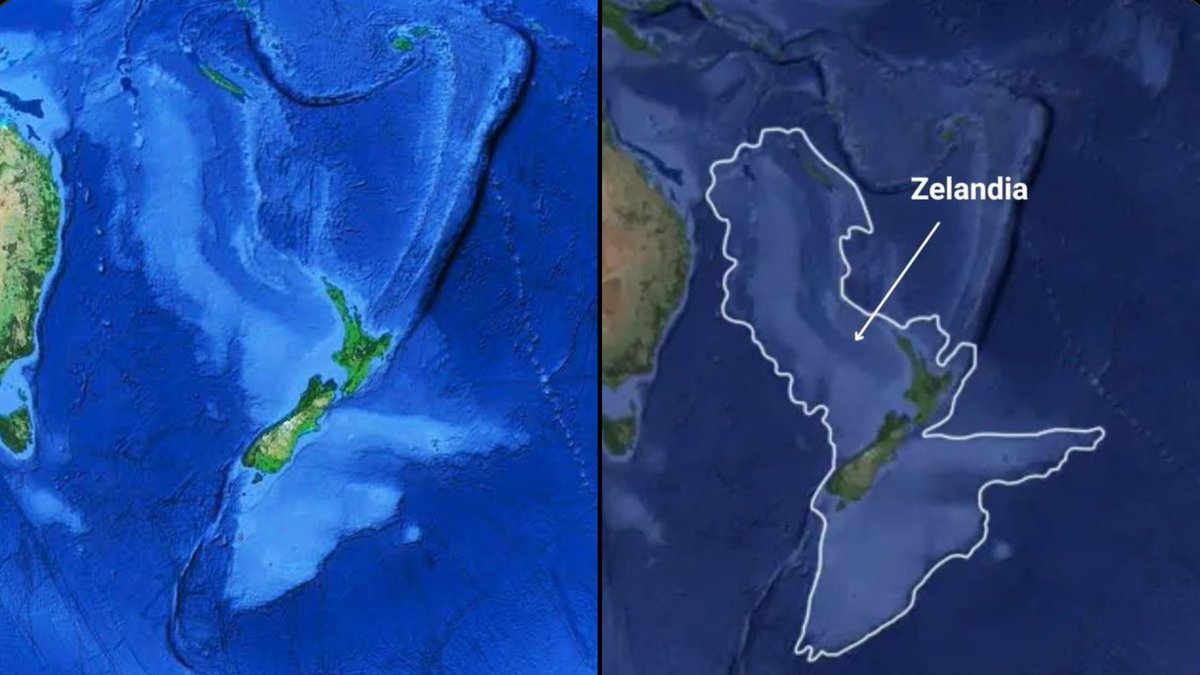
There could be SO MUCH lost history down there...
Zealandia, a 2-million-square-mile landmass covering nearly 5 million square kilometers, has been officially confirmed as Earth's eighth continent through rock dating and magnetic data analysis.
Ninety-five percent of it lies underwater, with only New Zealand and New Caledonia visible above the surface as remnants of ancient mountain ranges.
The continent broke away from Gondwana 85 million years ago, thinned, and sank due to tectonic forces.
English

I’ve said it before and I’ll say it again, the war in Iran is about China.
UnveiledChina@Unveiled_ChinaX
China has spent years claiming the US war with Iran has nothing to do with it. Then one of America's top think tanks ran the numbers. It turns out the war is bleeding China from five different directions simultaneously. The Center for Strategic and International Studies (CSIS) published a detailed economic analysis on April 30, 2026, examining how the Iran war, now in its ninth week, is hitting the world's second largest economy. The findings are more damaging than Beijing's public posture suggests. The most immediate pain is energy. China imports over one third of its total crude oil supply through the Strait of Hormuz every year. Since the war began on February 28, retail gasoline prices in China have surged 39%, and LNG prices have jumped 42%. That is the largest gasoline price spike China has recorded since its current pricing system began in 2013, surpassing even the shock from Russia's invasion of Ukraine in 2022. China has 70 vessels stranded behind the Strait of Hormuz that it is struggling to get free. Foreign Minister Wang Yi told his Thai counterpart directly. The export damage is just as serious. Nearly one third of China's entire GDP growth in 2025 came from net exports, the highest share since 1997. The IMF has already downgraded forecasts for eight of China's top 20 export markets, including the UAE, where projected import growth swung from positive 7.1% to negative 8.4% in a single revision. Fewer customers buying means fewer Chinese factories running. Then there are the supply chains. Pesticide prices in China surged 46% between February and mid-April. Sulfuric acid, a key fertilizer ingredient, climbed 72%. Polypropylene plastic surged 40%. In industrial regions, factory trucks are lining up to secure plastic supplies. In February 2026, 34% of Chinese manufacturing firms above a designated size were already running at a loss. If that number climbs, layoffs follow. Manufacturing employs roughly one fifth of China's population. China's chipmaking sector faces a specific chokepoint: helium. China imports 85% of its helium demand, roughly half from Qatar, which is directly affected by the war. No helium means semiconductor production lines slow down. Helium spot prices have already spiked. The effects will compound the longer the conflict runs. Chinese investments in the Middle East are also at risk. In 2025, the region was the single largest destination for Chinese overseas investment globally, with at least $26 billion in projects signed. A $4 billion Chinese port project in Kuwait was struck by Iranian drone and cruise missiles in March 2026. Beijing has pledged up to $400 billion in Iranian infrastructure over 25 years under a 2021 agreement. That program is now in serious question. China is better insulated than Japan, South Korea, or Taiwan, which depend on the strait for over 90%, 70%, and 58% of their crude imports respectively. China has the world's largest strategic oil reserve at 1.4 billion barrels. Its coal dependence and EV adoption provide buffers. But better insulated is not the same as unaffected. Xi Jinping told Saudi Arabia's Crown Prince that the Strait of Hormuz "should maintain normal passage." That is the closest Beijing has come to publicly acknowledging Iran is the problem. The country that buys over 80% of Iran's oil is now quietly hoping its best energy client stops blocking the waterway that feeds its own economy. Full analysis: chinapower.csis.org/china-economic… #China #CCP #IranWar #Economy #StraitOfHormuz #Energy #Geopolitics #CSIS #ChinaEconomy #MiddleEast
English

@ctoart1 @cybersh0gun @AdrianDittmann Well, if we're going to be accurate... your mom.
Dude, or dudette... can't we just cut to the chase?
You're an idiot. That's OK. Even small villages need idiots.
English
@incalcitrant @cybersh0gun @AdrianDittmann Your proof is from what? Reports from CIA / mossad operatives
English
@ctoart1 @cybersh0gun @AdrianDittmann Ah... thank you. And you have... what proof?
Not that I'm saying you're a liar. You could actually believe it, and just be ignorant.
Regardless, did American bombs get used on Americans? Did Israeli bombs get used on Israelis?
Did these happen across two days in January, 2026?
English
@incalcitrant @cybersh0gun @AdrianDittmann 40k*
And definitely not as many people as that which has died under American and Israeli bombs
English
@ctoart1 @cybersh0gun @AdrianDittmann You think it's higher? For Jan 8th-9th murder of protestors?
The estimates are all over the place.
Maybe they were thinking over the 47 years.
Ah, much better. That's less than 1000/year.
English
English
@AdrianDittmann Avoiding The strait of Hormuz disaster would be much better for American Power projection.
This has been a total f up
English