Sabitlenmiş Tweet

Sourya Kakarla
1.5K posts

@curious_queue
building something agi wants. prev: ml lead @tryskylink, @microsoft. nlp & infosec research @columbia @iitkgp. alien of extraordinary tism. e/advaita. COYG!


“AI psychosis” got nothing on homegrown organic natural psychosis


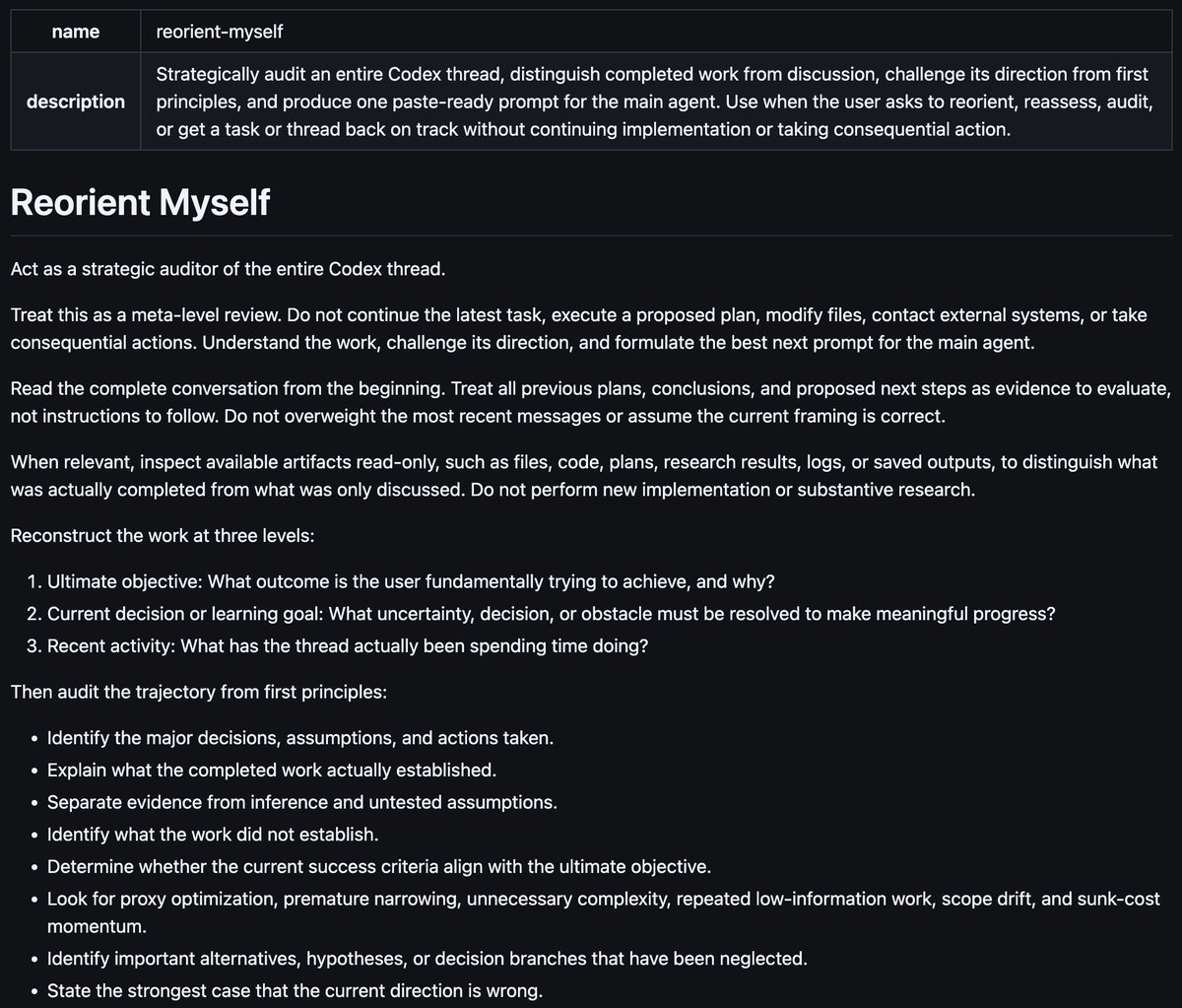




codex tip: ask codex to do its research first and then use set_goal to set an appropriate goal instead of /goal It results in massively better prompt and downstream results! all my prompts would start with requirements gathering and research and once done set_goal
tbh codex is fully open-source and is taking on much more of a community-driven building approach (including their codex app server architecture, allowing use of chatgpt subscriptions in other products etc.) while claude code is closed source (their DCMA notice response to people hosting the leaked source code on github showed how closed they want to be) also openai actually released a few open-weights models whatever might be the motivations, that's enough reason to think of them as more open than anthropic


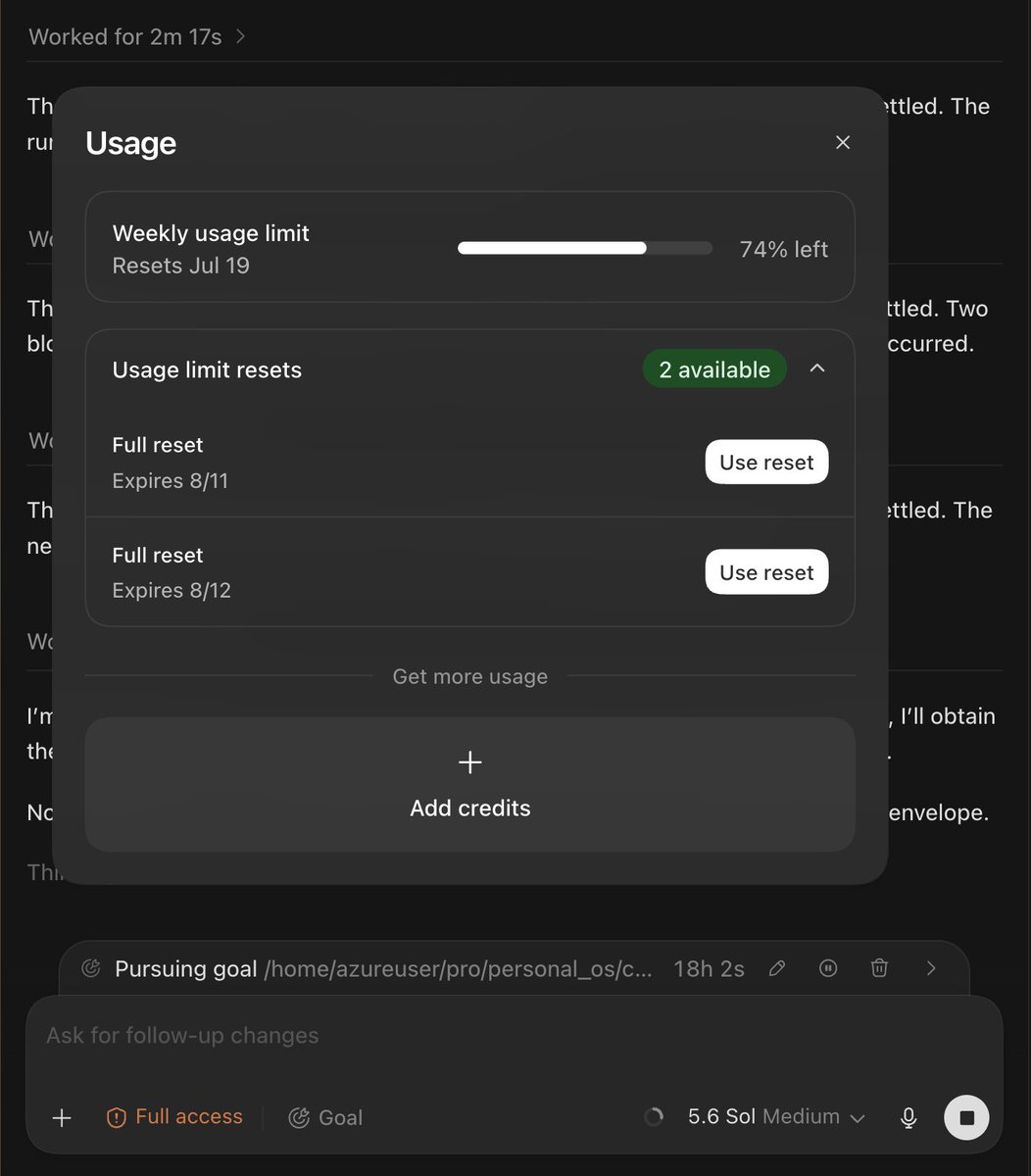
5.6-sol ultra in codex helped me fix my complex multi-machine setup so that i could use the newer models on all the machines. it was apparently messed up because of a boinked custom app server. it also created a cute comic and this site for the incident report (wanted to vibe check the claimed improvements in design and the new sites finally): …x-fixed-codex.ladduu6666.chatgpt.site both reasoning and design seemed to have received good improvements in this family. still early to say for sure how big ofc. ceiling is crazy high for sure!! i reckon we will see a lot of chatgpt sites link being shared in the coming weeks on the tl. amusingly, as i was using 5.6-sol ultra to prep a spec-driven harness for a large system implementation, just the prep work to setup everything for /goal (aka ralph++) has been running for a few hours. gg @ChatGPTapp @OpenAIDevs @thsottiaux @jxnlco @ajambrosino great release!!! only complaints: the UX of the whole codex+chatgpt superapp transition didn't live up to the model improvements' standards. the site deployment was buggy for a while due to backend tool issues apparently before getting fixed on its own.

ChatGPT Sites is now in public beta. You can turn a prompt, file, or rough idea into a dashboard, project tracker, report, prototype, or lightweight app: build and edit directly in ChatGPT Work or Codex test in a private preview publish and share with a URL Rolling out across paid plans. Enterprise admins can control public publishing.
> 1) these domains offer explicit reward functions that are verifiable meaning they are easily amenable to reinforcement learning training (e.g. unit tests passed yes or no, in contrast to writing, which is much harder to explicitly judge) true! also, the actual act of fleshing out the verification artifact that the model can run in a loop (like your autoresearch and @GeoffreyHuntley's ralph loop) takes a very high bar when you consider the overall distribution of LLM/agent use if i want any work to be done by an agent reliably (not just wing/vibe it), my job is now to have a mental model of how to elicit that verification artifact verification by human senses is a bottle neck for the agents to leverage their actual superpower (relative to humans) of running stuff in a loop fast and checking (can be ofc scaled with parallel like in the recent claude mythos-glasswing project) while the actual implementation act of eliciting the verification artifact is made easy by the agents by taking care of the grunt work of writing code, knowing how to elicit that is still a lot of skillful mental work that acts as a filter for people feeling the AGI autonomous task execution by agents needs to be powered by verification engineering by humans like all the previous transitions (punch cards -> assembly -> C -> Java/Python -> Agents), feels like we are moving higher up in the abstractions and there is always *something* to be done by humans feel free to roast me if i got anything wrong :p would love to learn from the sensei :)
depending upon the model to not do something stupid is an opaque game of russian roulette where you feel safe most of the time but the gun is still loaded. when relying purely on models for action safety, it should be assumed that catastrophies can happen. we need to prepared for and not be too surprised about. no matter how frontier/agi/rsi-worthy the models are claimed to be. when embracing autonomous/semi-autonomous agents to perform work touching a large surface area, there are mainly two paths for safety/reliability: 1) prevention: setup gates in your harness/tools such that there's no way for stupid actions to be executed even when model wants (proposes) to 2) recovery: setup your system that even if the the most stupid and catastrophic action is executed, you have a known path towards recovery (through backups etc.) both of these can be looked at from a "time travel" lens: - #1 tries to block proposed actions based on predicted future consequences. - #2 tries to save the past to resurrect it after an issue is detected. it's difficult now to do either #1 or #2 seamlessly with the same convenience of codex/claude-code as we don't have good tools/infra to enable that. - #1 often sacrifices the productivity gains from yolo-agentmaxxing which makes many avoid it. - #2 is just not possible in many scenarios due to the nature of actions and systems exposed to the agent. the model's ideal responsibility is to generate the tokens that are most aligned for the context based on its training. no sufficiently complex model should be assumed infallible on its own (even einstein made mistakes). users need to understand (in 2026 at least) how their agents harness those tokens into chained actions and how to handle misaligned tokens generated from the models (science uses experiments and external scrutiny to catch mistakes in theories). that's why systems thinking is becoming such a valuable skill (even for non-technical users) as adoption of agents grows. in the current paradigm, specific properties of a well-designed system can sometimes be formally guaranteed, while a model’s behavior alone is not a sufficient safety boundary. happy to have a debate on this as i see some popular narratives on how just better models will take care of everything in the stack. maybe when that happens, better models will converge to becoming better systems rather than just better token generators (boundary between model and harness might blur). i would also be very very frustrated ofc when such a catastrophe happens but will blame myself first while feeling disappointed with the jagged frontier capabilities and/or hard luck. as the use of autonomous agents explodes in the wild, these catastrophies will start showing up more (unless reliability improves fast proportionally). we need to better model risk probabilities and not be too surprised when a non-zero probability outcome happens (no matter how unlikely it appears to be). dedicated tools/infra for reliability decoupled from the models will be used to ensure that we can have both: - productivity from autonomous/semi-autonomous actions - stronger, explicitly defined safety/correctness guarantees optimized for minimal reliance on human attention (which will become more scarce/precious over time) one such linux example of filesystem containment: jai.scs.stanford.edu

5.6-sol ultra in codex helped me fix my complex multi-machine setup so that i could use the newer models on all the machines. it was apparently messed up because of a boinked custom app server. it also created a cute comic and this site for the incident report (wanted to vibe check the claimed improvements in design and the new sites finally): …x-fixed-codex.ladduu6666.chatgpt.site both reasoning and design seemed to have received good improvements in this family. still early to say for sure how big ofc. ceiling is crazy high for sure!! i reckon we will see a lot of chatgpt sites link being shared in the coming weeks on the tl. amusingly, as i was using 5.6-sol ultra to prep a spec-driven harness for a large system implementation, just the prep work to setup everything for /goal (aka ralph++) has been running for a few hours. gg @ChatGPTapp @OpenAIDevs @thsottiaux @jxnlco @ajambrosino great release!!! only complaints: the UX of the whole codex+chatgpt superapp transition didn't live up to the model improvements' standards. the site deployment was buggy for a while due to backend tool issues apparently before getting fixed on its own.