

Daniel
233 posts
Daniel
@danielementary
Building @Arcium Roasting & Brewing Specialty Coffee
Switzerland Katılım Kasım 2021
602 Takip Edilen377 Takipçiler



Daniel retweetledi

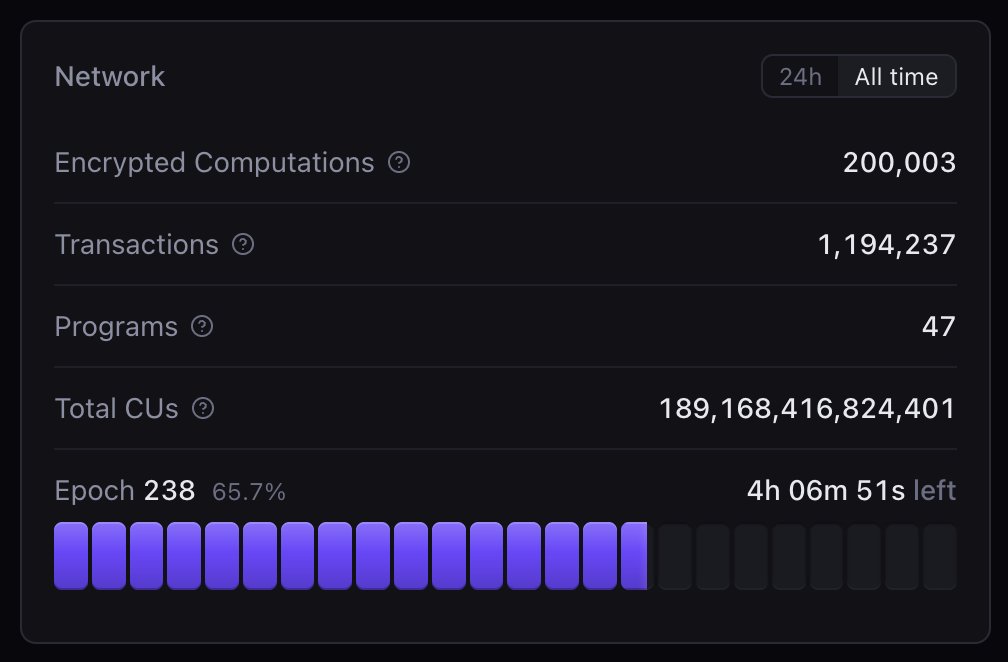
We’re building the biggest, fastest and most confidential <encrypted> computing network humanity has ever seen!
Numbers have been exploding over the past weeks of Mainnet Alpha, the network is getting ready for full mainnet launch.
English
Daniel retweetledi
Daniel retweetledi
The idea behind Arcium is simple:
Protecting any kind of sensitive information while being able to compute over it.
Using information without anyone ever seeing it.
On-chain confidentiality is only the beginning.
The future is fully confidential AI.
Stay tuned☂️
English
Daniel retweetledi

Daniel retweetledi

Daniel retweetledi
better privacy standards
Umbra Privacy@UmbraPrivacy
The floppy disk had a good run. So did bad privacy.
English
Daniel retweetledi

Technology stole your privacy, and with it your freedom. Yannik Schrade has a plan to get it back.
(0:00) Why Is Privacy So Important?
(4:13) Is Schrade Prepared to Suffer for His Cause?
(10:38) Why Doesn't Our Current System Protect Our Privacy?
(14:16) Are We Being Surveilled?
(26:19) Is the iPhone Safer Than Android?
(31:25) Is It Truly Possible to Communicate Privately?
(35:20) Is Signal a CIA Operation?
(47:54) Is the Current State of the Art Cryptography Secure?
(53:02) How Did Schrade Build This Technology?
(56:42) Is It Possible to Move Money Privately?
(1:03:20) The Arrest of Roman Storm
(1:14:48) Are Cash Transactions Private?
(1:18:37) Is Schrade Concerned for His Safety?
(1:23:02) How Will This Technology Impact Our Lives?
(1:28:54) Will Any Big Hardware Manufacturers Sell Truly Secure Devices?
(1:35:17) Are All Our Text Messages Being Monitored?
(1:39:58) Is Your Phone Listening to You?
(1:44:50) Where Can People Learn More About Schrade's Work?
English
English

English

Daniel retweetledi
Daniel retweetledi
Daniel retweetledi

Daniel retweetledi

In crypto, there is a fundamental distinction between single-purpose shielded pools and multi-purpose shielded pools.
Single-purpose shielded pools, such as Tornado Cash and majority of other privacy applications are built around a single function: private transfers. You deposit funds, wait, and later withdraw them in a way that attempts to break the onchain link between sender and receiver. That is the entirety of the design space.
The limitation becomes obvious very quickly. Because these pools only support transfers, users cannot do anything resembling normal DeFi activity inside them. You cannot swap assets, earn yield, participate in markets, or interact with applications while remaining shielded. Privacy exists only at the moment of transfer, and nowhere else.
This constraint has direct consequences for the anonymity set. Since funds inside the pool are effectively “idle,” transactional frequency is lower, and users have little incentive to keep their funds there for extended periods of time.
Users enter, wait, and exit. The anonymity set is bounded not just by total value locked, but by how many real, independent transactions occur over time. Low TVL combined with sparse transaction frequency makes it significantly easier to correlate deposits and exits, even if the underlying cryptography is sound.
Multi-purpose shielded pools, like Umbra, take a fundamentally different approach. Instead of isolating privacy to a single action, they allow users to remain inside a shielded environment while continuing to use their assets. Transfers are just one capability among many. Users can transfer, swap, and earn yield without constantly exiting and re-entering the pool.
This has a compounding effect on the anonymity set. When assets are actively used rather than parked, transactional frequency increases and capital stays shielded for longer periods of time. TVL becomes stickier, flows become noisier, and the anonymity set grows. More users, more actions, more overlap - making correlation attacks meaningfully harder.
Hell, why even leave the pool?
The key takeaway is that anonymity is not only a function of cryptography. It is a function of usage. Multi-purpose shielded pools naturally sustain higher TVL and higher transaction throughput, which in turn leads to larger, more robust anonymity sets. Privacy stops being a single, isolated action and becomes a persistent property of how users operate onchain.
Encrypted shared state makes this possible!
English
Daniel retweetledi
Daniel retweetledi
Daniel retweetledi