Data distributor

668 posts

Data distributor

Data distributor

@data_stern

Katılım Ekim 2020
1.1K Takip Edilen453 Takipçiler
Data distributor
Data distributor@data_stern·
@UBERSOY1 Per 1,000 women of reproductive age (15–44) rather than per 100k people
English
0
0
3
285
UBERSOY
UBERSOY@UBERSOY1·
Abortion rate per 100k people: Britain: 20.6 US: 16.7 France: 15.7 Russia: 10.1
English
28
12
408
17.7K
Data distributor
Data distributor@data_stern·
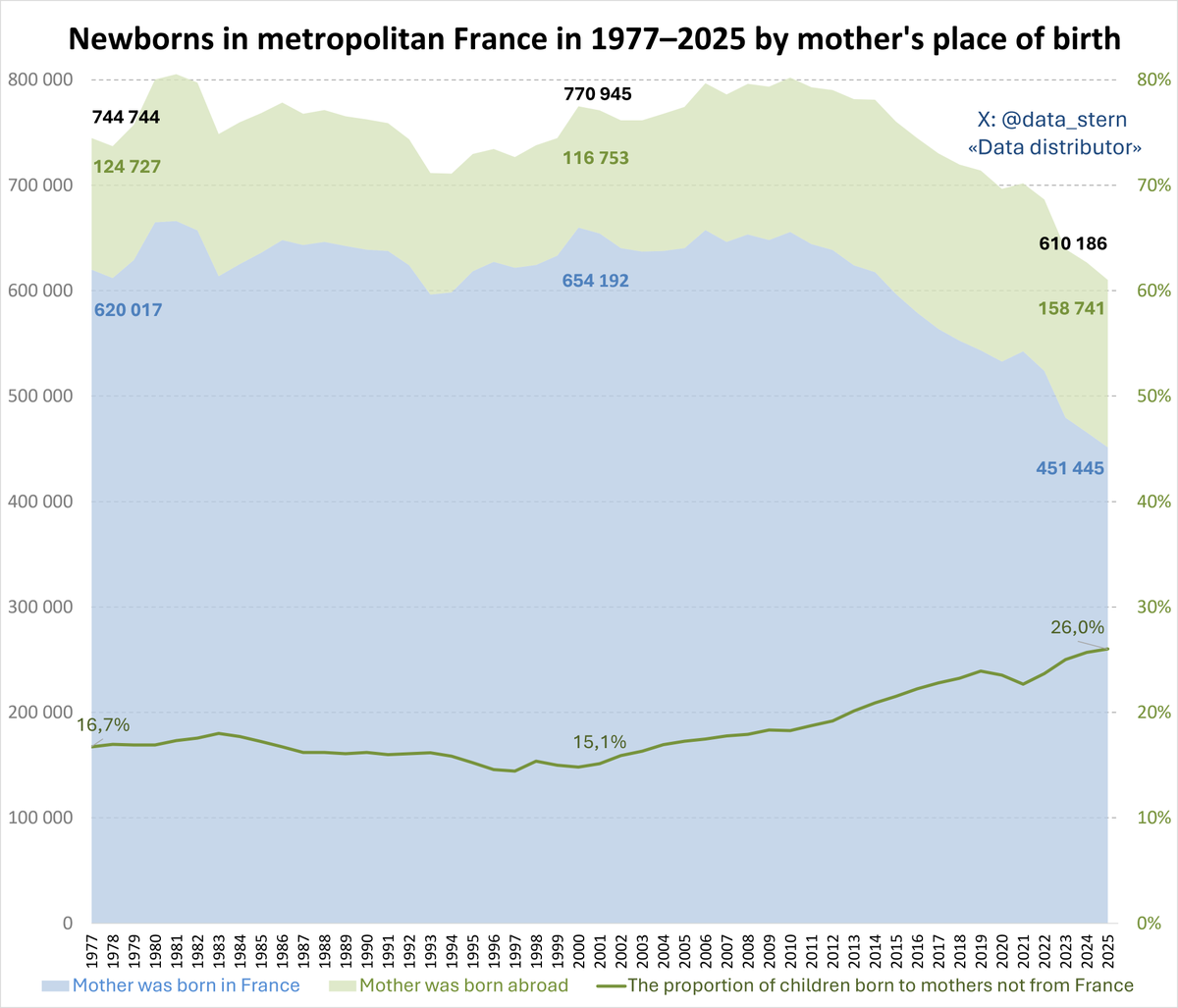
@jonatanpallesen Share in %? Own (very simple) calculations. Numbers? "T38BIS : Naissances vivantes selon le pays de naissance de la mère" dataset
Français
1
0
1
619
Data distributor
Data distributor@data_stern·
26% of babies in France in 2025 were born to mothers born outside the country (until the 2000s, this was no more than 18%.) When including the descendants of migrants, only 63% of births were to French women
Data distributor tweet media
English
15
27
232
12.7K
Data distributor
Data distributor@data_stern·
Thanks to the measures introduced, the Nizhny Novgorod Region has surpassed the Russian average birth rate for the first time in over 80 years—in less than a year, the increase was more than 11% or +0.14 children. The program includes a payment of 1 mln rubles ($15К) per child
Data distributor tweet media
English
2
5
52
2.9K
Data distributor
Data distributor@data_stern·
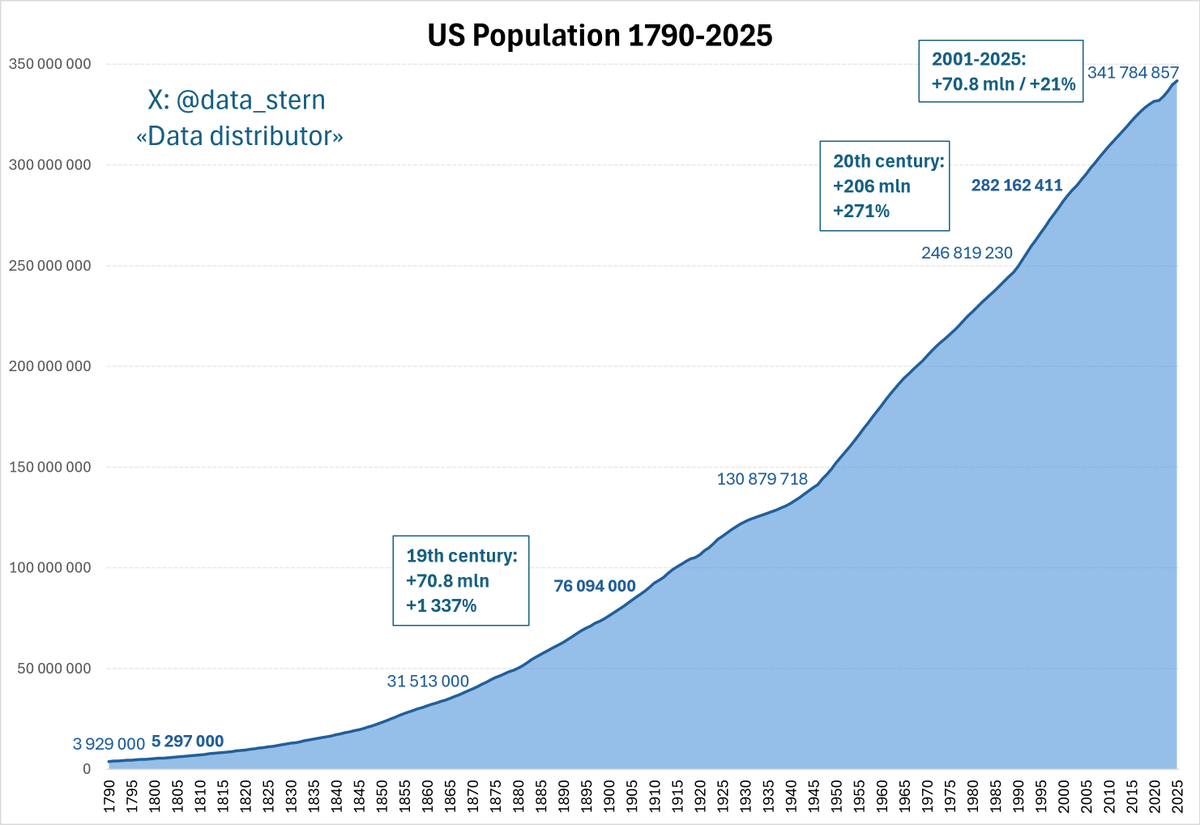
250 years of the US: from a 15-fold population growth in the 19th century to below-replacement TFR in the 1930s, then to a baby boom with an increase of 2.7 mln per year, and now—the countdown to the onset of depopulation
Data distributor tweet mediaData distributor tweet media
English
3
12
104
10.8K
Data distributor
Data distributor@data_stern·
During Soviet times,there were 2 newborns in Azerbaijan for every 1 born in Armenia. In 2013, a record was set:there were 4.13 babies born in Azerbaijan for every 1 born in Armenia. The ratio returned to 2.99:1 by the end of 2025 — still significantly higher than it was just 35ya
Data distributor tweet media
English
1
6
68
8.1K
Data distributor
Data distributor@data_stern·
The number of births in Azerbaijan is at its lowest since 1950. Azerbaijan reached its all-time high in births in 1991, at 190К. The TFR has decreased by more than 1.00 compared to 2012, dropping to 1.36 children by 2025—below the 1.374 in urban and secular Russia.
Data distributor tweet media
English
1
1
71
7.7K
Data distributor
Data distributor@data_stern·
Russian TFR yearly moving average declined to 1.347.If these trends continue Russia's fertility rate could fall to 1.212 children per woman by 2026—the lowest since 2000, the beginning of the 21st century. The demographic situation in the Russia is rapidly deteriorating
Data distributor tweet media
English
2
8
195
13.5K
Data distributor
Data distributor@data_stern·
100 ya the TFR of Korea was very high: 6.5+ children. Even during the Korean War natural increase maintained. From 1960 to 2023 the number of births in SK decreased from 1080k to 230k—x5 decrease. In 60 years the TFR decreased from 6.16 to 0.72
Data distributor tweet media
English
0
3
44
4.1K
Data distributor
Data distributor@data_stern·
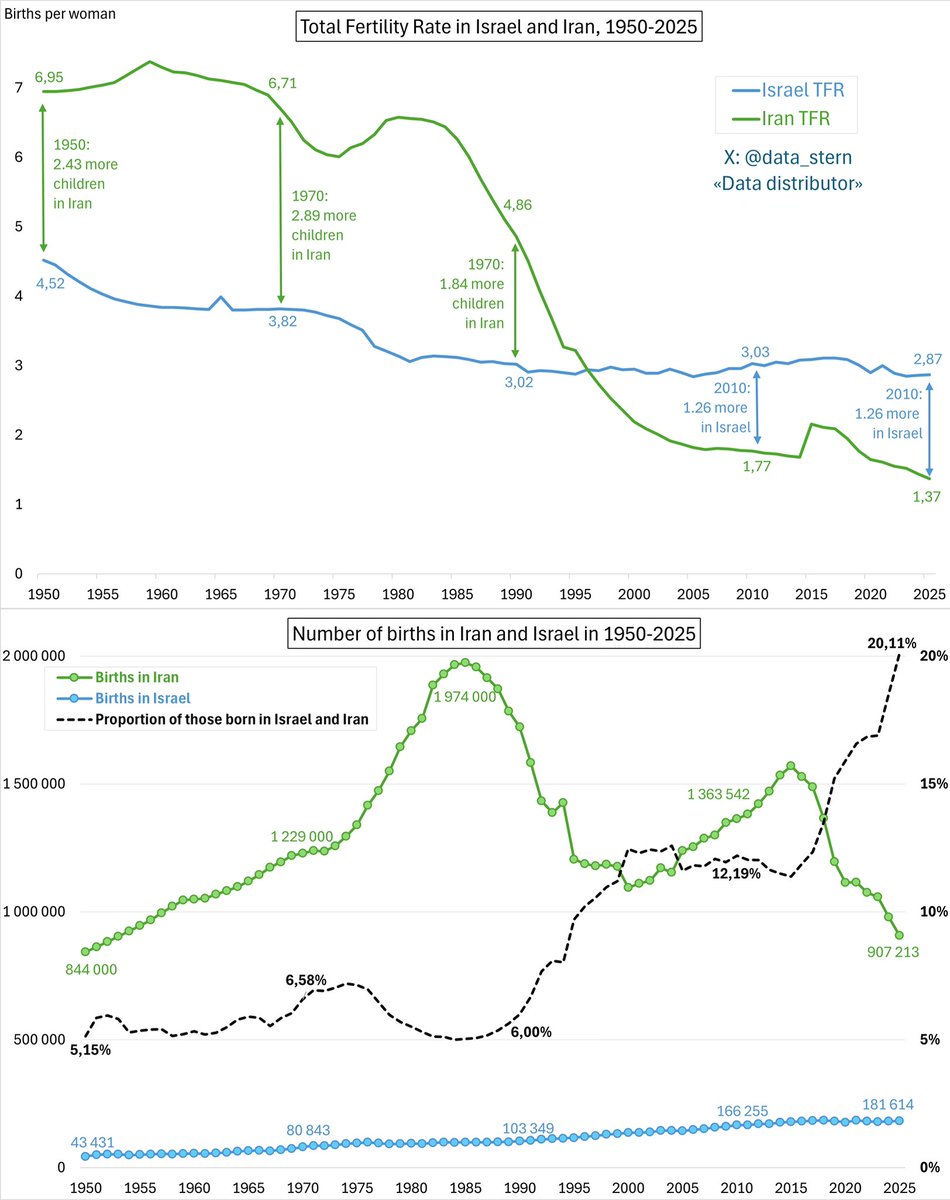
In 1950 Iran's TFR was 6.95 versus 4.52 with 88К births versus 43К.By 2025 the difference is in Israel's favor: the TFR is 2.87 versus 1.37 in Iran.The ratio has reached a multi-century high of 20.11%. By 2100 for the I time since Antiquity Israel will have as many births as Iran
Data distributor tweet media
English
4
11
90
5.9K
Data distributor
Data distributor@data_stern·
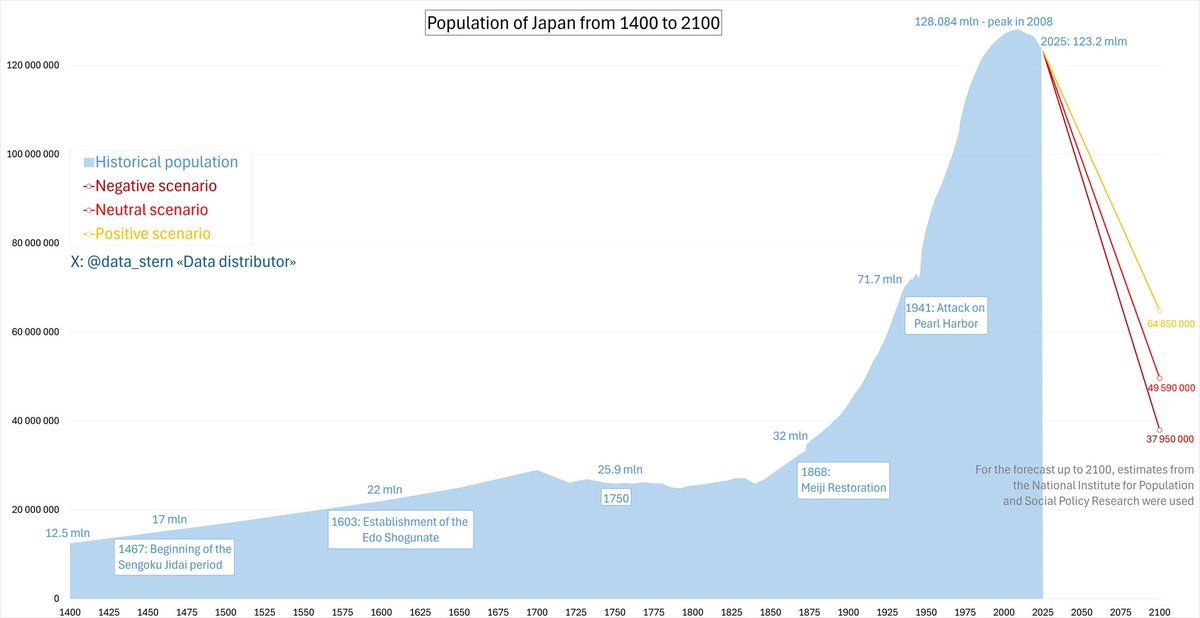
From 1700 to 1850,Japan's population stagnated. It then doubled between the Meiji Restoration and WWII, and then doubled again by 2008.Since then, the population has declined by 5 mln. However, assuming the low TFR likely persists, population will remain at only 37.95 mln by 2100
Data distributor tweet media
English
0
4
45
4.4K
Data distributor
Data distributor@data_stern·
The Jewish TFR in Israel is now 0.3 children higher than that of Muslims, compared to 2 children behind them 25ya. The Jewish share of the country's population will likely continue to grow.
Data distributor tweet media
English
17
32
377
29.3K
Data distributor
Data distributor@data_stern·
Over the 35 years of independence, Ukraine's natural population decline has amounted to 9.3 million people. Each year, more people died than were born. For every 1 born, 3 died, and many of them were born abroad. There is no hope for the country's functionality and sustainability
Data distributor tweet media
English
2
7
51
4.4K
Data distributor
Data distributor@data_stern·
The number of newborns in Russia has exceeded that of Ukraine by 7 times. For many decades, the ratio of Ukrainian to Russian newborns has remained stable, at around 2.5-3 to 1. Russia's long-term advantage in human resources is not only intact, it is rapidly growing
Data distributor tweet media
English
2
8
64
5.6K
Data distributor
Data distributor@data_stern·
The birth rate in Armenia is at its lowest since the 1940s. In 1960 the Armenian TFR was 4.63 per woman.The birth rate was more than twice what it is today (75K),the natural increase was 10 times higher (+62K).Within a few years, the country will enter a period of natural decline
Data distributor tweet media
English
2
12
88
10.1K
Artem Joyero Ucraniano 💍 🇦🇷🇺🇦🇮🇱🇬🇧🇫🇷🇪🇺
Russia has been falsifying demographic statistics since 2022. The real total family size (TFR) in 2025 is already below 1.1, and among ethnic Russians it has already fallen below 0.9. It's a catastrophe. This is why Putin is desperate with measures against child-free people, which only accelerate the collapse!
English
1
0
4
86
Birth Gauge
Birth Gauge@BirthGauge·
Decomposition of Russia's fertility rate into the number of children per mother and the total maternal rate. During Soviet times, the TMR (which is the average number of first children a woman has) hovered close to 1, indicating that childbearing was pretty universal and childlessness was extremely rare. Thus, the TFR moved pretty much in tandem with the number of children per mother. Already in the mid 1960s, Russian families on average consisted of only two children. After 1990, family sizes fell to one of the lowest values ever recorded (below 1.7, the same as in South Korea today and lower than in Hong Kong or Taiwan). The total maternal rate fell as well: to a value of 0.8 first children per woman, which was still comparably high. Around 2006, the number of chldren per mother started to climb to around 2.4 children now, which is a higher value than during the Soviet Union. Families in Russia today are indeed larger than during Soviet times! After 2016, the total maternal rate fell again to a value of 0.6 now, indicating a higher level of childlessness and a higher reluctance to start families.
Birth Gauge tweet media
English
12
24
248
25.5K