dataalways ⚡️🤖

2.8K posts

dataalways ⚡️🤖 banner
dataalways ⚡️🤖

dataalways ⚡️🤖

@dataalways

mev research @ flashbots

Katılım Temmuz 2013
400 Takip Edilen10.1K Takipçiler
Sabitlenmiş Tweet
dataalways ⚡️🤖
dataalways ⚡️🤖@dataalways·
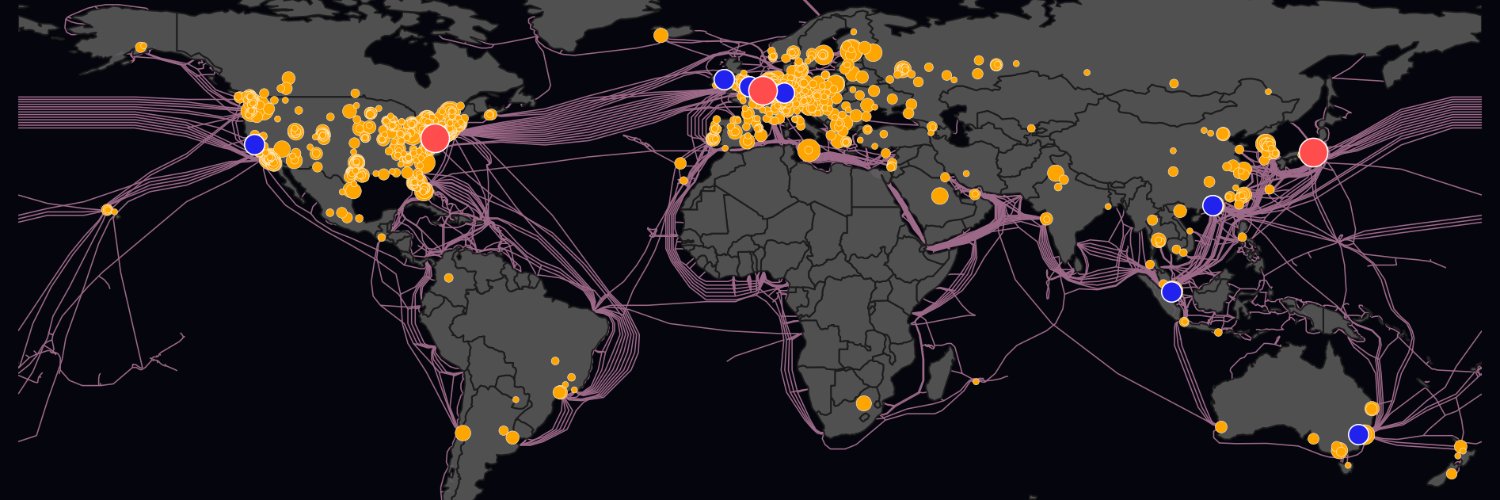
There's lots of debate over what market structure will look like with ePBS. I'm bullish trustless payments because a decentralized network shouldn't need to push 90% of blocks through three geographic chokepoints that just facilitate an offchain auction.
dataalways ⚡️🤖 tweet media
English
31
18
116
22.6K
dataalways ⚡️🤖
dataalways ⚡️🤖@dataalways·
@sajidazouarhi @nero_eth @0xQuintus if you guys want to collab we could look at our block building logs and better identify what is going / what types of mev carry over better v.s. disappear. also gauge if opportunities are disappearing v.s. being captured by the slot N-1 builder and hiding from public data
English
0
0
2
66
dataalways ⚡️🤖
dataalways ⚡️🤖@dataalways·
it definitely does happen to some extent, this disappearing mev is probably mostly trades that cex-dex searchers would have cancelled before the next block and lost money on. that said, most of our efforts are our minimizing LVR not maximizing it, so although it might be rational for validators to play timing games it is overall bad for defi and the network. also, you shouldn't consider this data reliable. at times searchers will dump transactions into the mempool (or to other builders) after a header has been selected; which will then find their way to other builders and inflate late block values if the order flow was previously exclusive to a single builder.
English
1
0
1
107
dataalways ⚡️🤖
dataalways ⚡️🤖@dataalways·
@binji_x MEV is just how to handle users competing to operate on the same state. There’s nothing inherently good or bad about it and there is no “fix” for it. Just a lot of complicated tradeoffs that work better/worse for different cases.
English
1
0
3
379
binji
binji@binji_x·
Please explain why MEV is good, what’s ONE good point about getting inexplicably bamboozled while doing a transaction? It’s like moving to London, getting your phone snatched, and then everyone celebrating the snatcher for being a chad. I thought this was a SAFE SPACE man.
English
44
2
123
19.1K
dataalways ⚡️🤖
dataalways ⚡️🤖@dataalways·
@0xYager @barnabemonnot imo this is mostly The Block sensationalizing the issue (definitely playing up the impact of short term non-finalization). I actually think that the report is relatively balanced.
English
1
0
2
36
Reid Yager
Reid Yager@0xYager·
Control is a very specific topic in policy. Consolidation among validators and stake or the cloud provider they use or even the hardware providers run themselves isn’t relevant to control — is it relevant to metrics a protocol grades itself on, to the day-to-day struggle protocol engineers have against and for decentralization — yes it is but it’s a debate very removed from policy and those that try to equate the two have mal incentives.
English
2
0
1
79
dataalways ⚡️🤖
dataalways ⚡️🤖@dataalways·
@liobaheimbach @stonecoldpat0 how do you adapt methodology to fcfs since blocks are basically an artifact in a continuous stream? even if it was happening, attacker ordering would be way harder so everything would be wide and attacks might even be in earlier blocks.
English
1
0
2
71
Lioba Heimbach
Lioba Heimbach@liobaheimbach·
@stonecoldpat0 Actually currently looking at this! Finding convincing no evidence of front running on Arbitrum. But are seeing it in other places where one might not expect it
English
3
0
2
161
Barnabé Monnot | barnabé.eth
Barnabé Monnot | barnabé.eth@barnabemonnot·
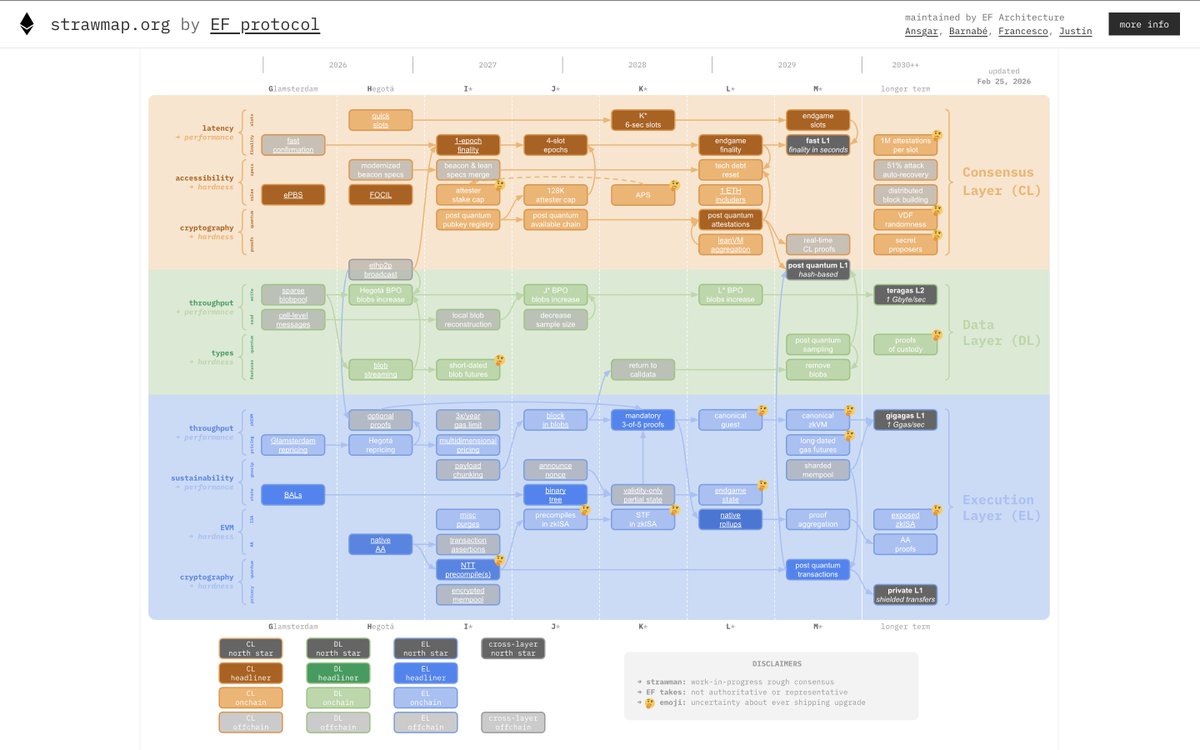
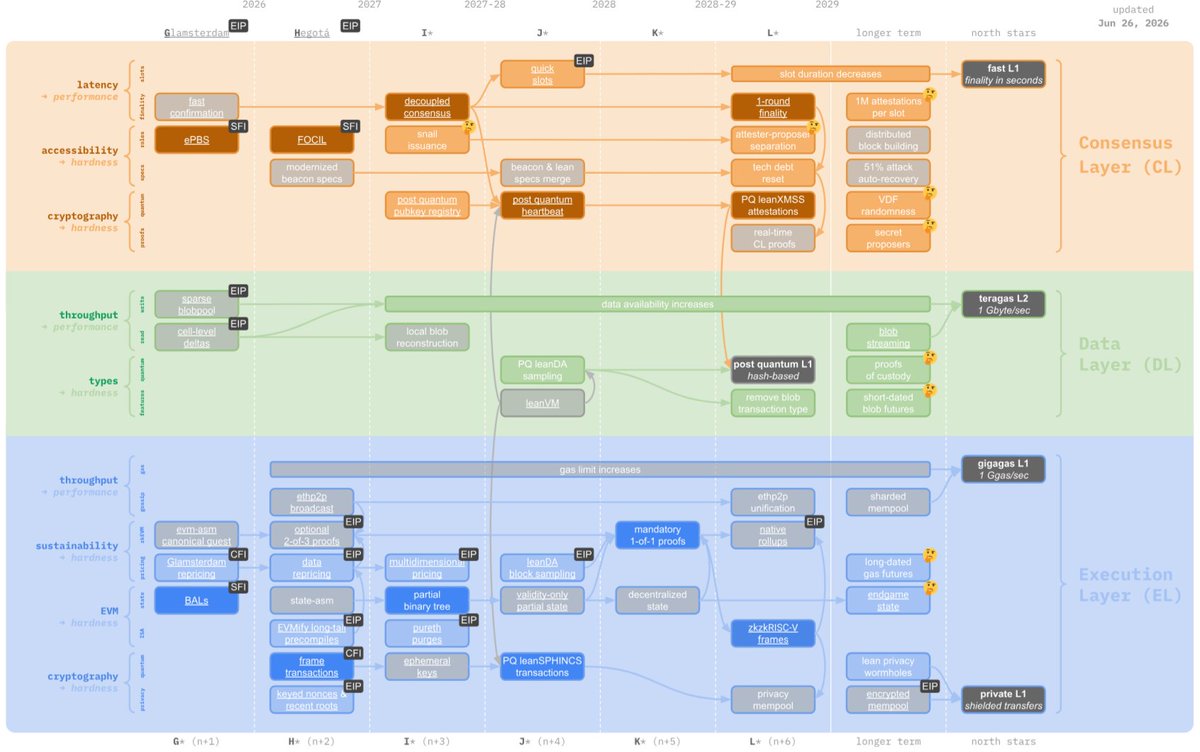
Comparing this updated strawmap with the original released four months ago in February. Some observations about the orange lane: - Quick slots pushed back from Hegota to J*, and further slot time reductions from K* to L*. - Decoupled consensus now slotted in for I*, this is very bullish! x.com/barnabemonnot/… - Removed "1 ETH includers" and "attester cap".. imo the two best upgrades to release pressure on the path to faster finality, lower issuance (if desired; note "snail issuance" now slotted in for I*) and better state provision guarantees. This is achieved by unbundling the includer role from the attester role, and expecting more from attesters rather than less, while includers fulfil the censorship-resistance role for the network.
Barnabé Monnot | barnabé.eth tweet mediaBarnabé Monnot | barnabé.eth tweet media
vitalik.eth@VitalikButerin

Two weeks ago, Ethereum researchers met in Berlin to continue charting the protocol's long-term trajectory, following along discussions with client teams in Svalbard in April. The updated strawmap is at strawmap.org, and I attached a picture of it to this post. My own high-level takeaways: * "Lean Ethereum" is not a single one-shot upgrade, it is a collection of improvements that will come online to the Ethereum network over the course of three or four years. But make no mistake, this IS the third major iteration of Ethereum in the same way that the Merge was the second. Almost every major piece of the protocol will be replaced: - Verification through recursive STARKs, rather than direct re-execution. Recursive STARKs become an enshrined first-class core component of the protocol - Replacing everything quantum-vulnerable with quantum-safe alternatives - Consensus: decoupled available chain and finality, one or two-round finality. Theoretically optimal security properties, simpler than today, and faster than today - Multidimensional gas - State: not just tree structure, but what *types* of state are available - Changes to client architecture ... At the same time, simplification, cleanup and future-proofing. And this will all be done in a way that minimizes disruption to existing application. We've done this before (the Merge), we can do it again. * H-star (aka Hegota) is probably Ethereum's last thematically "pre-Lean" fork. Starting from I-star, most of everything we do will have a very strong "Lean" feel to it in one way or another. * Privacy is no longer an afterthought, it is a first class goal. When designing Frames, the mempool, additions to the state tree, we explicitly ask the question "okay, how do quantum-safe, intermediary-free privacy protocol transactions go through this, and what is the overhead?" * Formal verification of everything for security. * FV also makes us much more comfortable with canonicalization (having pieces of the protocol that are directly defined as a piece of bytecode expressed in some language). evm-asm is being written in part to become a canonical proof system for the EVM. * Quantum safety has shifted up a LOT in priority. This adds a lot of work (eg. finalizing a quantum-safe blobs design has become urgent; this work has already been ongoing for months) * Probably the single most disruptive part of the plan is the changes to state. There is growing consensus around leaving present-day-style "dynamic state" mostly unchanged, but scaling it only a medium amount, and adding new types of state that are more scalability-friendly (eg. no need for builders to sync/store all of it) but more restrictive, and that will scale a large amount. eg. possible Ethereum in 2030: 2 TB of present-day-style (dynamic) state, and 100 TB of new-style (scalable but restrictive) state This "new-style" state would work very well for ERC20s, NFTs, many defi use cases, but not eg. highly "central" objects like Uniswap contracts, or onchain order books, or other complex things (which are crucial for Ethereum but which only take up a small percentage of state) Hence, it will not be *necessary* to rewrite any apps, but it will be *very cost-effective* to eg. rewrite an ERC20 token into a newer design that uses a new type of UTXO storage that is currently being explored, so that it will have >10x lower txfees. Design of these new state types (current ideas: keyed nonces, ring buffers, UTXOs, statically accessible state, temp state) is an area where we will need a lot of feedback from application developers (incl. privacy-friendly application developers) and probably several rounds of rethinking and iteration. * In the context of a much larger total state size, we need to figure out the incentive issues around who stores this state and what motivates them to. Even saying "each node stores 1%" is not good enough - why do they store that 1% and why are they willing to serve it? This is being elevated as a first-class research area. * Ethereum will need to have a "VM" other than EVM in one form or another - at the very least, we need something like leanISA for recursive STARKs - and the gains are large in exposing it to users so that we support programmable privacy and better scalability. Right now, the most likely contenders are leanISA and RISC-V. My own ideal is that in this world, we adjust the protocol so that the EVM becomes a high-level-language compiler-level feature, and the protocol only "sees" RISC-V / leanISA directly. But this is still far away. * Gas limit increases, blob increases and slot time decreases will happen many times over the next ~5 years. We expect a large gas limit increase with Glasterdam. Each step of increased scale or decreased slot time is a matter of getting to the point where it is safe to do it, which comes from a combination of client optimization and protocol changes. Ethereum is CROPS. Ethereum is scaling. Ethereum is reinventing itself. Onward.

English
11
15
127
12.1K
Mark (ethDreamer.eth)
Mark (ethDreamer.eth)@EthDreamer·
CLIENT DIVERSITY UPDATE Graffiti analysis from 272987 blocks: EL identified: 40.7%  |  CL identified: 42.9% EL Client Distribution:  go-ethereum          :   44.9%  Nethermind           :   36.0%  Besu                 :   17.4%  Reth                 :    1.5%  Ethrex               :    0.0%  Erigon               :    0.0% CL Client Distribution:  Lighthouse           :   43.9%  Teku                 :   26.4%  Prysm                :   22.7%  Nimbus               :    4.9%  Lodestar             :    1.5%  Grandine             :    0.6%
English
12
11
90
18.6K
storm
storm@notnotstorm·
@dataalways @ben_a_adams @christine_dkim before you lose a bunch of money you should check out the gas limit testing discord channel 100M is nearly already programmed to be ready post fusaka based on current benchmarks
English
2
0
3
279
Ben {chmark} Adams ⟠
Ben {chmark} Adams ⟠@ben_a_adams·
Am up for that🤝At least whether we can. I think we are going to surprise everyone; even those in the know 😉 ePBS + BAL + (moderate additional precompile repricing) --- Will need faster slots for sensible > 300M eqv; or blocksize caps will distort market Caveats: general opcode repricing (down); splitting blocks (faster slots), might make it 100M eqv; and delays from validator voting, can't do much about that x.com/tkstanczak/sta…
Ben {chmark} Adams ⟠ tweet media
Tomasz K. Stańczak@tkstanczak

@notnotstorm I feel that 300M can only come with zkVM, will see.

English
1
0
2
112
dataalways ⚡️🤖
dataalways ⚡️🤖@dataalways·
@zengjiajun_eth one of the brutal parts is that lowering base fees makes more and more trades profitable to sandwich. so in the limit where gas is free, every public swap gets front run and fills at its worst execution, regardless of slippage and size
English
1
0
3
411
jiajun.gwei
jiajun.gwei@zengjiajun_eth·
In case you still wondering why toxic MEV is one of the top priority of the EF execution roadmap. read this post (and learn Chinese).
jiajun.gwei tweet media
青十五@mev15_eth

这个事情是这样的,以Uniswap 的V2Router为例,调用swap的方法如下: function swapExactTokensForTokens(uint amountIn, uint amountOutMin, address[] calldata path, address to, uint deadline) 有一个amountOutMin,告诉调用者最低输出token会是多少。其他Router合约也类似。 但是在用户端,出于用户体验的考虑,各DEX和钱包都改成了预期输出token和滑点两个参数,同时出于下单转化率和竞争的考虑,把滑点和风险提示做得极其隐蔽。 (Uniswap自己甚至都缩到了右上角的按钮里,不点开根本不知道还有这些参数) 毕竟输出token量代表你这家DEX的流动性深度,你放一个最低输出token出来,用户不就跑到别家去了? 但这样一来,就造成了用户和三明治bot之间的理解偏差,用户认为你就应该给我预期输出token这么多;三明治bot认为,你既然已经提交了amountOutMin这个参数,那就是知情且可接受的,和预期的差额就是用来加速上链的,相当于Uber加价的小费(参考Jaredfromsubway的那篇访谈) 而造成理解偏差的DEX和钱包就美美隐身了,它的这部分锅都让三明治bot背了。 这是用户端,利润端也有同样的故事: 图3和图4是25360573块Jaredfromsubway的一次典型夹击,毛利润为0.000308748019040256 eth,但是成本就达到了0.000308850495682224 eth,甚至略高于毛利润,其中5%~10%是basefee,90%以上是贿赂,最终经Titan Builder去到了Lido那里。 Lido作为validator拿走了绝大部分收益,也同样美美隐身了,用户认为自己的全部损失都是三明治bot赚走了。 而甚至很多$stETH 的持有人也根本没有意识到,$stETH的stake收益相当一部分来自这些「肮脏的」、「不道德」的收入。 三明治bot一边要承担用户的所有怒火,另一边要支付DEX两道手续费(一买一卖,还是大额),毛利润99%以上还要给builder/validator交税/保护费。 操着卖白粉的心,赚卖白菜的钱,承担所有的骂名,我想这也是一直没有考虑去做三明治策略的第四个原因:把「道德」贱卖了

English
4
1
10
3.3K
dataalways ⚡️🤖 retweetledi
Ethlabs
Ethlabs@ethlabs_org·
Announcing Ethlabs: a non-profit R&D lab for Ethereum and ETH Our mission is to make Ethereum the settlement layer of the global economy. The internet became global because shared protocols created a common language between networks. Private systems remained useful, but bounded. Finance is approaching a similar moment. As value, assets, and markets become digital, the world needs shared settlement infrastructure. Ethereum is uniquely positioned to become that shared base layer, the neutral foundation on which users, institutions, and agents can transact without intermediation. What we believe: • We believe credible neutrality matters. Ten years of uptime and the lowest counterparty risk. Ground that cannot be pulled away by any one country, institution, company, or person. • We believe ETH matters. The most valuable, programmable store of value. A decade of broad distribution, deep liquidity in onchain markets, and maximally trustless asset on Ethereum. • We believe DeFi matters. Markets, liquidity, credit, exchange, and coordination, open to anyone. • We believe adoption matters. Principles do not change the world until people benefit from them. We sit between two worlds: real usage from the builders at the frontier, and the protocol that has to support it. We work with users, applications, wallets, L2s, infrastructure teams, institutions, ETH holders, core devs and researchers, then turn what they actually need into protocol work, shared standards, infrastructure, and shipped products. Ethlabs is independent but Ethereum is a shared project. We are one node in a much larger network of stewards. This is the multi-node future. We have spent the better part of the past decade contributing to Ethereum core research and development. We are opinionated and transparent. We move with urgency, learn in public, and course-correct when we’re wrong. We are building a lean, talent-dense team for people who want to do the most important work of their careers: join@ethlabs.org
English
536
1.1K
4.5K
1.8M
dataalways ⚡️🤖
dataalways ⚡️🤖@dataalways·
@AgentChud @tibolharicot flashloans need to be repaid in the same transaction to guarantee repayment. sandwich attacks usually require bots to buy a token, hold it while the victim buys, and then sell it, e.g. repaying two transactions later.
English
0
0
8
205
Agent Chud
Agent Chud@AgentChud·
Why the hell did Jared keep 15m on his automated bot? Absolute retardation
English
22
3
258
55.1K
dataalways ⚡️🤖
dataalways ⚡️🤖@dataalways·
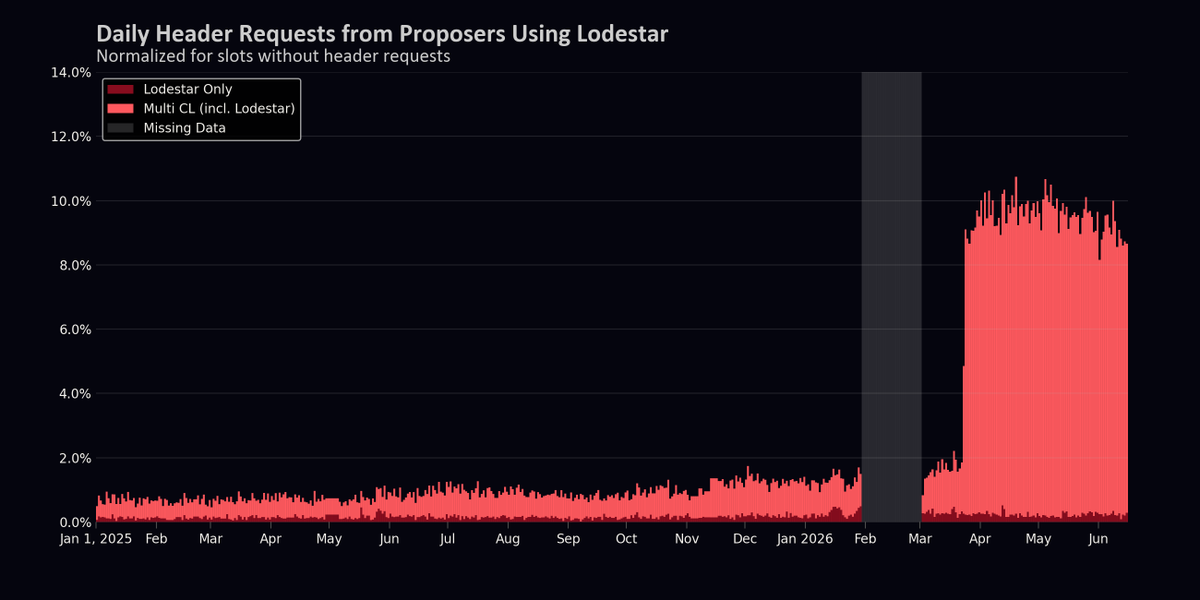
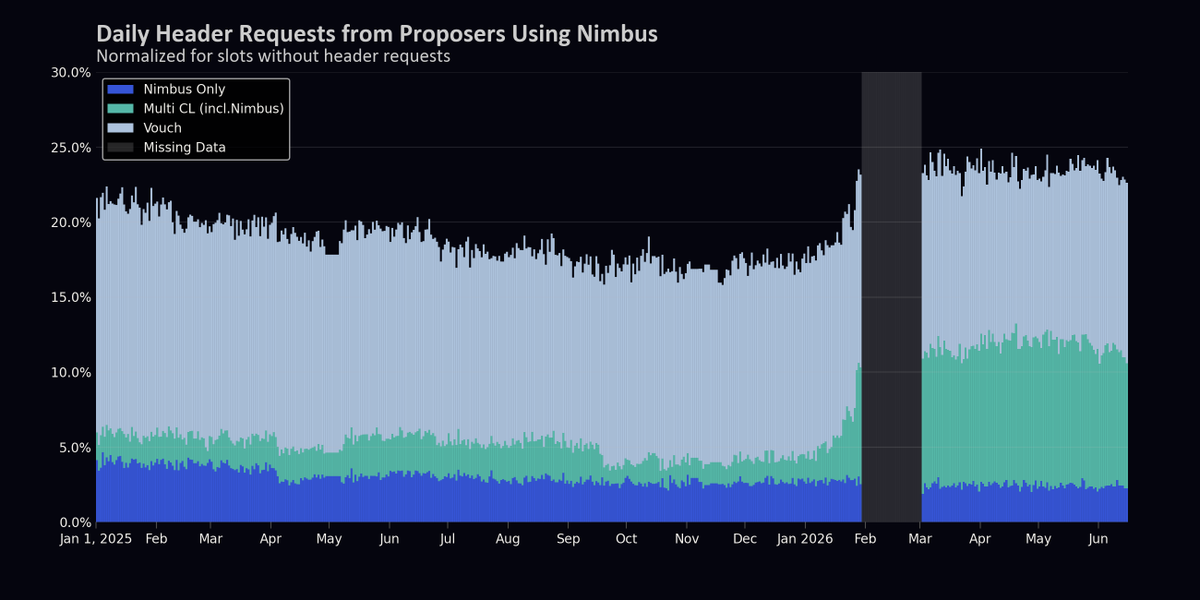
Nimbus and Lodestar have seen upticks in multi client setups. Lodestar usage jumped over 5x in one day earlier this year, probably from a single large proposer set adding it to their setup.
dataalways ⚡️🤖 tweet mediadataalways ⚡️🤖 tweet media
English
0
2
16
2K
dataalways ⚡️🤖
dataalways ⚡️🤖@dataalways·
Prysm continues to be downonly. Still the second biggest client, but incredibly distant to Lighthouse. It doesn't look like the outage/bug they had late last year caused a big exodus, mostly just long-term trending down.
dataalways ⚡️🤖 tweet media
English
1
0
8
747
dataalways ⚡️🤖
dataalways ⚡️🤖@dataalways·
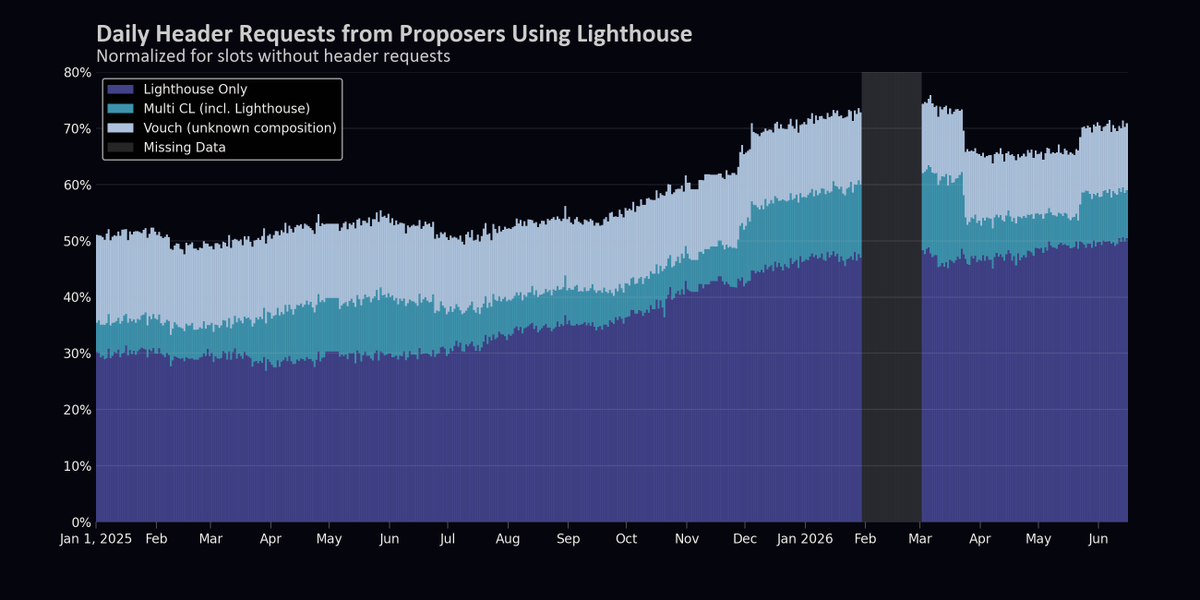
Long overdue CL diversity update: Lighthouse usage was steady for a while but seems to be increasing again the past couple months. Proposers using LH exclusively now account for ~50% of the slots we get requests in at Flashbots relay.
dataalways ⚡️🤖 tweet media
dataalways ⚡️🤖@dataalways

Lighthouse usage continues to climb. Proposers using the client exclusively make up about 47%, but almost all multi-client setups include it as well: about 57% of proposers use at least some Lighthouse. If we add in Vouch (unknown composition) this grows as high as 70%.

English
4
6
35
6.7K
dataalways ⚡️🤖
dataalways ⚡️🤖@dataalways·
@LefterisJP Also creates weird tax edge cases. You pay income tax on the grant, but if you already hold ETH, then in some countries, selling the grant also drags your ETH stack into the tax calculations and makes you pay more tax short-term.
English
1
0
6
618
Lefteris Karapetsas
Lefteris Karapetsas@LefterisJP·
Ethereum is a technology. It is not a cult. A grant is a payment of an invoice. A receivable of money that is meant to cover a portion of USD/EUR etc. denominated expenses. An invoice that is taxed at a given % with the $ value at time of receival. A few hours or days later having 10% less is insane. You not only have less money to do the thing you were tasked to do. You owe the exact same % on taxes, taxed on money you do not have. Grantees should not have to suffer those consequences. The grant sizes have already been reduced considerably as money is running out of the ecosystem. Asking grantees to submit to purity tests like being forced to be paid in ETH is simply idiotic.
EF Ecosystem Support Program@EF_ESP

Starting June 10, ETH will become the default payment method for all newly approved grants. 🦄 This brings our grant-making closer to the Ethereum ecosystem we support. This change applies to new applications submitted on or after June 10.

English
54
8
169
42.7K