Data For India

241 posts

Data For India banner
Data For India

Data For India

@dataforin

Insights, charts and data to create shared knowledge and expand our understanding of India.

India Katılım Ocak 2023
12 Takip Edilen8.9K Takipçiler
Data For India
Data For India@dataforin·
Global temperatures have been rising at a clear and measurable pace, with the past decade (2015–2025) being the warmest on record, and approximately 1.1°C warmer than pre-industrial levels (1850–1900). India’s warming mirrors this global trend, with the past decade (2015–2025) the hottest on record and 2024 standing out as the warmest year in over a century. In India, these trends carry direct implications for agriculture, water security, public health and energy demand. Data from the India Meteorological Department (IMD) shows that from 1901 to 2024, India’s mean temperature increased by approximately 0.9°C. This increase was relatively modest in the early decades, followed by more rapid warming from the 1990s onward. The warmest years in India’s 124-year temperature record are overwhelmingly concentrated in the recent period, with the highest mean temperature of 25.7°C recorded in 2024. Every fraction of a degree of warming matters. According to the Intergovernmental Panel on Climate Change (IPCC), each additional 0.1°C increases the intensity and frequency of heatwaves, rainfall extremes and droughts. What do India’s minimum and maximum temperatures look like across this 124-year period? Read @chatterjee_juhi's piece to find out: dataforindia.com/temperature-tr… #Temperature #Climate #Heat #India #DataForIndia
Data For India tweet media
English
1
1
13
402
Data For India
Data For India@dataforin·
Salaried workers are a minority in India's workforce, making up only 23% of workers. In contrast, more than half of the global workforce is in salaried employment. Labour statistics define salaried employment, or regular wage employment, as a working arrangement in which employees work in enterprises owned by others and are paid wages on a regular basis, generally by the same employer. As economies grow, the workforce tends to shift from agriculture to manufacturing and services. Alongside this shift, the share of salaried workers typically rises. Almost all jobs in advanced economies such as the United States and Japan are salaried jobs. While the share of salaried workers in India's workforce has grown only modestly over time, it is much higher in many emerging market economies than in India, and has also grown faster over time. This is true both in other lower-middle-income countries such as Bangladesh and in upper-middle-income countries such as China and Indonesia. What does the share of salaried workers in the workforce look like across different states in India? Read @akwaghmare’s piece to find out: dataforindia.com/salaried-jobs/… #Salary #Jobs #Work #India #DataForIndia
Data For India tweet media
English
4
12
72
2.5K
Data For India
Data For India@dataforin·
There has been a significant expansion in access to electricity across India. In 2000, only about 60% of India’s population had access to electricity. By 2021, this figure had risen to 99.6%. Despite this progress, access to electricity is not universal across all groups in India. Virtually all households in the highest wealth quintile have access to electricity, while about 1 in 5 (18%) of the poorest rural households did not have access to electricity as of 2021. Not just is access unequally distributed, but the consumption of electricity is also determined by household wealth. India’s Household Consumer Expenditure Survey (HCES) captures electricity consumption by recording the number of units (kWh) used by households over a 30-day reference period. On average, an Indian household consumes 97 kWh of electricity every month. This is enough to power five 60-watt incandescent light bulbs for about 10 hours each day, or to run one window air-conditioning unit for about two hours daily. However, the richest Indian households consume more than twice as much electricity on average as the poorest households. There is also a notable difference in electricity consumption between urban and rural households. Over half of urban households consume more than 100 units per month, whereas fewer than a quarter of rural households reach this level. How does access to electricity vary across different regions in India? Read @nileena_suresh 's piece to find out: dataforindia.com/access-to-elec… #Electricity #Power #Lighting #India #DataForIndia
Data For India tweet media
English
0
10
37
4.7K
Data For India
Data For India@dataforin·
With approximately 625 million workers, India represents the world's second-largest labour market. One important way to understand the labour market is by looking at unemployment rates. To measure unemployment, workers are asked how long they worked during the last year. A person who worked for at least 30 days in the preceding 365 days is considered employed, while a person who was looking for work or was available to work but did not work for at least 30 days is counted as unemployed. About 600 million Indians are currently employed, and roughly 20–25 million are unemployed. This puts India’s unemployment rate at 3.2% in 2023–24. In urban areas, the unemployment rate was higher, at 5.1%. But unemployment in India isn’t evenly distributed, and is higher among the better educated. While less than 1% of Indians educated only up to the primary level are unemployed, more than 13% of those with a graduate degree or higher are jobless. Female unemployment is significantly higher at this level. In low-income countries, skilled jobs may be scarce, and there may be a mismatch between skills and jobs. In addition, better-educated workers can often afford to stay unemployed for longer, and might hold out for a suitable job. How does unemployment vary across age groups in India? Read @akwaghmare 's work on employment to learn more: dataforindia.com/work-employmen… #Work #Employment #Unemployment #India #DataForIndia
Data For India tweet media
English
5
35
135
7.8K
Data For India
Data For India@dataforin·
The full extent of people's interactions with the law in India can be difficult to quantify. India’s National Crime Records Bureau publishes annual statistics on the number of offences registered each year under various criminal laws, as well as the share of these reported crimes that were sent to courts. However, this is an incomplete repository, and no analogous record exists for civil laws. To go beyond the limitations of police-recorded data, we use data from courts. For our analysis, we looked at all cases disposed of at the district level across every subordinate court in India, over a ten-year period. These cases before magistrates, civil judges, and district and sessions judges, are the first point of contact between Indians and the legal system. In all, we looked at 43 million records of legislation invoked in cases, the majority of which deal with criminal offences. Among criminal cases in the dataset, cheque-bouncing and rash-driving related offences dominate India's lower courts. Section 138 of the Negotiable Instrument Act is 'dishonour of cheque for insufficiency, etc., of funds in the account', or what is known as cheque-bouncing. It is punishable by an imprisonment for a period of up to two years and a fine of up to twice the amount of the cheque. At 2.8 million, Section 138 of NI Act is the single most common legal provision in this database; nearly a million more than the next most common provision, representing over 6% of the cases in the dataset. Section 279 (rash driving or riding on a public way) of the Indian Penal Code is the next most frequently invoked criminal offence. It accounts for 1.91 million records, or over 4% of the dataset. The Indian Penal Code (IPC) was the main criminal legislation in the country before it was replaced by Bharatiya Nyaya Sanhita (BNS) in 2024. What are the most commonly invoked civil laws in the dataset? Read Ameya Bokil and Apoorv Anand’s detailed analysis to find out: dataforindia.com/law-in-india/?… #CriminalLaw #Legal #Law #India #DataForIndia
Data For India tweet media
English
0
0
13
890
Data For India
Data For India@dataforin·
Childhood vaccinations are a cornerstone of India’s public health programme, playing an essential role in reducing infant mortality in the country. India provides free of cost immunisation against 12 vaccine-preventable diseases under its Universal Immunization Programme (UIP), including vaccines that prevent poliomyelitis, tuberculosis, rotavirus diarrhoea and measles. Vaccination coverage has improved sharply over time, especially in rural India. In 1993, fewer than one in three rural children were fully vaccinated. By 2021, this increased to over three in four children in both rural and urban India. Even among children who are not fully vaccinated, nearly all have received at least some vaccinations. 'Zero-dose children' is a term used as a measure of lack of access to routine immunisation services. It is defined by the World Health Organization (WHO) as children who have not received the first dose of the DPT vaccine, since this is included in most national immunisation programmes and is one of the first vaccines given across countries. The share of zero-dose children in India is now just 7%. How does India compare to other countries in its child immunisation efforts? Read @nileena_suresh's piece to find out: dataforindia.com/childhood-immu… #Immunisation #PublicHealth #Health #India #DataForIndia
Data For India tweet media
English
0
11
47
1.9K
Data For India
Data For India@dataforin·
India's roads host nearly 260 million two-wheelers and 50 million cars. This translates to 185 two-wheelers and 34 cars per 1,000 people. Globally, India has one of the lowest number of registered cars, but highest number of two-wheelers per 1,000 people. Advanced economies such as Germany and the UK generally have more cars relative to the population, as compared to two-wheelers. But emerging economies show both trends: South Africa and Brazil have more prevalence of cars, while India and Sri Lanka have a high prevalence of two-wheelers. However, these numbers don't tell the complete story, as some households may own multiple vehicles while others have none. The Household Consumption Expenditure Survey (HCES) conducted by India’s National Statistics Office provides a more accurate picture of vehicle ownership at the family level. More than half of Indian households own a motorcycle or scooter, while less than one in ten own a car or jeep, according to the 2023 survey. How does vehicle ownership look across different regions in India? Read @akwaghmare's piece to learn more: dataforindia.com/vehicle-owners… #TwoWheeler #Car #Vehicle #India #DataForIndia
Data For India tweet media
English
5
11
81
3.6K
Data For India
Data For India@dataforin·
Data For India was launched nearly two years ago to make India's data landscape more accessible, understandable, and useful. Since then, we have published 70 in-depth analyses featuring 329 interactive charts, and introduced "The Big Shift" — a weekly subscriber-only newsletter written by our founder, Rukmini S. Last year for the first time, we reached out to you — our readers — to understand your experience with Data For India. Today, we are excited to share the biggest update to Data For India since its launch: a significant redesign focused on making it easier than ever to discover, explore, and understand India through data. Read what’s new on the platform: dataforindia.com/redesign-annou… This milestone would not have been possible without the efforts of Gulshan, @pragnya_9 , Apoorv and @Rukmini from the Data For India team. Special thanks to our design partners Tibba Design Studio who helped bring this vision to life. And finally, thank you to you — our readers. Your curiosity and engagement with India's data continues to drive us forward. We would love to hear your thoughts on the redesign, and what you would like to see next. Write to us at info@dataforindia.com. Explore the redesigned Data For India platform: dataforindia.com/?utm_source=tw…
English
3
8
108
4.8K
Data For India
Data For India@dataforin·
One of independent India's most remarkable successes has been the vast improvement in its life expectancy. In 1950, a child born in India could expect to live only until the age of 41. By 2024, the life expectancy at birth in India had gone up to 72 years. Life expectancy is the average number of years a person would live if they were exposed to the sex- and age-specific death rates prevailing at that time. This data for India and other countries comes from the World Population Prospects, 2024 Revision, published by the United Nations Population Division. But if the life expectancy at birth in India is now 72, it doesn't mean that a 70-year-old today can only expect to live two more years. Life expectancy at birth is a crude measure, because it averages the death rates for all age groups in a population to produce an estimate of how long a child born in that year could live if the death rates remain unchanged. In India, as in most developing countries, mortality rates are high among infants and young children. As a result, life expectancy increases substantially once a person has successfully made it through early childhood. While life expectancy at birth in India is now 72 years, a 15-year-old today can expect to live to be nearly 75. An Indian who has already made it to age 65 can expect to live to be over 81. What does life expectancy look like in different regions across India? Read @Rukmini's analysis to find out: dataforindia.com/life-expectanc… #LifeExpectancy #Ageing #Population #India #DataForIndia
Data For India tweet media
English
4
20
129
10.4K
Data For India
Data For India@dataforin·
Six in ten workers in India are self-employed, making up the largest category of workers. India's labour statistics define the self-employed as persons who operate their own farm or non-farm enterprise, or are engaged independently in a profession or trade on their own, or with one or a few partners in household enterprises. Unlike salaried and casual workers, the self-employed are not paid  wages, but their earnings come from the profits of the enterprise. Self-employment is categorised into three types - own-account workers who run their own enterprise without employees, employers who run the enterprise by hiring paid employees, and unpaid helpers who work in a household enterprise for no wages. There is a stark difference between men and women in the way they are self-employed. Half of all self-employed women are unpaid helpers, who work for household enterprises owned typically by a family member, for no wages. Three out of four self-employed men, on the other hand, are own-account workers who run their own enterprises. Only 6% of the self-employed hire other paid workers, and this share is even lower among self-employed women. How has the share of self-employed women who are paid for their work changed over time? Read @akwaghmare’s piece to find out: dataforindia.com/self-employmen… #Employment #SelfEmployment #Work #India #DataForIndia
Data For India tweet media
English
2
12
50
1.8K
Data For India
Data For India@dataforin·
One of the most remarkable stories of change in India has been the successful effort to bring most children into schools. To understand how many children in a particular educational level are in school, we look at a measure called the enrolment ratio. The Gross Enrolment Ratio (GER) is the number of children enrolled in an education level relative to their population. Over time, the GER in India has risen across all education levels, but most substantially at the elementary level (Grades 1-8). At the primary level (Grades 1 to 5), India's gross enrolment ratio is now more than 100%. This is  a result of some underage or overage children being enrolled in primary classes. Even at the upper primary level (Grades 6-8), the gross enrolment ratio has reached 95% as of 2021. Beyond the overall growth in enrolment ratios lies yet another significant achievement - the closing of the gender gap in enrolment. In 1951, fewer than three in ten girls were enrolled at the primary level of education against six in ten for boys. At the upper primary level, girls were virtually absent - less than 5% were enrolled. This gap has now been closed; an equal or slightly higher proportion of female students as compared to male students are now enrolled at both stages. How does India’s GER compare to other countries across education levels? Read @akwaghmare's piece to find out: dataforindia.com/enrolment-in-e… #Enrolment #Education #HigherEducation #India #DataForIndia
Data For India tweet media
English
7
130
328
41.8K
Data For India
Data For India@dataforin·
Across the world, as incomes and access to education rise, women begin to marry and have children at a later age. While this change is taking place in India as well, it is relatively recent. The majority of births every year in India are still to women who are in their twenties. In comparison, most births in the United Kingdom, for example, are now to women in their thirties. Even then, the shift is apparent in India too. In the 1950s, the majority of births every year in India were to women in their early twenties. The largest share of annual births in India is now to women in their late twenties. These changes are taking place in the backdrop of one overarching long-term trend: fewer children born every year. As a result of falling fertility, the absolute number of children born every year in India began to fall at the turn of the millennium. This process is expected to only accelerate according to UN projections. What this will mean for the foreseeable future is fewer children born every year to mothers who are choosing to have them incrementally later in their lives. How has the age of women at their first and last childbirth changed in India over time? Read @Rukmini's analysis to find out: dataforindia.com/mother-age-chi… #Birth #Population #Fertility #India #DataForIndia
Data For India tweet media
English
3
27
151
6.5K
Data For India
Data For India@dataforin·
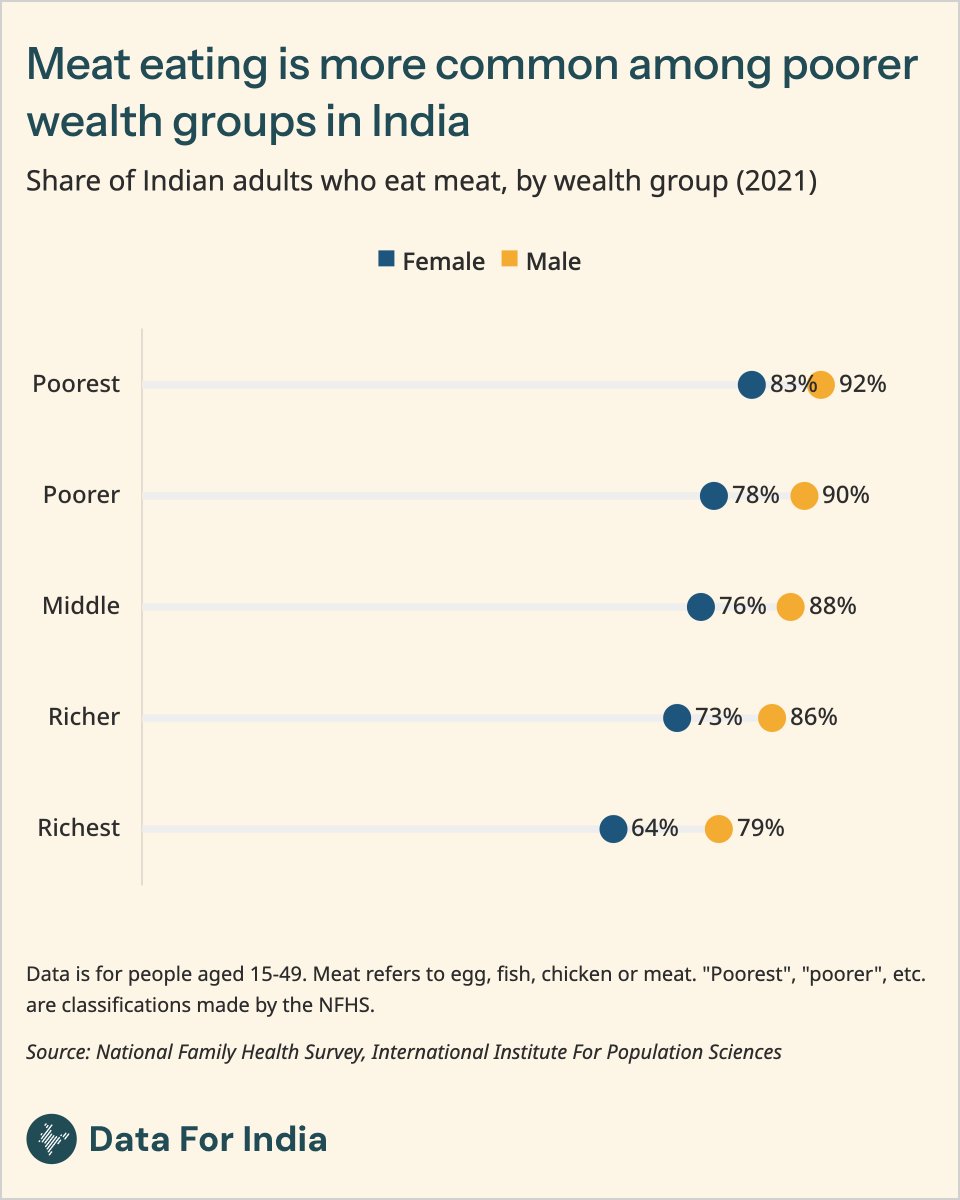
Dairy is a key source of nutrients, and plays a particularly important role in children's and women's health. Most Indians are regular consumers of dairy products (milk or curd). Half of adult Indians consume dairy products every day, while three out of four have them at least once a week. Only one in twenty Indians do not consume any dairy products. Data on dairy consumption comes from India's National Family Health Surveys, which ask a representative sample of the population about their food practices. India's National Nutritional Guidelines recommend that adults consume three servings of milk and dairy products of 100 ml each every day, or 300 ml of dairy in all every day. Dairy consumption in India is sharply affected by income, with consumption rising steadily by wealth group. Fewer than one in three of the poorest Indians consume dairy products daily, compared to two in three of the richest Indians. Consumption of dairy is also more common in the richer northern and southern states, and is lowest in the less developed eastern states of Odisha, Chhattisgarh, Jharkhand and West Bengal. How has expenditure on dairy changed over time for Indian households? Read @nileena_suresh's piece to find out: dataforindia.com/dairy-consumpt… #Dairy #Nutrition #Health #India #DataForIndia
Data For India tweet media
English
1
13
48
3.3K
Data For India
Data For India@dataforin·
Poverty lines help track and compare the levels of poverty in countries across the world. Since price levels for goods and services are different across countries, the World Bank expresses its poverty lines using a common currency that can be converted to national currency through what are known as purchasing power parities (PPPs). The resulting poverty lines from the World Bank are at three levels, each representative of median poverty in three different economic groups of countries. The median of the national poverty lines of low-income countries is known as the International Poverty Line, and it defines the threshold for extreme poverty for the world. In June 2025, it was set at spending of $3.00 per day per person in 2021 PPP terms. The median of the national poverty lines of lower-middle-income countries is the LMIC poverty line, set at $4.20 per day per person in 2021 PPP terms. Finally, there is the upper-middle-income (UMIC) poverty line at $8.30 per day per person in 2021 PPP terms. Since India is a lower-middle-income country, poverty estimates under the LMIC poverty line of $4.20 per day (2021 PPP) are considered more appropriate for the country. At the LMIC poverty line, 24% of India's population or nearly one in four Indians were poor in 2022. The LMIC poverty line corresponds to consumption expenditure of roughly ₹84 per person per day. How does poverty in India compare with other countries? Read @akwaghmare's piece to find out: dataforindia.com/world-bank-pov… #Poverty #Economy #WorldBank #India #DataForIndia
Data For India tweet media
English
2
27
99
3.1K
Data For India
Data For India@dataforin·
The quality of our homes is central to our health, comfort, safety and overall well-being. Six in ten Indian households lived in durable houses as of 2021. Another three in ten lived in partially durable houses. The remaining one in ten - or over 15 million families - still lived in non-durable homes. This data comes from India's National Family Health Survey, which asks the head of each household about the main material used for the walls, roof and floor of their current house. Each house is then classified into three categories: i) Houses where all three components are made of strong, long-lasting materials like concrete or burnt bricks are considered durable or pucca. ii) If at least one component is durable, the house is partially durable or semi-pucca. iii) If all components use non-durable materials like mud, bamboo, or unburnt bricks, the home is non-durable or kutcha. Among the three components, the floor is the biggest reason a home is classified as non-durable. Less than half of all rural homes are fully durable. In urban India, on the other hand, over eight in ten families now live in durable houses. How do housing conditions look across different regions in India? Read @nileena_suresh's analysis to find out: dataforindia.com/housing/?utm_s… #House #Housing #LivingConditions #India #DataForIndia
Data For India tweet media
English
0
12
54
2.3K
Data For India
Data For India@dataforin·
Access to mobile phones and the internet in India has expanded rapidly over the last decade. However, there is a gap in the technical skills needed to use these technologies effectively to communicate, learn and work. India is a signatory to the United Nations Sustainable Development Goals (SDGs), one of which is to substantially increase the proportion of young people and adults with information and communications technology (ICT) skills by 2030. The most common ICT skill among Indians is the ability to send messages, including via whatsapp, which more than half of all adults can do. In comparison, just half as many, or a quarter of adults, can send emails. Within India, the richer states with higher levels of education broadly have higher levels of ICT skills. One in three can send and receive emails in richer states like Gujarat, Kerala and Maharashtra. However, fewer than one in five have the same ICT skill in Odisha, Uttar Pradesh and West Bengal. The rural-urban gap in ICT skills is also significant, and increases with the relative difficulty level of the skill. There is also a significant gender gap, with men twice as likely as women to have most ICT skills. The Indian National Statistics Office's 2022-23 Comprehensive Annual Modular Survey (CAMS) collects this data on the prevalence of nine ICT skills listed in the SDGs. How do Indians across different states perform on the other eight ICT skills? Read @akwaghmare's piece to find out: dataforindia.com/ict-skills/?ut… #ICT #Technology #DigitalIndia #India #DataForIndia
Data For India tweet media
English
4
24
121
7.4K
Data For India
Data For India@dataforin·
Manufacturing is a key driver of India’s economy. Organised manufacturing that takes place mainly in factories accounts for 90% of the economic value created within manufacturing. As of 2023, India had around 200,000 operational factories, employing 18.5 million people. That’s nearly 30% of the manufacturing workforce and 3% of the total workforce. However, most factories in India do not hire a large number of workers. Nearly half of India's factories employ fewer than 20 workers, another quarter employ between 20-49 workers, and a little over one in ten factories have 50-99 people working. Over the last two decades, factory employment in India has more than doubled, and factories have grown slightly in terms of their headcount. In 2001, only one in ten factories employed more than 100 workers, but by 2023, one in five factories employed 100 or more workers. This data comes from the Annual Survey of Industries, conducted by India's National Statistics Office since 1960, and covers factories as defined by the Factories Act. What kind of employment do these factories offer, and what are the wages of factory employees? Read @akwaghmare's in-depth analysis to find out: dataforindia.com/factories/?utm… #Factories #Jobs #Manufacturing #Economy #India #DataForIndia
Data For India tweet media
English
3
77
404
14.2K
Data For India
Data For India@dataforin·
When a country's Total Fertility Rate (TFR) drops to 2.1, meaning that a woman is likely to have 2.1 children on average over her lifetime, demographers say that the country has reached 'replacement fertility'. This is a key milestone in a country's demographic journey, an indicator that the population will stop growing after some time, and will only replace itself. If fertility falls further below that level, the population will over time begin to decline in absolute numbers. India's fertility rate has dropped to 1.9 children per woman on average as of 2023. TFR in urban India reached this milestone much earlier in 2004. TFR in rural India is also estimated to have fallen below the replacement level as of 2023, the most recent year for which official Indian data is available. Across the south and west of India, TFR is now well below replacement level. Among Indian states, Kerala was the first to reach replacement fertility in 1988, when the national TFR was still 4. Tamil Nadu followed five years later in 1993, and then Andhra Pradesh in 2004. West Bengal in India's east is an outlier–despite being one of India's poorest states, it reached replacement fertility in 2005. These are among several Indian states that have been living with fertility rates that are as low as in parts of the developed world for several decades now. Maharashtra's fertility rate, for instance, is lower than that of Norway. Why is fertility falling across India, and what lies in the country’s future? Read @Rukmini's analysis to find out: dataforindia.com/fertility/?utm… #Fertility #Births #Population #India #DataForIndia
Data For India tweet media
English
28
118
552
32.7K