
Jero
3K posts


I do think this is important and probably should be talked about more openly for aspiring traders.
Steve Burns@SJosephBurns
Do you realize successful traders are all neurodivergent right? No normal person would be a trader.
English
Jero retweetledi

@Innerdevcrypto Is there any data that supports this? Have any studies been done, assuming it can even be measured? I can imagine there's some truth in that but is there any hard data?
English

Do not squander your energy & power thinking you have unlimited reserves
This may sound weird, but i will not become exceptionally old (unless some miracle therapies happen in science or longevity)
I already knew this since the day i met a very good Chinese acupunturist who told me ¨you basically burnt off half your life-force and you are only 24¨. Not strange, since in the 10 years before that i went through running a semi-marathon every day to be able to sleep, a super intense burn-out, horrible depression, total energy depletion, porn & masturbation addiction, plus a struggle for enlightenment.
Very very intense. 10 years alone on the mountain after that made me recover most of my strength, and i have since then managed to save as much of my remaining life-force as possible, while drastically reducing my ejaculation frequency to boost kidney energy and jing/essence (linked to longevity), but still, energy-wise, what is gone is gone, and this is why so many longevity experts will fail. They do not understand that true longevity is linked to one´s energy levels, especially chi (energy), and jing (sexual energy/essence). If interested in this, study taoism or Chinese medicine.
I have my peace with it though, it was worth it, pushing the limit so far, especially on the inner front. Also doing some special meditations to slowly increase my level of essence/jing again, but these are advanced meditations which are not easy to learn. If interested, look into the lesser, greater, greates kan & li meditations in the universal healing tao system
My remaining many years will be in peace on this planet, but do not squander your energy and forces thinking there is no limit, because there are serious consequences to depleting your power too fast
English
Really tired of people sharing their trade setup only when price is already going in their desired direction. Even in the MT community this is way too common. Even proof of execution is quite meaningless if the trade setups including the SL are only shared when the move is already playing out. Somehow it works and retards fall for it.
English

No before/after charts.
- If so, never a pre placed stop loss.
No proof of execution in addition.
But a recycled conceptual model that is easy to twist in hindsight. Many useless confirmations to rely on, but beneficial for hindsight larping.
“Buy my course - join the group”
- Selling >$100 price ticket.
These guys do NOT trade/invest.
They don’t even know how to.
They market themselves.
It’s so easy to unethically marathon a profitable trading business. Most players do it this way and it ruins the industry.
English
@Ancient8Wisdom @TraderDune sure, but then it doesn't matter what asset you're trading
English

@dataisgold8 @TraderDune Except if the whole platform goes down. Remember FTX?
English
If it gets worse, you'll want to care about the tech you're perp trading. Trading a random chart because it looks good, could suddenly turn into a Luna situation where order books freeze > trading halts > position or even portfolio fully liquidated.
These risk rules should always imply, but I know most have trading egos around here waiting to get humbled. Your leverage collateral is always @ risk, not just your stop loss size.
English
Jero retweetledi

For decades, the American political system has sustained itself on a single operating fiction:
that elections matter.
The left believed that electing the right Democrats would produce social progress, expand protections, and hold corporate power accountable.
The right believed that electing the right Republicans would restore traditional values, secure borders, and rebuild American economic strength.
The MAGA movement believed, with particular intensity, that Donald Trump represented a genuine rupture from the establishment, a wrecking ball sent to destroy the machinery of elite capture and return power to ordinary Americans.
All three groups are starting to converge on the same conclusion, arriving from different directions but landing in the same place.
The left watched Biden continue Trump's immigration enforcement architecture, expand military spending, and deliver nothing resembling the transformative social investment his campaign promised. They watched the Democratic establishment crush its own progressive wing with more energy than it ever directed at Republican obstruction. They are beginning to understand that the party exists to absorb and neutralize progressive energy, not to act on it.
The right watched two decades of Republican governance produce no meaningful reduction in the size of government, no reversal of cultural trends they oppose, and no restoration of the economic conditions they remember.
Every Republican president expanded the deficit. Every Republican Congress funded the wars. Every conservative Supreme Court majority failed to produce the cultural restoration that was promised. The institutions captured the revolutionaries, not the other way around.
And the MAGA base is now watching Trump, their chosen instrument of disruption, fill his administration with the same Goldman Sachs alumni, the same defense contractor lobbyists, the same private equity figures who populated every administration before him. They watched Jared Kushner collect two billion dollars from Saudi Arabia's sovereign wealth fund while generating zero return on investment, because the investment was never commercial.
It was blackmail.
They are watching tariffs that were sold as protection for American workers function instead as leverage for renegotiating the terms under which global capital accesses American markets, terms that benefit the negotiators and their financial networks, not the factory workers in Ohio who were promised their jobs back.
The convergence is not ideological.
These three groups do not agree on policy, on values, or on what America should become. What they are converging on is a structural recognition:
the electoral system is a selection mechanism for which faction of private sector power gets to operate the state apparatus for the next four years.
The policies that affect their lives, the ones that determine whether wages rise or fall, whether housing is affordable or financialized into an asset class, whether healthcare is accessible or remains a debt generation mechanism, those policies do not change with administrations because they are not set by administrations.
They are set by the capital interests that captured the state, and those interests are continuous across every presidency, every Congress, and every judicial appointment of the last forty years.
This is not cynicism. It is a structural observation that can be verified by anyone willing to look at outcomes rather than rhetoric.
Track what actually happens to wages, to household debt, to incarceration rates, to healthcare costs, to infrastructure quality, to wealth concentration, across administrations of both parties.
The trajectory is identical. It does not matter who sits in the Oval Office. The operating system runs the same code regardless of which user interface is installed on top of it.
That is what state capture means. The state has been captured by business, and business has been captured by the financiers, and the financiers are captured by zero-sum game theory; no national loyalty, no ideological commitment, and no obligation to the population of any country.
They optimize for return.
When America provided the best return, they invested in America.
That calculation has changed.
With a categorical decision.
The financial industrial complex has made the decision that most Americans have not yet absorbed, a decision that was not announced, was not debated, and will never be acknowledged publicly, but which is visible in every data point that matters. They have concluded that the United States, as a platform for capital growth, has passed its peak utility.
This is not speculation. It is observable in the movement of capital itself.
Between 2021 and 2024, venture capital investment in India crossed thirty billion dollars. Microsoft committed over two billion dollars to data center expansion in Japan and pledged more than a billion to build AI infrastructure in Kenya and East Africa.
Google established its first cloud computing region in Africa in 2022. Amazon Web Services began building data centers across Nigeria, Kenya, and South Africa. BlackRock's leadership has stated publicly that the firm is transitioning its investment thesis toward emerging markets and the Global South.
These are not experiments.
These are exits.
The logic is not complicated.
The United States has a fertility rate of 1.62, below the replacement level of 2.1, and falling.
Its infrastructure earned a C minus rating from the American Society of Civil Engineers.
Its education system ranks 38th globally in mathematics.
It lost five million manufacturing jobs between 2000 and 2015, and those jobs are not coming back because they were sent away deliberately, not lost accidentally.
Its political system cannot pass basic legislation. Its social cohesion has fractured along every available fault line: racial, generational, geographic, economic, cultural.
Its consumer base is sustained not by income but by credit, which means not by wealth but by debt, which means the consumption that drives the economy is itself a form of extraction from the population.
Compare that to what the Global South offers.
Nigeria's population will double by 2050. India's median age is 28. Sub-Saharan Africa's population will exceed China and Europe combined within thirty years.
Indonesia, Pakistan, Bangladesh, Egypt, and Ethiopia represent billions of consumers who have not yet been fully integrated into the global financial system.
The labor is cheaper, the markets are growing, the regulatory environments are more accommodating, and the demographic trajectory guarantees decades of expansion.
For capital that optimizes on a fifty-year horizon, the calculation is obvious. The future is not in a country whose population is aging, indebted, divided, and shrinking.
The future is where the people are.
The categorical decision is not to destroy the United States. Destruction is unnecessary and counterproductive. The decision is to phase it out as the central hub of capital accumulation and to reposition toward new centers of gravity.
The state apparatus will continue to be useful, its military still projects power, its financial system still clears the majority of global transactions, its technology sector still produces valuable intellectual property. But the investment thesis has shifted. What was once the engine is becoming the legacy asset.
What was once the growth market is becoming the managed decline.
To understand what this means for ordinary Americans, you have to understand how the wealth distribution system actually works, not the way economics textbooks describe it, but the way it functions in practice.
The financialized capital that sits at the top of the American economic hierarchy does not distribute wealth downward through wages and investment in domestic productivity. It distributes wealth downward through the complexes: the Military-Industrial Complex, the Technology-Industrial Complex, the Consumer-Industrial Complex, and the Financial-Industrial Complex itself.
These complexes are the transmission mechanisms through which capital spending reaches the broader population. Defense contracts employ engineers and factory workers. Technology companies employ programmers and support staff. Consumer platforms employ warehouse workers and drivers. Financial institutions employ analysts and administrators. The wealth does not trickle down through generosity. It trickles down through the operational needs of the complexes that serve the capital class.
That's how the wealth distribution ACTUALLY works in America.
When those complexes redirect their operations outward, the trickle dries up.
The Technology-Industrial Complex is already well into this transition. The next generation of data centers, AI research facilities, and cloud infrastructure is being built in India, Kenya, Japan, and Southeast Asia.
The jobs that would have gone to American workers, the construction contracts, the maintenance positions, the technical roles, are going to workers in countries where the growth is happening. Silicon Valley will retain its headquarters functions and its highest-value roles, but the mass employment that technology expansion generates will increasingly occur elsewhere.
The Military-Industrial Complex is pivoting in two directions simultaneously. Internationally, it is converting NATO from a US-subsidized security alliance into a customer base.
Trump's pressure on European members to increase defense spending to three or four percent of GDP is not about burden-sharing.
It is about market creation.
European nations will buy American weapons systems through American-approved procurement channels, generating revenue for Raytheon, Lockheed Martin, and Northrop Grumman without the American taxpayer bearing the cost.
The military-industrial complex gets its returns from European budgets instead of American ones.
The Consumer-Industrial Complex is following the consumers. When the next billion customers are in Lagos and Jakarta and New Delhi, the investment in retail infrastructure, logistics networks, marketing systems, and consumer credit platforms follows them there.
American consumers, already stretched to their limit on credit, are a declining market.
Their spending power is artificial, sustained by debt rather than income, and debt-sustained consumption is inherently self-limiting because each dollar of spending generates a future dollar of repayment that reduces future spending capacity.
The consumer complex will continue to extract from American consumers through subscription models, planned obsolescence, and financialized purchasing (buy-now-pay-later for groceries is the clearest signal of where this trajectory ends), but the growth investment, the new stores, the new platforms, the new logistics networks, will be built where the demographic growth is.
The Financial-Industrial Complex, the apex of the entire structure, is already globally positioned by design. It has never been nationally loyal. Its assets are distributed across jurisdictions, its instruments are denominated in multiple currencies, and its optimization is borderless.
The shift is not that the financial complex is leaving America.
It is that the financial complex is reducing the share of its attention and capital that flows through American channels.
That reduced volume means reduced fees, reduced intermediation revenue, reduced employment in the American financial sector, and reduced tax revenue for American municipalities that depend on financial sector activity.
The combined effect is a progressive hollowing out of the economic foundation that sustains American daily life. Not a dramatic collapse. Not a single catastrophic event. A slow, grinding contraction of opportunity, services, and stability that has already been underway for years and will accelerate.
The jobs that remain will increasingly be concentrated in two categories.
At the top, a shrinking pool of high-value positions in technology, finance, and management that serve the global operations of the complexes. These jobs will pay well and will be concentrated in a handful of metropolitan areas.
At the bottom, a vast and growing pool of service, logistics, enforcement, and gig-economy positions that pay subsistence wages and offer no security, no benefits, and no path to advancement.
The middle, the manufacturing jobs, the stable white-collar careers, the small business ownership that once defined American economic life, will cease to exist.
The factories are in Asia. The growth markets are in the Global South.
The capital has moved on.
Public services will continue to degrade. This is not a prediction. It is already happening. When the tax base contracts because capital and high-income earners optimize across jurisdictions, the revenue that funds schools, roads, water systems, and public safety declines.
The response, visible in every post-industrial American city, is not to raise taxes on the capital that left but to cut services for the population that stayed, and then to financialize the gap.
Public water systems are privatized.
Public education is replaced by charter networks.
Public transportation is replaced by ride-sharing platforms.
Public safety is supplemented by private security.
In each case, what was once a public good funded by collective taxation becomes a private service funded by individual payment, and the people who cannot pay simply go without.
This is structural adjustment.
It is the same program that the IMF imposed on Global South nations throughout the 1980s and 1990s, now arriving in the country that designed it.
Healthcare will remain financialized.
The American healthcare system does not exist to make people healthy. It exists to generate revenue for insurance companies, pharmaceutical manufacturers, hospital networks, and medical device firms.
That revenue model does not require a healthy population. It requires a population that is sick enough to need treatment, insured enough to pay for it (or indebted enough to be billed for it), and politically powerless enough to be unable to change the system.
As the complexes redirect outward and the domestic economy contracts, the population will become sicker (stress, poverty, environmental degradation, reduced access to nutrition) while the healthcare system becomes more expensive. This is not a bug in the system. It is the system operating as designed.
Housing will remain an asset class. The financialization of housing, the process by which homes were converted from places to live into investment vehicles for institutional capital, is irreversible within the current structure.
BlackRock, Vanguard, and institutional investors now own significant portions of the American single-family housing stock. Their business model requires housing prices to rise, which requires housing to remain unaffordable for a growing share of the population, which requires a growing share of the population to rent rather than own, which generates perpetual cash flow for the institutional owners.
The population pays an increasing share of its declining income in rent, enriching the same institutional capital that is simultaneously redirecting its growth investment elsewhere. The citizen becomes a revenue source for capital that no longer invests in the citizen's country.
The convergence of disillusionment described at the beginning of this post will intensify. As the structural reality becomes more visible, the population will increasingly recognize that the electoral system offers no mechanism for changing the trajectory. This recognition produces one of three responses.
The first is paralysis. A significant portion of the population will disengage entirely from political participation, concluding that the system cannot be changed from within and that resistance is futile. This outcome serves the capital class because a disengaged population does not organize, does not protest, and does not interfere with the extraction process.
The second is misdirection. Another significant portion will be channeled into reactive political movements that direct anger at visible but structurally powerless targets: immigrants, racial minorities, cultural opponents, foreign governments. This misdirection is actively cultivated because it prevents the population from identifying the actual source of their declining conditions.
Every dollar of political energy spent fighting the culture war is a dollar not spent examining the balance sheets of the institutions that own the country.
The third is organization. A smaller but potentially consequential portion of the population will recognize that the only response to structural abandonment by the capital class is structural self-sufficiency: community-based economic systems, mutual aid networks, cooperative housing, parallel education, local food production, and the gradual construction of institutions that serve the population rather than extracting from it.
It's possible. But very hard.
Understand that it's nothing personal.
This is the path that colonized populations throughout the Global South have walked for generations. It is now the path available to the American population, or more precisely, to the portions of the American population willing to build rather than to rage.
The capital class is indifferent to which of these three responses predominates. Paralysis, misdirection, and organization all produce acceptable outcomes from their perspective, as long as none of them generates sufficient organized economic pressure to make injustice unprofitable.
That's the only language they understand.
Profit and loss.
English
Guys,
I’m starting a Patreon soon.
Deeper explanations, education, direct engagement, group chat, and member-requested topics will happen there.
I’ll keep posting here, but I won’t be doing full breakdowns or engaging in the replies.
There will be two tiers. One on geopolitics with the other finance- focused. Both permanently capped at limited spots.
I chose Patreon over Substack because Substack forces a $5 minimum.
The prices will be minuscule by design.
This isn’t my bread and butter.
But I have learned in here that geopolitics is the one field where everyone thinks they’re an expert. That creates endless noise and kills quality.
Paying a token amount means you will take the membership seriously, think critically, and engage thoughtfully. It keeps the riff-raff out and lets me focus on real depth.
Your critically thought out questions and opinions, help me refine and expand what I know.
That’s the real exchange I’m looking for.
And I don’t find it here.
I will update in the coming weeks.
English
Jero retweetledi
God his early posts were magic.
This post is the entire formula. Two years ago I didn’t understand a word. Now I look at it like a check list. ✅
🎯 Master@Moneytaur_
Trade less > Earn more. More trades doesn't mean more money. It means exposing yourself to more risk. Learn to find major key-reversal levels by reading where whales buy/sell, master fibs as algorithms use them, understand liquidity and that it acts as "fuel" on the markets, master ranges and avoid trading mid-range (if you want higher % probability to succeed), understand fair-value-gaps (the proper way), learn to identify breaks of market structure (especially on HTF's), learn to identify H&S and Three Drives Pattern... Success in Trading is hard-work and Mindset + you really must think outside the box, because the real understanding of this game will show you what our world actually is, and it's not pretty, but we must accept, adapt, and not fall on the traps the elites place in every corner 🤝
English
@Moneytaur_ This downtrend has been a blast to trade. And if the market goes higher from here spot will print. Feels so good to be in a position to make money regardless of what the market does. Ty for showing the way 🙏
English

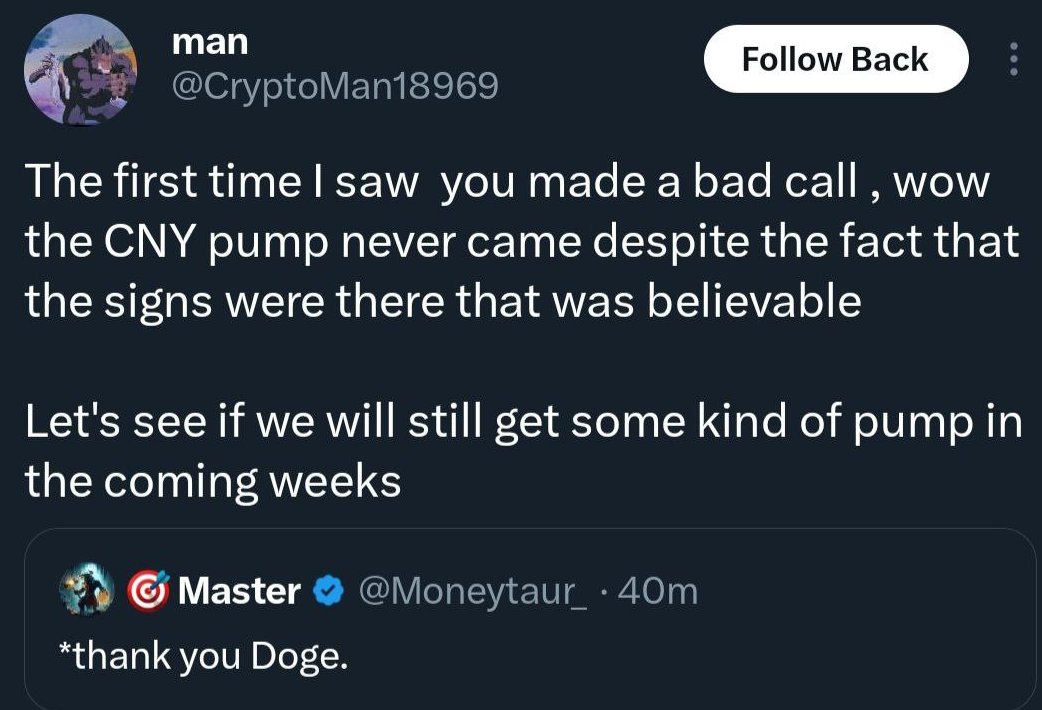
The difference between my 'bad call' and most influencers bad calls is simple: No one lost $ because of it, unless they ignored PA and decided to gamble with dates and high leverage.
If anything, many are in small % profit simply from buying when i said I was buying. A 'small' % profit can mean $10 for some, $10,000 for others, or $100,000 for those who size properly. The reality is that there's a huge difference between small players and bigger capital. Someone with a $100 position won't care about a 20–50% move, which is precisely why many remain stuck losing. Who had the size and 'balls' to buy aggressively during the latest HTF low are in good $ profits as of today. The ones who didn't are impatient and asking why there was no 'moonshot' yet.
So far we may have seen an HTF local bottom during CNY, which i'll take any day over nonstop bleeding into the 40s or lower. At the end of CNY, Bitcoin pumped $8,000 within a day. I said upside, not a moonshot, and not a fixed percentage.
Did i expect more upside during CNY?
- Yes, but welcome to financial markets. Sometimes things move a day later, or a week later. Sometimes they move a lot less than most people want, because markets rarely donate $ to micro investors.
Right now the market is simply waiting for a more decisive move. ETH/BTC is just above the key level i highlighted months ago, and as soon as the level hit the world saw one of the largest geopolitical shocks many of us have lived through. Meanwhile, lower levels have also been shared for whenever relevant.
So far, i'm in profit from this so-called 'bad call'
If you bought you're also in profit at the moment. What i see is impatience. Expecting someone to be a non-stop oracle, never allowed to miss even dates. I chose to take the risk of forecasting dates, not just levels. It's far harder and often close to impossible to get right consistently, but strong confluence sometimes makes it worth attempting. Those who've followed me for years have seen me call dates with remarkable accuracy on multiple occasions.
I also said to wake me up at the end of the month and a lot has been happening since. Is this a 'good call' at all?
Which makes me wonder: To you, what exactly would a real bad call look like?...
English
Jero retweetledi

Stop blaming discipline for everything.
You are not undisciplined.
You are perfectly disciplined toward what you actually believe in.
If you still believe the outcome in front of you matters more than the process behind it, you will follow that belief faithfully.
You will override rules, chase exits, and adjust size without hesitation.
That is not a lack of discipline.
It is discipline in service of the wrong game.
The fix is not to argue with that belief in live trading.
It is to test and practice your system through your own hands until that old belief no longer gets the final vote.
English
Partially agree. One should stick to their system and rules, and give it time to prove itself. But, even if a system is profitable, reviewing your losses (after a large enough sample) can allow you to tighten the rules in order to increase the win rate or RR. An individual loss means nothing, but if many losses have something in common, that might present an opportunity to optimize your system - even if it already works as is.
English
Stop learning from the loss in front of you.
That is not the path to success.
What traps traders is not the loss.
It is the rewrite that follows it.
Many traders think they are trading one system.
They are not.
They trade version 1 on Monday.
A rules-based loss comes.
They add a filter.
Version 2 loses on Tuesday.
They tighten the entry.
Version 3 feels late, so they change the exit.
By Friday, they are on version 4 and still calling it the same system.
It is not the same system.
This is why so many traders feel like they are working hard, reviewing constantly, and still becoming certain about nothing.
They never stay with one version long enough for probability to speak.
A rules-based loss does not tell you the system is broken.
It tells you the system produced one of its possible outputs.
The moment you change the rules because of that one output, you leave the thing you tested.
What you have after that is not improvement.
It is a new version with no verified edge.
That is the trap.
You think you are collecting evidence.
You are actually deleting it.
You cannot measure a system you keep rewriting in live conditions.
You cannot trust a version you never repeated.
And you cannot become consistent with something that changes shape every time money disappears.
What many traders call learning is version drift.
Real improvement has an order.
First, define the rules.
Then freeze the version.
Then test the full structure across a large enough sample through your own hands.
Then practice it until execution no longer turns into negotiation.
Then go live.
Once you are live, the question after a loss is not "what should I change?"
It is "did I follow the version I came in with?"
If yes, take the next trade.
That loss was already inside the data.
If no, fix execution.
Do not rewrite the system.
Many traders do not lack effort.
They lack a version they actually stayed with.
Without that, live trading becomes a laboratory where nothing is ever repeated long enough to become trusted.
If you do not yet have a system with a tested edge
→ payhip.com/b/bqKpV

English
Jero retweetledi

Why Now is the best time to Start
You maybe watch all the Trades I or other people share, the Setups, the executed ones and those who still need to be executed. The Scalps, the Swings - but you stay on the sidelines.
Staying on the sidelines won't build skill, you have to do the next Step.
Waiting for confidence will keep you stuck, you have to escape the loop and take the risk - if you want to become a trader.
Those who start - even if small - always gonna outperform those who don't. There won't be a perfect moment, so just do it.
By not beginning you gonna lose the opportunity to build the skill you desire.
You choose your path. Start now.
English
Jero retweetledi
"When you have done something long enough, your mind begins to recognize patterns automatically, even if you cannot immediately explain them.
This kind of intuition is a gift. It cannot be bought or quickly learned. It can only be earned and refined through experience, through mistakes, and through repetition"
CryptoError 369@CryptoError369
Your Real Edge Is Your Own Intuition Almost without exception, whenever I get the feeling that a trade might hit my stop loss, it usually does. It feels like an internal warning telling me this is not the trade you want to take. For a long time, I relied firmly on my original analysis, the reasoning that led me to open the trade in the first place. But when I started truly listening to myself, I noticed something interesting. On the other hand, when a trade gives me a sense of excitement and confidence, I rarely even think about it hitting my stop. It feels as if I already know how the market is likely to unfold. The feeling is clear when I allow myself to pay attention to it. What I realized is that in the middle of all the analysis, data, noise, and manipulation, your own intuition does not lie to you. I am not talking about normal fear or greed. I mean the kind of intuition that develops after more than 10,000 hours of experience. When you have done something long enough, your mind begins to recognize patterns automatically, even if you cannot immediately explain them. This kind of intuition is a gift. It cannot be bought or quickly learned. It can only be earned and refined through experience, through mistakes, and through repetition. Never ignore your inner signal, especially just because someone else disagrees with you. Your feelings are not random. Study them. Learn from them. Turn them into a tool. When you do, you unlock something powerful.
English
@winnicrypto @Moneytaur_ it's pretty clear at this point you went heavy into AXS hoping for $40 and got rekt. Take accountability and learn or you will never make it.
English

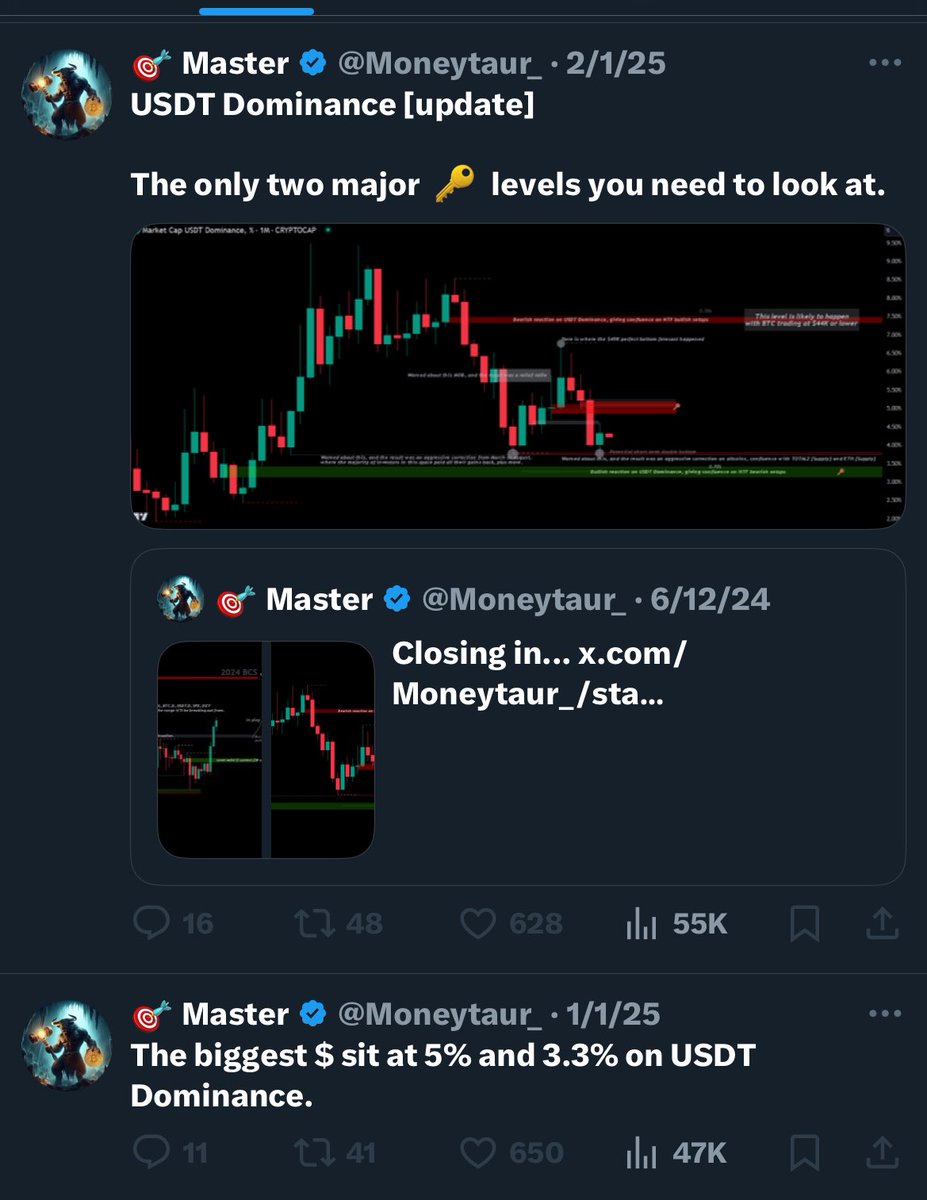
. @Moneytaur_ Major forecasts failures:
- USDT.D 3.3%
- AXS
- NEO
Hey Mr Cryptic, I like how you’re constantly talking about me implicitly, which indicates that whatever I have said about you were right.
I am the only “hater” that you’ve written paragraphs for.
English
@Moneytaur_ "...it transfers money from who can't time it right to who can time it right." Speaking of timing... impressive

English
The hidden meaning of accumulation in Cryptoland
Whales accumulate time, belief, and reload capacity. They wait months while crypto bros rebuild savings, convince themselves "this time is different" and slowly regain confidence after being wiped.
When whales are in no rush, they let boredom do the work. When they are in a rush, they don't take from the market directly. They distribute first. Wealth appears under friendly banners: support, grants, rewards, incentives.
It feels generous, empowering, and it also quietly buys loyalty from the foolish. But it's not charity. It's logistics.
That money isn't meant to stay in those hands. It's meant to be cycled. Given time, emotion, leverage, and poor timing, it finds its way back legally, patiently, and multiplied from project treasuries to whale wallets, through the people.
Most never realize they were part of the transfer. They just remember that they "almost made it" and that's the game behind the game.
Nothing happens. Price goes nowhere and boredom sets in. Then, right on bearish headlines, war mongering, recession talk and "crypto is dead" narratives, they print God candles. Late chasers rush in. Fear of missing out replaces risk management, and the market does what it always does: it transfers money from who can't time it right to who can time it right.
English
@Moneytaur_ Moneytaur showed the way. Haters are rekt and action takers are winning.
English
Moneytaur timestamped the macro top range years ago, right after the 2021–22 bear market bottom.
A long while before the macro top hit, that projected range was tightened into a possibility of seeing the 120s. Reasons were given. Then came the pico-top and i was exiting longs and taking shorts. Sold a lot of ETH and alts before the wreckage.
Shorted BTC in the 120s, rode into the 80s. Public. Timestamped, closed, and then prepared to buy back on spot once the levels i shared and updated several times hit. Time will tell if i took another good decision or if i'll pay gains back if i didn't time it as accurately this time around.
As conditions evolved, expectations were adjusted in real time, shared openly, well before price confirmed them. No edits. No hindsight. No disappearing acts.
More recently, Moneytaur clearly stated spot re-accumulation. Again public, simple, verifiable.
If i've been quieter lately, it's for two reasons:
1] I don't farm engagement. My forecasts are already on the table, and the latest macro one avoided major losses to who decided to sell and short alongside me, against the euphoric CX herd.
2] I'm traveling, living, and enjoying the proceeds of good decisions, often funded by the same people who hate out of jealousy, so thank you for your service.
For some, the hardest truth isn't price, but comparison. Knowing that thousands voluntarily gather here as a community, while they stand alone, unheard, called out, earning in a year what i make in a week, if that.
What's left are desperate attempts to cherry-pick non-optimal sub-scenarios, pretending they invalidate forecasts whose time windows are still active. That level of tunnel vision only exposes panic, frustration, depression.
Most of the haters are gone, dead. Mental collapse is one of the most common outcomes of getting completely wrecked in this game.
English