Timcrypt@slim_timothy24
Top of the morning CT
Security in Web3 is usually treated as protection after the fact. Something users only think about when something goes wrong, but the real change happens when security is no longer passive knowledge and becomes an active skill that carries value on its own.
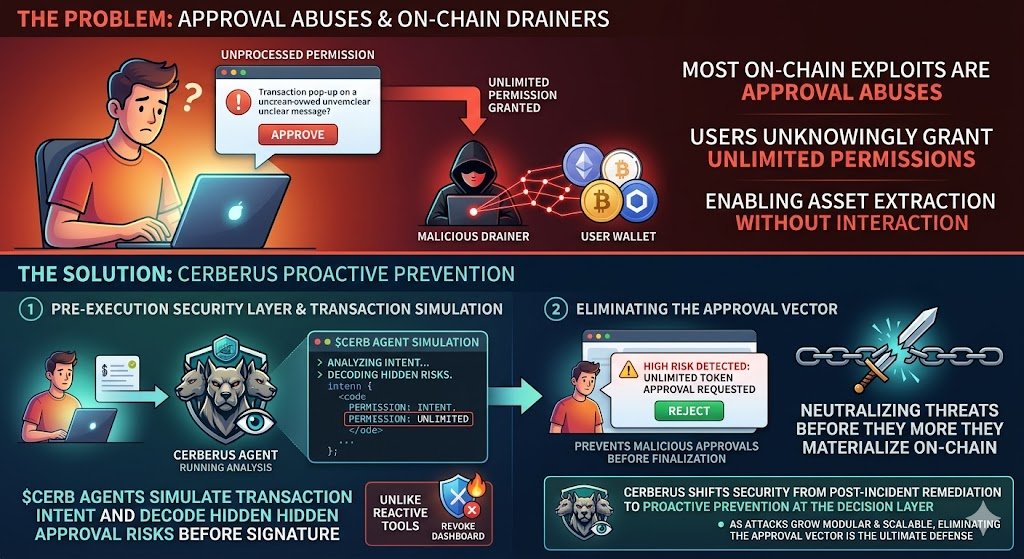
Most users interact with systems without understanding what their actions authorize. Transactions are signed, permissions are granted and exposure is created without clear visibility into long term impact.
The result is a system where decisions carry risk, but carry no feedback on quality.
That missing feedback loop is where the opportunity sits.
If decision making under risk can be observed, it can also be measured. And if it can be measured, it can become part of a value system.
Security stops becoming just awareness and becomes performance.
@CerbAgent treats security understanding as something that can be evaluated in real time. How well a user interprets a threat, how clearly a risk is explained, accurately an attack pattern is broken down, and how consistently safe behaviour is demonstrated.
These are no longer abstract ideas but signals. Once signals are visible, they gain value. Not because attention is rewarded, but because clarity, accuracy and correct judgment become scarce outputs inside the system.
Users who consistently demonstrate strong understanding begin to stand out, not for volume but for precision. This changes how participation works, Security is no longer something users learn only after loss. It becomes something they refine through repetition, feedback and structured understanding.
Each interaction becomes part of a learning loop that improves both awareness and execution.
Users begin to evaluate actions before execution.
They read permissions more carefully.
They recognize patterns instead of reacting to outcomes.
They think in terms of exposure before commitment.
Security becomes part of how they operate, not something added on top.
The broader effect is structural.
When better decision making is consistently recognized, fewer failures scale through the system. Risk reduces not through restriction, but through improved judgment across participants.
$CERB