

Lockedin
4.7K posts

Lockedin
@dawnofjeff
Aspiring(developer/Web 3.0 enthusiast)
Katılım Kasım 2021
0 Takip Edilen143 Takipçiler

I just scored 10 / 10 on truthlens round 7 by @SuccinctLabs! #SuccinctStars
light work
English
Why does MEXC always frontrun listings?
And why do projects keep giving them tokens? It makes no sense
They do this so many times I feel it's time they get called out
King.sol 🇶🇦@teddi_speaks
$PARTI really launched without publicizing their tokenomics or airdrop claim/checker going live. Bybit and binance list in 2 hours.
English
@Boy_Yuskid @0xzoe_im @sign @realyanxin @toby_sign @OxSolexade Nice one man. Hope I can get a dm too
English
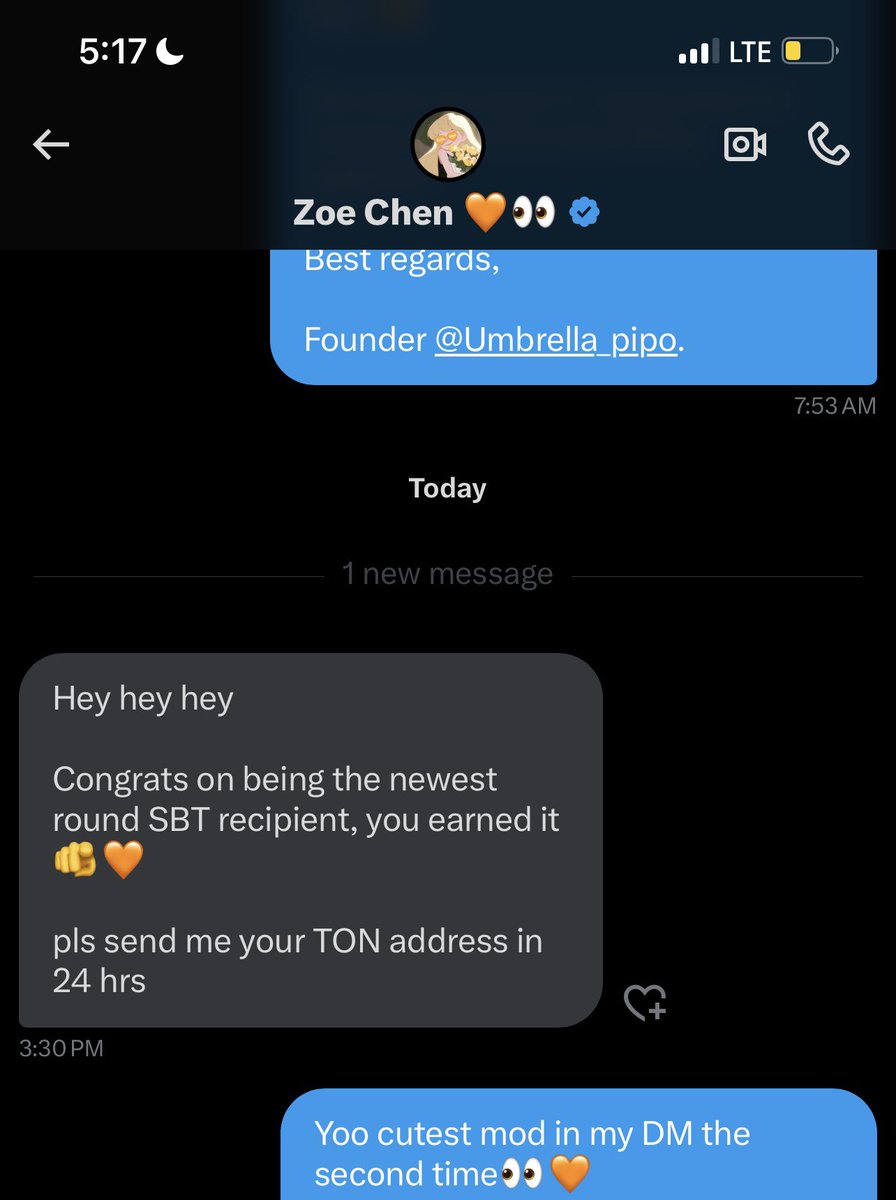
@JibrinIbr @realyanxin @0xbossj @0xzoe_im @_biggids @AngelofWeb3_ @AruchanSign @brave_rengoku Will be there!
English

Advaith keeps cooking!!! 🔥🔥
Advaith@advaith
DOUBLE CUP DASH TRAILER THE LONG AWAITED LEAN GAME OUT TOMORROW YALL BETTER LOCK TF INNNNNNNNNN
English
gProve @SuccinctLabs @0xCRASHOUT
Watch out for my day 2/7 deep dive into Succinct.
Check out day 1 incase you haven't seen it, x.com/dawnofjeff/sta…
Lockedin@dawnofjeff
One thing I like about @SuccinctLabs is the fact their technology aims to make life easier for everyone, from users down to developers. Infact, developers are the main target when it comes to making life easier using SP1 technology. How does Succinct aim to ease the process of developing for developers using SP1? What even is SP1? Join me as I try to explain it from my own understanding as a non-developer(for now). What is SP1? SP1 stands for "Succinct Processor 1" and is a tool, a Zero-knowledge Virtual Machine to be specific, that is designed to make Zero-knowledge proofs more accessible, efficient and developer-friendly. SP1 takes rust code, or any code complied through LLVM(a compiler framework), and proves that it ran correctly by producing a compact proof that can easily and speedily be verified. It allows developers to utilise tools and languages that they are familiar with, unlike traditional ZKP systems which require specialised cryptographic knowledge and custom-built circuits. By doing this, SP1 makes ZKPs more practical for real world applications. Incase this is too much to digest, please take a look at a post I made about what Zero-knowledge proofs are x.com/dawnofjeff/sta… Now how does SP1 work? I will try and simplify this as much as I can for my non-dev and noob friends out there. Imagine you’re baking a cake, and you want to prove to a friend that you followed the recipe exactly without showing them the messy kitchen or every step you took. You could give them a small "certificate" (the proof) that confirms the cake matches the recipe. SP1 does this for software: -> A developer writes a program like calculating a sum or verifying a blockchain transaction. -> SP1 executes this program inside its zkVM and tracks every step. -> SP1 then creates a small, cryptographic proof to show that the program ran correctly -> With this, anyone can check this proof- for example on a blockchain- without re-running the program or seeing the inputs. So, basically Write Code -> Run it in SP1 -> Generate proof -> Verify Anywhere. SP1 makes everything so easy! Key Features Of SP1 Now what features does SP1 offer that makes this particular ZKVM stand out from other ZKVMs? Well, for one; Speed: SP1 knocks other zkVMs out of the water when it comes to speed as it is designed to be fast-up, to 28x faster than other zkVMs for certain tasks. This will be due to its use of precompiles, optimised shortcuts for common operations like hashing or epileptic curve math. Open source: SP1 is also 100% open source, allowing anyone to use, contribute to, or modify it. Flexibilty: With SP1, there is no need for custom cryptography as it supports complex programs like blockchain rollups or light clients without it. Why SP1? What problems can SP1 solve? Why does SP1 matter? I'll give a couple of sample scenarios where SP1 can be utilised to either scale a blockchain, improve privacy, and/or improve interoperability. Scaling A blockchain processes thousands of transactions but can not store them all on-chain due to space limits. How can SP1 solve this? One can write a rust program to process those transactions off-chain. SP1 generates a proof that the transactions were all handled correctly. The blockchain only needs to verify this tiny proof, not reprocess everything. This results in faster, cheaper transactions, similar to squeezing a big book into a one-page summary. Privacy An individual wants to prove they are over 21 without showing their birth certificate. How can they do this using SP1 or it's concepts? They can write a rust program that checks their age against their birth year, say "birth year <2004". SP1 proves this condition is true without actually revealing your birth year, or details on your birth certificate such as your name. This results in privacy preserved, proof delivered- like showing a "yes" stamp instead of one's ID. Interoperabilty Let's say Ethereum and bitcoin need to share data securely, how can SP1 be utilised in this scenario? A rust program will verify bitcoin's consensus rules, and SP1 generates a proof that Ethereum can trust without having to recheck all of bitcoin's entire history. This leads to seamless bridging. I believe in speed, privacy, scalability, simplicity, seamlessness, gud tek. I believe in Succinct. gProve @0xCRASHOUT @pumatheuma
English

I will only vouch for real ones.
If you’re cheating, hacking, or bug abusing.
You’re a cancer to the game.
This project is my baby.
You mess with it, I’ll ruin you. No mercy. #slay
@immortalrising2 #DeliverUsToEvil

English


IF @eliyyang GETS A LOT OF NOTIFICATIONS WE WILL HAVE OUR IRL SUCCINCT CAP 🗿🗿
LET'S TAG HIM EVERYWHERE SO HE FINALLY SAY YES

Succinct@SuccinctLabs
@cabenx @eliyyang @pumatheuma bro i just asked him and he said.. He is gonna think about it – but if he gets a lot of notifications, he'll probably say yes.
English
English

GUYS YALL BETTER QUOTE TWEET ELI
SPAM PING HIM
REPLY TO HIS POSTS
FOLLOW
WE NEED THE PINK HAT
LOCK IN PLS
eli@eliyyang
@cabenx @mac_KMV @SuccinctLabs @pumatheuma I need a lot of notifications
English





@InternBitsy Have no thoughts. Never really watched Snow White anyway
English
Lockedin retweetledi

Lots of controversy surrounding Disney's Snow White Live-Action 🍎🎬
Between Rachel Zegler and Gal Gadot's tension and turning the Seven Dwarves into "animated magical creatures," using CGI, disability activists are saying they feel disregarded and erased with Disney’s choices ❌
The topic of tech vs. representation - where do we draw the line? What are your thoughts on this?

English
English

English
Day 4 of asking @eliyyang approval to drop an irl succinct cap collection 🗿
( @pumatheuma & @SuccinctLabs agreed btw )

Caben@cabenX
Day 3 of asking @eliyyang approval to drop an irl succinct cap collection 🗿 (@pumatheuma & @SuccinctLabs agreed btw )
English
Lockedin retweetledi
One thing I like about @SuccinctLabs is the fact their technology aims to make life easier for everyone, from users down to developers.
Infact, developers are the main target when it comes to making life easier using SP1 technology. How does Succinct aim to ease the process of developing for developers using SP1? What even is SP1? Join me as I try to explain it from my own understanding as a non-developer(for now).
What is SP1?
SP1 stands for "Succinct Processor 1" and is a tool, a Zero-knowledge Virtual Machine to be specific, that is designed to make Zero-knowledge proofs more accessible, efficient and developer-friendly. SP1 takes rust code, or any code complied through LLVM(a compiler framework), and proves that it ran correctly by producing a compact proof that can easily and speedily be verified.
It allows developers to utilise tools and languages that they are familiar with, unlike traditional ZKP systems which require specialised cryptographic knowledge and custom-built circuits. By doing this, SP1 makes ZKPs more practical for real world applications.
Incase this is too much to digest, please take a look at a post I made about what Zero-knowledge proofs are
x.com/dawnofjeff/sta…
Now how does SP1 work?
I will try and simplify this as much as I can for my non-dev and noob friends out there.
Imagine you’re baking a cake, and you want to prove to a friend that you followed the recipe exactly without showing them the messy kitchen or every step you took. You could give them a small "certificate" (the proof) that confirms the cake matches the recipe. SP1 does this for software:
-> A developer writes a program like calculating a sum or verifying a blockchain transaction.
-> SP1 executes this program inside its zkVM and tracks every step.
-> SP1 then creates a small, cryptographic proof to show that the program ran correctly
-> With this, anyone can check this proof- for example on a blockchain- without re-running the program or seeing the inputs.
So, basically
Write Code -> Run it in SP1 -> Generate proof -> Verify Anywhere.
SP1 makes everything so easy!
Key Features Of SP1
Now what features does SP1 offer that makes this particular ZKVM stand out from other ZKVMs? Well, for one;
Speed: SP1 knocks other zkVMs out of the water when it comes to speed as it is designed to be fast-up, to 28x faster than other zkVMs for certain tasks. This will be due to its use of precompiles, optimised shortcuts for common operations like hashing or epileptic curve math.
Open source: SP1 is also 100% open source, allowing anyone to use, contribute to, or modify it.
Flexibilty: With SP1, there is no need for custom cryptography as it supports complex programs like blockchain rollups or light clients without it.
Why SP1? What problems can SP1 solve? Why does SP1 matter?
I'll give a couple of sample scenarios where SP1 can be utilised to either scale a blockchain, improve privacy, and/or improve interoperability.
Scaling
A blockchain processes thousands of transactions but can not store them all on-chain due to space limits. How can SP1 solve this?
One can write a rust program to process those transactions off-chain. SP1 generates a proof that the transactions were all handled correctly. The blockchain only needs to verify this tiny proof, not reprocess everything.
This results in faster, cheaper transactions, similar to squeezing a big book into a one-page summary.
Privacy
An individual wants to prove they are over 21 without showing their birth certificate. How can they do this using SP1 or it's concepts?
They can write a rust program that checks their age against their birth year, say "birth year <2004". SP1 proves this condition is true without actually revealing your birth year, or details on your birth certificate such as your name.
This results in privacy preserved, proof delivered- like showing a "yes" stamp instead of one's ID.
Interoperabilty
Let's say Ethereum and bitcoin need to share data securely, how can SP1 be utilised in this scenario?
A rust program will verify bitcoin's consensus rules, and SP1 generates a proof that Ethereum can trust without having to recheck all of bitcoin's entire history.
This leads to seamless bridging.
I believe in speed, privacy, scalability, simplicity, seamlessness, gud tek. I believe in Succinct.
gProve @0xCRASHOUT @pumatheuma
English
This is day 1/7 of my Provathon challenge btw, where I break down concepts related to @SuccinctLabs . Join me for day 2 tomorrow.
Lockedin@dawnofjeff
One thing I like about @SuccinctLabs is the fact their technology aims to make life easier for everyone, from users down to developers. Infact, developers are the main target when it comes to making life easier using SP1 technology. How does Succinct aim to ease the process of developing for developers using SP1? What even is SP1? Join me as I try to explain it from my own understanding as a non-developer(for now). What is SP1? SP1 stands for "Succinct Processor 1" and is a tool, a Zero-knowledge Virtual Machine to be specific, that is designed to make Zero-knowledge proofs more accessible, efficient and developer-friendly. SP1 takes rust code, or any code complied through LLVM(a compiler framework), and proves that it ran correctly by producing a compact proof that can easily and speedily be verified. It allows developers to utilise tools and languages that they are familiar with, unlike traditional ZKP systems which require specialised cryptographic knowledge and custom-built circuits. By doing this, SP1 makes ZKPs more practical for real world applications. Incase this is too much to digest, please take a look at a post I made about what Zero-knowledge proofs are x.com/dawnofjeff/sta… Now how does SP1 work? I will try and simplify this as much as I can for my non-dev and noob friends out there. Imagine you’re baking a cake, and you want to prove to a friend that you followed the recipe exactly without showing them the messy kitchen or every step you took. You could give them a small "certificate" (the proof) that confirms the cake matches the recipe. SP1 does this for software: -> A developer writes a program like calculating a sum or verifying a blockchain transaction. -> SP1 executes this program inside its zkVM and tracks every step. -> SP1 then creates a small, cryptographic proof to show that the program ran correctly -> With this, anyone can check this proof- for example on a blockchain- without re-running the program or seeing the inputs. So, basically Write Code -> Run it in SP1 -> Generate proof -> Verify Anywhere. SP1 makes everything so easy! Key Features Of SP1 Now what features does SP1 offer that makes this particular ZKVM stand out from other ZKVMs? Well, for one; Speed: SP1 knocks other zkVMs out of the water when it comes to speed as it is designed to be fast-up, to 28x faster than other zkVMs for certain tasks. This will be due to its use of precompiles, optimised shortcuts for common operations like hashing or epileptic curve math. Open source: SP1 is also 100% open source, allowing anyone to use, contribute to, or modify it. Flexibilty: With SP1, there is no need for custom cryptography as it supports complex programs like blockchain rollups or light clients without it. Why SP1? What problems can SP1 solve? Why does SP1 matter? I'll give a couple of sample scenarios where SP1 can be utilised to either scale a blockchain, improve privacy, and/or improve interoperability. Scaling A blockchain processes thousands of transactions but can not store them all on-chain due to space limits. How can SP1 solve this? One can write a rust program to process those transactions off-chain. SP1 generates a proof that the transactions were all handled correctly. The blockchain only needs to verify this tiny proof, not reprocess everything. This results in faster, cheaper transactions, similar to squeezing a big book into a one-page summary. Privacy An individual wants to prove they are over 21 without showing their birth certificate. How can they do this using SP1 or it's concepts? They can write a rust program that checks their age against their birth year, say "birth year <2004". SP1 proves this condition is true without actually revealing your birth year, or details on your birth certificate such as your name. This results in privacy preserved, proof delivered- like showing a "yes" stamp instead of one's ID. Interoperabilty Let's say Ethereum and bitcoin need to share data securely, how can SP1 be utilised in this scenario? A rust program will verify bitcoin's consensus rules, and SP1 generates a proof that Ethereum can trust without having to recheck all of bitcoin's entire history. This leads to seamless bridging. I believe in speed, privacy, scalability, simplicity, seamlessness, gud tek. I believe in Succinct. gProve @0xCRASHOUT @pumatheuma
English