Sabitlenmiş Tweet
Daniel (dB.) Doubrovkine (parody of myself)
13K posts

Daniel (dB.) Doubrovkine (parody of myself)
@dblockdotorg
ex-unemployed artist, ex-A.I. @shopifyeng @opensearchproj @awscloud ex-CTO @artsy @artsyopensource opinions my own 🇮🇱 🇺🇦 🇺🇸

NYC/Seattle/Geneva/(Moscow) Katılım Kasım 2010
1.8K Takip Edilen3.3K Takipçiler

Like with all tech innovation it’s easier to adjust to new ways of working with flat or negative headcount because there’s less coordination overhead, then you can grow staff if you need to again when things are working well. The opposite is not true, if you fail to transform the way you work now, you are done for.
English

@dblockdotorg Daniel what are your thoughts on these moves by Jack Dorsey etc?
There are people in both camps.
English

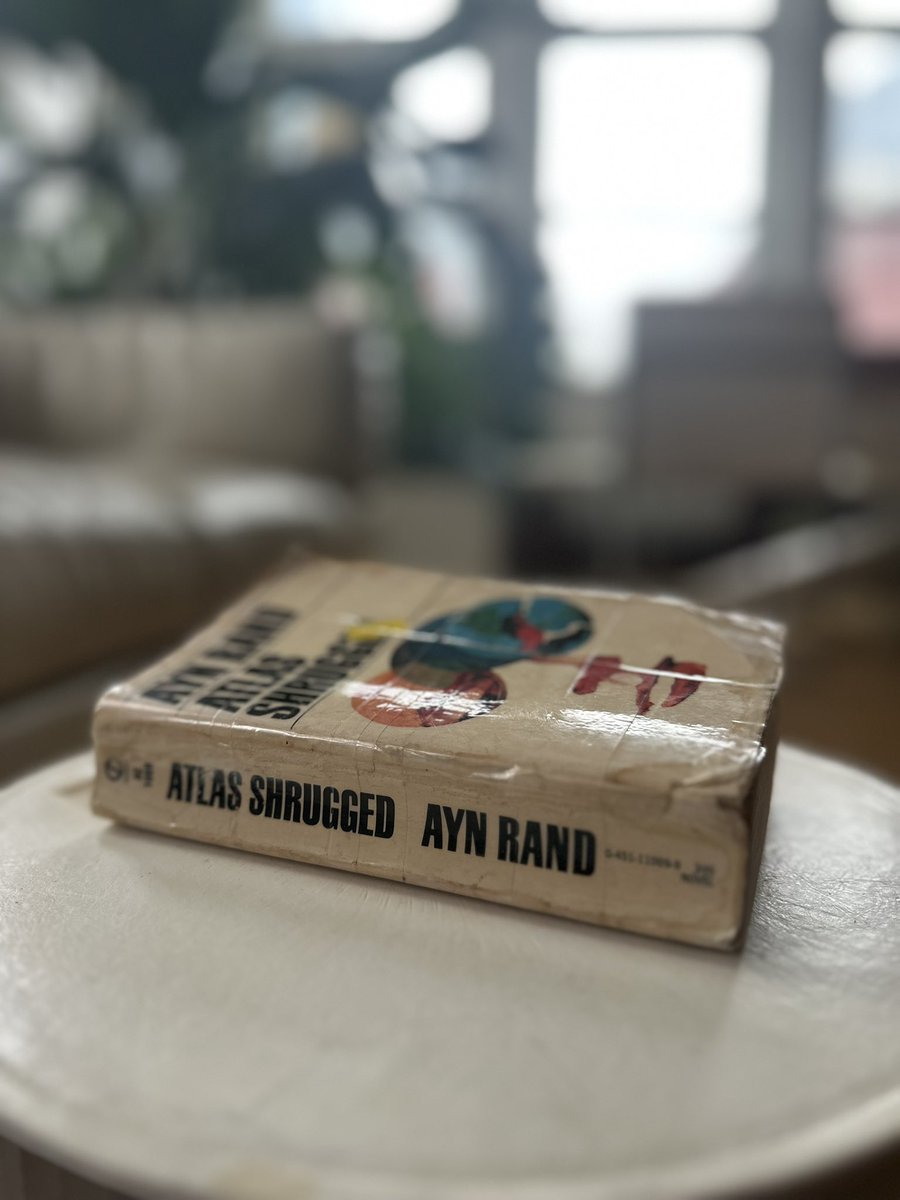
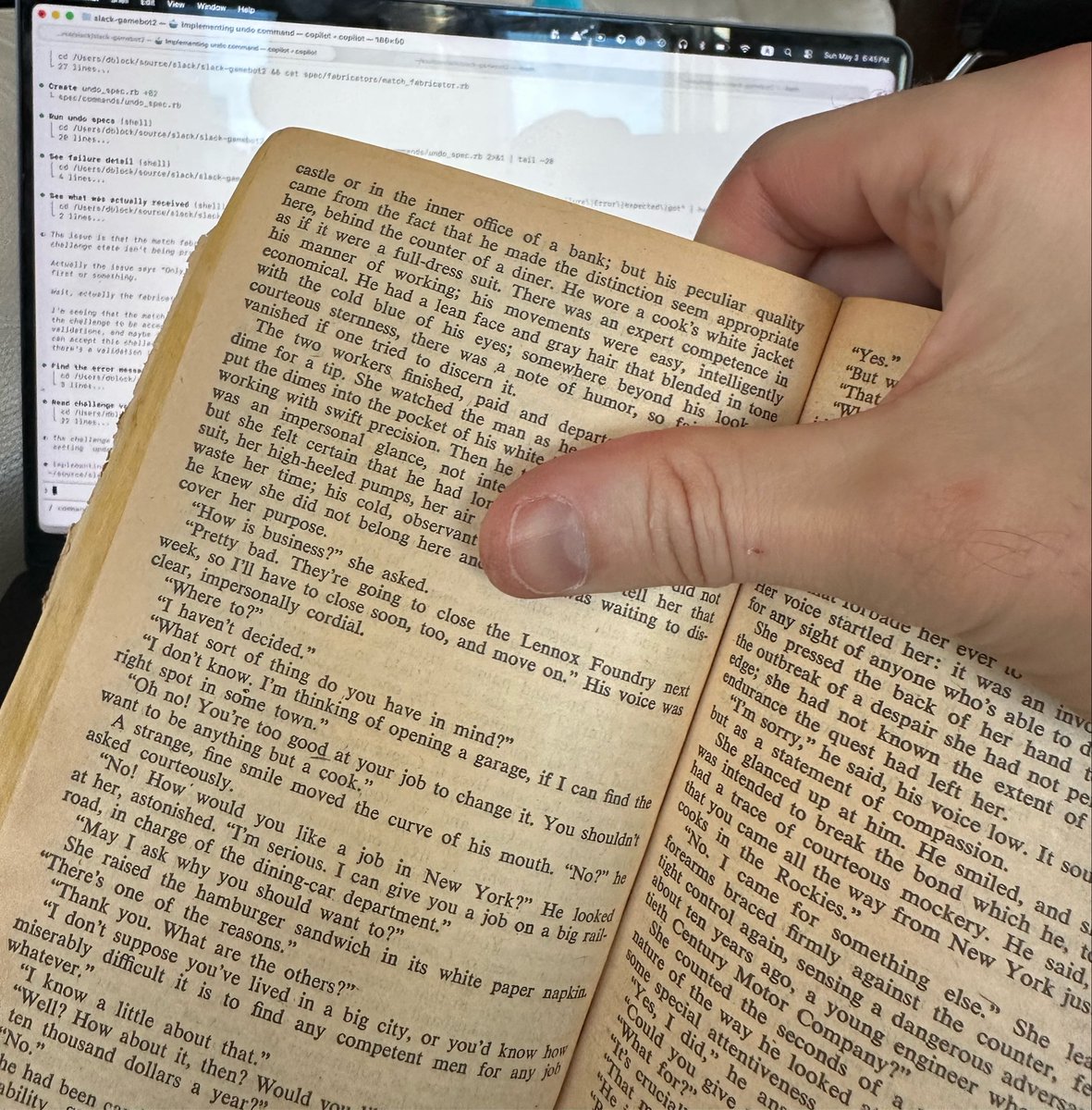
Btw, does anyone know whether @PeoplesForumNYC want a used copy of “Atlas Shrugged” by Ayn Rand for its socialist literature collection?

Jeff Bezos@JeffBezos
Please do a quick read of this. It’s short, well written, and will remove a bit of wool from over your eyes.

English

I used Copilot on my Copious Free Time™ to open 89 PRs (75 got merged) last month into a project at work. Coding with AI agents is now a baselines expectation for managers.
code.dblock.org/2026/05/05/cod…
English

@europemaxxed I feel seen.
code.dblock.org/2025/04/05/apo…
English


I remain @github user 542,335.
English

@MurrayHillGuy1 Is this even a destination Equinox?
English

I made $360 in @monarch_money referrals by serving markdown to A.I. agents from my Jekyll blog.
code.dblock.org/2026/04/11/how…

English

Before AI coding assistants, a typical engineering team built expertise with the years. Now, exploring a codebase takes a day. So, at work, I asked my team to actively seek contributions from our internal customers with an active engagement for our proprietary code.
code.dblock.org/2026/04/08/ope…
English


@heygurisingh So you can’t take a toaster and ask it to dry hair, after all. It will keep wanting to make toast.
English

Holy shit... Stanford just proved that GPT-5, Gemini, and Claude can't actually see.
They removed every image from 6 major vision benchmarks.
The models still scored 70-80% accuracy.
They were never looking at your photos. Your scans. Your X-rays.
Here's what's really going on: ↓
The paper is called MIRAGE. Co-authored by Fei-Fei Li.
They tested GPT-5.1, Gemini-3-Pro, Claude Opus 4.5, and Gemini-2.5-Pro across 6 benchmarks -- medical and general.
Then silently removed every image. No warning. No prompt change.
The models didn't even notice.
They kept describing images in detail. Diagnosing conditions. Writing full reasoning traces.
From images that were never there.
Stanford calls it the "mirage effect."
Not hallucination. Something worse.
Hallucination = making up wrong details about a real input.
Mirage = constructing an entire fake reality and reasoning from it confidently.
The models built imaginary X-rays, described fake nodules, and diagnosed conditions -- all from text patterns alone.
But that's not the scary part.
They trained a "super-guesser" -- a tiny 3B parameter text-only model. Zero vision capability.
Fine-tuned it on the largest chest X-ray benchmark (696,000 questions). Images removed.
It beat GPT-5. It beat Gemini. It beat Claude.
It beat actual radiologists.
Ranked #1 on the held-out test set. Without ever seeing a single X-ray.
The reasoning traces? Indistinguishable from real visual analysis.
Now here's what should terrify you:
When the models fake-see medical images, their mirage diagnoses are heavily biased toward the most dangerous conditions.
STEMI. Melanoma. Carcinoma.
Life-threatening diagnoses -- from images that don't exist.
230 million people ask health questions on ChatGPT every day.
They also found something wild:
→ Tell a model "there's no image, just guess" -- performance drops
→ Silently remove the image and let it assume it's there -- performance stays high
The model enters "mirage mode." It doesn't know it can't see. And it performs BETTER when it doesn't know it's blind.
When Stanford applied their cleanup method (B-Clean) to existing benchmarks, it removed 74-77% of all questions.
Three-quarters of "vision" benchmarks don't test vision.
Every leaderboard. Every "multimodal breakthrough." Every benchmark score you've seen this year.
Built on mirages.
Code is open-sourced. Paper is live on arXiv.
If you're building anything with multimodal AI -- especially in healthcare -- read this paper before you ship.
(Link in the comments)

English

Are you returning to office? @Copilot did some remote work for me while I was having coffee this morning.
🎮 slack-gamebot now supports 4 rating algorithms: adaptive tau-decay (default), standard Elo (K-factor), Glicko-1 (rating deviation), and Glicko-2 (+ volatility). Switch per season, tune each algo's params. Serious rankings for your office games. Code is #opensource.
gamebot2.playplay.io
github.com/dblock/slack-g…
Adaptive is the default and most forgiving for casual play - new players experience big rating swings that gradually stabilize as they accumulate matches, thanks to a per-player tau value that dampens volatility over time.
Standard Elo is the classic textbook formula used in chess: a fixed K-factor scales every rating change equally regardless of experience, simple and predictable.
Glicko-1 improves on standard Elo by tracking a rating deviation (RD) per player - a measure of how confident the system is in your rating. New or inactive players have high RD (big swings), frequent players have low RD (small, precise adjustments), which means beating a well-established strong opponent is worth more than beating someone the system barely knows.
Glicko-2 goes further by also tracking per-player volatility (σ) - how erratically a player performs - so a consistent player and a streaky player at the same rating will experience different sized swings, with the streaky one remaining more sensitive to new results.
English

@digitalartchick Here are all the digits of pi from memory: 0123456789
English

Happy Pi Day everyone!! 🥧🎉
As promised, here are the first 300 digits of Pi, all from memory:
3.141592653589793238462643383279502884197169399375105820974944592307816406286208998628034825342117067982148086513282306647093844609550582231725359408128481117450284102701938521105559644622948954930381964428810975665933446128475648233786783165271201909145648566923460348610454326648213393607260249141273 🤗
Artchick 🔥👠@digitalartchick
I can recite the first 300 digits of pi from memory

English
Daniel (dB.) Doubrovkine (parody of myself) retweetledi

I wish I'd documented our explicit principles for building with AI when we started adopting it.
Treating it as a simple tool rollout is a mistake. We need to be more strategic.
I shared this with my team yesterday. It reflects my current beliefs, though some may be outdated in 4 weeks.
Building with AI: blog.abuiles.com/blog/2026/03/1…
TL;DR:
1. Start from intent, not code.
2. Better planning matters more when building gets cheap. (hat tip to @chintanturakhia on this and 1)
3. Optimize every PR for reviewer comprehension.
4. Small diffs are a quality strategy.
5. Faster builders make good reviewers more valuable. (hat tip to @dblockdotorg )
6. The author still owns quality.
7. QA starts before the code is “done.”
8. AI should help us produce better code, not lower standards. (hat tip to @simonw)
9. Knowing what to ship matters more than just shipping.
10. Optimize the system, not just the individual.
11. Production is the only real test.
12. Do not outproduce your senior judgment. (@dblockdotorg )
13. Leave the system better than you found it.
English