@RobertTalbert If you want the vector field normalized to unit lengths, you have to do the normalization by hand.
Several students wanted to work offline and used pure Python solutions in those cases.
@RobertTalbert I had students using CoCalc.com, which meant the Jupyter notebooks had SageMath kernels available. The commands plot_slope_field and plot_vector_field made this work fairly simple.
In my linear algebra/DEs course last semester I had to figure out how to draw a direction field using Python. Many existing tutorials on this didn't work for me, so I wrote my own. Enjoy and let me know if I'm missing something. link.medium.com/WoGxRH8ghAb
@sbagley I wasn't familiar with that profile with the extra triangular grooves. Here is a supplier and a filtered search that hopefully is close. digikey.com/en/products/fi…
@kaidegner@A__Campbell A @WHSVnews article was updated around 12:45 to paraphrase the superintendent that they are investigating "an alleged weapon on campus". Also, it might be helpful to clarify that HCPS automated text and phone call came at 12:12 pm, instead of rounding to 12:30.
BREAKING: Harrisonburg High School is currently on lockdown, according to a Harrisonburg police officer at the school. He said he couldn’t give me more information other than there are officers in and outside the school and the kids are safe.
Ever wanted an interactive lightning-fast solver for models in physics, chemistry, or biology? Do you have a web browser?
I'm thrilled to announce VIsualPDE.com, built explicitly to solve PDE models interactively on most devices, written by @bj_w95@Pecnut and I.
Crews continue to respond to this animal complaint and are currently in the area of Middlebrook Street and Sharon Street. Please do not approach the animal and let officers work.
Why did @Canvas_by_Inst make it so you don't see the full history of comments on an assignment, but now they are only visible by submission attempt? This is such a pain! I can't see my old feedback while evaluating a new submission.
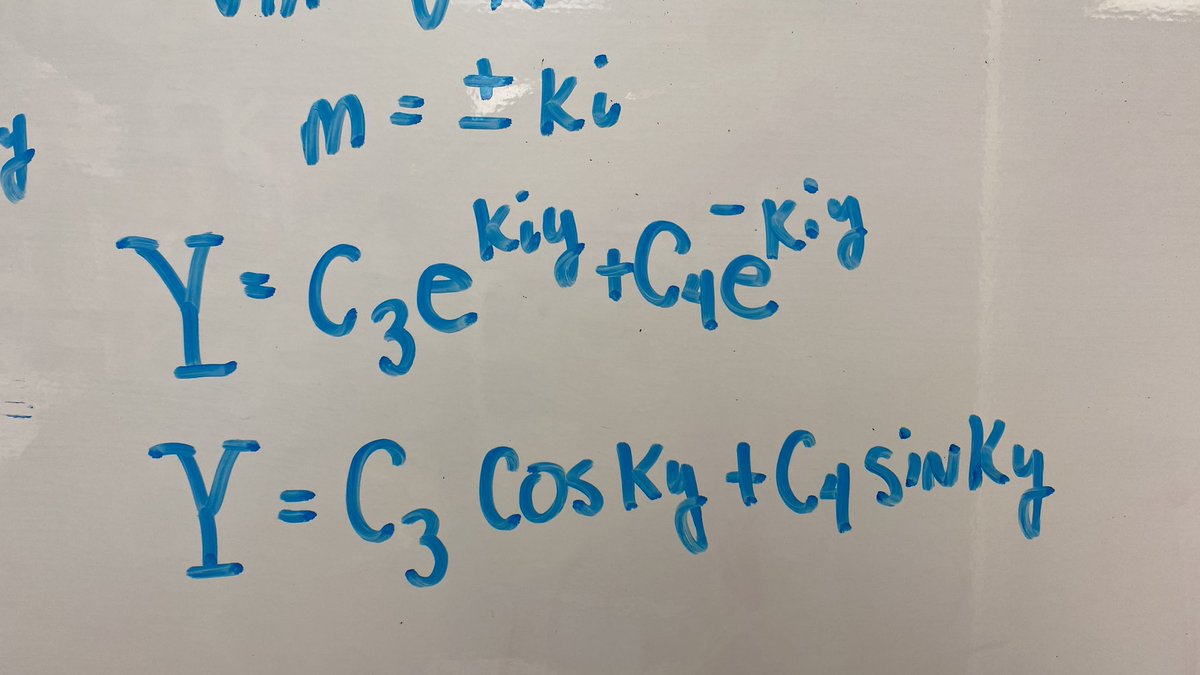
@Zen_Cygnus@smartereveryday Yes, this would be an improvement to refer to using different constants. The idea of "without the i" suggests a methodological approach to remembering rather than a conceptually complete interpretation.
@Zen_Cygnus@smartereveryday It's not that we "drop" the i, but that the real and imaginary parts of complex-valued solutions are themselves *real*-valued solutions to the differential equation. Since they are independent, cos(ky) and sin(ky) form a fundamental solution set.
@smartereveryday The thing is that the c_3 and c_4 of the second equation are *real* constants and are not the same as the c_3 and c_4 of the first equation.
Some other responses are describing the relation between the coefficients, and how you go from complex to real.
@smartereveryday Yes *AND* No.
Y=c_3 e^(kiy) + c_4 e^(-kiy) *is* the general form of solutions if we think of Y as a complex-valued function.
Y=c_3 cos(ky) + c_4 sin(ky) *is* the general form of real-valued solutions.
That is the *yes* part. The *no* part is they don't equal each other.
@virginiadwr This article says you need to register for MRC's FIP program, but that FIP page says this is automatic if you have a license. Having a dual freshwater/saltwater license takes care of this, right? dwr.virginia.gov/blog/the-occoq…
@BresockCalculus Newton's law of gravy. Gravy causes things to accelerate. The falling object is subject to constant gravy, but is it a biscuit or a potato?
@pwr2dppl Is it good enough in the context you care about to show you can recover the original rows for each type of operation? Swap the rows back to their original order. Rescale back to the original scaling. Add the opposite multiple of some row to recover the original row.