
Sabitlenmiş Tweet
초코초코
3.4K posts


초코초코
@ddd67303572
프사는 @PanTo_PT 틀딱 늦깍이 컴공 / 이탈리아 여행 좋아함!
Katılım Temmuz 2019
239 Takip Edilen44 Takipçiler



이거 우주선 미니엘레나처럼 안보이거나 아쉬운 부분 있으신 분들은 무슨 이유로 그렇게 느껴지는지 답글로 말씀해주시면 감사드리겠습니다!!
시버지 (5일페 K07)@Sibeoji
집앞에 우주선 추락함;;
한국어
초코초코 retweetledi

[이벤트] 트릭컬 리바이브 × 더현대 대구점 콜라보 상세 안내
안녕하세요, 교주님들!
귀염뽀짝! 볼따구 라이프! 트릭컬 리바이브입니다.
더현대 대구점에서 교주님들과 함께 걸어온 시간과 트릭컬 리바이브의 주요 여정을 한자리에서 만나보세요!
5월 29일(금)부터 시작되는 트릭컬 리바이브 × 더현대 대구점 콜라보 정보에 대한 상세 정보는 커뮤니티 공지를 참조해주세요.
naver.me/xiLmZ8dF
#트릭컬 #더현대대구점 #콜라보

한국어

MBC는 바로바로 고발 해줘야 하지요.
공직선거법위반 “선거 직전 왜곡•편파보도 선거개입”
엄벌받길
🫡🫡


한국어

🚨스타벅스보다 심각한 문제(한국 발칵!!)
전 스타벅스 논란보다
"10000배"
*대군부인 논란이 심각한 문제*라고 확신합니다 😡😡😡
동의하시는 분들은 릴레이 부탁드립니다 🙏 국민들이 눈 뜨길 바랍니다.


한국어



@chhpark75 @yonhaptweet 제발 생각 좀 하고 사세요 ㅋㅋㅋㅋ
지금 저긴 여행금지 구역이고
한번 꺼지라고 소리 듣고도 꾸득꾸득 기어들어가다가 잡힌겁니다
한국어

@yonhaptweet 유대인놈들!! 우린 교회집회할때도 무지한 노인들조차 이스라엘 국기를 흔들어주거늘 이스라엘은 우리와 무슨 은원이 있다고 한국인을 홀대한단 말인가
한국어
이재명 "세입자 갱신권 침해·중국인 싹쓸이 보도, 명백한 왜곡 조작"
중국인이 부동산 싹쓸이 하는 건 또 조작이라는데요?


한국어
재명아, 니는 호르무즈 해협에서 우리 선박이
이란한테 위협받을 때는 입도 뻥끗 못하면서
지령이라도 받은 건가?
이스라엘은 저번부터 계속 건드리고 있네?
그래, 더 해라. 더 열심히 재촉해라.
니가 직접 명줄을 당기는 거 우리야 땡큐지.
그리고 니도 국제범죄자로 기소될 가능성 있는 거 아님?
대북 불법 송금 건으로 제대로 재판받아야 할 사람처럼 보이는데.
한국어


안녕하세요, 백억커피 마케팅팀입니다.
이 영상 RT하고 싶어서 계정 만들었습니다.
배달용 캔 풀오픈 뚜껑은 생각보다 강합니다.
빨대로 싸우지 마시고 뚜껑을 열어서 이용해 주세요🙏
일구이구@3_1929
나 비하인드에서 이정도로 시강하는사람 처음봄
한국어

받)무신사 사과문
무신사입니다.
최근 한 기업의 역사 비하 논란을 무거운 마음으로 지켜보던 중, 7년 전 무신사의 큰 잘못이 다시 거론되고 있음을 인지하였습니다.
2019년 7월, 무신사는 故 박종철 민주열사 고문치사 사건을 연상케 하는 문구를 인용해 SNS 마케팅에 활용함으로써, 대한민국 민주화를 위해 희생하신 열사님의 뜻과 민주주의의 가치를 훼손하는 결코 있어서는 안 될 큰 잘못을 저질렀습니다.
당시 사건 발생 직후, 무신사 대표를 포함한 경영진은 (사)박종철기념사업회를 직접 찾아 진심으로 사죄드리며 용서를 구했습니다.
하지만 7년의 시간이 지난 지금까지도, 당시 내부 프로세스의 부재와 경솔한 판단이 남긴 상처가 결코 가볍지 않다는 사실을 깊이 새기고 있습니다. 다시 한번 박종철 열사님과 유가족 여러분, (사)박종철기념사업회를 비롯한 모든 관계자분들, 그리고 무신사에 실망하셨을 모든 분께 진심으로 사죄드립니다.
2019년 7월 사건 이후, 무신사는 아래와 같은 조치를 즉시 시행했으며, 동일한 잘못이 반복되지 않도록 관련 프로세스를 지속적으로 강화해오고 있습니다.
1. 故 박종철 열사님 유가족 여러분께 직접 사죄
• 사건 직후 무신사 대표를 비롯한 주요 임직원들이 유가족분들을 직접 찾아뵙고 사죄드렸습니다.
• 이후 현재까지 조만호 대표는 개인적으로 (사)박종철기념사업회에서 7년간 꾸준히 회원으로 활동하며, 열사님의 희생과 뜻을 기억하기 위한 행동에 함께하고 있습니다.
2. 전 임직원 대상 역사 교육 및 콘텐츠 검수 프로세스 강화
• 당시 무신사는 임직원의 윤리 의식과 사회적 감수성에 대한 개선이 필요하다고 판단해 전 직원을 대상으로 최태성 강사님을 초빙하여 역사 교육을 진행했습니다.
• 또한 마케팅 콘텐츠 및 홍보물 제작 과정 전반에서 역사적·사회적 맥락을 더욱 엄격히 검토할 수 있도록 다중 검수 체계를 운영하고 있습니다.
3. 고객 대상 세 차례 공식 사과 및 내부 경각심 강화
• 사건의 심각성을 무겁게 받아들이며 세 차례에 걸쳐 공식 사과문을 발표했습니다.
• 고객 여러분께 심려를 끼쳐드린 점에 대해 다시 한번 사과드리며, 내부적으로도 이 사안을 결코 잊지 않고 경각심을 이어가고 있습니다.
7년 전의 뼈아픈 과오는 무신사가 결코 잊어서는 안 될 엄중한 교훈으로 남아 있습니다. 시간이 지나도 당시의 반성과 다짐이 퇴색되지 않도록, 무신사는 앞으로도 올바른 역사 인식과 책임 있는 자세로 고객 여러분을 마주하겠습니다.
다시 한번 故 박종철 열사님과 유가족 여러분, 그리고 상처받으신 모든 분께 진심으로 깊이 사과드립니다.
2026년 5월 20일

한국어
롤에서 저런 지표가 얼마나 부족한 지표냐면
메시에게 헤딩 경합율을 보는것
저지에게 도루 횟수를 보는것
커리에게 덩크 득점율을 보는것과 같아요.
우리가 보기 편한 지표와 전문가가 선수를 판단하는 지표의 레이어는 달라야해요
Parth N@parthenaan
This is something that is pervasive throughout LoL despite it being touted as a team game. You are shown mostly individual statistics after the game. I know players love to go look at their own K/D/A or damage numbers after the game as a metric to determine how they performed. Broadcasts for years have shown individual statistics without proper consideration of sample size and context, leading to really skewed perceptions of players. The problem isn't that individual stats are wrong, but they present an incomplete picture. If LoL is a game of efficient resource allocation and usage, then there are times where it's more efficient for you as a player to earn less gold or deal less damage by putting your allies in the position to do so or to prevent your opponents. I honestly believe that a lot of problems in LoL from players in ranked to scouting for professional teams to player focus in development comes from the lack of transparency around how to quantify the impact of your decisions on the people around you. We built a model a few years ago that somewhat addresses this issue and it's been cool to find value in players, especially those who know when to play for others: arxiv.org/abs/2403.04873 We've mostly used it for research, but if anyone wants to ever chat about the use case of this for teams, broadcasts, or game itself -- would be happy to. The last thing I'll say about this is that statistics in a game as complicated as LoL should only be used as a supplemental criteria and never should be the sole source of truth.
한국어
@DonutChurros22 그냥 멍청한 애들 많아요.
애초에 지표로 뽑는다 했으면 지표로만 뽑고
현폼으로 뽑을꺼면 평가 기준을 저렇게 했으면 안됐고
지표로 뽑을꺼였으면 저딴 엑셀 딸깍으로 순위 나오는 지표가 아니라 플레이 챔피언에 따른 가중치 줘야하고
어느 팀이랑 경기했는지에 따라 가중치 줘야하는데
한국어

아놀드는 자기가 어제 한 주장처럼 케스파가 선정한 기준이 의미 없다고 말하고, 이 사실에 동의하지 않는 사람들이 있더라도 그 기준을 msi, fst, ewc까지 확장하면 기인이 앞선다는걸 말해주고 있어
하지만 몇몇사람들은 어제는 지표가 무의미 하다더니 왜 이젠 지표를 꺼내냐며 논점을 흐리고있지
Gen.G Arnold@arnoldwh
Now let's talk about MSI, and why I wanted to establish that the criteria themselves are flawed before getting into this. I still do not know why MSI, the midseason international event, wasn't in the criteria, while KESPA Cup, a preseason event, was. So I pulled Riot's API and ran their own criteria stats across 2024–2026: EWC 2025, MSI 2024–25, Worlds 2024–25, LCK 2024–26, and First Stand 2025–26. The result: Kiin ranks #1 in Overall (image 1), and clearly so. Include KESPA Cup (image 2) as well and the margin narrows, but he's still #1. For a moment, I'm willing to set aside every concern about whether these are even the right metrics, and take their stat list exactly as given. Even then, the moment the event scope is wider, Kiin is the top player. He only isn't #1 if the window stays narrow, limited to just their chosen list of events. And you don't even have to agree with my earlier point that the metrics themselves are flawed. Even using their statistical metrics across a wider, fairer set of events, their own numbers put Kiin first. Kiin deserves better.
한국어

@cnmnmnmnc I’m now starting on episode 6 and enjoying the drama. I feel sorry for Korean actors/entertainers who often find themselves at the mercy of their own race at the slightest issue with some ending up either committing suicide or end up a nobody after a glorious start 🙄
English


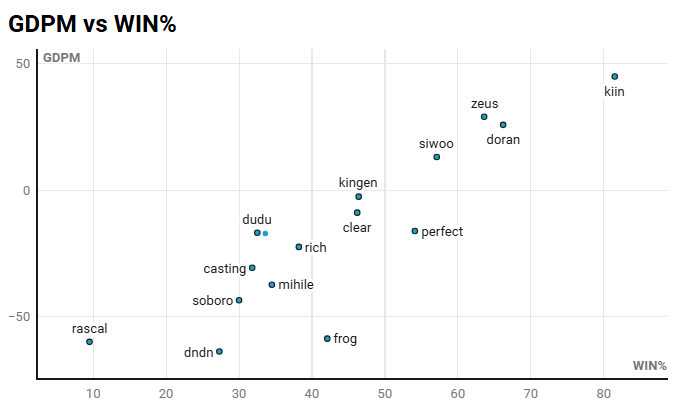
It's basically just 1:1 with Win%
Just a weird stat to use
Molecule@MoleculeLOL
Any Koreans know if "GDPM (분당 상대 라이너와의 골드 차이" Is a common stat? I don't even know what GD per Minute as a stat would show or like what you're trying to get with it
English
초코초코 retweetledi

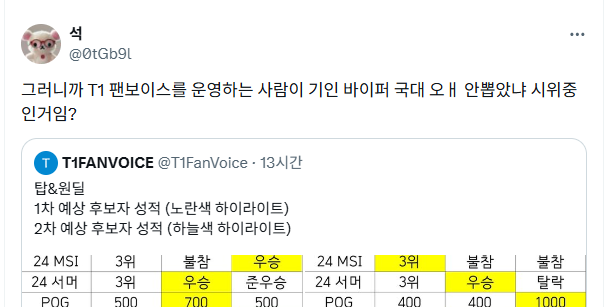
글 올릴때마다 드는 생각인데 문해력 수준미달인 사람들 많네. 상상력이 풍부하나? 이게 국대 왜 안뽑았냐는 시위라고 생각했는지 도저히 모르겠습니다만, 단순 성적비교표를 놓고 공개한 기준이랑 대비해본다는 생각은 안드냐? 기록정리한거만 올린건데도 상상력 발휘해서 내 의도까지 멋대로 정하네?
한국어

This is completely correct, using these 'Detailed individual metrics' to judge a player without additonal context is a joke
It's a huge self report that you don't understand league of legends if you do this
Stats are a tool and are so often misused in the most incompetent ways
Gen.G Arnold@arnoldwh
I want to say something about Kiin, because I want to be direct with our fanbase about how I feel. They published the selection criteria. Read them for yourself, because they matter. After the achievement-based shortlist, the final roster came down to what they themselves called "detailed individual metrics." If you understand the game, look at that list and ask one question: what does a top laner do to make most of those numbers go up? He gets the favorable matchup. He gets the comfort pick. He gets resources funneled into his lane. Solo kills, DPM, DPG, gold diff at 14, CS diff at 14, every one of those climbs when the draft is built around you, and sinks when you give the lane up so a teammate can have theirs. Now ask what Kiin does. Kiin is the top laner who says "draft around everyone else and give me the leftover pick, I'll make it work." He takes the counterpick so a teammate gets comfort. He eats the hard matchup so the map opens elsewhere. Every one of those choices is a teammate's DPM going up instead of his. He trades his stat line for his team's win condition, every single game. There's no column on that list for that. The closest it comes to team value, gold share, damage share, still rewards the player who gets the resources, not the one who gives them up. And champion pool size is right there on the list: a metric that should favor exactly the kind of flexible player Kiin is. He plays one of the widest, most selfless pools in the role and still didn't make it. And before anyone runs with this: this is not about Zeus. Zeus is world-class and earned his spot. The players aren't the problem. The measuring stick is. We need to more rigorously test the statistics we cite, especially when it becomes a measuring stick that can impact decisions like these. If your criteria are built mostly from individual mechanical stats without proper statistical context, you haven't found the best players, you've found the players whose teams were built to make them look best. Kiin plays the game the right way. If these metrics say otherwise, the metrics are the problem, not Kiin, and not the players who were picked. To Kiin's fans: you already know this. You watched him do it. Please show him more support than ever.
English